Your new post is loading...

|
Scooped by
Jacques Urbanska
October 13, 2016 11:56 AM
|
Edito : Attentive aux plus récentes manifestations de l’imaginaire contemporain et soucieuse d’en saisir les fondements historiques et théoriques, Captures est la toute nouvelle et première revue à comité de pairs de Figura, le Centre de recherche sur le texte et l’imaginaire. Sa création est source de grande fierté. Dédiée à la publication de travaux consacrés à l’analyse de problématiques liées aux figures, théories et pratiques de l’imaginaire, sans limitations territoriales ou nationales, située à la croisée des études littéraires et cinématographiques, des sciences humaines, de l'histoire de l'art, des arts visuels et médiatiques, Captures se veut une pièce maîtresse de la diffusion internationale de la recherche menée au Centre. La revue exploite résolument les ressources du Web en publiant des numéros évolutifs, ouverts à des enrichissements continus et périphériques à chaque parution, et dont les contenus sont intégrés aux environnements de recherches et de connaissances mis en ligne par Figura. Assumant pleinement la mutabilité de son support, Captures aspire à renouveler les formes de la revue savante...
|
|
Scooped by
Jacques Urbanska
October 13, 2016 11:49 AM
|
Telegram est souvent présentée comme l’alpha et l’oméga du terrorisme de la messagerie cryptée. Nombreux sont ceux qui voient son utilisation par des djihadistes comme la conséquence logique des ses supposées qualités cryptographiques, de la personnalité libertarienne de son fondateur, Pavel Durov, ou encore de la nature insaisissable de son infrastructure juridique et technique. Un intéressant article du Monde décortique l’architecture fiscale et juridique de l’organisation. L’un des développeurs de Telegram y explique, parlant de son infrastructure technique, qu’elle serait «répartie sur plusieurs points de la planète, pour des raisons de vitesse et de sécurité »...
|
|
Scooped by
Jacques Urbanska
October 13, 2016 3:31 AM
|
Le projet KRONOS part d’une prise de conscience que le système financier qui gouverne nos sociétés aujourd’hui ne correspond plus aux réalités humaines et sociétales. Il a généré et continue de répandre une crise qui touche de façon accélérée la majorité d’entre nous, de façon individuelle et collective, jusqu’à toucher les états et les nations.
Sous les sacro-saints principes de la croissance, de l’emprunt, et du remboursement sur plusieurs décennies des intérêts de ces mêmes emprunts, nous nous retrouvons prisonniers du système bancaire et de ses effets retors sur notre façon de vivre et d’appréhender le monde.
En gardant le principe d’une monnaie universelle qui reste un moyen efficace d’échanger des biens et des services, le projet Kronos tente d’apporter une réponse en modifiant le paradigme de l’échange : Au lieu de baser la monnaie sur l’inflation ou la déflation d’une valeur factice, il serait sans doute plus pertinent de lui substituer la réelle valeur qui préside ces échanges : le temps humain.
Ce temps humain, c’est à dire le temps passé à réaliser ou transmettre une chose, devrait être une valeur fondamentale, inaliénable et universelle.
Le projet Kronos propose donc la création d’une monnaie dont l’index est basé sur ce temps humain. Ainsi, à une unité de cette monnaie, un Kronos, correspond une heure d’activité dépensée par une personne ou un groupe de personne.
Ce projet serait possible dans le cadre d’un dispositif technique qui puisse offrir la capacité de se passer des intermédiaires principaux, c’est à dire les établissements bancaires... http://guez.org
|
|
Scooped by
Jacques Urbanska
October 13, 2016 3:17 AM
|
IPOcle is an installation by Candaş Şişman simulating the way we perceive the reality that exist in our physical world and the various layers, variables, cycles that are present in this process of perceiving. With the senses that we have, we can perceive only a limited portion of the physical reality that surrounds us. This perceived physicality keeps altering as it goes through many layers and processes (biological and psychological) in our brains. These perceptions draw our perceptual schemas and these schemas in turn shape the reality we perceive. Our perceptions and what we perceive, therefore, constantly reshape call each other into being, as in a vicious cycle. At this point, how can we define what reality really is, what constant can we refer to, and aren’t we supposed to look at this issue in a more holistic and intertwined manner? The IPOCle is made of a strong light source, lenses, a convex mirror, a fog machine and a sound system; installed inside a dark container. The light source is located so that the goes through the lenses, hung one after another. The refracted light reaches the mirror. The convex mirror transforms the light and reflects it back. The fog machine keeps running to make the dispersed light visible for us; while a base frequency keeps running in the background. The light and the light source describe physical reality and input The lenses: The process and various factors of perception The mirror: What is perceived, the output and the cycle.
|
|
Scooped by
Jacques Urbanska
October 8, 2016 9:22 AM
|
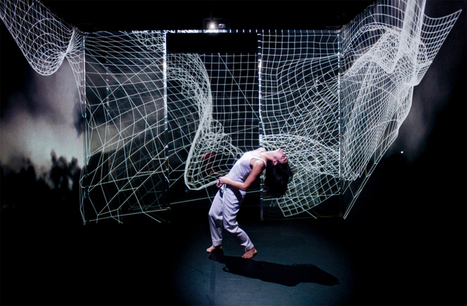
The International Digital Art Festival Patchlab takes place between 11 - 16 October 2016 in Krakow, Poland. This event is dedicated to interdisciplinary digital art and created on the boarders of humanities, new technologies and creative programming. This 5th edition of the festival focuses on the relation between human and machine, especially the relation existing within the new virtual reality, and on the issue of privacy and online safety. More than 30 invited artists will present their works. Patchlab is an exhibition at the Manggha Museum of Japanese Art and Technology, Contemporary Art Gallery Bunkier Sztuki presenting selected interactive installations and VR works, interdisciplinary dance spectacle, audiovisual performances and live acts, also screenings of selected works awarded during MADATAC Festival in Madrid...
Website | FB page
|
|
Scooped by
Jacques Urbanska
October 8, 2016 5:23 AM
|
ORLAN est une des plus grandes artistes françaises reconnue à l’internationale. Elle utilise la sculpture, la photographie, la performance, la vidéo, la 3D, les jeux vidéo, la réalité augmentée ainsi que les techniques scientifiques et médicales comme la chirurgie et les biotechnologies. ORLAN change constamment et radicalement les données, déréglant les conventions, les prêt-à-penser. Elle s’oppose au déterminisme naturel, social et politique, à toutes formes de domination, la suprématie masculine, la religion, la ségrégation culturelle, le racisme…
|
|
Scooped by
Jacques Urbanska
October 7, 2016 4:14 AM
|
|
|
Scooped by
Jacques Urbanska
October 4, 2016 6:37 AM
|
18:00 – vernissage | Galeria Sztuki Współczesnej Bunkier Sztuki
20:00 – vernissage | Muzeum Sztuki i Techniki Japońskiej Manggha
21:00 – performance Recession 1024 architecture [FR] | Muzeum Sztuki i Techniki Japońskiej Manggha 11:00 – 19:00 – exhibition of interactive installation | Contemporary Art Gallery Bunkier Sztuki
10:00 – 20:00 – exhibition of VR and interactive installations | Manggha Museum of Japanese Art and Technology
18:00 – VR works presentation, meeting with creators| Manggha Museum of Japanese Art and Technology 11:00 – 19:00 – exhibition of interactive installation | Contemporary Art Gallery Bunkier Sztuki
10:00 – 20:00 – exhibition of VR and interactive installations | Manggha Museum of Japanese Art and Technology
12:00 – 2nd International Conference Patchlab Generator 2016 | Pawilon Wyspiańskiego
20:00 – interactive spactacle | Manggha Museum of Japanese Art and Technology 11:00 – 19:00 – exhibition of interactive installation | Contemporary Art Gallery Bunkier Sztuki
10:00 – 20:00 – exhibition of VR and interactive installation | Manggha Museum of Japanese Art and Technology
20:00 – AV Night 1 | Manggha Museum of Japanese Art and Technology
22:00 – AV Night 1 | Barka 11:00 – 19:00 – exhibition of interactive installation | Contemporary Art Gallery Bunkier Sztuki
10:00 – 20:00 – exhibition of VR and interactive installations | Manggha Museum of Japanese Art and Technology
10:00 – 18:00 – Madatac screenings | Manggha Museum of Japanese Art and Technology
15:00 – 19:00 – media lab | Pawilon Wyspiańskiego
22:00 – AV Night 2 | Forum Przestrzenie 11:00 – 19:00 – exhibition of interactive installation | Contemporary Art Gallery Bunkier Sztuki
10:00 – 20:00 – exhibition of VR and interactive installations | Manggha Museum of Japanese Art and Technology
10:00 – 18:00 – Madatac screenings | Manggha Museum of Japanese Art and Technology
15:00 – 19:00 – media lab | Pawilon Wyspiańskiego
|
|
Scooped by
Jacques Urbanska
October 4, 2016 6:18 AM
|
Founded in 2015. By exploring the nodes of entanglements between these fields, NOME aims to raise critical awareness of the crucial issues facing our age. The gallery works with international emerging and mid-career artists whose practices engage diverse disciplines and involve a broad range of media. NOME enables artists to deepen their research and further their artistic potential by collaborating with various cultural institutions and facilitating the production of new works for each exhibition. Director: Luca Barbeni
Managing Director: Manuela Benetton
|
|
Scooped by
Jacques Urbanska
October 3, 2016 6:00 PM
|
Rodrigo Carvalho [VISIOPHONE], is a Designer & Interactive New Media artist from Porto/Portugal. His work on live visuals, coding and interactive art involves a range of different outputs, from screen digital work, interactive installations, audiovisual live acts, or interactive visuals for stage performance.
His research is focused in the real-time relations between sound, image and movement in audiovisual interactive spaces....
|
|
Scooped by
Jacques Urbanska
October 3, 2016 5:49 PM
|
The Conservation Center’s Topics in Time-Based Media Art Conservation lecture series takes place on Mondays during the 2016 Fall semester and is generously supported by the Andrew W. Mellon Foundation. The list of presentations is given below. A video of each lecture will be archived and available after the event in the Institute's video archive.
Please note that seating is very limited. While these events are open to the public, we require an RSVP through our mailing list followed by a confirmation. If you sign up for our Time-Based Media Art Conservation mailing list, you will receive an invitation to RSVP well in advance of each event listed below. Please sign up here.
|
|
Scooped by
Jacques Urbanska
October 3, 2016 5:28 PM
|
Daft Gallery believes in the strength and the potential of anonymous artists. We are therefore deeply committed to the growth and development of this kind of artists, and through a market oriented approach and promotion internationally. Daft Gallery supports and represents anonymous artists whom, in their work, remain true to their convictions and their ideals. We are the intermediary between artist and client and place equal value on the interests of both parties. As gallery we offer the artists a professional and stable basis which serves as a solid foundation for the development of their careers. We support not only the development of the artist, but also the development of the art market, since ultimately this benefits the artist as well as the client. It is after of great interest to the client, when the artist he or she has invested in, is capable of growing professionally. This process is also particularly well served when the number of collectors of Post-Internet Art increases. Our international goal is to increasingly present and promote anonymous artists. For another art galleries that are searching new ways of art, we offer our service. In close collaboration with the client the most fitting selection is put together for each particular space....
|
|
Scooped by
Jacques Urbanska
October 3, 2016 4:59 PM
|
Amour, sexualités et haut débit : dans le cadre de la Carte Blanche à Elisabeth Meur-Poniris, nous vous invitons à partager une après-midi de réflexions artistiques, théoriques et pratiques sur nos relations à l'heure de l'hyper connecté.
Des sites de rencontres à l’explosion de la pornographie en ligne en passant par le développement d’intelligences artificielles toujours plus séduisantes, comment l’avènement du numérique modifie-t-il nos définitions de l’amour, des relations et la manière dont nous construisions nos identités de genre et sexuelle ? Internet est-il la cause d'un certain désenchantement ou un formidable multiplicateur de possibles ? Nous nous poserons toutes ces questions – et bien d'autres – en excellente compagnie, avec :
PASCALE BARRET
NATHALIE GRANDJEAN
MARINE HAVERLAND
et, à la modération,
ELISABETH MEUR-PONIRIS
|
|
|
Scooped by
Jacques Urbanska
October 13, 2016 11:51 AM
|
In January 2011, protests broke out across Egypt to demand an end to the despotic and repressive regime of Hosni Mubarak. The protests were largely organized online, through social networks like Twitter and Facebook. Mubarak quickly realized this, and launched a counterattack: He severed all access to the internet from within Egypt. Dyn Research, a internet performance company that analyzes how the internet performs, noted that Egypt’s Arab Spring shutdown started with just a couple phone calls from the government: The prior day [before the internet shutdown], we had received a tip from an Egyptian telecom engineer that the government was warning some telecoms that they should be prepared to act quickly if the government ordered the shutdown of internet services. Just after midnight local time in Egypt, that order came and nearly all Egyptian access to the global internet was down in a matter of minutes...
|
|
Scooped by
Jacques Urbanska
October 13, 2016 11:45 AM
|
M Plummer-Fernandez : Software automation for content wants. Critiquing by exacerbating our entanglements with socio-technical systems. 3D objects and other formats. Remix exploits of well-known or unknown sources. Lost and found models. Critical and playful in application. Scheduled Tasks. Color Management. Printers. Misprints. British and Colombian. Mostly Artist. http://www.plummerfernandez.com
|
|
Scooped by
Jacques Urbanska
October 13, 2016 3:24 AM
|
|
|
Scooped by
Jacques Urbanska
October 8, 2016 9:29 AM
|
unfold est une installation audiovisuelle, comprenant trois écrans disposés verticalement de façon à créer une forme parabolique. Profondément immersive, elle est le fruit d’une collaboration art/science entre Ryoichi Kurokawa et l'astrophysicien Vincent Minier, ce à l’initiative de Stereolux et du CEA, Paris-Saclay. Évocation extrêmement précise et scientifiquement poétique de la naissance des étoiles, unfold manie des données difficilement compréhensibles pour le commun des mortels (dynamique, densité, température, couleurs de l'univers, etc.), tout en offrant une intense et troublante impression de déploiement des sens.
|
|
Scooped by
Jacques Urbanska
October 8, 2016 8:36 AM
|
Until yesterday, Elon Musk didn’t follow any women on Twitter. Plenty of men, plenty of companies, but not a single woman. This was originally pointed out by Motherboard, which prompted Musk—aka, the man trying to send the first humans to Mars—to make his 55th follow Caity Weaver of GQ Magazine. He now follows one woman on Twitter...
|
|
Scooped by
Jacques Urbanska
October 7, 2016 2:41 PM
|
Almost two hundred identical, small mirrors are arranged in a grid to form a flat, homogenous surface. Hung against the wall, the mirrors are closely spaced and apparently static; but they possess the ability to move in harmony with one another. Approaching the artwork, the individual mirrors turn together to face the onlooker, following as he or she moves. The plane of the surface distorts into varying, three-dimensional forms — perhaps a wave, or a curve, or a circle. The reflection becomes fragmented and the apparently inanimate object becomes akin to something organic and alive. A divided whole, it disperses a divided reflection. Engaging with the piece creates a physical, interrelated dialogue between human and non-human behaviour.
|
|
Scooped by
Jacques Urbanska
October 4, 2016 8:22 AM
|
3D Stereo MEDIA is THE international event fully dedicated to “3D” and covering ALL aspects and ALL applications of ALL forms of "3D" (stereoscopic, holographic, integral, range, print, audio...).
The event is designed to fulfill the needs of most people interested in the scientific, technical, artistic, and/or business aspects of 3D.
The power of 3D Stereo MEDIA lies in the fact that it focuses on 3D, provides high-quality information, uses 3D visualization extensively, brings together scientists, engineers, artists, businessmen, and deciders, is supported by a major university and the local imaging industry.
This year, 3D Stereo MEDIA reinforces its offering by introducing a scientific conference, with appeal to researchers, and a 3D film market, with appeal to artists and investors
|
|
Scooped by
Jacques Urbanska
October 4, 2016 6:25 AM
|
Interface I investigates the boundary between two interacting systems rendered into the physical. One system is a compound of motors, strings and elastic bands arranged horizontally. The two units face each other vertically (one on the top, one on the bottom). Each motor of one level (top, bottom) is connected to its opponent with a string, meeting in the center. Both motors pull their string in the opposite direction (like in a tug of war). At the junction of the strings, a mesh of elastic bands connects the string to its neighbours. The mesh couples each element to its surrounding elements in order to achieve a local emergent behaviour.
In order to excite (stimulate) the system’s behaviour, each motor is feeded with random impulses of different pulling strength. Random signals are taken from a number of geiger mueller tubes used as an entropy source. The geiger-müller tubes pick up the natural ambient radiation of the earth. This noise acts as a catalyst that enables the systems to change....
www.rlfbckr.org
www.nomeproject.com
|
|
Scooped by
Jacques Urbanska
October 4, 2016 6:01 AM
|
|
|
Scooped by
Jacques Urbanska
October 3, 2016 5:53 PM
|
L’édition 2016 du festival accès)s( présentera des œuvres et des pratiques qui se font cartes des différents états et logiques du monde contemporain. Elles proposent des projections alternatives et questionnent les frontières géographiques, sociales, technologiques, pour imaginer un Atlas ouvert, critique et poétique, ainsi que de nouveaux rapports à notre œcoumène*. La notion de « frontière » est donc envisagée comme un point de départ, afin d’en proposer des dépassements possibles, des extensions, des projections vers autre chose que la simple idée de séparation ou de barrière. Elle est explorée comme un espace de possibles, générant de nouvelles potentialités de réflexion.
|
|
Scooped by
Jacques Urbanska
October 3, 2016 5:38 PM
|
Le laboratoire numérique éphémère Digital Breakfast est un espace de création d’oeuvres sonores. Au cours de ce laboratoire les participants transformeront bouilloire, grille-pain ou cuillère en instruments délirants car désormais il régnera une ambiance électrique au petit déj! Cet espace participatif qui ne demande aucun prérequis, permet aux participants de développer leur créativité musicale de manière active en collaborant ensemble à la réalisation d’une installation à l’issue de la journée. Ce projet à été produit et soutenu par Transcultures, Centre des Cultures Numériques & Sonores.
Ce laboratoire est destiné aux jeunes à partir de 14 ans, aux animateurs des Maison des jeunes et du secteur des musiques amplifiées et professeurs de la Province du Luxembourg.
SAISON NUMERIQUE 2016 - Fédération Wallonie-Bruxelles
|
|
Scooped by
Jacques Urbanska
October 3, 2016 5:23 PM
|
Faire émerger une communauté de chercheurs autour de l’image, des artefacts visuels, et des dispositifs de vision et de visualisation.
L’origine du projet Sciences et Cultures du Visuel est à chercher dans la collaboration étroite qu’entretiennent depuis 2007 le laboratoire IRHiS (UMR 8529 rattachée à l’INSHS du CNRS et à l’Université Lille 3) et un groupe de chercheurs du département « Art, Art History and Visual Studies » de Duke University (NC, USA). Initialement centrée sur un programme d’échanges (International Graduate Program in Art Markets and Visual Studies, soutenu par le Partner University Fund de la Fondation FACE et par la Région Nord-Pas-de-Calais (2007-2011)), cette coopération a permis d’initier une réflexion croisée sur les études visuelles et d’organiser un premier symposium international (22-23 juin 2009), réunissant à Lille professionnels et chercheurs français, américains (Duke University, Durham) et allemands (Jacobs University, Bremen), aujourd’hui étroitement associés au projet SCV...
|