Media Arts Watch Lab - www.arts-numeriques.info - laboratoire de veille Arts Numériques - twitter @arts_numeriques - @processing_org - @DigitalArt_be - by @jacquesurbanska @_Transcultures
Invisible Lines explores the artistic potential of controlled feedback, and subsequently, the ability to compose temporal structures with microphone feedback as primary material.
In this work, six iconic SM58 microphones are coupled with six extracted speaker cones. Functioning as elementary components in both sound reinforcement systems and the history of sound art, the relationship between each microphone/speaker pair becomes audible.
The six audible feedback loops are controlled by custom software which oscillates between states of stability and instability, resulting in a self-regulating and self-balancing system. Beyond the reining in of feedback-“squeal”, the system accurately determines the pitch and envelope of audible feedback; the once unwanted byproduct gains a notion of instrumentality, or instrumental capacity.
In this sense, Invisible Lines plays off dangerous expectations and attempts to showcase feedback as a quiet, pitched, delicately unstable, acoustic and relational phenomena.
The Interactive Fiction (IF) genre describes text-based narrative experiences in which a person interacts with a computer simulation by typing text phrases (usually commands in the imperative mood) and reading software-generated text responses (usually statements in the second person present tense). Re-examining historical and contemporary IF illuminates the larger fields of electronic literature and game studies. Intertwined aesthetic and technical developments in IF from 1977 to the present are analyzed in terms of language (person, tense, and mood), narrative theory (Iser's gaps, the fabula / sjuzet distinction), game studies / ludology (player apprehension of rules, evaluation of strategic advancement), and filmic representation (subjective POV, time-loops). Two general methodological concepts for digital humanities analyses are developed in relation to IF: implied code, which facilitates studying the interactor's mental model of an interactive work; and frustration aesthetics, which facilitates analysis of the constraints that structure interactive experiences. IF works interpreted in extended "close interactions" include Plotkin's Shade (1999), Barlow's Aisle (2000), Pontious'sRematch (2000), Foster and Ravipinto's Slouching Towards Bedlam (2003), and others. Experiences of these works are mediated by implications, frustrations, and the limiting figures of their protagonists.
Hardcore Software is a platform for decoding the language and legacy of systems. We take an archaeological approach to discovering patterns in networked culture.
Hardcore Software operate at the intersection of exhibition systems and virtual architecture.
Formed in 2013 by artist Lawrence Lek and curator Rachel Falconer, we take an archaeological approach to discovering patterns in networked culture. By stripping widely adopted technologies down to their skeletal core, we provide a platform for decoding the language and legacy of systems.
Sound Delta est un projet de création d’environnements sonores immersifs et géolocalisés diffusés au casque. À partir de cet outil, le Clair Obscur propose de faire parler les œuvres du Musée des Beaux-Arts de Caen.
Depuis plusieurs années, les images envahissent l’espace scénique. La présence des écrans sur la scène a été maintes fois remarquée et commentée. Pourtant, l’avènement d’une scène-image – scène et écran se superposant jusqu’à se confondre – n’a que rarement été pris comme objet d’étude. Dans la scène-image, les interprètes et/ou les spectateurs sont immergés dans des images sans écran, en 3D, grâce à divers stratagèmes optiques, à des machines de vision. Le numérique, avec l’interactivité, permet d’agir sur ces images, de les modifier, en temps réel ou en temps différé. Les images deviennent des espaces habitables. Certaines mises en scène de Mark Reaney, Teatro Cinema, Dumb Type, Victor Pilon et Michel Lemieux, Kris Verconck, Kitsou Dubois, Gilles Jobin, Jean-Michel Bruyère… sont caractéristiques de cette démarche.
Aujourd’hui, la scène-image connaît un essor sans précédent, en particulier grâce à l’essor de diverses technologies, dont certaines ont un ancrage historique de plusieurs siècles : écran panoramique ou écran géant, réalité virtuelle, stéréoscopie, images virtuelles en 3D, renouvellement de la technique du Pepper’s ghost, création « d’hologrammes », casques HMD…
À l’occasion du spectacle d’Art Zoyd, Trois rêves non valides, présenté au phénix scène nationale Valenciennes le 27 novembre 2013, ce colloque propose de faire le point, tant d’un point de vue esthétique, historique que technologique sur les relations entre arts de la scène et 3D. Les derniers développements en la matière (techniques contemporaines de Pepper’s ghost, réalisation et projection de films stéréoscopiques sur scène, installations plastiques avec des images en 3D réalisées par des metteurs en scène ou des chorégraphes, etc.) seront privilégiés. De nombreux artistes de la scène internationale seront invités à exposer leur démarche.
Pe Lang’s kinetic objects obey a stringent constructive optimization in which each element can be decoded with respect to its functionality. Nothing about them seems ornamental or arbitrary. Their syntax is dominated by precision and control as the framework for sophisticated aleatorics, in which order and chaos are placed in fragile balance. This happens within an intensely aestheticized context wherein each detail has a formal significance.
Pe Lang came to kinetic art through experimental music and sound art. For the artist, born 1974 in Switzerland, it is a development that seems completely natural, in the sense that each sound is caused by movements of air molecules. Mechanical movements are, from his perspective, nothing more than greatly slowed wave frequencies. This fundamentally musically inspired attitude can be observed in Pe Lang’s kinetic systems: with bewitching elegance, they harness physical forces and put them on stage. These are constructions that are as soulful as they are ingenious, and which challenge seeing, hearing and thinking equally." Text by Marc Wellmann
Artistes bidouilleurs, techniciens amateurs d’art, le Artlab et les Ekluz vous invitent le samedi 30 novembre à venir créer, prototyper, vous faire plaisir, lors du Hack Inutile, 1ère édition.
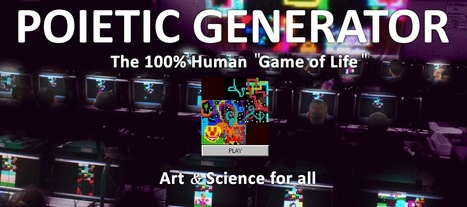
Être ensemble en temps réel et voir ce qui se passe... Le Générateur Poïétique est une expérience artistique et scientifique pour les petits et les grands. Vous pouvez participer 24 heures sur 24 et 7 jours sur 7. Joignez-vous aux rendez-vous, ou bien proposez-en un avec votre classe ou vos amis !
The Poietic Generator is an free art and science experience for kids and old people. Being all together in real time and see what happens... You may participate 24/7 on your mobile & desktop. Join the appointments or suggest one with your classroom or your friends!
Après avoir un peu trop bourlingué sur la toile, certains veulent simplementeffacer toutes traces de leur passage, aussi bien sur les réseaux sociaux que sur les sites web. Si c’est votre cas, voici comment procéder.
Avant d’aller tenter d’effacer vos vieux compte Multimania, iFrance et MySpace, vous devriez sans doute commencer par aller effectuer une purge du côté du « Big Four », composé du quatuor Facebook, Twitter, Google+ et LinkedIn. En somme, c’est à ces endroits qu’on devrait logiquement avoir le plus de facilité pour consulter et/ou récupérer des informations vous concernant. ...
This is the first one on a series of three short films we have produced for LEV Festival 2013 (Laboratorio de Electrónica Visual / Visual Electronics Lab).
The documentation trailer captures some of the best moments of the seventh edition of the festival, which was held at Laboral Ciudad de la Cultura (Gijon, Spain) in May 2013. Music by Jon Hopkins “We disappear”.
By producing this series of short films we had the pleasure to document the live shows and atmosphere across the different venues of the festival and to interview some of the great featured artists: Clark | Oneohtrix Point Never | Tim Hecker | Andy Stott | Raime | Jon Hopkins + Dan Tombs | Kid606 | Pole | Emptyset + Joanie Lemercier | John Roberts | Roly Porter + MFO | Evian Christ | Santiago Latorre | Face&Heel | dot tape dot | Pye Corner Audio | Futuregold | thr3hold | Cristina Busto.
LEV Festival 2014 dates announced: 2nd and 3rd May 2014
Avec : Vincent Ricordeau, fondateur de KissKissBankBank et auteur de « Crowdfunding : Le financement participatif bouscule l’économie ! Pour libérer la créativité ». Diana Filippova, connector à Ouishare, projet collectif qui promeut le développement de l’économie collaborative. Jean-Jacques Birgé, compositeur, réalisateur, auteur multimédia, designer sonore et écrivain.
Cette émission de télévision interactive est préparée et présentée par Nils Aziosmanoff, président du Cube, Pierre de la Coste, écrivain spécialiste des TIC et Eloi Choplin, directeur de l’agence de communication innovante Triple-C. Émission réalisée par JD2 - http://www.jdcarre.fr
By exploring digital landscapes and excess of wireless communication in urban space, we started to search for poetic expression by applying radio waves. The intention was to create totally invisible and intangible work that will exist in the air. Hence we got an idea to display poems by Eduard Escoffet, who kindly agreed to collaborate with us. Each minute we are sending from dedicated WiFi router 4 32-character lines of a poem by changing the names of device. It means while choosing a network one will discover some lines of poetry instead of typical networks' names. Moreover, the work introduces an unusual way for not only applying WiFi waves for artistic purpose but also for a novel form for performing poetry. We have created a sculptural piece that displays reachable WiFi networks' names, and thus, also the poetry performed through the radio waves.
C'est juste une borne wifi qui génére toutes les minutes un nouveau részau wifi avec un SSD (son nom) tiré d'un poème...
Et si le programme générait des SSD combinatoires de son "propre" cru?
et si on faisait une piratebox en ville (chez moi ça n'a aucun sens) qui génénère du texte sur son état de piratebox laissée à l'abandon mais alimentée en énergie... et si...
Lesley Flanigan is an experimental electronic musician living in New York City. Inspired by the physicality of sound, she builds her own instruments using minimal electronics, microphones and speakers. Performing these instruments alongside traditional instrumentation that often includes her own voice, she creates a kind of physical electronic music that embraces both the transparency and residue of process — sculpting sound from a pallet of noise and subtle imperfections. Her work has been presented at venues and festivals internationally, including Sonar (Barcelona), the Guggenheim Museum (New York), ISSUE Project Room (Brooklyn), The Stone (New York), TransitioMX (Mexico City), CMKY Festival (Boulder)...
Cinema, video games, and the moving image reinterpreted through complex, time-based visualizations
Z/Z/Z/ describes the dimensions of cultural artifacts that are difficult to explain using natural language. We use visualization techniques with trial-and-error methodologies to explore individual cultural artifacts (e.g. a scene of animation) as well as larger cultural data sets (e.g. a director's filmography ).
Our primary goals for visualizing culture are:
aesthetic production—to create new work from existing worksproviding better descriptions of cultural artifacts than language aloneto analytically and heuristically reveal previously unseen cultural patternsbetter representing the complexity, diversity, variability, and uniqueness found in animation, cinema, and video games
More than just a prefix. re- is an approach. A perspective. re- is a meeting point. re- glances back while moving forward. re- represents not only a return but also a re-imagining.
Refest is a 3-day art and technology festival that celebrates the convergence of new and old, digital and analog, near and far. The artists featured in Refest are those who are breaking open possibilities through their practice. Creators working across a broad range of technologically informed media will gather at CultureHub in New York City to share video, performance, music, and more. Refest invites artists to share how they are reforming, rebuilding, reiterating, and renewing ideas. ...
If you used the Internet in 2013, there's a good chance your traffic passed through the hands of ISPs in Belarus and Iceland. It shouldn't have happened.
This is a deeply technical but potentially very troubling story. Imagine one day you’re using the Internet the same way you do every day. Reading the news, shopping, sending email, checking your bank and credit card balances. Maybe even doing some work for your employer.
Typically, but not always, the bits being sent from your computer, tablet or phone will flow from where you are to where they need to be via the most direct route available.
But what if they didn’t? What if someone slipped in between you and the various servers you’re connecting with and diverted your traffic elsewhere, funneling it through a choke point of their choosing, so they could capture, copy and analyze it? Your data takes some extra — and imperceptible — milliseconds to get where it’s going and ultimately everything you’re doing online works just fine. But your traffic has been hijacked by parties unknown and you’re none the wiser that it has happened.
Après une formation d’ingénieur, il étudie ensuite la composition électroacoustique aux conservatoires de Bruxelles et de Mons. Après avoir été chercheur dans le domaine de l'analyse et de la synthèse de la voix au Laboratoire de Phonétique Expérimentale de l'Université Libre de Bruxelles, Todor Todoroff a dirigé pendant cinq ans la recherche en informatique musicale à la Faculté Polytechnique de Mons. Il y a développé des programmes informatiques de synthèse, d'analyse et de transformation des sons, ainsi que des outils de spatialisation en temps réel à destination des compositeurs de musique électroacoustique. Il poursuit ses recherches dans le cadre d'ARTeM où il développe des systèmes interactifs tant pour les installations sonores et la danse que pour les compositeurs et les musiciens. Il collabore avec le Centre de recherche en Informatique et Création Musicale de l'Université de Paris VIII, la Maison des Sciences de l'Homme de Paris-Nord, le département de physiologie de l'Université de Cambridge ainsi qu'avec Musiques Nouvelles et Art Zoyd. Ses compositions montrent un intérêt particulier pour la multiphonie et la problématique de la gestion de l'espace sonore ainsi que pour la recherche et l'expérimentation de nouvelles méthodes de transformation du son.
Dans le cadre d'ARTeM, il a également développé des systèmes interactifs tant pour les installations sonores et la danse que pour les compositeurs et les musiciens, en explorant les possibilités d’utilisation de nombreux types de capteurs.
En 2008 il a repris la recherche à la Faculté Polytechnique de Mons à l'Institut Numediart. Il enseigne également depuis 2008 à l’Ecole Supérieure des Arts Plastiques et Visuels (ESAPV, Mons), dans la finalité Arts Numériques.
Il a également développé plusieurs installations interactives ou performances multimédias, telles que Lungs [the breather], installation audiovisuelle interactive en collaboration avec Laura Colmenares Guerra et Yacine Sebti ou Insondables, installation sonore interactive pour le festival “Les Bains Numériques” à Enghien-les-Bains...
"Orbita"-installation consists of a stainless steel ball 40 cm of diameter slowly moving around circular stainless steel tracks 8 m of diameter. In the centre point of the tracks there is a single light bulb, the only light in the space, which casts a shadow of the moving ball to the surrounding walls. The sound of the rolling ball is picked up with contact microphones attached to the tracks. Then it is amplified and played back real time through speakers in the corners of the exhibition space.
The constant movement of the ball is possible because of gravitational pull and minimal friction. There are three servo motors along the tracks on equal distance of each other pulling the tracks closer together just when the ball is passing by. This lifts the ball a little and it starts to run "downhill" where the tracks are wider from each other, gathering more speed. This extra speed is enough to keep the ball rolling until the next servo motor.
Art Critic and Writer Maja Markovic in Conversation with Mexican-Canadian electronic artist Rafael Lozano-Hemmer about his inspirations, his work and his new commissioned work at Borusan Contemporary.
To read the full interview you can download the digital version of exhibist magazine here.
To begin with, please tell us a little about your work. What is it you endeavour to discover or reveal in your art? When asked about what you do, how would you describe your artistic practice?
My work is mostly at the intersection of architecture and performance art. I develop audiovisual platforms for public interaction: many pieces are about self-representation, intimacy, agency and the key idea that absence and presence are not opposites. The content of my work is often derived from participation, typically through technologies that are both violent and seductive. ...
SUDLAB is a hi-tech openlab devoted to communication and artistic and cultural research. An open venue created for stimulating integrated design and creative interaction. An ideal platform for promoting the very best of glocal art and culture. A cross-disciplinary research and social workshop.
All SUDLAB activities are actively founded on the principles of free association and cooperation, as well as on the creation and shearing of quality ideas and contents. Arts reunited, cross-disciplinary and international comparison, research and skill shearing, for worldwide collective communication involving not only art, but also personal competences and ideas. As a matter of fact, creative and geographical seclusion often keep southern creative artists away from spotlight. In addition, even the best ideas die out if there are not supported by an organized group including the most talented people, the strongest motivations, specialist skills and quality projects, along with the resources needed to realize them .
SUDLAB is a venue that welcomes all those who wish to share their interests, offering them a network of top ranking Websites on the leading search engines, specific media and communication know-how, software and hardware tools, high profile professional relations for exchange and interaction and a physical location for meeting, imagining, designing and realizing together artistic-cultural events and projects of superior standing.
If SUDLAB's ideals reflect your owns, and you would like to take part in our projects and our network by joining an open, culture- oriented and dynamic community, please contact us for further information.
our obtenir ce que vous voulez d’un service client par téléphone, il vaut mieux montrer son émotion que la retenir, explique Noreen Seebacher (@writenoreen) pour All Analytics(@allanalytics). La colère, l’indignation et les larmes fonctionnent mieux que la raison.
On se demande souvent à quoi sert l’enregistrement des conversations que l’on est contraint d’accepter lorsqu’on appelle un service client… Et bien certains centres d’appels les utilisent pour étudier les interactions vocales entre clients et téléopérateurs. Nice Systems développe ainsi un programme d’analyse automatique de la voix pour traiter plus efficacement les réclamations des utilisateurs. Des logiciels de ce type aident à mesurer l’humeur du client en temps réel afin de proposer des options au téléopérateur pour restaurer la relation. Nice Systems par exemple réagit à des mots clefs pour déclencher des contre-mesures : dire des obscénités, se mettre en colère ou faire référence à des concurrents déclenche ainsi des alertes (notamment l’intervention d’un superviseur) pour désamorcer la colère du client et éviter de le perdre. Selon une étude du SQM Group, lorsque les problèmes des clients sont résolus au premier appel, seulement 1% des clients sont susceptibles d’essayer la concurrence, contre 15% lorsque leur problème n’est pas suffisamment pris en compte. L’analyse automatique de la parole est devenue un investissement ordinaire dans les Centres d’appels, rapporte une autre étude. ...
La semaine dernière, le Kikk Festival invitait Namur (et pas que, sachez-le) pour un voyage technologique rigoureusement chorégraphié. Entre konférences, workshops, skreenings, kontest, ekzibition et diskussions, le festival international des cultures numériques et créatives donnait le ton de ces deux jours en présentant un programme dense, pointu et ultra-attractif où même 8 petites mains et 4 cerveaux en ébullition eurent du mal à tenir la cadence. ...
Stereolithography has been around for years. The art of taking uncured liquid resin and pulling out solid objects, while amazing, is not itself a new technology. In fact, its origin dates back to the seventies.
Why then has such an amazing technology that has immense potential been so inaccessible to the general public? Stereolithographic printers cost upwards of up to 200,000 dollars for printers the size of a compact car. On top of that, the print material these devices use is inaccessible due to cost and toxicity.
For the past year, the team of Pryntech has been working on an open hardware design for a high resolution stereolithographic printer. The printer has both small physical and environmental footprints — it utilizes VOC Free UV curable resin and fits naturally on your desk with a beautiful 20cm square base and 35cm height.
We’re proud to look back at a successful and sold-out second instalment of Coded Matter(s). For those who were unable to attend we asked Kimberly Waldbillig, a keen blogger with a MA in New Media & Digital Culture, to do a write-up of the afternoon. If you don’t like words, the full set of photos can be found on our Flickr account. If you do like words, read on! And in any case: stay tuned for the event video coming soon.
The introduction from director of STEIM Dick Rijken was a layman’s primer to the ideas that are keeping today’s sound hackers awake into the wee hours of the night. He questions the roles of composer and performer in the new worlds into which digital electronics can bring us. Rijken reiterates the paradoxical point that code concedes flexibility at the same time that it demands autonomy. That’s precisely what the Coded Matter(s) series is designed to investigate: the definition, categorisation and evaluation of hybrids which emerging in the atemporal algorithmic mess that is our sonic reality. ...
To get content containing either thought or leadership enter:
To get content containing both thought and leadership enter:
To get content containing the expression thought leadership enter:
You can enter several keywords and you can refine them whenever you want. Our suggestion engine uses more signals but entering a few keywords here will rapidly give you great content to curate.


 Your new post is loading...