Media Arts Watch Lab - www.arts-numeriques.info - laboratoire de veille Arts Numériques - twitter @arts_numeriques - @processing_org - @DigitalArt_be - by @jacquesurbanska @_Transcultures
. Our dictionary diccan.com is primarily aimed to the community of digital art, from artists to fans and from corporations to associations. Its insistence on external references makes it a choice tool for research and in depth studies... without forgetting enjoyment. It's written mostly by Pierre Berger, retired computer journalist, author of Roxame software and presently art critic.
It is permanently updated and enriched, with the risk of some "work in progress" here and there. Your remarks will always be welcome.
The Office for Creative Research is a multidisciplinary research group exploring new modes of engagement with data, through unique practices that borrow from both the arts and sciences.
Memopol-II is a social machine that maps the visitor’s information field. By inserting an identification document such as a national ID card or EU passport into the machine, it starts collecting information about the visitor from (inter)national databases and the Internet. The data is then visualized on a large‐scale custom display. The collection panel also shows the portraits of the visitors from their ID card.
The Cyrillic spelling of the installation’s name refers to George Orwell's concept of Big Brother from his 1949 dystopian novel 1984. Over the past decades, technological means have transformed the surveillance of society. When surfing on the Internet, paying with an ATM card, or using an ID card, people leave their digital traces everywhere. Internet and social networks gather and provide a great deal of personal information, and a person’s profile is no longer constituted by his or her physical being alone, but also by the person’s digital information, over which he or she sometimes has little control. Background checks through Internet search engines and social network sites have become routine when we meet somebody new or apply for a job. Memopol-II enables us to make a thorough background check of ourselves, mirroring back to us all the data about us that is accessible via the Internet.
At this high-point of high-tech, machines are producing aesthetic experiences for us as never before. Should we respectfully thank them and consider ourselves their peers? Curt Cloninger suggests something more irreverent
Aesthetic experience is always asymmetrical; it needs to be posed in terms of a subject, as well as an object.
– Steven Shaviro
What Is the ‘New Aesthetic’?
If, according to Debord, ‘the spectacle is capital accumulated to such a degree that it becomes an image’, then the New Aesthetic is technology accumulated to such a degree that it becomes an image. The New Aesthetic (NA) image is a special kind of image – an image which is bodily, affectively sussable by humans. The NA image is not merely (or even) an image to be intellectually pondered by humans. You ‘get it’ before you understand it (if you ever even come to understand it). ...
A l’initiative de deux structures culturelles, ZINC/ECM à Marseille et SHAMS/ICARE à Beyrouth pour animer des échanges internationaux autour de la création contemporaine et des outils numériques et du multimédia.
Les arts numériques s’affirment comme un secteur artistique de plus en plus repérés et intégrés à la diversité des expression artistiques actuelles. En France, elles sont très liés aux arts plastiques, avec des liens forts avec certaines écoles des Beaux Arts, mais aussi de plus en plus connectés aux arts de la scène, dans le domaine de la danse en particulier. Au Liban, les artistes passent facilement de la vidéo expérimentale à la fiction voire au cinéma. En Egypte, c’est à partir des arts graphiques et visuels, que les artistes s’avancent vers des installations et performances multimédia.
A travers la plate-forme RAMI, nous voulons faire se rencontrer dans un espace-temps commun ce qui se développe dans les arts visuels, de l’audiovisuel et dans les arts de la scène, pour mieux en comprendre les motivations des artistes, les ressorts de la création et les effets auprès des publics
Un premier cycle de workshops, de séminaires et d’évènements a été organisé en 2006 et 2007, à Marseille, Alexandrie et Beyrouth avec SHAMS, l’Atelier d’Alexandrie et le Studio AZZURRO de Milan.
En 2008 et 2009, une liste de diffusion a été mise en place, plusiuers résidences d’artistes, de rencontres et d’évènements ont eu lieu à Bari ( BJCEM 08), à Beyrouth ( Première Nuit Blanche), à Marseille ( résidences d’artistes), à Istanbul (fondation du réseau AMBER NETWORK )...
La plate-forme RAMI se développe en lien avec le réseau YASMIN, des projets novateurs connectant arts, sciences et technologies, comme e-mobile art..
Google a obtenu un brevet sur une technologie d'intelligence artificielle qui vise à suggérer automatiquement des réactions aux internautes, en pré-rédigeant des réponses à apporter aux e-mails, SMS ou autres messages publiés par des contacts sur les réseaux sociaux. Des réponses adaptées à la psychologie de chacun.
Sommes-nous à ce point prévisibles que des algorithmes pourront demain rédiger des tweets ou des messages sur Facebook à notre place, sans trahir ce que l'on aurait écrit spontanément ? Google semble le penser, avec unbrevet qui vient d'être publié, qu'il a déposé dès juin 2011. La firme de Mountain View y décrit un système qui suggère à l'individu les réponses à apporter à un événement ou à un message particulier, pour que celui-ci puisse se contenter de valider la suggestion sans même avoir à faire un effort de réflexion et de rédaction. ...
En prédisant le comportement et même l'opinion de ses utilisateurs, Google pourrait bien marquer encore des points. Cet innovation est une autre preuve de la puissance de l'entreprise en avance sur son temps.
articule.net est un site consacré aux cultures urbaines numériques et aux pratiques artistiques impliquant les technologies de géolocalisation (“locative media art”).
Les supports numériques mobiles reliés aux réseaux numériques sans fil influencent notre manière d’habiter la ville, sa socialisation et notre relation au bâti.
Le corps en mouvement, celui du flâneur ou de l’usager, est dorénavant totalement impliqué dans l’accès et la consultation des réseaux de façon contextualisée.
Les nouvelles écritures cartographiques modifient notre vision et nos pratiques du monde.
Les interfaces se diversifient, deviennent de plus en plus volatiles, se fondent dans l’existant et se confondent avec lui.
Les réseaux numériques fusionnent avec l’environnement matériel pour former des espaces hybrides et stratifiés (“réalité mixte”). Ces espaces sont le lieu d’expérimentations plastiques, de propositions fonctionnelles et de réflexions théoriques que ce site se propose de référencer.
Frédérique Entrialgo est Professeur d’enseignement artistique à l’Ecole des Beaux-Arts de Marseille, Doctorante en Sciences de l’Information et de la Communication à l’Université de Nice Sophia-Antipolis (laboratoire I3M) et membre de l’équipe de recherche InsARTis.
Humatic's Re-Performance concepts and technologies allow visitors' access to pre-recorded music & dance. The spectator is invited ( but not obliged) to control the flow of a pre recorded activity. To do so, he is given easy-to-learn physical interfaces. He selects the degree of his involvement and can change his role from observer to player to co-performer at any time, or can take over complete control of the system and play it as a musical instrument.
'MNM' autonomously generates always new visual and musical clusters, which can be influenced and re-composed by operating push buttons, levers and a turn table interface...targeting direct (body)contact between visitor and video-performer.
MNM employs the arm of a modified traditional Japanese mojo figure Maneki Neko. Asked why?... Christian Graupner says: ' It is POP ... it is confusing ... it is a Ready-made '.... We introduce well known stuff in a new context and leave it open to the visitor to read the old or a new meaning or just allow the juggling in between with the option to find a totally new interpretation.
The triptych in its antique golden frame is a punch in the face of all who are optimistic without reason. Graupner's radical, insane working methods result in a tightrope walk between cutting edge autistic magic and death metal spiral-ism. The MNM film is organized in a triple helix. Non linear but non-abrupt presentation and real time access boost spectator's imagination of perfection in movement and sound art to a level where he might get an idea of what to find beyond cliché. Complex technologies and concepts are hidden behind collapsing surfaces showing permanently re-composing accidents to be controlled by human (failure). Triple headed protagonist Ming Poon, one of a few survivors of Graupner's controversial creation processes succeeds in transmitting his drastic experiences, not leaving out, to raise some hope. Visitors of earlier works as of the media slot machine MindBox, -especially young players- experienced temporary healing from gaming addiction and mental disorder.
The world's biggest recording companies have been stripped of two billion YouTube hits after the website cracked down on alleged 'fake' and 'dead' views.
Universal, home of Rihanna, Nicki Minaj and Justin Bieber, lost a total of one billion views in the video site’s biggest ever crackdown on its viewing figures.
Sony was second hardest hit, with the label behind such stars as Alicia Keys, Rita Ora and Labrinth losing more than 850million views in a single day. ...
La licence professionelle CDAISI (Contribution pour la Défense et l'Anti-Intrusion des Systèmes informatiques) de l'IUT de Valenciennes/Maubeuge forme les étudiants aux techniques de piratage. Ces petits génies savent s'infiltrer n'importe où mais le font en toute légalité. ...
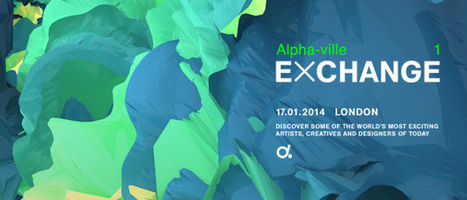
Alpha-ville EXCHANGE is a one-day event designed to offer the London art, tech and creative communities the opportunity to connect, exchange ideas, get inspired and discover new talent. The event takes place on Friday 17th January 2014 at Rich Mix Cinema and Arts Centre and brings together some of the world’s most talented artists, creatives and designers of today to talk about their practice, influences and recent works.
EXCHANGE 1 features a Day Programme packed with presentations, talks and social events alongside a music programme in the evening for attendees to network and enjoy. Work will be presented across: motion graphics, graphic design, illustration, interaction design, generative design, digital and software art, mixed media art, data visualisation and more.
Bicycle Built For 2,000 is comprised of 2,088 voice recordings collected via Amazon's Mechanical Turk web service. Workers were prompted to listen to a short sound clip, then record themselves imitating what they heard.
Near the end of this summer, I was asked by the publishers of Popular Science magazine to produce a visualization piece that explored the archive of their publication. PopSci has a history that spans almost 140 years, so I knew there would be plenty of material to draw from. Working with Mark Hansen, I ended up making a graphic that showed how different technical and cultural terms have come in and out of use in the magazine since its inception.
The graphic is anchored by a kind of molecular chain – decade clusters in turn contain year clusters. Every atom in these year clusters is a single issue of the magazine, and is shaded with colours extracted from the issue covers via a colour clustering routine. The size of the issue-atoms is determined by the number of words in each issue. ...
From the whiff of your first pet to the smell of that seaside holiday, the Madeleine captures the scent of your memories
With the one-click simplicity of Flickr and Facebook, Instagram and Twitter, recording our memories has never been easier. But with such ease has come overload. More than seven billion photos are added to Facebook every month, while 100 hours of video are uploaded to YouTube every minute. We are drowning in a sea of hastily snapped images, our entire existence flattened into a scrolling feed of frozen frames.
"We take pictures of everything and load it all online, to the point where it is all infinitely replicable and disposable," says designer Amy Radcliffe, whose MA project at Central Saint Martins set out to bring a more meaningful sensory dimension to storing our favourite memories. ...
Aujourd'hui, l'Assemblée nationale a adopté en première lecture le projet de loirelatif à la programmation militaire pour les années 2014 à 2019. Ce texte marque une dérive sans précédent vers la généralisation de la surveillance sur Internet. En l'état, il permet la capture en temps réel sur simple demande administrative et sans mandat judiciaire des informations et documents traités dans les réseaux concernant tout un chacun. Il rend par ailleurs permanents des dispositifs qui n'étaient que temporaires.
Quelques mois seulement après les révélations d'Edward Snowden, comment est-il possible que le gouvernement ait soumis au Parlement un projet de loi aussi attentatoire aux droits fondamentaux ? À son article 13, ce texte organise la généralisation d'une surveillance en temps réel des « informations et documents traités et conservés dans les réseaux », concernant potentiellement tous les citoyens1, à la demande et pour le compte d'une variété de ministères (sécurité intérieure et défense, mais aussi économie et budget), dont l'implication de certains dépasse largement la protection des citoyens contre des incidents d'une exceptionnelle gravité. En effet, ce projet de loi permettrait à ces ministères d'autoriser la surveillance en temps réel de tout citoyen pour la seule « prévention […] de la criminalité » ou la particulièrement vague « sauvegarde des éléments essentiels du potentiel scientifique et économique de la France »2. ...
Between Blinks & Buttons is a twofold thesis project about the camera as a networked object. Through making their photos public on the Internet, individuals create traces of themselves. In addition to their value as a memory, each image contains a multitude of information about the context of its creation.
Through this metainformation, every image is linked to the precise moment in time when it was taken, making it possible to see what happened simultaneously in the world at that instant. This work tries to focus the user's imagination on that other, to create narratives that run between one's own memory and a stranger's moment which happened to coincide in time.
Julian Oliver provides new and alluring approaches to augmented reality. Augmented reality means creating virtual ad-on's to what is already there. Recently Oliver started working on new forms of utilizing public space that is already dense with advertisements. Just imagine seeing art all around Times Square instead of advertisements for sport shoes and soft drinks. Or imagine some one entering one of those advertisements for soft drinks and thus adding new message and meaning to what it was before. You could be the one who decides what you want to see or be invited by a - preferably famous - curator to look at his selection. ...
Exercice de synthèse pour essayer de satisfaire celles et ceux qui ont demandé un retour sur le cycle de conférences-conversations Musée au 21ème siècle : disparition ou renaissance ? qui s’est déroulé à l’ISELP, Bruxelles, de janvier à avril 2013
5 conversations publiques avec 5 directeurs de musées européens : Zeev Gourarier (MuCEM – Marseille), Boris Charmatz (Musée de la Danse – Rennes), Marc-Olivier Gonseth (Musée d’Ethnographie – Neuchâtel), Laurent Le Bon (Centre Pompidou – Metz), Chris Dercon (Tate Modern – Londres)
Vous trouverez ici des réponses aux questions d’Isabelle Capitani, étudiante en master II expo-muséographie à l’université d’artois, sous la direction de Serge Chaumier ...
The Cryptosphere is a global peer-to-peer cryptosystem for publishing and securely distributing content pseudonymously with no central point of failure. The system is openly federated and anyone can join. To ensure quality service and prevent abuse, the Cryptosphere uses an integrated cryptographically secure reputation system which provides a distributed web of trust.
There are several systems with similar goals to the Cryptosphere, such as MNet, Freenet, and Tahoe-LAFS. These systems serve as inspiration for the Cryptosphere's design. The Cryptosphere is also heavily influenced by Git, the distributed version control system.
L'industrie des jeux vidéo aura généré 70 milliards de dollars dans le monde en 2013, soit plus que l'industrie musicale (51 milliards de dollars) et l'industrie de la vidéo (50 milliards de dollars).
To get content containing either thought or leadership enter:
To get content containing both thought and leadership enter:
To get content containing the expression thought leadership enter:
You can enter several keywords and you can refine them whenever you want. Our suggestion engine uses more signals but entering a few keywords here will rapidly give you great content to curate.


 Your new post is loading...