Your new post is loading...

|
Scooped by
Jacques Urbanska
October 26, 2016 4:19 PM
|
Tazasproject. A name, for both artists. Since 2009, Guillaume Beinat and Alexandre Suné create artistic works in fields as graphic design and the new technologies. Attached to the volume, in relation to space, their approach focuses on the fragility that digital provides to the material and the object. Their scenography design and interactive installations from various projects respond with thoroughness to a space, its identity and temporality.
For the last six years, they worked hard to connect their graphic production to an app dimension or interactive space solution. Their iPhone and Android App TazasPlayGround has allowed them to integrate Augmented Reality technology into a varying number of products, including: t-shirts, posters, postcards, and product packaging. Their projects are produced in limited edition, and sold in stores and museum across Europe or huge city as New York or Tokyo. Augmented Reality integration has allowed them to convert their static objects into digitally interactive creations.
Tazasproject is currently working on interactive projects, Art Exhibitions, or doing workshops/seminars and courses in different schools as ECV Aquitaine. Whether for professional or cultural purposes, these two artists are developing a vision that anticipates today the future of interactivity.
|
|
Scooped by
Jacques Urbanska
October 26, 2016 4:06 PM
|
Toutes les informations utiles aux designers pour optimiser leurs créations textiles et leurs échanges avec les industriels sont réunies dans ce memento. Embrassant toutes les bases de la discipline - termes, outils, machines et leurs spécificités, appellations, codes et symboles, techniques et histoire - l'ouvrage a aussi le rare mérite d'investir de façon tout aussi précise le territoire des textiles innovants.
|
|
Scooped by
Jacques Urbanska
October 26, 2016 3:56 PM
|
|
|
Scooped by
Jacques Urbanska
October 26, 2016 3:44 PM
|
Depuis 2010, de nombreuses collaborations entre artistes et chercheurs ont vu le jour en région, créant des avancées significatives dans les activités de ces deux communautés. L’événement F O O R a pour objectif de construire un premier bilan de plus de 5 ans de projets Art/Sciences-Technologies en région et en Belgique, mais surtout de préparer le futur et d’ouvrir les discussions sur une stratégie de pérennisation. L’après-midi sera consacrée aux questions de production et de diffusion des oeuvres.
|
|
Scooped by
Jacques Urbanska
October 24, 2016 4:51 PM
|
Iregular is a Montreal-based studio founded in 2010. Working at the intersection of art and technology, the studio approaches design using a code-driven and real-time mindset. Creators of audiovisual experiences for installations and websites, its work combines geometry, typography, light and sound with software, mathematics and algorithms. The result are systems with infinite possibilities, making every instant of its projects unique. Iregular est un studio basé à Montréal et fondé en 2010. À l’intersection de l’art et de la technologie, le studio envisage le design par le code et avec la notion de temps réel.
Créateur d’expériences audiovisuelles pour des installations et des sites Internet, notre travail allie la géométrie, la typographie, la lumière et le son aux logiciels, aux mathématiques et aux algorithmes.
|
|
Scooped by
Jacques Urbanska
October 24, 2016 4:43 PM
|
Founded in 2009 and generously supported by the College of Media, Communication and Information as well as the Department of English at the University of Colorado at Boulder, the motto of the Media Archaeology Lab (MAL) is that “the past must be lived so that the present can be seen.” Nearly all digital media labs are conceived of as a place for experimental research using the most up-to-date, cutting-edge tools available. By contrast, the MAL – which very well might be the largest of its kind in the world – is a place for cross-disciplinary experimental research and teaching using still functioning media from the past. The MAL is propelled equally by the need to both preserve and maintain access to historically important media of all kinds – from magic lanterns, projectors, typewriters to personal computers from the 1970s through the 1990s – as well as early works of digital literature/art which were created on the hardware/software housed in the lab. Just in terms of our collection of digital devices, we currently have 35 portables/laptops, 73 desktop computers, 22 handheld devices, 8 other computing devices, and 10 game consoles.
|
|
Scooped by
Jacques Urbanska
October 24, 2016 4:29 PM
|
L'espace virtuel du Jeu de Paume ouvre ses portes à une série d'expositions dématérialisées, coordonnées par l'artiste curateur Nicolas Maigret. Intitulé Futurs Non-Conformes, ce programme mêle art, ethnographie, critique et spéculation à travers 3 cycles (passé, présent, futur). Une occasion pour interroger son curateur autour des thèmes de l'anticipation, de la propagande de l'innovation et de l’archéologie des médias. Nicolas Maigret, Futurs Non-Conformes correspond à une forme que l’on peut appeler le « musée virtuel », pouvez-vous nous présenter ce concept ? Nicolas Maigret : Futurs Non-Conformes est une exposition en ligne, rassemblant une série de liens contextualisés autour de pratiques artistiques et techno-critiques. J’ai proposé que l’on articule ce programme autour de trois cycles, avec différents points de vue et différentes approches, qui chacune viennent décoder, décrypter et révéler les enjeux propres à différentes technologies, tout en développant une forte dimension critique. Nous avons donc écrit les présentations de chacun des projets avec les artistes, pour ensuite offrir un accès direct,via des liens hypertextes, aux expositions en ligne qui peuvent être aussi bien des collections d’objets (photos), que des éditions de magazines ou d’articles, des documentaires, etc...
|
|
Scooped by
Jacques Urbanska
October 22, 2016 7:48 AM
|
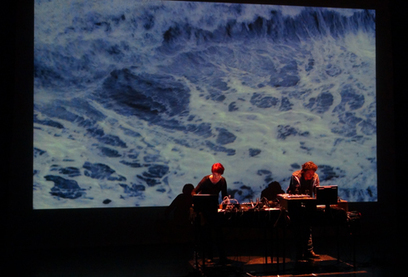
One or More Schachtophones, the new schachtophone audio-visual installation for playing schachtophonies; a sound sculpture for 10 performers made out of springs, that is at the same time the basis for the performance E.P.Z. and the reflectophone installation/performance 9,81 m of Accelerationism.
The performance E.P.Z. relies on the cut-up poetry of William S. Burroughs and the African horror story Jeddade Jeddade in creating improvised music lines by using schachtophone instruments and musical scores for three performers. By investigating the word “virus” in its auditive qualities and meaning, the narrative of the performance is based on the Ebola Zero Patient of the West African Ebola epidemic – a boy who is believed to have caught the virus by playing an instrument made out of wood in which infected bats were living in, and thus triggering the epidemic. E.P.Z. is performed by Damir Bartol Indoš, Tanja Vrvilo and Helge Hinteregger....
|
|
Scooped by
Jacques Urbanska
October 21, 2016 10:19 AM
|
Nous avons là la mise en scène d'un système nerveux augmenté, un spectacle qui bas comme un muscle, une machine synesthésique, un tout intrinsèque, organique et numérique... Le cadre esthétique de la performance est dressé : des impulses, du nerf, et toujours la nécessité de repousser les limites des champs du cognitif. Nous interrogeant en filigrane sur les limites de perception de notre propre corps, les relations ambigües qu'entretiennent notre individu contemporain avec son environnement numérique : Sommes-nous des corps exponentiels ? Ou des corps esclaves ?
Le Clair Obscur cherche des modes de communication inédits entre l'ordinateur et l'acteur/danseur. Par l'interaction/ synchronisation de ce dernier avec des outils multimédias, le Clair Obscur interroge la place de l'être, humain, dans son environnement, et particulièrement un environnement numérique qui le dépasse.
Le 22 octobre à 20h30 - #Liège
http://bamfestival.be
|
|
Scooped by
Jacques Urbanska
October 21, 2016 5:53 AM
|
The field of design has radically expanded. As a practice, design is no longer limited to the world of material objects, but rather extends from carefully crafted individual looks and online identities, to the surrounding galaxies of personal devices, new materials, interfaces, networks, systems, infrastructures, data, chemicals, organisms, and genetic codes, as Beatriz Colomina and Mark Wigley, curators of the 3rd Istanbul Design Biennial, put it in their manifesto (→). Our response to the Biennial’s theme—Are We Human?—draws from “The Obligation to Self-Design” (e-flux Journal 0, →), a text by Boris Groys in which a genealogy of design is traced from the design of the soul and the design of the self to "the design of life as a whole." Superhumanity seeks to explore and challenge our understanding of “design” by engaging with and departing from the concept of the “self.” Superhumanity aims to probe the idea that we are and always have been continuously reshaped by the artifacts we shape, to which we ask: who designed the lives we live today? What are the forms of life we inhabit, and what new forms are currently being designed? Where are the sites, and what are the techniques, to design others? Over fifty writers, scientists, artists, architects, designers, philosophers, historians, archeologists and anthropologists will bring new insight to these and related questions over the coming four months. Contributions will be published both on the e-flux website and dispatched as emails. To join the Superhumanitymailing list, please subscribe to e-flux Architecture here. In addition to online publication, a Superhumanity reading room will be exhibited from October 22 to November 20 at DEPO (Tütün Deposu Lüleci Hendek Caddesi No.12, Tophane 34425 İstanbul) as a part of the 3rd Istanbul Design Biennial. Editors
Beatriz Colomina - Nikolaus Hirsch - Anton Vidokle - Mark Wigley
|
|
Scooped by
Jacques Urbanska
October 21, 2016 5:32 AM
|
The Blockchain – Change everything forever has been made as part of Furtherfield's Art Data Money programme which seeks to build a commons for the arts in the network age. A book, Artists Re:Thinking The Blockchain in partnership with itinerant publisher and arts organisation Torque will be published in Spring 2017 with the prequel due out November 2016. Furtherfield is an international hub for arts, technology and social change. Since 1997, Furtherfield has created online platforms and physical places for exhibitions, labs and debates where different types of people explore today’s important questions. Furtherfield is an Arts Council England ‘National Portfolio’ organisation with a Gallery and Lab in London’s Finsbury Park http://furtherfield.org/ Digital Catapult works with SMEs to help them grow and scale faster. It helps larger corporates in their digital transformation. It does this through programmes of collaboration and open innovation, by bringing academic leading edge expertise into the mix combined with the organisation’s own business and technological expertise. https://digital.catapult.org.uk
|
|
Scooped by
Jacques Urbanska
October 21, 2016 5:24 AM
|
De la réunion de deux entités, connues sous leur nom respectif – Art2M et Anne & Julien – est né ArtJaws, une plateforme de vente d’œuvres d’art et d’éditions limitées.
ArtJaws met en contact privilégié les acteurs de l’art (artistes, galeries, collectionneurs, amateurs). Pensée comme l’espace-outil d’exploration des champs contemporains de l’art numérique et de celui de l’outsider pop, ArtJaws souhaite s’engager pour des artistes peu ou sous représentés – notamment dans le paysage actuel du marché de l’art – afin d’étendre les ponts de leur rayonnement.
Son originalité est d’être le fruit d’une réflexion de même nature qu’un commissariat d’exposition grâce auquel on retrouve un présupposé, une identité claire, une force de proposition régulière – le commissariat faisant valeur d’expertise.
La réunion des deux entités est également synonyme d’innovation avec la proposition et le développement de nouvelles manières de produire « l’objet artistique », et d’étendre ainsi le territoire créatif des artistes. En faisant le pari d’être 100% connecté au présent grâce aux capacités numériques, ArtJaws invite le collectionneur confirmé ou en devenir à partager cette vision neuve et dynamique.
Pour un hacking vertueux des habitudes du marché de l’art, ArtJaws mord à pleines dents dans des normes et des catégories figées de la création contemporaine afin d’en repousser les frontières.
|
|
Scooped by
Jacques Urbanska
October 21, 2016 5:18 AM
|
Depuis les années 80, l’activité humaine poursuit sa métamorphose « digital » passant d’îlots automatisés à une numérisation globale de la société, toujours plus hybridée à notre travail, notre créativité et notre intimité. LES ARTS CODÉS est un lieu de recherche, de création et de production partagé par plusieurs partenaires qui investissent la conjugaison des savoir-faire traditionnels et de la programmation, vers un possible entre artisanat et micro-industrie numériques. Notre collaboration est riche à la fois d’exigences nouvelles par rapport au travail mais aussi d’expériences concrètes qui permettent de toucher du doigt des façons originales de produire, d’innover, de collaborer, de concevoir...
|
|
|
Scooped by
Jacques Urbanska
October 26, 2016 4:11 PM
|
Adam Basanta is a sound artist, composer and performer based in Montreal. His sculptural sound installations are minimalistic choreographies of speakers and microphones, replicating real or imagined scenarios of listening. These installations operate around an alternative perception of sound, through attuning to sensations that are not necessarily perceived by the human ear — and through recognising that what may appear to be empty space is full of sonic phenomena that is material. Basanta may translate statistical information — a dossier that documents geospatial, and thus social, patterns in movement between cities — by codifying it into a different medium than we are accustomed to reading. Information is processed not through text or image, but through sound, as in the documentation of domestic and international flights of Going Nowhere Fast. By making audible the ratios, lengths or repetitions of individual travel, raw data attains a curious musicality. ...
|
|
Scooped by
Jacques Urbanska
October 26, 2016 4:00 PM
|
Le Collectif est un réseau d’acteurs culturels qui œuvre pour le rapprochement entre les structures. Aussi, pensons nous toutes nos interventions en terme de mutualisation. Nous sommes un lieu ressource structurant pour le département et les institutions, un lieu également de questionnement pour les acteurs culturels tout en étant force de propositions dans le débat culturel et la mise en œuvre d’actions complexes. L’association regroupe : - des équipements culturels (médiathèques, cinémas…)
- des équipements d’enseignement artistique
- des structures sociales (Culture du cœur…)
- des structures en lien avec les publics
- des centres de recherche (universités, grandes écoles, laboratoires…)
Le pôle Art & Science du Collectif pour la Culture en Essonne se donne pour mission de constituer : - un pôle ressource qui vient en support de « La Science de l’Art » en permettant aux artistes et aux scientifiques convaincus de l’intérêt de croiser leurs réflexions, de se rencontrer plus facilement et d’élaborer un projet commun.
- un pôle fédérateur qui œuvre, en concertation avec les principaux acteurs du département essonnien, d’île de France et des grandes régions, à la mutualisation des savoirs et des pratiques des champs artistiques et scientifiques sur l’ensemble du territoire.
- un pôle transdisciplinaire à vocation plus large de veille (nationale, européenne et internationale) sur l’évolution de l’axe Art, Science et Société, dans le but d’éviter la défragmentation des savoirs et des connaissances et d’aller vers des systèmes éducatifs et de recherche privilégiant l’échange et la transdisciplinarité expérimentale.
|
|
Scooped by
Jacques Urbanska
October 26, 2016 3:49 PM
|
Sound ∆ ƒields (S∆ƒ) est une œuvre technologique sonore interactive.
Équipés d’un casque et d’un terminal, les spectateurs voyagent dans une cartographie sonore qui résonne avec les œuvres du musée.
http://sounddelta.leclairobscur.net
|
|
Scooped by
Jacques Urbanska
October 24, 2016 4:58 PM
|
Rodrigo Carvalho work on Live Visuals and Interactive new media. Designer & Interactive New Media artist from Porto/Portugal. works on live visuals, coding and interactive art involves a range of different outputs, from screen digital work, interactive installations, audiovisual live acts, or interactive visuals for stage performance. Currently pursuing a PhD in Digital Media in U.Porto/UT Austin Colab /FCT.
|
|
Scooped by
Jacques Urbanska
October 24, 2016 4:46 PM
|
In the nineties his avantguard mechatronic performances combined such elements as Bodybots (body-controlled robots), Systematugy (interactive narration with computers) and dresskeleton (the exoskeleton body interface). The themes explored in his work include: the use of biological materials in robotics, as in Joan l’home de carn (1992); telematic control on the part of a spectator of an alien body in the performance EPIZOO (1994); the expansion of body movements with dresskeletons (exoskeletical interfaces) sed in the performances AFASIA (1998) and POL (2002); involuntary choreography with the bodybot REQUIEM (1999); and microbiological ansformations in the installations RINODIGESTIO (1987) and AGAR (1999). He is currently working on the spatial and utopian artwork TRANSPERMIA In the early nineties his performance EPIZOO caused a commotion in the international art scene. For the first time a performer’s body movements could be controlled by the audience. By operating a videogame, a spectator interacts with the bodybot worn by Antúnez, moving his buttocks, pectoral muscles, mouth, nose and ears. This performance stresses the ironical, and even cruel, paradox rising from the coexistence between virtual digital iniquity and the performer’s physical vulnerability. http://www.marceliantunez.com
|
|
Scooped by
Jacques Urbanska
October 24, 2016 4:36 PM
|
ACCELERATE Croatia is the first opportunity for a Croatian artist to carry out artistic research in the field of art, science and technology inspired by the world of particle physics in intense dialog with the scientists of CERN.
Particle physics considers notions of time, space and gravity to understand what constructs the universe while being invisible to the naked eye. CERN, the world’s largest particle physics laboratory, provides an inspirational place to realize ambitious visual or sound artwork and to expand artistic practice into new creative dimensions.
ACCELERATE Croatia is a one-month residency at CERN, organized in collaboration with Kontejner | bureau of contemporary art praxis. This initiative is specially designed for an artist. He/she must have the nationality or permanent residency in Croatia. It is intended to inspire the development of an imaginative project by the artist, inspired by the high level research into particle physics as well as the engineering and technology at CERN. The deadline for applications is January 11th, 2017.
|
|
Scooped by
Jacques Urbanska
October 22, 2016 12:15 PM
|
Ce qu’il y a de bien avec Accès)s(, c’est que chaque année, le festival nouveaux médias de Pau parvient à se renouveler tout en poursuivant son exploration des territoires technologiques et ses bordures. Sans doute cela tient-il à son exceptionnelle ouverture : chaque édition est construite par un (ou deux) commissaires invités, le plus souvent artistes. Après « Vu du ciel » en 2015 (invitée : Agnès de Cayeux), « Disnovation » en 2014 (invités Bertrand Grimault et Nicolas Maigret), l’édition 2016 a pour thématique « Frontières et projections », sur proposition des commissaires artistes Hortense Gautier et Philippe Boisnard, connus sous le nom d’HP Process. Crise migratoire, perte des repères géographiques et mentaux qui faisaient le ciment de nos sociétés… Sur cette crête d’actualité douloureuse, Accès)s( surfe jusqu’en décembre pour proposer un ensemble chaotique, exigeant et parfois labyrinthique, prenant l’idée de la carte et des frontières comme un « espace de possibles, générant de nouvelles façons d’être au monde, grâce à des artistes et chercheurs qui travaillent à l’intersection de l’art numérique, des arts visuels et sonores, de la poésie, de la géographie, du documentaire et de la prospective »...
|
|
Scooped by
Jacques Urbanska
October 21, 2016 12:46 PM
|
Today I’m announcing a $100M commitment to Kernel in an effort to enhance human intelligence and reimagine our future. Unlocking our brain is the most significant and consequential opportunity in history — and it’s time sensitive. We’re starting to identify the mechanisms underlying neural code and make them programmable. Our biology and genetics have become increasingly programmable; our neural code is next in line. Programming our neural code will enable us to author ourselves and our existence in ways that were previously unimaginable I started Kernel in 2016 (read more at the Washington Post) to build the world’s first neural prosthetic for human intelligence enhancement. The investment I’m making in Kernel today will expedite the development of this prosthetic and similarly transformative neurotechnologies. Why now?
...
|
|
Scooped by
Jacques Urbanska
October 21, 2016 6:04 AM
|
Kimchi and Chips have just released a video of their 483 Lines Second Edition exhibited at the Asian Cultural Centre (ACC) last year and presented during the first edition of ACT Festival curated and co-organised by HOLO/CreativeApplications.Net team. Two scenes of kevlar rope face one another tensioned to 5000kg. The audience is presented with highly parallel lines which contrast the darker space, building panoramic moire patterns. Video projection is used to address each line with digital pixels, activating visual matter within the volume of string.
This second edition of the 483 Lines was commissioned by the ACT Festival, Gwangju 2015, continuing to celebrate and interpret the non-constructive aspects of the NTSC television format. via http://www.creativeapplications.net/news/483-lines-second-edition-kimchi-and-chips
|
|
Scooped by
Jacques Urbanska
October 21, 2016 5:42 AM
|
Le groupe ICA—ACROE, ACROE pour Association pour la Création et la Recherche sur les Outils d’Expression et ICA pour Ingénierie de la Création Artistique, couvrent un même projet global de recherche, de développement et de pédagogie en informatique musicale, image animée et synthèse. L'ACROE a été crée en 1976 par Claude Cadoz, Annie Luciani et Jean-Loup Florens à l'Institut National Polytechnique de Grenoble (Grenoble INP) avec le soutien du Ministère de la Culture et de la Communication. Le laboratoire ICA en tant qu’unité de recherche de Grenoble INP a été créé en 1999. Les travaux scientifiques, technologiques et artistiques du groupe s’attachent à une problématique générale introduite dès sa création, se révélant aujourd’hui de pleine actualité : l’ingénierie pour la création artistique dans les arts instrumentaux du temps, arts recourant à des objets matériels produisant des effets sensoriels via l'interaction avec l’être humain...
|
|
Scooped by
Jacques Urbanska
October 21, 2016 5:28 AM
|
Cette thèse interroge le design depuis les pratiques de programmation en montrant qu’elles ne se réduisent pas à une industrie des programmes, qui empêche les inventions de naître tout à fait. Pour cela, elle confronte au sein d’une lecture non linéaire cinq moments de l’histoire du numérique (depuis Vannevar Bush en 1945, dont une traduction inédite est proposée en appendice, jusqu’aux usages contemporains du site web GitHub) à quatre formulations conceptuelles issues d’un corpus philosophique. Le choix d’auteurs qui n’ont pas directement voué leurs réflexions au design (comme Jacques Derrida, Hannah Arendt ou Walter Benjamin) permet de déconstruire un certain nombre de discours entourant la réception des technologies dites nouvelles. Critiquant nombre d’usages faits des notions de conception et de projet et s’appuyant finalement sur Gilbert Simondon, cette thèse s’intéresse à ce qui n’est pas prévisible dans les programmes. Elle soutient cinq axes ou directions pour une recherche dans le champ concerné : décentrer, authentifier, appareiller, traduire et désarticuler. La plausibilité de ces façons de faire du numérique, encore à l’état d’ébauche dans les productions contemporaines, peut intéresser les designers au-delà des spécialistes. Elle est avérée en fin d’ouvrage dans la description d’une fiction curatoriale. Thèse dirigée par M. Pierre-Damien Huyghe. Université Paris 1 Panthéon-Sorbonne, ufr 04, École doctorale d’arts plastiques et sciences de l’art. Discipline : Esthétique et Sciences de l’Art, spécialité Design. 550 pages, 1 200 000 signes, 923 notes de bas de page et 266 figures.
|
|
Scooped by
Jacques Urbanska
October 21, 2016 5:19 AM
|
Three days of talks, performances, workshops and art about computer networking technologies and the communities we build with them. Learn how to create your own offline networks, portable web servers, mesh networks or internet gateways in hands on workshops. Attend panels where you can discuss your visions for how a localized network could support your school, your community, or your cause. Listen to speakers talk about the future of computer networks and why it’s important to understand how networks work in this age of hyper-connectivity.
|