Media Arts Watch Lab - www.arts-numeriques.info - laboratoire de veille Arts Numériques - twitter @arts_numeriques - @processing_org - @DigitalArt_be - by @jacquesurbanska @_Transcultures
Kyle McDonald is a contributor to arts-engineering toolkits like openFrameworks, and spends a significant amount of time building tools that allow artists to use new algorithms in creative ways. His work is very process-oriented, and he has made a habit of sharing ideas and projects in public before they're completed. He enjoys creatively subverting networked communication and computation, exploring glitch and embedded biases, and extending these concepts to reversal of everything from personal identity to work habits. Kyle is a member of F.A.T. Lab, community manager for openFrameworks, adjunct professor at ITP, and has been a resident at the STUDIO for Creative Inquiry at Carnegie Mellon, as well asYCAM in Japan. His work is commissioned by and shown at exhibitions and festivals around the world, including: Ars Electronica, Sonar/OFFF,Eyebeam, Anyang Public Art Project, Cinekid,CLICK Festival, NODE Festival, and many others. He frequently leads workshops exploring computer vision and interaction.
MakeHuman is a free program that runs under the Windows, Linux and Mac operating systems.
The models created with MakeHuman are released under CC0, the most liberal license in the world. They are completely free to use in any project, commercial or noncommercial.
As rents - and broadband speeds - keep rising, the internet as a site for the presentation, creation and dissemination of work continues to grow beyond its straightforward use as a promotional tool, or a public way to document work.
Internet galleries
Internet galleries have been around since the earliest days of the web in one form or another, such as free-for-all sites like Saatchi Gallery online, where artists simply upload images of art in all media; or online communities of Net and New Media Art like Rhizome, which continues to foster debate through essays, artist profiles and online artworks, or more recently, projects like or-bits.com which focus on thematic exhibitions.
Dans les tentatives de donner chair aux images, de donner l’illusion de leur tridimensionnalité, le cube scénique, et sa mise à distance de la salle, ne sont pas remis en cause. Pour que l’artifice opère, le spectateur doit se tenir à distance de la scène – à la bonne distance. Ce qui faisait illusion hier, et provoquait la stupeur ou l’émerveillement, apparaît parfois aujourd’hui comme un bien pauvre artifice. Dans cette fascination pour les effets de l’illusion, il ne s’agit jamais que d’adapter les techniques contemporaines aux nouveaux modes de perception du spectateur. J’examine ci-dessous les principaux dispositifs utilisés dans les digital performances : écran panoramique, tulle, Pepper’s ghost, projection d’images en 3D, réalité virtuelle. ...
Local Projects is a media design firm for museums and public spaces. While innovation drives much of today’s design, we’re interested in creating projects that endure.
We’re reinventing public space through media, creating meaning and connections in places as diverse as Memorials, Times Square, and art installations. We focus on engaging audiences through emotion and technology, developing new ways for people to interact with art, cities and one another. We gather stories through collaborative storytelling projects, and between Storycorps, the 9/11 Memorial Museum and Change By Us, we have brought forth over 100,000 individuals’ stories and memories, sharing them with the world and touching millions of lives.
With the ubiquity of smart phones and rise in photo-sharing services, the world has recently exploded with photographers from all backgrounds who are embracing new technology to tell their stories in innovative ways.
Motion photography has emerged as a new trend, but until now required special tools and know-how. Google+ allows users to effortlessly and automatically animate a series of still photographs and turn them into motion photography.
In recognition of the exciting potential of this new technology, the Saatchi Gallery and Google+ announce the Motion Photography Prize, inviting photographers all over the world to celebrate this new creative art form.
Conférence inaugurale du cycle de conférences/rencontres et workshops Ecoute du lieu scénique(partenariat entre l’ESAC, Transcultures, et la Faculté d’Architecture et d’Urbanisme de Mons), Philippe Franck propose une introduction aux arts du son conjugués aux problématiques de l’espace urbain et aux flux humains. Comment la création audio se nourrit et joue de la ville, à la fois comme source, organisme vivant et sonnant, espace de pollution, de production et de diffusion sonore pour le métamorphoser ? A partir d’exemples historiques (Max Neuhaus, Bill Fontana, Christina Kubisch,…) mais aussi contemporains, avec diverses approches contextuelles (notamment à travers les productions du festival des arts sonores City Sonic), Philippe Franck commentera certains enjeux liés aux architectures, sculptures et paysages sonores jusqu’à des développements géolocatifs et audio numériques plus récents.
Dans le cadre du projet Ecouter l’espace scénique - une collaboration entre l’Académie royale des Beaux Arts de Bruxelles, la Faculté d’urbanisme et d’architecture/UMons, Transcultures
Chaque semaine, FUTUREMAG explore le monde à la rencontre des hommes et des femmes qui inventent l’avenir. Présentée par Raphaël Hitier, cette émission bimédia décrypte l'innovation dans tous les domaines et mesure l’impact des nouvelles technologies sur notre quotidien. Quelles perspectives nous offrent-elles en matière de santé, d’alimentation, d’agriculture, de communication, d’énergie, d’urbanisme ou de mode de vie ? Tous les samedis à 13h15
Urgent rethinking is required to avoid the revolutionary potential of 3D printing being lost in a sea of pointless plastic products
Norman Foster plans to print moon bases using an array of mobile printing nozzles on a 6 metre frame to squirt out sequential layers of lunar soil that will be set with a binding solution. The current system can work at a rate of 2 metres per hour, but next generations of printers are expected to reach 3.5 metres per hour or more, and be able to finish an entire building in a week.
Back on Earth, firms are using Contour Crafting to structurally match building design with their environments by combining 3-D printers and Geographic Information Systems (GIS). This experimental technology may one day design entire ports to withstand future earthquakes that devastate places like Haiti, at a fraction of the cost of a traditional construction company. And more 3-D magic is on the way.
Stratasys has just announced its new revolutionary 3-D printer that can produce multiple material types in a single print run, reducing the price of complex prototypes by around 50 per cent, while Skylar Tibbits promises us a phase of 4-D printing where strange geometries become even weirder when they encounter activating solutions.
FΔCEWORLD is a website that allows users to navigate through a 3-dimensional realm of their own personal Facebook history. *open app in Google Chrome for maximum performance.
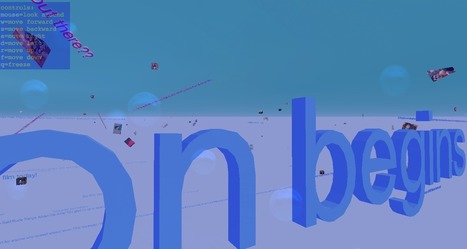
My NetEnvironment project. Using Processing and the FBI's Carnivore source code to generate a real time 3D environment that reflects current traffic on a network.
The code sniffs for all TCP/UDP connections and plots machines (cubes) and then draws connections between two machines (curves).
In this version higher port numbers (I had BitTorrent running) are higher in space, and lower port number are lower in space (take a close look when I refresh The New York Times website).
Super basic and super slow at this point, but hey, it works!
A short video showing recent work done by the openFrameworks community. Its by no means complete and we'll be doing new showreels over the coming months with much more of a comprehensive and reflective selection. The clips were pulled algorithmically from vimeo videos tagged 'openFrameworks'
Thanks to everyone using OF, contributing code and inspiring the community with amazing work.
In 2014 the Edith-Russ-Haus for Media Art will award up to five grants for artistic works in the area of new media.
two grants to the amount of 3,000,- € (three thousand euros) and participation in the Award for Emerging Artists exhibition at the ERH;
up to three artists will be acknowledged by having their work presented in the Award for Emerging Artists exhibition at the ERH.
The Edith-Russ-Haus for Media Art would like to recognize new stances in media art and support the winning artists with grants and/or an exhibition. The Edith-Russ-Haus Award for Emerging Media Artists of the Sparda Bank is intended to lastingly promote the careers of young media artists.
Une plateforme hybride conçoit et diffuse sur la FM berlinoise et sur le Net un programme participatif.
Depuis le 24 janvier, une quinzaine d’artistes, bricodeurs et radioamateurs travaillent à la création d’un nouveau genre de radio hybride web-FM qu’on pouvait écouter en ligne et sur son poste à Berlin, dans les zones couvertes jusqu'au 2 février...
Le mercredi 12 février 2014 à 14h - au Fresnoy - Studio National des arts contemporains - 22 rue du Fresnoy - Tourcoing
Le cinéma émotif est un prototype de cinéma interactif dans lequel le film varie en fonction des émotions des spectateurs, analysées par des casques EEG qui captent leur activité cérébrale. Le film répond ainsi au ressenti des spectateurs en temps réel, les personnages agissent différemment et le scénario varie d'une séance à l'autre. Mademoiselle Paradis est un film pilote d'une vingtaine de minutes avec lequel on pourra tester les possibilités offertes par ce dispositif. Inspiré de faits réels, le film évoque la guérison controversée d'une jeune musicienne souffrant de cécité nerveuse par Franz-Anton Mesmer, médecin viennois du XVIIIe siècle et pionnier du magnétisme. Selon les ondes cérébrales qui émanent des "spectateurs agissants" dans la salle, les variantes du film dessineront une interprétation différente de l'origine du traumatisme de Mademoiselle Paradis.
Interprétation, conception, chorégraphie et mise en scène Marie-Claude Pietragalla et Julien Derouault Librement inspiré de l'œuvre d'Eugène Ionesco - Création musicale Laurent Garnier Coproduction Dassault Systèmes, The 3DExperience Company. Mehdi Tayoubi
Europeana Creative is an exciting new European project which will enable and promote greater re-use of cultural heritage resources by Europe's creative industries. The project was launched at the end of February 2013 at the Austrian National Library in Vienna and will run for 30 months. 26 partners from 14 European countries with diverse backgrounds are contributing to the project. These include content providing institutions with world famous collections, creative industry hubs and organisations, the tourism and education sectors, living labs, software developers and multimedia experts, as well as think tanks. ....
Is your code your art? Be awarded a commission alongside some of the world's best interactive artists at the Barbican, London.
DevArt is a new type of art. It is made with code, by developers that push the possibilities of creativity and technology. They use technology as the canvas and code as the raw materials to create innovative, engaging digital art installations.
DevArt is the opportunity to open their creative process, share their art with the world and be a part of a new movement in art.
Google, with the Barbican in London, will commission a developer to create a new digital art installation alongside some of the world's best interactive artists at the Digital Revolution exhibition: the biggest and most comprehensive exploration of digital creativity ever to be staged in the UK. From there, the exhibition will then go on tour to cities around the world.
rural scapes – lab in residence is a rural residence program that focuses on research, articulation, reflection and transdisciplinary artistic practices and critical production in the rural environment.
rural.scapes – lab in residence works as an interface among regional, state, national and international networks and focuses on the revaluation of the countryside environment through a review of our notions of individual and collective identity in terms of territory. These actions stimulate the development of projects that promote new productive networks and alternative micro-economies, making the region more self-sustaining and fostering new creative dialogues between city and countryside.
Art Paris Art Fair réunit sous la nef du Grand Palais quelque 140 galeries internationales de 20 pays, présentant un panorama de l’art moderne et contemporain qui inclut également la photographie, le design et l’édition d’art.
La Galerie Charlot a été crée à l’initiative de Valérie Hasson-Benillouche en 2010.
Ouverte au développement de l’art contemporain en Europe, la galerie instaure un partenariat privilégié avec des galeries européennes par l’échange et la mise en valeur de leurs artistes.
La Galerie Charlot est un lieu dédié aussi bien à des jeunes créateurs, fraîchement sortis des écoles d’art européennes, qu'à des artistes confirmés peu exposés en France.
La particularité de la Galerie Charlot est de défendre deux formes artistiques contemporaines : art traditionnel (peinture et dessin) et art des "nouveaux medias" (art numérique et vidéo).
Chaque exposition est l’occasion de réunir ces deux réflexions et ces deux sensibilités : les unes viennent enrichir les autres sous des formes diverses.
La Galerie Charlot veut ouvrir un dialogue entre les nouveaux talents découverts et soutenus par la galerie, et les collectionneurs de demain.
Tardigotchi is an artwork featuring two pets: a living organism and an alife avatar. These two disparate beings find themselves the unlikely denizens of a portable computing enclosure. The main body for this enclosure is a brass sphere, housing the alife avatar in an LED screen and the tardigrade within a prepared slide. A tardigrade is a common microorganism measuring half a millimeter in length. The alife avatar is a caricature of this tardigrade, its behaviour is partially autonomous, but it also reflects a considerable amount of expression directly from the tardigrade’s activities (like eating).
Featuring essays by Adilkno, Clemens Apprich, Alejo Duque, Gary Genosko, Michael Goddard, Félix Guattari, Brian Holmes, Felipe Fonseca, Howard Slater, Cadence Kinsey, Oliver Lerone Schultz, Rasa Smite & Raitis Smits
Félix Guattari’s visionary term ‘post-media’, coined in 1990, heralded a break with mass media’s production of conformity and the dawn of a new age of media from below. Understanding how digital convergence was remaking television, film, radio, print and telecommunications into new hybrid forms, he advocated the production of ‘enunciative assemblages’ that break with the manufacture of normative subjectivities.
In this anthology, historical texts are brought together with newly commissioned ones to explore the shifting ideas, speculative horizons and practices associated with post-media. In particular, the book seeks to explore what post-media practice might be in light of the commodification and homogenisation of digital networks in the age of Web 2.0, e-shopping and mass surveillance.
TUIO is an open framework that defines a common protocol and API for tangible multitouch surfaces. The TUIO protocol allows the transmission of an abstract description of interactive surfaces, including touch events and tangible object states. This protocol encodes control data from a tracker application (e.g. based on computer vision) and sends it to any client application that is capable of decoding the protocol. There exists a growing number of TUIO enabled tracker applications and TUIO client libraries for various programming environments, as well as applications that support the protocol. This combination of TUIO trackers, protocol and client implementations allows the rapid development of table based tangible multitouch interfaces. TUIO has been mainly designed as an abstraction for interactive surfaces, but also has been used in many other related application areas. Technically TUIO is based on Open Sound Control - an emerging standard for interactive environments not only limited to musical instrument control - and can be therefore easily implemented on any platform that supports OSC. ...
To get content containing either thought or leadership enter:
To get content containing both thought and leadership enter:
To get content containing the expression thought leadership enter:
You can enter several keywords and you can refine them whenever you want. Our suggestion engine uses more signals but entering a few keywords here will rapidly give you great content to curate.


 Your new post is loading...