


In this tutorial you'll learn how to use a bluetooth module and MIT's app inventor to create a wireless serial link between an android phone and an arduino board.

 Your new post is loading...
 Scoop.it! In this tutorial you'll learn how to use a bluetooth module and MIT's app inventor to create a wireless serial link between an android phone and an arduino board. 
No comment yet.
Sign up to comment
Scoop.it!

x-OSC is a wireless I/O board that provides just about any software with access to 32 high-performance analogue/digital channels via OSC messages over WiFi. There is no user programmable firmware and no software or drivers to install making x-OSC immediately compatible with any WiFi-enabled platform. All internal settings can be adjusted using any web browser.
Axel's insight:
No Arduino inside but a nice companion for your favorite board.
Scoop.it!
This is my Arduino quadcopter. It uses one Arduino Uno to control the motors based on information received on the Xbee module. Controls are sent from the iOS device wirelessly to a laptop into Processing which then feeds them into my Arduino Base Station.
Scoop.it!

Other than the near omniscience of Edgar Dijkstra, I don’t think any prediction of the future of software development has been so dead-on as Atwood’s Law. JavaScript is everywhere: running applications in browsers, running the servers that feed HTML to the browser, and running database engines, to name a few. It should be no surprise, then, that JavaScript can also be used to control off-the-shelf hardware, circuits and other electronics like the Arduino platform. Through the use of frameworks like Rick Waldron’s Johnny-Five for NodeJS, and the “StandardFirmata” software package for Arduino, you can write JavaScript on your computer and use it to control and manipulate nearly any aspect of an Arduino-based hardware setup.
Scoop.it!

This Arduino powered 5 Million samples per second oscilloscope uses an external CA3306 analog to digital converter. the Ca3306 produces less glitches than the AD775 did. Here is the video on YouTube: http://youtu.be/f_RD1oQuKiw I fixed the memory issue and even sped it up some more by changing the array from 320 integers to 240 bytes. Integers are 16 bits long and bytes are 8 bits long, so it is much faster and uses less memory.

Aaron McGruder's curator insight,
July 16, 2013 9:17 PM
Our ability to create hardware and soft ware that can effectively recreate analog sound is what will give the digital process of recording the upper hand over its older competitor.
Scoop.it!

Electronics can be great fun. Electronics are also a part of our every day life. Knowledge about electronics is vital for the future and is very important to learn and teach it starting from a young age as I did. We want to make the basic tools for learning electronics affordable to anyone, anywhere, by removing all the useless costs and profits.
Scoop.it!
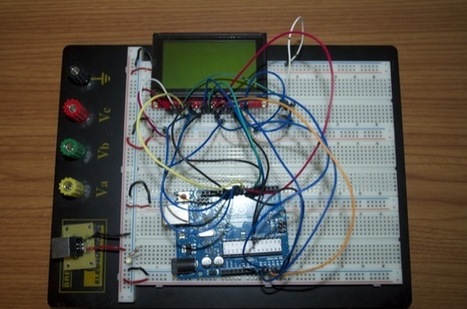
A while back I picked up a SparkFun 128x64 LCD and an Adafruit 66-channel GPS module to have a go at making a GPS clock.
Scoop.it!

NFC, or Near Field Communication, is a protocol for the contactless exchange of data between devices (such as the Android-powered Nexus S) and/or certain kinds of tags. NFC also interoperates with certain RFID tags such as the Mifare tags.
Scoop.it!

This instructable is a detailed guide on how to build an automated controller to run a motor that can operate the opening and closing of blinds. The controller enables the blinds to open and close based on a schedule, room temperature and out door luminosity. The controller settings can be set up via a web UI which enables a user to open or close the blinds manually or place them on a schedule with certain parameters.
Scoop.it!

Want to make delicious, perfectly-cooked food using a robot? Who doesn't!? This project will show you how to build your own "Sous viduino", an automated cooking pot that makes perfect eggs, succulent steaks and tender fish without the whole "slaving over a stove." All this is possible due to a recent advancement in cooking technology - instead of using a pan or pot, a "sous vide" (pronounced suu veed) machine heats the food in sort of a cross between a jacuuzi and a crock pot.
Scoop.it!
From
apcmag

Create a network-connected stereo audio player that you control via a web browser. Darren Yates shows you how with an Arduino microcontroller.
In our previous Arduino masterclass, we briefly introduced the Ethernet Shield, an Arduino expansion board that adds Ethernet connectivity plus microSD card storage. We used that storage as the basis of a simple one-button digital audio player. It was functional, but limited to 8-bit mono WAV files with a 19kHz sample rate. We also gave you the software to create those specific files. The audio quality was a bit better than AM radio level, which is good enough for audiobook and basic music playback.
Scoop.it!

From
github
OpenCV for Processing. A creative coding computer vision library based on the official OpenCV Java API
Scoop.it!

Created by Felix Worseck at the Berlin University of the Arts (Digitale Klasse), installation“parabolic soap” is a fusion of artificial / mechanical and natural behaviour. The aim of the install is to produce a paraboloid surface that can be moved for approximately 60 seconds. This minimal surface is created only after the connection of the membrane and the soap pool is broken.
|
Scoop.it!

Before A 3 months Ago , one of my friend ask me to build a Simple FM transmitter , he Would to transmit An Audio File from computer and PLAY it on any radio channel , By adjust the frequency of receiver as same as transmitter frequency
Scoop.it!

The new modules are entirely based on a CC430F5137 SOC (made by Texas Instruments). This means that microcontroller and radio front-end are now integrated into a single IC capable to provide a nice list of characteristics: - 16-bit Microcontroller with 32 KB of Flash and 4 KB of SRAM - On-board 2 KB EEPROM (I2C) - CC11XX compatible 868/915 MHz radio - Clock speed from 12 MHz up to 24 MHz, depending on configuration and targeted consumption - Six 12-bit Analog-to-Digital converters - Digital functions (PWM, UART, I2C, SPI) can be connected to any physical I/O pin - Low-power mode with RTC under 2 uA - Low-power mode with internal VLO oscillator under 1 uA - Voltage supply range starting from 2V - 128-bit AES Security Encryption and Decryption Coprocessor.
Axel's insight:
The article also mentions an important detail: "How can we work with a pure Texas Instruments solution and still keep compatibility with the Arduino fashion? The response isEnergia, an open source initiative created to port Wiring (the IDE used by Arduino) for theMSP430 family of MCU's and LaunchPad boards and also port most libraries already created for Arduino."
Scoop.it!

I just happened to see some large strips of LED lighting when I was picking up some parts at Maplin which were on sale (if I remember correct they were around £12 per approx. 2m strip) however the controller/driver was still around £40, so I thought I would just build a better one myself.
Scoop.it!

The BareDuino Nano is the world’s smallest Arduino compatible board. It was designed by a very young maker, Niek Blankers, aged 15, from the Netherlands.
Scoop.it!

An Arduino-compatible shield that allows you to monitor and control your Arduino application from an Android device. ALL WITHOUT ANDROID APP DEVELOPMENT.
Scoop.it!

Last night I picked up a Ford Mustang 1:24 Scale Radio Control Sports Car from Walmart for under 9 bucks. I’ve seen electronics enthusiasts and makers buy cheap RF cars and use parts for their projects. For example this cute Wall-E robot. I wanted to see if I could use an Arduino to control the RC car.
Scoop.it!

Most solutions to send data through Wifi with your Arduino include anEthernet shield orWifi shield.
Scoop.it!

I had just started playing with Arduino, so I thought a Dryer Messenger would be a good first project. When I ran the idea by my wife, she was enthusiastic but didn’t want me disassembling the dryer or voiding its warranty, since it was only months old. We decided to use SMS since our phones are usually nearby. Fast-forward a week or two and the dryer was texting us like a household assistant. We haven’t forgotten a load of laundry since.

ratzelster's curator insight,
July 12, 2013 7:48 AM
What a terrific story....and it illustrates the whole idea of a real life problem serving as the best starter to a project.
Thanks for writing this. I think it will be inspirational to lots of other people too.
Scoop.it!

Annnyway stand back witness a very cool project that literally took me less than an hour to prototype. And the prototype isn’t that far from the complete project. For a long time now I wanted automated window blinds, because to me, blinds are pretty useless on their own. I don’t open them when it’s sunny, and if I do, I forget to close them for privacy when it’s dark. Can’t this just happen for me? Like come on.
Scoop.it!

In this article, I will use the current monitor based on the ZXCT series IC for measuring current voltage and watts.
Scoop.it!

This Instructable will demonstrate the building of a bare bones (and really inexpensive... less than $5) Arduino compatible module that can be put together on a small piece of stripboard and can be used either on a breadboard or independently.
Scoop.it!

Exploring Arduino uses the popular Arduino microcontroller platform as an instrument to teach topics in electrical engineering, programming, and human-computer interaction. The book shares best practices in programming and design that you can apply to any project, and code snippets and schematics that will serve as a useful references for future projects even after you’ve mastered all the topics in the book.
|




