Controlling motors with an Arduino is a fun and generally integral part of the learning process for most up-and-coming embedded electronics enthusiasts. Or quite simply, using motors is fun ’cause you can make robots, tanks and stuff that moves. And thanks to Freetronics we have their new HBRIDGE motor shield for Arduinoto review, so let’s check it out and get some things moving with it.
When I was a kid my father had a panic button under his desk that was wired to call 911. While I thought this was pretty cool at the time, it later occurred to me that he had this because the neighborhood that his business was located in was a bit rough, and -- perhaps -- we were in perpetual danger. Nonetheless, I always thought the idea of having a panic button was pretty darn neat. Perhaps this notion stuck with me for so long of a time because I was never allowed to press it as a kid. It was 'off limits,' and thus a very appealing idea.
This project was my take on a DIY visual impairment aid that uses haptic and sound feedback. Basically it uses a distance sensor to measure how far objects are from it and then it beeps/vibrates accordingly (far away is slow vibrate/long beep delay and close up is fast vibrate/quick beeps). Real quick I'd like to acknowledge that I'm not the first to do something like this, but I have added many things to it that are different from designs I have seen. This isn't being used for commercial purposes but just as a guide for others to make them for people who would actually benefit from having them. The difference between this project and others is this project uses one distance sensor (as opposed to many) to make feedback more specific and simpler to interpret, use of both haptic and sound feedback, the mounting of the device under the arm and not attached to the hand (keeps it free to feel where you're going and use for daily tasks), and a few simple control buttons on the case (I also put the word for each button in braille next to them). What I really like about the design is how compact and sturdy it is. I wore it around for a few hours to get used to it and found it didn't hinder too many of my daily activities (I found it fit in sleeves too!).
The Arduino OBDCAN Shield connects Arduino board to CAN OBD-II compliant car, light truck, or motorcycle.
ISO15765-4 (CAN) protocolArduino R3 form factorStacking headers for expansion and connection to LCDJoystick control for menu navigationProvides operating voltage for the Arduino board from OBD connectorSerial port operating voltage either 3.3V or 5V, driven by IOREF pinStandard DB-9 subconnector for use with OBD-II cable.
For some Arduino projects, you don’t actually need that many IO pins. That’s exactly the case when I tried to build a simple RGB throwie that would cycle through colours. I was looking for a cheaper alternative to the Arduino UNO’s ATmega328P when I stumbled across this post by MIT’s High-Low Tech lab. They developed a library for programming the 8-pins ATtiny45/85 from the Arduino IDE. It’s a very smart solution to use permanently in some low pin-usage projects, but you still need to hook up individual wires from your programmer to the ATtiny to be able to program it. That’s when I came up with the idea of the BareDuino Micro.
How to capture and reverse engineer an infrared IR code and use an Arduino or other microcontroller to replay the command. Oscilloscope and logic analyser capture, coding, troubleshooting, tounge angle, it's all here. In this instance Dave captures the NEC (Japanese) code from his Canon video camera remote control on the digital oscilloscope, figures out all the bits and encoding, and writes an Arduino library to replay the code back, and verifies it with his Saleae Logic logic analyser.
The DIY Cellphone is a working (albeit basic) cellphone that you can make yourself. It can make and receive phone calls and text messages, store names and phone numbers, and display the time. It builds on the hardware and software in the Arduino GSM Shield but extends it with a full interface, including display, buttons, speaker, microphone, etc. The source files for the cellphone are hosted on GitHub (hardware, software), which also includes an issue list where you can file bug reports or request enhancements.
In the first article in this series, you walked through the basics of getting an Arduino device up and running with NodeJS and Johnny-Five. The second article had you connect a food-grade thermometer probe to your Arduino via a breadboard. The net result is that you can know when your steak, pork chops, tofu or other food item is done cooking, using a NodeJS application on your computer. It lights up an LED on the breadboard and tells you that the temperature has reached the desired temperature. But wouldn’t it be nice to have a little more information than just done or not done? Wouldn’t it be nice to know the actual temperature of the steak so that you can start getting other food ready just before the steak is done?
After making a 8X10 matrix a lot of people asked me about expanding the matrix to some thing bigger, and some wanted to write stuff to the matrix via a PC, so one day I looked at a pile of LEDs that I had leftover from a LED cube projected and I decided to make a bigger matrix with all the things people wanted.
So what are you waiting for? Get those LEDs out and heat up your soldering iron because we are about to make a 24X6 LED matrix!
Recently a few people have been asking about the PCF8563 real-time clock IC from NXP – so this is a tutorial on how to use it for time, date, alarm clock and square-wave generation purposes.
The PCF8563 is another inexpensive RTC that can be used with an Arduino or other platforms due to the wide operating voltage (1 to 5.5V DC), I2C interface, and very low power consumption (when powered by a backup battery it only draws 0.25 μA). If you aren’t up to speed on the I2C interface, please review the I2C tutorialsbefore moving forward. And please download the data sheet (.pdf).
This post is a narrative overview of the build process for our Fireball HD Pinball – it is a good story of what I’d call an “accidental project” that has led to lots of learning, many nights of puzzlement as we moved from one problem to the next, lots of fun as we’ve shown it to others, and occasionally a game of pinball. This story will make it all sound so simple, but the reality was much, much more difficult. Huge thanks to those who helped along the way, especially my friends at FamiLAB – if you are interested in making things, and live in Florida (or visit!), please stop by to say hi and make things with us!
One of my SD card “died” the other day. More specifically, my laptop wouldn’t read it anymore, and neither would any other machines or cameras I tried. It did react (looking at the dmesg output), but would only throw errors, and not recognize any partitons on the card. So I decided to try and read it using an Arduino.
The biggest problem with the sensor we made in the first post is that it cannot operate on battery power for any considerable amount of time. In our testing using 8 AA-batteries the sensor lasted for about 24hrs, which is not acceptable for most sensors. So, how can we make it run for longer periods of time?
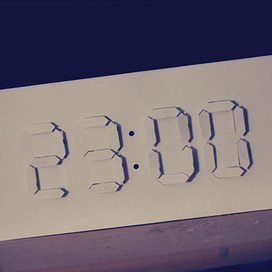
In this instructable we will be recreating a clock inspired by Alvin Aronson's original design. When I first saw this clock I was very impressed by how clean an elegant the design was I immediately wanted to recreate this effect. I hope some of you feel the same and use this as a guide to be one-step closer to having one of your own
Essentially, we have a seven segment clock where instead of LED's we have digits moving in and out of the pane, the shadow created by these digits will allow the user to read the time against the white on white digits. By using 28 servos, we can use a arduino to first process the current time and then push the digits out accordingly through the motor controller. more will be explained in the later pages.
Bootloading an Arduino with a ZIF socket allows you to easily program a lot of chips at once without worrying about mangling the pins. The reason for this is that ZIF stands for "zero insertion force," and as the name implies, ZIF sockets don't require any force to take the chip in or out. This means that you do not have to worry about any of the pins bending when you take the chip in and out of the socket. This is particularly useful if you need to bootload a lot of Arduino chips at once for inclusion in an electronics kit or if you need to repeatedly program a chip and transfer it back and forth between a separate circuit board.
An Arduino is an open-source microcontroller development board. In plain English, you can use the Arduino to read sensors and control things like motors and lights. This allows you to upload programs to this board which can then interact with things in the real world. With this, you can make devices which respond and react to the world at large.
For instance, you can read a humidity sensor connected to a potted plant and turn on an automatic watering system if it gets too dry. Or, you can make a stand-alone chat server which is plugged into your internet router. Or, you can have it tweet every time your cat passes through a pet door. Or, you can have it start a pot of coffee when your alarm goes off in the morning.
Space exploration made simple. We offer affordable satellite access with an open platform for development. Develop an experiment, an application or even a game, the sky is no longer the limit.
Cap'n ArrDrownHo! is the lovechild of Ardweeny and Boarduino and he's here to commandeer your AVR ships. ArrDrownHo! inherits pros of both and cons of neither. Pick up an AVR chip and start prototyping instantly on a breadboard! Want to replace that costly Arduino in your project with a cheap AVR, but don't know how? Use the simple plug-and-play ArrDrownHo! piggybacked onto the AVR to act as interface for programming and provide power.
If you're like me, after I got my Arduino and performed a final programming on my first chip, I wanted to pull it off my Arduino Duemilanove and put it on my own circuit. This would also free up my Arduino for future projects.
The problem was that I'm such an electronics newbie that I didn't know where to start. After reading through many web pages and forums, I was able to put together this Instructable. I wanted to have the information I learned all in one place, and easy to follow.
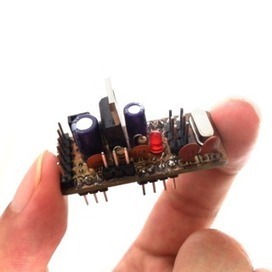
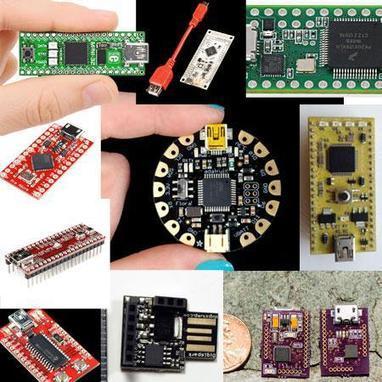
Not so long ago, the typical development board was big, bulky, and often handmade. Recently a flood of Lilliputian-size development boards has been released -- one for just about any need.
We've assembled a collection of 10 boards so small you might lose them in the cushions of your couch.
To get content containing either thought or leadership enter:
To get content containing both thought and leadership enter:
To get content containing the expression thought leadership enter:
You can enter several keywords and you can refine them whenever you want. Our suggestion engine uses more signals but entering a few keywords here will rapidly give you great content to curate.


 Your new post is loading...
 Scoop.it!