Your new post is loading...

|
Scooped by
David Connolly
October 28, 2012 2:57 AM
|
Discovery has opened new chapter in understanding maritime trade of Indian Ocean countries, say historians... A Tamil-Brahmi script inscribed on a potsherd, which was found at the Khor Rori area in Oman, has come to light now. The script reads “nantai kiran” and it can be dated to first century CE, that is, 1900 years before the present. The discovery in the ancient city of Sumhuram has opened a new chapter in understanding the maritime trade of the Indian Ocean countries, according to specialists in history. It was by chance that the potsherd was sighted. Alexia Pavan, an Italian archaeologist, had displayed the potsherd during an international ceramic workshop on “The Indian Ocean Trade and the Archaeology of Technology at Pattanam in Kerala” held in September in Kochi. P.J. Cherian, Director, Kerala Council of Historical Research (KCHR), and Roberta Tomber of the British Museum, London, had jointly organised the workshop. Pottery from several Indian Ocean countries was on display during the workshop. K. Rajan, Professor, Department of History, Pondicherry University, D. Dayalan, Regional Director, Archaeological Survey of India, and V. Selvakumar, Head of the Department of Epigraphy and Archaeology, Tamil University, Thanjavur, spotted the potsherd displayed by Dr. Pavan.
|
|
Scooped by
David Connolly
October 27, 2012 3:53 AM
|
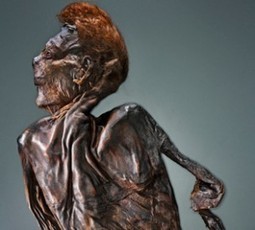
Recent bog body discoveries from Ireland, including the latest bog body from Cul na Mona, Co. Laois as well as Old Croghan man and Clonycavan man bog bodies. A nother ancient body has just been recovered from the depths of an Irish bog. This time the remains consist of a partial bog body that appears to have been covered in a leather bag (update: the leather bag may actually be the upper torso). The bog body, which may be the remains of a woman, was found just outside Portlaoise in Cul na Móna bog and is being excavated by archaeologists from The National Museum of Ireland.
|
|
Scooped by
David Connolly
October 26, 2012 2:09 AM
|
ne of the oldest Mayan tombs ever found has been uncovered in western Guatemala, say archaeologists.Located at a temple site in Retalhuleu province, the grave is thought to be that of an ancient ruler or religious leader who lived some 2,000 years ago. Carbon-dating indicated the tomb had been built between 700 and 400 BC, said government archaeologist Miguel Orrego. A rich array of jade jewels, including a necklace depicting a vulture-headed human figure, were found.
|
|
Scooped by
David Connolly
October 26, 2012 2:04 AM
|
Peter James, MD of Cintec International, has worked on projects around the globe, strengthening and restoring historically significant structures from Windsor Castle to the parliament buildings in Canada. After fourteen years working on Egypt’s historic buildings, temples and most recently, the Step Pyramid, he draws on his experience to dispel some of the more common theories surrounding Egypt’s ‘collapsing’ pyramids. Peter goes on to suggest that the gradual crumbling of the pyramids’ outer casings as the structures became unsound may have been the trigger behind moving Pharaohs’ burials from the pyramids to the Valley of the Kings.
|
|
Scooped by
David Connolly
October 26, 2012 1:53 AM
|
A team of archaeologists, paleoanthropologists, and paleoartists has created a more accurate Neanderthal reconstruction, based on a nearly complete skeleton discovered in France more than 100 years ago.
this takes a thought that no archaeologist or evolutionary scientist thought about? Who would win a fight!
|
|
Scooped by
David Connolly
October 25, 2012 2:59 AM
|
China plans to build its first vessel capable of retrieving archaeological findings from the sea by the end of 2013, a major step to strengthening the underwater search abilities of Chinese archaeologists.
|
|
Scooped by
David Connolly
October 25, 2012 2:31 AM
|
TECOZAUTLA, MEXICO.- During the excavations in Pañhu, an archaeological zone which will soon open its doors to the public in the municipality of Tecozautla, Hidalgo, archaeologists registered a burn stucco floor, evidence that its main pyramid was desacralized approximately 1,350 years ago. This coincides with an astronomical event which was thought, by its inhabitants, to be a cataclysm. Archaeologist Fernando Lopez Aguilar, director of the site’s investigation project promoted by the National Institute of Anthropology and History (INAH – Conaculta), informed that there was a solar eclipse at sunrise the 3rd of August in the year 650 AD. “To these old societies, the eclipse must have represented a catastrophe which is why they made sacrifices in order to ‘keep the star alive’, since they believed the black sun or hell’s sun had imposed on their sun ‘a giver of life’. This event generated a gradual abandonment in Teotihuacan and also had repercussions in Pañhu”, the investigator explained.
|
|
Scooped by
David Connolly
October 24, 2012 4:20 AM
|
IN a world first, laser technology has been used to clean up millennia-old Aboriginal rock art at Davies Creek, near Kuranda. And the results are going to be shown in a 52-minute documentary on Austrian, German and Swiss television next April. Jurgen Steiner, who for 17 years has worked on restoring old churches and castles in his native Austria, worked at the site in 2008 and 2009 applying a substance to harden the rock underneath. Now he has returned with a unique laser to clean up thousands of years of dirt and grime to return the ancient artwork to near to its original condition.
|
|
Scooped by
David Connolly
October 24, 2012 3:33 AM
|
Seventy years after it was scuttled off Los Angeles, Calif., government archaeologists have found the wrecked remains of a rare Pacific Coast schooner that was employed in the lumber trade during the early 1900s.Today, Robert Schwemmer, maritime archaeologist for NOAA's Office of National Marine Sanctuaries, presented a scientific paper on the George E. Billings history and its discovery in February 2011 at the eighth California Islands Symposium in Ventura, Calif. The Billings, a five-masted schooner built in 1903 by Halls Bros. of Port Blakeley, Wash., hauled lumber from the Northwest to Hawaii, Mexico, South America, Australia and southern California. After decades servicing the lumber trade it was converted into a sport-fishing barge. In 1941, the owner decided to scuttle the aging vessel off the coast of Santa Barbara Island.
|
|
Scooped by
David Connolly
October 22, 2012 3:50 PM
|
Martin Carver recreates the lives of three powerful pagan women: a privileged pagan girl from the earliest period, a 'cunning woman', and a princess buried in her bed.
Excellent series on Radio 3
|
|
Scooped by
David Connolly
October 22, 2012 9:44 AM
|
Peter James, MD of Cintec International, has worked on projects around the globe, strengthening and restoring historically significant structures from Windsor Castle to the parliament buildings in Canada. After fourteen years working on Egypt’s historic buildings, temples and most recently, the Step Pyramid, he draws on his experience to dispel some of the more common theories surrounding Egypt’s ‘collapsing’ pyramids. Peter goes on to suggest that the gradual crumbling of the pyramids’ outer casings as the structures became unsound may have been the trigger behind moving Pharaohs’ burials from the pyramids to the Valley of the Kings. My first introduction to working in Egypt was a project in Cairo’s historic old quarter, following the 1992 earthquake that caused widespread and devastating damage. Cintec International won the contract to repair and reinforce a number of badly affected structures, with work commencing in 1998. The project consisted of some 15 notable mosques and maqaads, successfully strengthened using Cintec’s patented anchoring systems. Most of the essential work was completed by early 2005, with ongoing localised repairs still being undertaken as and when required.
|
|
Scooped by
David Connolly
October 22, 2012 2:51 AM
|
Cliffside caves in the former kingdom of Mustang are giving up their secrets. The skull, a human skull, was perched atop a crumbly boulder in the remote northern reaches of the Nepalese district of Mustang. Pete Athans, the leader of an interdisciplinary team of mountaineers and archaeologists, stepped into his harness and tied himself to a rope. He scrambled up the 20-foot boulder, belayed by another climber, Ted Hesser. When he reached the skull, he pulled on blue latex gloves to prevent his DNA from contaminating the find, and gradually removed it from the rubble. Athans was almost certainly the first person to hold this skull in 1,500 years. Dirt spilled from the eye cavities. He placed it in a padded red bag and lowered it to three scientists waiting below: Mark Aldenderfer of the University of California, Merced; Jacqueline Eng of Western Michigan University; and Mohan Singh Lama of Nepal’s Department of Archaeology.
An amazing story and photographic article from the National Geographic. Taking us to the kingdom of Mustang in Nepal.
|
|
Scooped by
David Connolly
October 21, 2012 4:58 PM
|
The Richard III Society has officially thanked the team which exhumed a skeleton believed to be that of the last Plantagenet king. The society gave the project's instigator Philippa Langley its Robert Hamblin Award, which recognises "work of outstanding service" by a society member.
|
|
|
Scooped by
David Connolly
October 28, 2012 2:43 AM
|
B LONDON (AP).- /B British lawmakers are sparring over what may be left of Richard III. o one is certain yet that remains dug up last month at a Leicester parking lot are those of the monarch immortalized by William Shakespeare for his willingness to trade his kingdom for a horse. It may take months for DNA testing to determine if the body is the king's, but that hasn't stopped lawmakers in Parliament from sparring over the remains for their valuable tourism potential.
|
|
Scooped by
David Connolly
October 26, 2012 2:56 AM
|
The EARTHWATCH expedition was ENCOUNTERING THE PREHISTORIC PEOPLE OF NEW MEXICO, in early September, and we were excavating test units in the obsidian rich sites at Obsidian Valley on the preserve.
The international team of 16 Earthwatch volunteers from Singapore, the U.K and all around the U.S. was housed at the comfortable VCNP Science & Education Center in the scenic little town of Jemez Springs. The center’s cooks prepared hearty breakfasts and dinners and laid out lunch fixings to take to the field.
get involved!
|
|
Scooped by
David Connolly
October 26, 2012 2:05 AM
|
The latest project from Dassault Systèmes with the help of historians and archaeologists is the remarkable Paris 3D Saga, an interactive model that guides you through two millennia of Paris’ history. You are taken through the French capital at various stages of its’ development from 52 BC Gallic Oppida through the Roman city and on to the present day. You can witness the construction of the Bastille and Notre Dame and walk through winding stone streets in the middle ages and then visit the 1889 World’s Fair to see the Eiffel Tower just after completion.
|
|
Scooped by
David Connolly
October 26, 2012 2:00 AM
|
Tel Aviv University’s Institute of Archaeology will be conducting archaeological digs in East Jerusalem’s Silwan neighbourhod and financed by the right-wing settlement group Elad.
|
|
Scooped by
David Connolly
October 25, 2012 3:01 AM
|
HMS Dasher exploded and sank off the coast of Arran in Scotland in 1943.
Video attached
|
|
Scooped by
David Connolly
October 25, 2012 2:47 AM
|
Construction workers in Bali have discovered what is thought to be the biggest ancient Hindu temple ever found on the Indonesian island, archaeologists said.
The workers were digging a drain in the island's capital Denpasar at a Hindu study centre when they came across the remains of the stone temple. They reported the discovery to the Bali archaeology office, which then unearthed substantial foundations of a structure that the excavation team believes dates from around the 13th to 15th centuries. "We think this is the biggest ancient Hindu temple ever discovered in Bali," Wayan Suantika, the head of the team
|
|
Scooped by
David Connolly
October 25, 2012 1:48 AM
|
Aѕ thе fіrѕt capital оf Portugal аnd birthplace оf thе nation's fіrѕt king, Guimarães іѕ оnе оf thе country's mоѕt historic cities, аnd іtѕ World Heritage medieval streets wіth well-preserved monuments mаkе іt оnе оf thе mоѕt attractive places tо visit іn Portugal.
it is a good place to go an spend some time.
|
|
Scooped by
David Connolly
October 24, 2012 3:37 AM
|
Call it “Building X.” What remains of it lay, buried and long forgotten until now, beside today’s Fredericksburg City Hall where a new courthouse will soon rise. Now, thanks to intense scrutiny by archaeologists and local researchers in recent weeks, you can add this once-substantial row house to the casualties of the Battle of Fredericksburg. The Civil War’s most lopsided Confederate victory, won 150 years ago this December, not only killed or wounded nearly 18,000 men, it erased the brick structure from the town’s landscape. Excellent long and well informed piece on the excavations in house destroyed in Battle of Fredericksburg, Virginia.
hiding in a cellar, while battle raged... now read on!!
|
|
Scooped by
David Connolly
October 23, 2012 2:58 AM
|
Top ten archaeological finds in Ireland - PHOTOS...
simple as that!
|
|
Scooped by
David Connolly
October 22, 2012 3:48 PM
|
Archaeologists discovered a late Iron Age/early Roman settlement along the route of the Highway Agency’s A453 widening scheme. The team from Wessex Archaeology identified the site as a farmstead dating from the 1st century BC to the 3rd century AD. Finds from the site include the foundation of a stone building, human remains, and pots placed in pits in the ground. Remnants of household waste also survived, such as broken domestic pottery and discarded animal bone.
Wessex Archaeology have offices in Salisbury, Sheffield, Rochester and Edinburgh. We are one of the UK's leading heritage practices.
|
|
Scooped by
David Connolly
October 22, 2012 3:23 AM
|
Telltale blade sharpeners may be smoking guns in the quest for the New World's second known Viking site.
For the past 50 years—since the discovery of a thousand-year-old Viking way station in Newfoundland—archaeologists and amateur historians have combed North America's east coast searching for traces of Viking visitors. It has been a long, fruitless quest, littered with bizarre claims and embarrassing failures. But at a conference in Canada earlier this month, archaeologist Patricia Sutherland announced new evidence that points strongly to the discovery of the second Viking outpost ever discovered in the Americas. --- What a great new find! ---
|
|
Scooped by
David Connolly
October 22, 2012 2:29 AM
|
A rich history lies within the Ispartakule area of Istanbul’s Avcılar neighborhood, which has been riddled with treasure hunters for many years and is currently being eyed by Turkey’s Mass Housing Administration (TOKİ) as a desired location to build residences, according to daily Radikal. Excavations carried out by archaeologists from the Istanbul Archaeology Museum have unearthed graves and objects from the 5th and 6th centuries. The museum defines the area as the ancient city of Spradon while TOKİ’s own experts have prepared a report claiming there is no ancient city in the area.
|