Archaeologists have uncovered the remains of at least 20 soldiers killed during the First World War after a chance discovery by a group of tourists.
The bones were pulled from the earth at the scene of the destroyed village of Fleury-devant-Douaumont, in Meuse, north-east France, after hikers spotted a bone sticking out of the ground.
Many personal belongings belonging to the deceased have also been uncovered, including ammunition, rings, watches, scissors, military books and wallets
Remains found at the site of the village of Fleury-devant-Douaumont, which was destroyed during the Battle of VerdunIt is believed that the location where the men were found was a first-aid station blown apart by a German artillery shellThe Battle of Verdun was the longest and one of the most devastating battles in the history of warfare
IONA ABBEY, founded sometime prior to 1203 on the site where St Columba built his monastery in the sixth century, was built following Ranald Somerled’s invitation to the Benedictine order of monks to construct a new monastery - and the first Benedictine nunnery - on the site of the original church.
Historic Scotland has been researching the archaeology of the abbey as part of their re-presentation of the site.
In this image from around 1900, kindly provided by the RCAHMS, several ghostly figures appear to be walking across the courtyard. The result of a simple double exposure? Or is it a case of the paranormal being captured in an old photo?
Digital Dwelling at Skara Brae is a collaborative project bringing together three visualisation specialists, each with very diverse methods and mediums of working. The project was initiated following a series of discussions between PhD researchers Alice Watterson and Kieran Baxter together with Dr Aaron Watson, which established a mutual concern for the ways digital methods were shaping archaeologists’ engagement with sites and material culture.
as been reported that the Vienna archaeologist is safe and sound after he lost his way in the woods. After the 82-year old man was lost in the enigmatic forests, a search party was deployed to find him.
Game Warden Dan Christianson said that Mark Hedden was moving on the Anderson Road for about three hours before he found his way for home.
Fleshing out the details, Christianson said that Hedden and his wife were wandering in their 118 acres property and decided to separate after 11:20 a. m. Hedden wished to walk further on the property.
Archaeologists discovered the remains of a toddler in Romano-Christian-period cemetery in Dakhleh Oasis, Egypt, who showed evidence of child abuse. Here, mud bricks for two tomb structures in the cemetery. In the foreground, several excavated graves can be seen.
In particular, the so-called Kellis 2 cemetery, which is located in the Dakhleh Oasis town of Kellis (southwest of Cairo), reflects Christian mortuary practices. For example, "instead of having children in different places, everyone is put in one place, which is an unusual practice at this time," Wheeler told LiveScience. Dating methods using radioactive carbon from skeletons suggest the cemetery was used between A.D. 50 and A.D. 450.
When the researchers came across the abused toddler — labeled "Burial 519" — in Kellis 2, nothing seemed out of the ordinary at first. But when Wheeler's colleague Tosha Duprasbegan brushing the sand away, she noticed prominent fractures on the child's arms.
Janet Stephens earns a living trimming, straightening and dyeing the hair of customers seeking the latest look.
But the stylist from the US city of Baltimore is more interested in the hairdos of the past.
Stephens is a hairstyle archaeologist who specialises in recreating how women in ancient Rome and Greece wore their hair.
She spoke to the BBC about a museum visit that marked the start of a long journey of discovery on which she solved a historical mystery and had her work published in an academic journal.
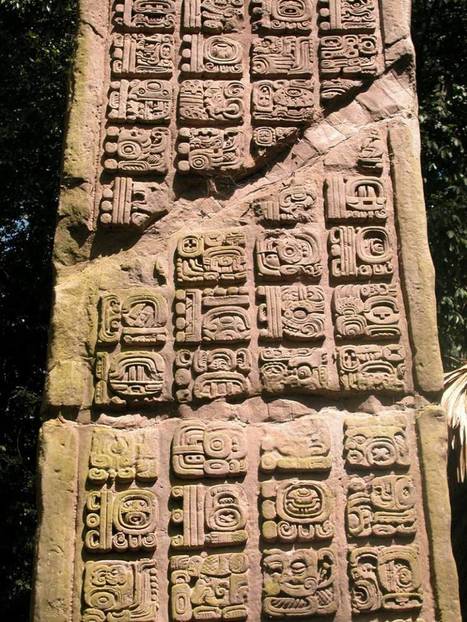
Researchers began decoding the glyphic language of the ancient Maya long ago, but the Internet is helping them finish the job and write the history of the enigmatic Mesoamerican civilization.
For centuries, scholars understood little about Maya script beyond its elegant astronomical calculations and calendar. The Maya dominated much of Central America and southern Mexico for 1,000 years before their civilization collapsed about 600 years before the Spaniards reached the New World.
The Maya script began to give up its secrets in the 1950s and ’60s, and progress accelerated in the 1970s. But much remains to be puzzled out from the immense body of carvings and inscriptions that has languished for centuries in jungle ruins and museum closets.
Enter University of Texas archaeologist David Stuart, one of the world’s leading experts on Maya script.
“I had all these boxes of notes and papers in my office, and I was never going to publish every little observation,” he said. “But I thought that if I had a blog, I could talk about new things and bring out some old stuff from my dusty files.”
So five years ago, Stuart started up Maya Decipherment, a blog for scholars and amateurs to post new inscriptions, refine translations and debate the subtleties of Maya language, all in an effort to fill out the history of the civilization.
The work will take years, but with the help of the Internet, the pace is quicker than it has ever been
Its is amazing how the internet can help us solve ancient history. if we in the modern day are able to learn whto read Maya language then we would be able to identify some of there struggles and find out about there successe.
In advance of the creation of an artisan centre in the federated districts of Bléré-Val-de-Cher, central France, archaeologists have been excavating Neolithic, Antique and Medieval remains. Among the Medieval remains, a well preserved underground refuge chamber was discovered, representing a rare archaeological find.
gulfnews.com India seeks to revive ancient seat of learning gulfnews.com Nalanda, Bihar: Flocked by thousands of scholars and thinkers from far and wide, Nalanda, the ancient seat of learning, was famed the world over as a hub of knowledge.
For centuries, merchants have traveled to the Danakil Depression, one of the hottest and harshest environments on earth, with caravans of camels to collect salt from the surface of the vast basin.
This is the first lecture in the series of 10 - 'Flodden 1513, an Introduction to Archaeology' Given by Dr Kristian Pedersen on 22 May 2013 at Crookham Villa...
Scientists have devised a new molecular technique, inspired by Celtic Knots and trees, which could be used in the treatment of multiple diseases.
Researchers at the Network of Excellence for Functional Biomaterials (NFB) in NUI Galway have discovered a new process that could be used in the industrial and medical fields.
“Polymerisation is the adding together of many smaller units,” says research assistant to the project’s leader Doctor Wenxin Wang, Ben Newland. “It is one of the most important processes in industrial manufacturing.”
The new process gives scientists a “simple method to produce large quantities of well-defined material”, which could be used in diagnostic, therapeutic and imaging processes in the body Newland says.
Research by archaeologists at the University of Southampton and the Natural History Museum Vienna will be showcased in London at a special prehistoric fashion show event – staged as part of an international Humanities festival, ‘The Time and the Place’.
Clothing and jewellery displayed on the catwalk will demonstrate findings of a three-year collaborative research project called ‘Creativity and Craft Production in Middle and Late Bronze Age Europe’ (CinBA).
When the Indiana Historical Society bought the 480 acres of farmland at the heart of what is now Angel Mounds State Historic Site in 1938, few people might have imagined what it would become.
The next five years would see the land worked like never before as hundreds of men employed by the federal Works Progress Administration dug into its mounds and fields in search of archaeological treasure.
Angel Mounds was the site of a walled city built by Native Americans of the Mississippian Culture, a network of mound-building Native Americans living throughout the Southeastern United States. It is believed to have been occupied from about A.D. 1100 to 1450.
On a blustery day in April, Italian archaeology student Marco Valeri stepped into an archaeological dig at the Cahokia Mounds.
He bent down to adjust a trowel, pointing it north to help orient a photograph of the broken pottery. A blackboard was placed in the frame to indicate the location: Collinsville, Illinois.
At its peak, Cahokia was the epicenter of ancient Mississippian culture. With a population of 20,000 in 1250 A.D., Cahokia was larger than London was at the same time. It had every marking of a large city such as population density and surplus capital: everything but writing, according to an exhibit in the visitor’s center. Now, a group of archaeologists from the University of Bologna in Italy are unearthing the mounds, trying to learn how civilizations develop political complexity.
CAIRO, May 28, 2013 (AFP). Egyptian restoration experts have managed to remove graffiti from an ancient monument after it had been defaced by a Chinese tourist, the antiquities department said on Tuesday.
Ancient sites encroached, on the verge of extinction Times of India PATNA: Several ancient sites in Begusarai, Lakhisarai, Gaya and Khagaria which could be a treasure trove for archaeological study have either been encroached or ruined due to lack...
The cultural role of the consort in the period 1500-1800 will be studied in a new project led by an Oxford University academic.
Professor Helen Watanabe O’Kelly of Oxford University’s Faculty of Medieval and Modern languages will lead the project, called ‘Marrying Cultures: Queens Consort and European Identities, 1500-1800′, in collaboration with experts in Germany, Poland and Sweden.
This work forms the basis for a reciprocal relationship between networked research hubs where ownership and control of information lies with the source,” explained Hogsden. “Although the networked content is collaboratively produced, the interpretation of digital objects differs. This is important because the Maori community views objects in a highly relational way – everything is connected to everything else – and so whereas our database is object-centric, theirs is relationship-centric. The two databases can nonetheless talk to each other and share content.”
A Turkish lawyer and film producer, Remzi Kazmaz, has sent a letter to the Queen of England Elizabeth II, demanding the return of some pieces from Bodrum’s famous Mausoleum of Halicarnassus, which are on display at the British Museum.
Kazmaz sent the letter to the Queen via the British Ambassador to Ankara and is currently waiting for a positive or negative answer to be given within the next two months, which is the official responding time.
If the Queen doesn’t send a satisfactory answer, Kazmaz says, they would apply to the European Court of Human Rights as a group of thirty lawyers.
The forts and temples of the ancient Buddhist town at Mes Aynak in Afghanistan throng with the biggest crowds they have seen in more than 14 centuries. Nearby, rows of sheet metal housing built for Chinese miners are almost empty.
Hundreds of archaeologists are working at the site to excavate gilded statues of the Buddha, elaborate stupas that rise from ornately carved floors and delicate frescoes protected by centuries of mud and forgetfulness. The rich vein of copper that once funded Mes Aynak’s creation is now likely to bring about its destruction: a Chinese state-owned mining company paid $3bn (£1.9bn) for the extraction rights, and the site will eventually become the world’s biggest copper mine.
A young tourist who scrawled his hame on the almost 3,500-year-old Luxor Temple in Egypt has drawn the ire not of Egypt but his home country of China.
The graffiti, which translates roughly as "Ding Jinhao wuz here," was etched onto the the Luxor's wall engravings with a rock. A photo of the tag was taken by a different tourist and posted on China's Twitter-like Sina Weibo microblogging site.
The photo has caused outrage in China, where only last week Chinese visitors to foreign countries received an official admonition to straighten up and fly right. There is much hand-wringing in China over the image of the country abroad and the graffiti has been highlighted as an example of why China has such a poor reputation.
11,000-year-old artefacts from Star Carr, Britain’s largest-known Mesolithic settlement, will go on display for the first time tomorrow (24 May), with the opening of a new exhibition at the Yorkshire Museum.
The 1,800-year-old Tyche Shrine in Side has been restored and opened to visitors with a ceremony attracting a number of senior figures.
Speaking at a ceremony for the shrine, Antalya Gov. Ahmet Altıparmak said it was very important to unearth cultural artifacts buried under the soil.
Altıparmak also said there were many valuable unearthed monuments and works in the region around Side. The remains are still standing but excavations need to be undertaken, according to Altıparmak.
To get content containing either thought or leadership enter:
To get content containing both thought and leadership enter:
To get content containing the expression thought leadership enter:
You can enter several keywords and you can refine them whenever you want. Our suggestion engine uses more signals but entering a few keywords here will rapidly give you great content to curate.


 Your new post is loading...