Your new post is loading...

|
Scooped by
David Connolly
July 26, 2013 4:28 AM
|
Warship, privateer, or passenger ship: The identities of three early 19th-century shipwrecks resting on the seafloor in the Gulf of Mexico (map) could be any number of things. But a group of researchers have spent the past week mapping and excavating these well-preserved finds in order to find out. Their initial target, dubbed the "Monterey shipwreck," is a copper-clad sailing vessel that came to rest in 4,300 feet (1,330 meters) of water, making it the deepest wreck currently under investigation in U.S. waters, say experts.
|
|
Scooped by
David Connolly
July 25, 2013 2:58 PM
|
Another mystery coffin has been found in a tomb next to Richard III's final resting place. Archaeologists discovered the 600-year-old casket yesterday morning. We can't really be sure about what's happened to the grave over the past 600 years, but the lid of the coffin doesn't match the rest of it and there's some damage to the mortar so it looks like it might have been opened.' The remains are encased in 5mm-thick lead. But the exposed feet, and some damage to the lead, suggest the corpse was dug up and reburied hundreds of years ago. A crucifix embellished on the lid suggests religious valuables may have been placed in the coffin but removed some time later, according to lead diggers. The team discovered the tomb containing the lead coffin last August but recovered it to concentrate on excavating Richard III.
|
|
Rescooped by
David Connolly
from Kiosque du monde : Océanie
July 25, 2013 12:55 PM
|
Recently I completed a two year project to conserve a unique Micronesian textile. It was such a pleasure to get acquainted with this very rare object with distinctive features–I was amazed to see that the colour changes in the patterned end of the...
Via musée du quai Branly - Jacques Chirac
|
|
Scooped by
David Connolly
July 25, 2013 12:01 PM
|
n collaboration with Stonepages, British Archaeological Jobs Resource and Past HorizonsHeadlines6,000 year old carved wooden post found in WalesRemains of pre-Ashokan shrines in NepalEarliest Middle Palaeolithic stone tools in IndiaVolunteers to map ancient hill forts‘New Stonehenge’ tourist attraction proposedThe world’s first calendar discovered in Scottish fieldPainted bronze excavated from central China tombsProtein analysis sheds new light on OetziMammoths may not have been hunted only for foodHarappan-era site bigger and older than Mohenjo-daro?Ancient rock art maps cosmological beliefPrehistoric flint mines discovered in PolandFarming in Iran 12,000 years ago3
|
|
Scooped by
David Connolly
July 25, 2013 6:34 AM
|
Historical ruins including a vaulted ceiling were intentionally destroyed yesterday with heavy construction equipment in İnönü Stadium, which is undergoing reconstruction, despite the Istanbul Archaeology Museums’ appointment of archaeologists to inspect the area.
The stadium is being demolished and a new one will be rebuilt 23 meters north of its current location.
However some historical ruins were demolished yesterday, despite the Istanbul Archaeology Museum’s previous notices that construction should stop if any artifacts were found.
|
|
Scooped by
David Connolly
July 24, 2013 5:31 PM
|
Several pieces of Viking jewelry, some of which contain gold, have been uncovered at a farm site in Denmark that dates as far back as 1,300 years. Although the Vikings have a popular reputation as being raiders, they were also farmers, traders and explorers, and the craftsmanship seen in this jewelry demonstrates their artistic skills. Archaeologists working with volunteers used metal detectors to find the jewelry in different spots throughout a farmstead on Zealand, the largest island in Denmark. The remains of the site, which is now called Vestervang, date from the late seventh to the early 11th centuries.
|
|
Scooped by
David Connolly
July 24, 2013 6:04 AM
|
Just as they have done for 17 centuries, the Greek Orthodox monks of St. Catherine’s Monastery in Egypt’s Sinai desert and the local Jabaliya Bedouins worked together to protect the monastery when the 2011 revolution thrust Egypt into a period of uncertainty. “There was a period in the early days of the Arab Spring when we had no idea what was going to happen,” says Father Justin, a monk who has lived at St. Catherine’s since 1996. Afraid they could be attacked by Islamic extremists or bandits in the relatively lawless expanse of desert, the 25 monks put the monastery’s most valuable manuscripts in the building’s storage room. Their Bedouin friends, who live at the base of St. Catherine’s in a town of the same name, allegedly took up their weapons and guarded the perimeter.
|
|
Scooped by
David Connolly
July 24, 2013 4:11 AM
|
The remains of the earliest European fort in the interior of what is now the continental United States have been discovered by a team of archaeologists, providing new insight into the start of the U.S. colonial era and the all-too-human reasons spoiling Spanish dreams of gold and glory.
|
|
Scooped by
David Connolly
July 23, 2013 7:13 AM
|
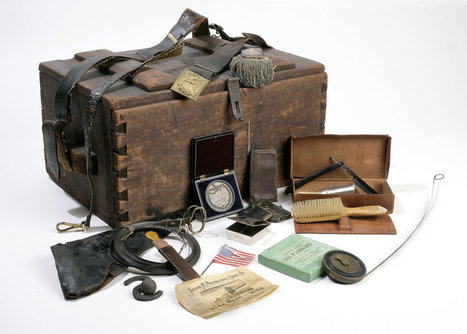
Tracing history through objects is popular these days. Neil McGregor, the director of the British Museum, did it in 700 best-selling pages, and for the last couple of months, the New-York Historical Society has had an exhibition called “The Civil War in 50 Objects.” Finding the 50 objects involves something of a scavenger hunt — they are on display in different places at the society, at 170 Central Park West, at West 77th Street. All 50 came from the society’s collection of about 1 million Civil War-era items, “a definitive record of slavery, secession, rebellion and reunion from the time these movements first roiled the city and the nation,” according to the Lincoln scholar Harold Holzer. He made the final decisions on which 50 objects were chosen, and which were not, after members of the museum’s staff had winnowed the possibilities to 75.
|
|
Scooped by
David Connolly
July 22, 2013 3:36 AM
|
Ancient Maya believed that the rain god Chaak resided in caves and natural wells called cenotes. Maya farmers today in Mexico’s parched Yucatán still appeal to Chaak for the gift of rain. Meanwhile cenotes are giving archaeologists new insights into the sacred landscapes of the ancestral Maya.By Alma GuillermoprietoPhotograph by Paul Nicklen On the edge of a small cornfield near the ruined Maya city of Chichén Itzá, in the sparse shade of a tropical tree, a voice ricochets wildly up the mouth of a well. “¡Lo vi! ¡Lo vi!” the shout proclaims. “I saw it, I saw it!” “¡Sí, es verdad! Yes, it’s true!” Leaning over the mouth of the well, underwater archaeologist Guillermo de Anda needs to make sure that this is what he has been longing to hear for so many months. “What is true, Arturo?” And his fellow archaeologist Arturo Montero, floating down at the bottom of the well, yells up again, “The zenith light! It really works! Get down here!” Then he whoops ecstatically.
|
|
Scooped by
David Connolly
July 21, 2013 2:37 PM
|
Thousands of years after their owners' mouths stopped moving forever, the teeth of Egyptian mummies are telling scientists details about their civilization. After analyzing the oxygen isotope levels in teeth recovered from the mummies, researchers at the Université de Lyon in France were able to determine that the ancient Egyptians endured an extensive period of drought. Scientists have long attempted to link the Egyptian civilization's rise and fall to changes in climate, but they've been stymied by gaps in Nile River sediment records and historical accounts. The mummy research, carried out over several years, involved drilling tiny holes in the teeth and bones of mummies housed at the Musée des Confluences de Lyon in France. Bone and enamel samples were then tested for two oxygen isotopes. Changes in the isotopic ratios showed researchers that, for a time, the region was subjected to extremely dry conditions. "Climate changes can be tracked through the oxygen isotope fractionations," the researchers wrote about their findings. "We show that [the oxygen isotope composition of meteoric waters] increased progressively from the Predynastic Period (∼5500 B.P.) to the Late Period (2550 B.P.), reflecting a decrease in the amount of precipitation at the sources of the Nile and/or an increase in temperature and evaporation." Essentially, the teeth revealed a drought spanning thousands of years, resulting from a decrease in rain coupled with temperature increases.
|
|
Scooped by
David Connolly
July 16, 2013 2:55 AM
|
Archaeological excavations in the Black Sea province of Amasya have revealed 2,000-year-old mosaics with kilim-like motifs that are believed to date back from the Roman period.
The excavations are being carried out by the Amasya Museum Directorate in the Yavru village. Officials said that the mosaics with kilim motifs were “unique
|
|
Scooped by
David Connolly
July 8, 2013 2:32 AM
|
Much of what we know about ancient Greece and Rome tends to come from films and TV. And, well, much of what we know is plain wrong. (The Romans weren't as orgy crazed as you think.... for example. ). but what else?
|
|
|
Scooped by
David Connolly
July 26, 2013 4:19 AM
|
Archaeological sites should be introduced more to tourists who visit Iceland, says the director of the Institute of Archaeology. Load could be taken off the most popular tourist attractions in Iceland by directing tourists more to archaeological sites Most of the tourists who come to Iceland visit some of the many natural wonders, Icelander do not have any large buildings from the viking age, which could be visited. Archaeological sites store the history of Iceland, they are many but not very visible to tourists. "In Iceland there are few places that are visible or known, maybe around 10 archaeological remains that travelers might consider to visit. Other remains or not known to many, but there are around 120 thousand archaeological remains in Iceland and this is therefore just a small fraction" said Adolf Fridriksson, director of the Institute of Archaeology.
|
|
Scooped by
David Connolly
July 25, 2013 1:47 PM
|
Dozens of archaeologists in white hard-hats patiently sift the reddish-brown earth in the caves of Atapuerca, searching for remains a million years old. From under strata spanning hundreds of millenia at this site in northern Spain, they unearth ancient mouse bones and the teeth of horses -- but what they most hope for is a sign of prehistoric humans that could write a new chapter in our evolution. "The site covers a very long period of time, practically from when the first humans arrived in Europe, up to the present day," says Jose Maria Bermudez de Castro, one of the directors of the dig. "If we add up all the sites found in the Sierra de Atapuerca, it covers a period from one and a half million years ago." The site, near the city of Burgos, has been under excavation since 1978. In 2000 it was classed by UNESCO as a piece of world heritage. "Most periods are represented here. That's what makes it a spectacular and unique site," Bermudez says.
|
|
Scooped by
David Connolly
July 25, 2013 12:32 PM
|
Sensing the Iron Age and Roman Past: Geophysics and the Landscape of Hertfordshire. An adventure in Hertfordshire archaeology. Menu. Skip to content. Home · About · Calendar ...
|
|
Scooped by
David Connolly
July 25, 2013 6:39 AM
|
President Vladimir Putin has formally approved a bill imposing tougher punishments on so-called "black archeologists" found guilty of stealing archaeological artifacts, a news report said Thursday. The law increases the maximum jail sentence for those found guilty of illegally acquiring archaeological artifacts or avoiding handing them over to the state from five to six years and raises the maximum fine applicable from 500,000 to 7 million rubles ($15,000 to $215,000). Despite this, the archaeologists also claimed that the law had come too late to save a considerable volume of material.
|
|
Scooped by
David Connolly
July 25, 2013 6:29 AM
|
THE ARCHAEOLOGY COMMUNITY IS in mourning after losing Professor Mike Morwood, to cancer on Tuesday. The New Zealand-born archaeologist became well-known worldwide when his research team discovered remains of the "Hobbit” species of human, Homo floresiensis, on Flores Island, Indonesia in 2004. The significance of Morwood’s discovery has been compared to the discovery of the Neanderthals in the 19th century. It caused archaeologists and palaeoanthropologists to redefine what they thought they knew of human evolution.
|
|
Scooped by
David Connolly
July 24, 2013 2:06 PM
|
Archaeologists in Bulgaria have found a Thracian temple and a sanctuary of Zeus and Hera in Sredna Gora in the central part of the country. The discovery was made at a dig in the Kozi Gramadi region near the village of Starosel in the Hissarya municipality by a team of archaeologists from the National History Museum led by Associate Professor Ivan Hristov, National History Museum director Bozhidar Dimitrov told Bulgarian media on July 22 2013. The area where the large Thracian temple as well as the sanctuary of Zeus and Hera was found covers about 50 sq m. The earliest use of the site is estimated to date from the early Iron Age, about the eighth to sixth centuries BCE
|
|
Scooped by
David Connolly
July 24, 2013 5:58 AM
|
The four temples of Bergama ancient city, Zeus, Athena Altar, Red Yard and Asklepion will be transformed into a 3D platform and visitors will have a chance to see these ancient venues via their tablets and phones. The project, which was a part of the “History comes alive in 3d” has been launched with the support of Bergama Municipality and Bilkom. The project is being launched for the first time in Turkey.
Students from the architectural faculties of Dokuz Eylül, Gediz, Yaşar Universities took part in the project.
Bergama mayor Mehmet Gönenç and Bergama Chamber of Commerce held a press conference at Tonozlu Hall and said Bergama was a very important area of heritage for the world and for Turkey, which was why the project had been launched, as well as to contribute to the cultural values of the society.
|
|
Scooped by
David Connolly
July 23, 2013 11:44 AM
|
Elizabethan craftsmen developed advanced manufacturing technology that could match that of the 21st century, claim researchers from Birmingham City University who are analysing a 400-year-old hoard of jewellery. The team from Birmingham City University have analysed the craftwork behind the famous Cheapside Hoard – the world’s largest collection of Elizabethan and Jacobean jewellery discovered in a London cellar in 1912.
|
|
Scooped by
David Connolly
July 22, 2013 12:00 PM
|
Pre-Pottery Neolithic assemblages are best known from the fertile areas of the Mediterranean Levant with most research focussed on the internal cultural dynamics of the ‘core area’ of what is known as the Fertile Crescent. The development of the Neolithic in Southwest Asia has long been seen as a pivotal phase in human evolution and history; a cultural and economic ‘revolution’, which fundamentally transformed the relationship between humans and their environments, paving the way for population explosion, a shift towards sedentary settlement and a profound change in technology.
However there has been (for a variety of reasons) less research devoted towards understanding the interactions between the core and peripheral regions.... until now!
|
|
Scooped by
David Connolly
July 21, 2013 3:34 PM
|
Working near the Temple Mount in Jerusalem, Hebrew University of Jerusalem archaeologist Dr. Eilat Mazar has unearthed the earliest alphabetical written text ever uncovered in the city. The inscription is engraved on a large pithos, a neckless ceramic jar found with six others at the Ophel excavation site. According to Dr. Mazar, the inscription, in the Canaanite language, is the only one of its kind discovered in Jerusalem and an important addition to the city’s history. Dated to the tenth century BCE, the artefact pre-dates by two hundred and fifty years the earliest known Hebrew inscription from Jerusalem, which is from the period of King Hezekiah at the end of the eighth century BCE. A third-generation archaeologist working at the Hebrew University’s Institute of Archaeology, Dr. Mazar directs archaeological excavations on the summit of the City of David and at the southern wall of the Temple Mount.
|
|
Scooped by
David Connolly
July 21, 2013 7:32 AM
|
Ancient past vs. the BPA: Archaeological site at heart of a battle for Forks ...
Peninsula Daily
The new tower would be taller, wider and require blasting to construct — which he feared would destroy the cave and its ancient art.
|
|
Scooped by
David Connolly
July 11, 2013 2:51 PM
|
When did people first begin to express their feelings with flowers? It turns out that in prehistoric times, Mount Carmel residents in what today is northern Israel buried their dead on a literal bed of fragrant wild flowers, such as Judean sage, as well as blooming plants of the mint and figwort families. Assuming they had the same positive associations with flowers that we do today, these ancient humans must have sought to ensure for the deceased a pleasant passage from the world of the living. Judean sage. Image: Gideon Pisanty(Wikimedia Commons, used under a CC BY 3.0)
The discovery is the oldest known use of flowers in grave lining. According to radiocarbon dating performed by Dr. Elisabetta Boaretto at the Weizmann Institute of Science, the graves are 11,700 to 13,700 years old.
|