Your new post is loading...

|
Scooped by
David Connolly
August 12, 2013 4:45 AM
|
The year is—let us say—1170, and you are the leader of a city watch in medieval Persia. Patrolling the dangerous alleyways in the small hours of the morning, you and your men chance upon two or three shady-looking characters loitering outside the home of a wealthy merchant. Suspecting that you have stumbled across a gang of housebreakers, you order them searched. From various hidden pockets in the suspects’ robes, your men produce a candle, a crowbar, stale bread, an iron spike, a drill, a bag of sand—and a live tortoise. The reptile is, of course, the clincher. There are a hundred and one reasons why an honest man might be carrying a crowbar and a drill at three in the morning, but only a gang of experienced burglars would be abroad at such an hour equipped with a tortoise. It was a vital tool in the Persian criminals’ armory, used—after the iron spike had made a breach in a victim’s dried-mud wall—to explore the property’s interior.
|
|
Scooped by
David Connolly
August 11, 2013 11:04 AM
|
Mammal populations shrank during three abrupt climate shifts over the past 6,000 years.
Ancient Egyptian rock inscriptions and carvings on pharaonic tombs chronicle hartebeest and oryx — horned beasts that thrived in the region more than 6,000 years ago. Researchers have now shown that those mammal populations became unstable in concert with significant shifts in Egypt’s climate. The finding is based on a fresh interpretation of an archaeological and palaeontological record of ancient Egyptian mammals pieced together more than a decade ago by the zoologist Dale Osborn1. Thirty-eight large-bodied mammals existed in Egypt roughly six millennia ago, compared to just eight species today. “There are interesting stories buried in the data — at the congruence of the artistic and written record,” says Justin Yeakel, an ecologist at Simon Fraser University in Vancouver, British Columbia, who presented the research this week at the annual meeting of the Ecological Society of America in Minneapolis, Minnesota. For example, the philosopher Aristotle said 2,300 years ago that lions were present, though rare, in Greece; shortly thereafter, the beasts appeared in the local art record for the last time, Yeakel says.
|
|
Scooped by
David Connolly
August 11, 2013 3:52 AM
|
FOR 2000 years the ancient and decomposing hulk lay buried in deep, muddy waters, off the Italian coast. Everybody knew it was down there because for more than 80 years local fishermen had been collecting bits of Roman artefacts and pots in their nets. Finds of this nature are not unusual in Italian waters, which are littered with treasures going back thousands of years.
|
|
Scooped by
David Connolly
August 10, 2013 9:49 AM
|
Visitors to Lynn Museum can now buy a rather unusual souvenir from the gift shop.
|
|
Scooped by
David Connolly
August 8, 2013 4:41 PM
|
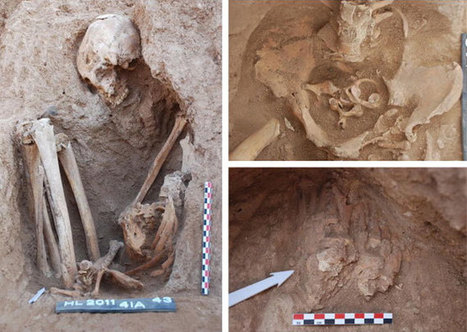
Taphonomy is the study of how organisms decay and become altered following their death. Understanding how this process manifests in human burials during the excavation is extremely important, and can lead to improved interpretations of the burials when carried out properly.
|
|
Scooped by
David Connolly
August 6, 2013 3:50 PM
|
Over 5.5 thousand years old brewing installation discovered by Polish archaeological mission at Tell el-Farcha in Egypt has been reconstructed in 3D by Karolina Rosińska-Balik, PhD student at the Jagiellonian University Institute of Archaeology. "The presented reconstruction is a hypothetical assumption based on preserved structures of similar analogous buildings at both Tell el-Farcha and other brewing centres in Upper Egypt" - reserved the archaeologist. The installation consists of three vat pits and measures about 3.4 by 4 m. The entire structure, with plan reminiscent of a three-leaf clover, was surrounded by a wall with a height of up to 60 cm. Vat pits were also separated from each other with low, narrow walls. In order to stabilize the vessels used for brewing beer, base was used in the form of a solid clay, which was surrounded by a clay ring with a clear break.
|
|
Scooped by
David Connolly
August 6, 2013 2:25 PM
|
A community group wants to analyse the bones exhumed from a graveyard in Hampshire to see if they belong to King Alfred the Great. Archaeologists removed the remains from an unmarked grave at St Bartholomew's near Winchester earlier this year.
|
|
Scooped by
David Connolly
August 5, 2013 8:11 AM
|
In Turkey, there appears to be a policy of illegal non-employment of archaeologists in order to ensure the non-recovery and non-documentation of politically-unacceptable cultural heritage. That is to say that the state seems to violate its own law, which requires the employment of archaeologists for the assessment of development work and the performance of cultural heritage work. This violation prevents archaeologists from prohibiting culturally-destructive activity and excavating and recording material which is evidence of politically-inconvenient pasts. So when repression provoked democratic resistance in Turkey earlier this year, archaeologists were on the front line as victims of government policy and police brutality and as advocates of real democracy. The first protester hospitalised at Gezi Park was an archaeology student, Hazar Berk Büyüktunca, and both unions and autonomously-organised platforms went to the occupations and squares to resist out of professional responsibility.
|
|
Scooped by
David Connolly
August 5, 2013 3:31 AM
|
More than 4,000 years ago, Dilmun merchants traveled from Mesopotamia to the Indus River, titans of trade and culture before rise of the empires of the Persians or the Ottomans Over a millennia, the civilization that Dilmun created on the back of trading in pearls, copper and dates as far as South Asia faded into the encroaching sands. It wasn't until an excavation by Danish archaeologists in the 1950s that its past was rediscovered. Now, with Bahrain in a deepening political crisis between its Sunni rulers and majority Shiite population, the connection to ancient Dilmun is one of the few unifying symbols on the island. It also is a rare and vivid look at pre-Islamic life in a region with few sites celebrating cultures before the time of the Prophet Muhammad.
|
|
Scooped by
David Connolly
August 3, 2013 5:45 PM
|
FOR archaeologists like me, the Flowerdew Hundred Plantation near Williamsburg, Va., is our Woodstock, a sentimental spot where dozens of professionals earned their trowels. The farm’s incredible archaeological wealth ranges from 12,000-year-old Native American tools to a tree that shaded Union soldiers in June 1864. Imagine our dismay, then, when a professed “relic hunter” from Texas named Larry Cissna sold some $60,000 in tickets for his Grand National Relic Shootout — an artifact-hunting competition — at Flowerdew Hundred. The shootout took place in early March, and participants walked away with 8,961 artifacts dating from the Civil War or before. In Virginia, as in many states, relic hunting is illegal on public land, but legal on private land. Flowerdew, it turns out, belongs to the James C. Justice Companies, whose chairman, president and chief executive is James C. Justice II, whom Forbes ranks as the 882nd-wealthiest individual on the planet. (According to a spokesman, Mr. Justice was unaware of the “shootout.”) Paid hunts like this have increased in the last 15 years, fueled by the market for Civil War relics, where a rare button can bring $5,000. Mr. Cissna has built a small empire using a Web site to organize hunts and sell advertising, a job that became easier in June when the Travel Channel began airing his reality show, “Dig Wars.”
|
|
Scooped by
David Connolly
August 3, 2013 10:39 AM
|
Grumpy Cat, Shocked Cat, Lil Bub – their images are the currency of the web, passed between friends, family, and co-workers. When they go viral, funny cat pictures heal daily drudgery with a dose of furry, cuddly cheer. But, in terms of the reverence they receive, these cats are hardly the first of their kind. Ancient cultures had cat memes too, and archaeologists have their own term for them: feline motifs. The word meme, itself a meme, feels ultra-modern, but was coined in the 1970s by Richard Dawkins to refer to any non-genetic unit of replicated information. And it would be chronocentric to presume this term applied only to the proverbial Caturdays following its contemporary articulation. Some archaeologists, known as evolutionary archaeologists, incorporate memetics into their explanations of cultural transmission and change. In their view, cultural evolution, or the speciation of different cultures, happens by selective forces acting on cultural memes, motifs and styles. We can look back about two thousand years and see cat memes on objects made in the Americas before Columbus set boot here. In fact, the feline motif is a powerful point of acccess to Pre-Columbian cultures, as it was a common from the Mississippi to the tip of South America.
|
|
Scooped by
David Connolly
August 3, 2013 5:53 AM
|
The Rothwell Charnel Chapel and Ossuary Project has been established between the Department of Archaeology, at the University of Sheffield and Rothwell Holy Trinity Church, Northamptonshire. The church houses one of only two known surviving and in situ medieval ossuaries in England.
|
|
Scooped by
David Connolly
August 2, 2013 6:59 AM
|
The ritualistic shield, dating back some 1,300 years, was made by the Moche people and provides evidence that the Moche may have engaged in ritualized battles like gladiatorial combat. Made by the Moche people, the rare artifact was found face down on a sloped surface that had been turned into a bench or altar at the site of Pañamarca. Located near two ancient murals, one of which depicts a supernatural monster, the shield measures about 10 inches (25 centimeters) in diameter and has a base made of carefully woven basketry with a handle. Its surface is covered with red-and-brown textiles along with about a dozen yellow feathers that were sewn on and appear to be from the body of a macaw. The shield would have served a ritualistic rather than a practical use, and the placement of the shield on the bench or altar appears to have been the last act carried out before this space was sealed and a new, larger, temple built on top of it. [See Photos of the Shield & Ancient Murals]
|
|
|
Scooped by
David Connolly
August 12, 2013 4:31 AM
|
Margalit Fox’s deft, sharply written account of the cracking of Linear B (the earliest Greek script) has a trio of flawed heroes. They are Arthur Evans, the British archaeologist who, in 1900, discovered tablets covered with the mysterious ancient writing at Knossos on Crete; Michael Ventris, the architect and inspired linguist who, having set himself the task of solving the riddle as a teenager spectacularly did so in 1952, only for his mental state to crumble; and a third, whose story has been, until now, scarcely known. Alice Kober was the unassuming, overworked and ferociously clever Brooklyn classicist whose life was cut short in 1950 at the age of 43 as she came frustratingly close to unlocking the secrets of the Minoan script.
|
|
Scooped by
David Connolly
August 11, 2013 11:00 AM
|
Council workers have discovered 700 year old human skulls and bones as they dug up a new site. At least three human skulls, and an assortment of human and animal bones were discovered close to the surface when workers dug up the site on Nicholas Street in Limerick city. The area is the historic old quarter of the city where the Vikings landed in the 10th Century. Brian Boru, High King of Ireland during the 11th Century, is also reputed to have resided in a castle adjacent to where the skeletal remains were found. St Mary’s Protestant Church now lies on the old castle grounds at Merchants Quay. Workers were digging the area up to make way for a new walkway for pedestrians to access the riverfront. Aegis Archaeology, a private company based on Nicholas Street, had been supervising the dig, in case any historical finds were discovered.
|
|
Scooped by
David Connolly
August 10, 2013 11:02 AM
|
Some 1,200 years ago, a prominent Moche woman was laid to rest with great pomp and ceremony. Now archaeologists have uncovered her tomb along with clues that testify to her privileged status and the power she once wielded. The discovery—made over the last couple of weeks at the site of San José de Moro in the Jequetepeque River valley of northern Peru—is one of several that have revolutionized ideas about the roles women played in Moche society. In about A.D. 750 this revered woman was buried in a large chamber some 20 feet (6 meters) beneath the ground. The earthen walls of her tomb were painted red, and large niches held offerings of ceramic vessels. Two adults, presumably sacrificed female attendants, were buried with her along with five children. (See video of a Moche tomb.)
|
|
Scooped by
David Connolly
August 10, 2013 4:48 AM
|
A ship that served both for trade and as a warship in the ancient city of Phaselis in the southern province of Antalya will be reconstructed by Akdeniz University
|
|
Scooped by
David Connolly
August 6, 2013 4:28 PM
|
One of the world’s oldest religions, Zoroastrianism originated amongst Iranian tribes in Central Asia during the second millennium BCE and spread to Iran where it became the principal faith until the advent of Islam. Central to the religion is the belief in a sole creator god, Ahura Mazda, his agent Zarathustra (Zoroaster) and the dichotomy between good and evil. The Everlasting Flame: Zoroastrianism in History and Imagination to be held at the Brunei Gallery, School of Oriental and African Studies (SOAS) in London, is the first exhibition of it’s kind to provide a visual narrative of the history of Zoroastrianism, its rich cultural heritage and the influence it has had on the major world religions of Judaism, Christianity and Islam.
|
|
Scooped by
David Connolly
August 6, 2013 3:49 PM
|
Sliven. Archaeologists discovered a rich Thracian grave from the 1st century AD in a mound in the municipality Sliven in south-eastern Bulgaria.
|
|
Scooped by
David Connolly
August 5, 2013 8:12 AM
|
Over the weekend Jen-Luc Piquant found herself pondering the works of Herodotus, specifically the tale of the Lost Army of Cambyses. Sometime around 524 BC, priests at the oracle of the Temple of Amun decided they didn’t much care for their new ruler, Cambyses II, son of Cyrus the Great. Cambyses decided that he didn’t much care for their insubordination. And he had soldiers — 50,000 of them, sent marching through the Sahara from Thebes to put those rebellious priests in their place. But they never reached their destination (the Oasis of Siwa, where the mutinous temple was located). Seven days into their march, a massive sandstorm broke out and buried Cambyses’ entire army, never to be seen again. Per Herodotus: “A wind arose from the south, strong and deadly, bringing with it vast columns of whirling sand, which entirely covered up the troops and caused them wholly to disappear.”
|
|
Scooped by
David Connolly
August 5, 2013 3:36 AM
|
A HEXHAM archaeologist has challenged perceived wisdom with startling claims that Hadrian’s Wall was originally built of wood. In a 65,000 word thesis published on his website, Geoff Carter says his hypothesis answers some age-old questions. Archaeologists have long wondered why the ditch that runs parallel is several feet away from the Wall itself, reducing its effectiveness as a deterrent to invaders. They also question why the ditch curves inwards towards each of the milecastles. The answer, says Mr Carter, is that the ditch was originally dug at the foot of a timber wall that was put up as a temporary measure. The temporary wall ran between each of the milecastles, providing a swift means of defence against marauding Scots while auxiliaries built the permanent stone wall behind.
|
|
Scooped by
David Connolly
August 5, 2013 2:29 AM
|
nce upon a time… about half an hour ago actually, we (Paul, Stef and Ceris) witnessed the magical wonders of archaeological photography. Before our enlightening experience we knew less about cameras than a fish knows about a tropical tree. As we believe our pictures show we are now experts in the field of handling very expensive fancy cameras. We learnt there is more to life than pointing and clicking! There are ways of making your pictures actually look good! By (if you did not know before) simply altering your aperture and shutter speed! AMAZING!
|
|
Scooped by
David Connolly
August 3, 2013 10:43 AM
|
Archaeologists have identified for the first time the full extent of a convicts’ mass grave on what was once a notorious concentration camp-style prison in Cork harbour. The Spike Island Archaeological Project team, led by UCC archaeologist, Dr Barra Ó Donnabháin, has identified up to 250 previously unmarked burial plots, all dating from Famine times, within a walled cemetery area on Spike Island in Cork Harbour.
“We have always known that this area contained graves but we never knew how many,” Dr Ó Donnabháin said.
“There were about 11 headstones in this area, all dating from 1862, but which are not now in their original locations.
“Following geophysical analysis, we identified four or five rows with about 50 individual graves in each.”
|
|
Scooped by
David Connolly
August 3, 2013 9:00 AM
|
A timber post used by people to help them across the boggy marshes of the Waveney Valley more than 2,000 years ago has gone on display at a local museum. The timber posts were discovered by workmen undertaking a flood defence scheme close to the River Waveney at Beccles in 2006. At first they were thought to be a relatively modern feature because they were so well preserved. However, when archaeologists were called in they were able to confirm that the timbers were from a much earlier construction. In further digs during 2007 and 2009, archaeologists from Birmingham University managed to remove the posts.
|
|
Scooped by
David Connolly
August 2, 2013 12:09 PM
|
With one eye on recording Scotland’s ancient history and another on the ground, Dave Cowley is the Indiana Jones of the skies. He is aerial survey projects manager with Royal Commission of Ancient and Historical Monuments of Scotland (RCAHMS) and he and his colleagues make 40 to 50 trips a year in a four-seater Cessna to record rare glimpses of the past. And this hot, dry summer has provided the best conditions in years to see crop marks, which reveal evidence of ancient settlements long lost to modern agriculture methods. While farmers rue the arid weather, Mr Cowley said now is the time to take to the air and survey “the glorious detail” of Roman forts and Iron Age camps “lost” since the 1970s.
|