
Aprendiendo a Distancia
109.9K views |
+21 today


Colaborando para una mejor educación en línea para adelantar la evolución de la enseñanza y aprendizaje usando la tecnología y pedagogía como estrategias.
Curated by
Alfredo Calderón
 Your new post is loading...
 Scoop.it! 
Si bien la premisa de la educación online es masificar los conocimientos, una experta en Marketing explica que en realidad este tipo de formación no está al alcance de todos. Conoce los detalles 
Scoop.it!

e-learning, conocimiento en red y web colectiva
Scoop.it!

Noticias dirigidas a los actores de los procesos educativos, culturales, científico y de innovación tecnológica. Información para docentes, investigadores, alumnos y padres de familia.
Scoop.it!

Whether you are looking for resources on integrating science, technology, engineering, and math or on infusing the arts to transform STEM into STEAM, this curated compilation will help you strategize around different approaches to integrated studies. Via John Evans
Scoop.it!

Training enhances skills and abilities of employees to be aligned to changing business needs. It is well understood that assessments are vital components o
Scoop.it!

Wondering about online facilitation? Check 5 top tips for Online Facilitators that may help them run their online courses effectively.
Scoop.it!

The Internet poses to us an active challenge to deeply reconsider what it means to be literate in the twenty-first century.
Scoop.it!
This is "Presentación Higher Education in the World 5 web" by guni on Vimeo, the home for high quality videos and the people who love them. Via Raquel Zabala, juandoming
Scoop.it!

We can interpret the rise in production value of MOOCs as a sign of what's to come for all of online higher education, or as merely an aberration - a by-product of the one-upmanship that characteri...
Scoop.it!

From fireflies to humpback whales, learn about animals and the scientists who study them.
Scoop.it!

A new application programming interface promises to enable education developers to introduce scoring analytics into simulations, games and other open-ended assessment items and digital learning objects.
Scoop.it!

La Escuela Invertida (en inglés: Flipped School) es una forma de aprendizaje semipresencial donde los alumnos aprenden los conceptos en casa viendo vídeos educativos en línea y los ejercicios que anteriormente eran realizados en clase, se convierten ahora en tareas llevadas a cabo en casa. De esta manera, tanto los profesores como los alumnos interaccionan para la resolución de problemas más personalizados.
|
Scoop.it!

Digital technology has the potential to dramatically expand access to education to underserved children worldwide.
Scoop.it!

George Siemens is a key innovator in higher education, having coined the term “MOOC” and worked to study the effectiveness of online learning. So it’s no surprise that he was invited to a recent closed-door gathering at the White House to discuss “innovation and quality in higher education.” Though he isn’t able to divulge details of what transpired, he wrote about the meeting on his blog, in a post filled with strong feelings about some of what he heard there. The post uses such words as “stunned,” “exceptionally irritated,” and “disappointed.” His frustrations ran in all directions. Some leaders in higher education, he wrote, remain uninformed about “what’s brewing in the marketplace as a whole” — such as shifts in demand for education and the emergence of “code academies” — which will change higher education “dramatically.” And some for-profit players are unnecessarily “antagonistic” to higher education, he argued, failing to recognize that colleges serve other missions beyond operating efficiently, like educating well-rounded citizens and broadening access to education in underserved communities.
Scoop.it!

A Definition Of Web Literacy (And How Students Can Benefit)
Scoop.it!
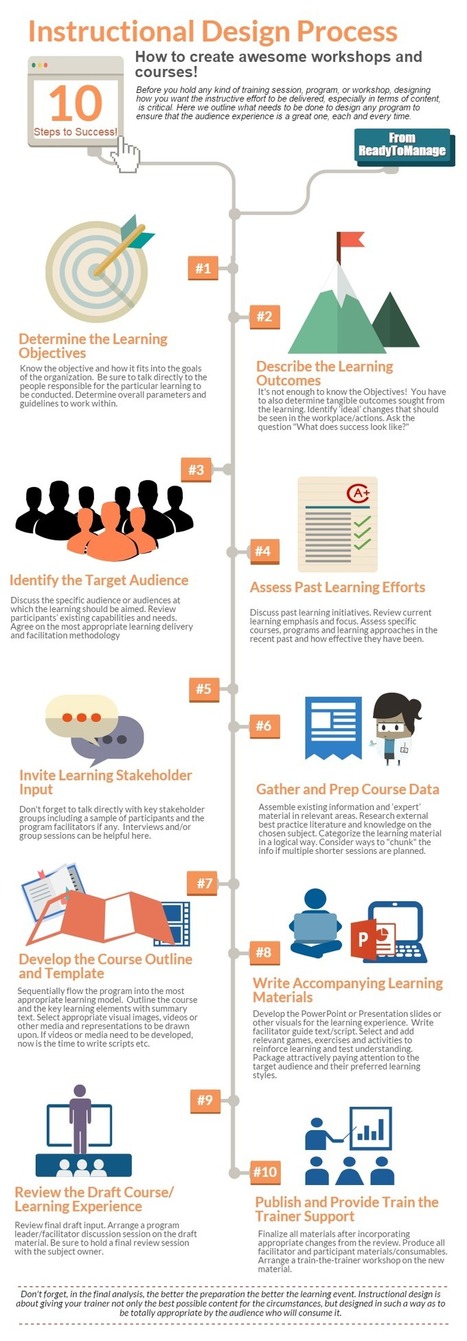
Why is Well-Thought Through Instructional Design More Important than Ever in the Modern World? Via Mark E. Deschaine, PhD

Florence Gilzene-Cheese's curator insight,
August 6, 2015 1:39 PM
Interesting, in the future of education instructional design must be flexible enough to accommodate the rapid growth of technology and the changes in content while covering the learning process and Curriculum needs. 
Ellen Dougherty's curator insight,
August 8, 2015 8:48 PM
Why is Well-Thought Through Instructional Design More Important than Ever in the Modern World?
Learn more:
https://gustmees.wordpress.com/2014/10/03/design-the-learning-of-your-learners-students-ideas/

Dennis Swender's curator insight,
August 10, 2015 11:55 AM
Why is Well-Thought Through Instructional Design More Important than Ever in the Modern World?
Learn more:
https://gustmees.wordpress.com/2014/10/03/design-the-learning-of-your-learners-students-ideas/
Scoop.it!

Howard Gardner desarrolló su famosa teoría de las Inteligencias Múltiples donde nos explica que no tenemos una sola capacidad mental, sino varias. ¿Quieres saber qué tipo de inteligencia o inteligencias dominantes tienes? Averígualo con este sencillo test.
Scoop.it!

With a little planning ahead, even a beginner can make decent eLearning infographic. Here's how!
Scoop.it!

¿Quieres crear un blog? Es mas sencillo de lo que crees. Aquí te explico cómo hacerlo.
Scoop.it!

En estos tiempos de desencuentros, repensar la pedagogía desde otra perspectiva, no solo parece útil sino urgente. Pronunciamientos del prof. Javier Abad, espa…
Scoop.it!
Abstract
Motivation is the drive to will and desire to succeed or achieve something. Motivation in this treatment refers to when the lecturers feel the motivation in using online teaching tools in the classroom. Self-motivation of lecturers to change their teaching styles or methods is one of the problems stated by few researchers. The objective of this paper is to identify the factors that motivate lecturers to use online teaching tools, such as Web 2.0 tools. There are a variety of online teaching tools available to the lecturers. The popular tools are online whiteboard, WordPress, YouTube, Facebook, Edmodo and others. There are not many lecturers who apply the Internet as an alternative to provide access to information that can help to enhance teaching and learning materials. An evaluation of the lecturer's motivation had been completed by 30 lecturers from different subject matter experts. The instruments used were interview sessions and classroom observation, which were used to measure four motivation variables: ease of use, enjoyment, usefulness and self-confidence, based on the ARCS Motivation model. Based on the findings, factors that can affect lecturers’ motivation in using online teaching tools are knowledge, perceptions and skills.
Scoop.it!

Public health has a long and distinguished visual record. From seventeenth-century engravings to the latest digital images, visual representations have played a critical role in educating the public about modern health crises. But what purposes do these images serve beyond their immediate role in disease prevention and health education? What do they tell us about the history of health care, or attitudes toward our bodies, or the world that we live in? As part of its Profiles in Science project, the National Library of Medicine has digitized and made available over the World Wide Web a historical exhibit of Visual Culture and Health Posters for use by educators and researchers. This Web site provides access to the posters selected for inclusion in an exhibit designed for the NLM sponsored "Visual Culture and Public Health" symposium, held on October 16-17, 2003. Individuals interested in conducting research in the Visual Culture and Health Posters are invited to contact the National Library of Medicine. This online Exhibit is designed to introduce you to the history of the Visual Culture and Health Posters in the twentieth century. It is divided into sections that focus on the subjects covered in the collection. We suggest that new visitors begin with this exhibit, which includes a small selection of visuals. Each section begins with a "Background Narrative," which leads to "Visuals." Visitors may access additional materials through Search on the navigation bar. They may also view the materials alphabetically or chronologically by choosing Browse on the navigation bar. Visuals in these lists are arranged by format and then either alphabetically by title or chronologically.
Scoop.it!

This post was written jointly with Katia Hildebrandt and also appears on her blog. Recently, we presented at OER15 in Cardiff, Wales, on the topic of developing a framework for open courses. In our...
|






