 Your new post is loading...
This presentation uses the same slides as the presentation delivered in Banff in April, and the text of which may be found here. The context is updated a bit b…
Via juandoming
By Brian Stack & Tyler Nakatsu - How a New England Principal is working to support teachers with meaning opportunities that support competency education.
Via Ramiro Aduviri Velasco, juandoming

|
Scooped by
Alfredo Calderón
August 23, 2015 6:04 AM
|
After a long and happy life a teacher passes away but due to a disappointing clerical error stands before Beelzebub ready to hear what
fate awaits in eternity. ‘You shall create a curriculum’ cries the dark lord. ‘It will capture the mood of the people, utilise all that we
understand about education and learning, it will prepare students for an unknown future, provide teachers with clear guidance on what they should
teach but will not be too lengthy, overcrowded or disempowering. It will be simultaneously coherent and flexible ensuring every child receives the same individualised education that they are entitled to. This single document
will meet the needs of the government, industry and both religious and special interest groups while appearing entirely apolitical. It will save
the nation from poverty, create economic stability and bring unity and cohesion. Once complete it will be the subject of ongoing review and
criticism and you will be singularly blamed for every child who slips through the gaps, every despondent teacher and at the next election your
work will be replaced by an entirely new curriculum that is in every respect exactly the same as yours.'
It is a wonder that anyone would ever want to be involved in writing a curriculum. 'Curriculum is a contentious and messy field’ wrote Jackson in
the ‘Handbook of research on curriculum’ in 1992 and since then there have been few changes for the better. Today the curriculum of any actions seems to be under increased pressure and faces demands that cross state and
national boundaries. Ken Robinson has described the effect that international tests such as PIRLS (Progress in International Reading Literacy Study) and the high profile PISA (Programme for International Student Assessment) have had on education. These tests bring with them the
opportunity for nations to compare their educational systems in ways that did not easily exist in the past. With these international tests has come a realisation that some educational systems perform better than others and
as the go to response of governments is either curriculum reform or teacher blaming it is no surprise that we are seeing a movement to reimagine the curriculums that will guide our students into their future.
But curriculum is a messy field and making changes to it carries risks; it is easy to get it wrong and the evidence so far from national Curriculums developed in recent times is that this is what is happening. Tim Oates in 2011 wrote a comprehensive review of the National Curriculum in England the title of which left little doubt about his thoughts on the subject, ‘Could do better: using international comparisons to refine the national Curriculum in England’. According to Oates the need for review was quickly
identified and a process of introspection became the norm 'This introspection was perpetuated by rapid recognition of the need to review the National Curriculum in the face of obvious curriculum overload – it was simply too big’ (Oates 2011 p 124). Oates goes onto argue that the response should have been to look to high-performing international systems for guidance. Had England done this they may have noticed that much of the success of these high-performing systems came not from the curriculum in a traditional sense but from a commitment to providing a coherent curriculum
through highly competent teachers. ‘A well-defined and enhanced National Curriculum is a necessary but insufficient condition for ensuring that the performance of the English system approaches that of the leading nations –
policy needs to be formulated in respect of other ‘control factors’ such as teacher expertise, teaching quality, learning materials and inspection.’ (Oates 2011 p 143)
What is striking from Oates’ review of the English National Curriculum is his focus on the changes required to the system and not just the
curriculum. 'Greater problems will most likely be created by expecting too much of a National Curriculum’. The poster child of recent years in
education is an example of a nation that has achieved success not through isolated or short lived changes but through long running systemic shifts.
As Oates identifies much of Finland’s current success is due to the changes introduced there in the 1960s. Moving to a teacher population where a Master’s degree is the norm is not a change that may be introduced quickly
and while this improvement in teacher quality was underway tight controls were put in place. Borrowing pieces of the Finnish system will not ensure transferable results.
There parallels with the Australian National Curriculum are also apparent in Oates’ writing. In the foreword to Oates’ article reviewing the then two decade old national Curriculum there is mention that Australia is looking to modernise its curriculum offering. The process of developing the Australian National Curriculum has been led by ACARA (Australian Curriculum, Assessment and Reporting Authority) as the body which writes the national curriculum which is then implemented by Sate and Territory bodies such as BOSTES (Board of Studies, Teaching and Educational Standards). To date syllabus documents have been implemented for English,
Mathematics, Science & Technology, History (compulsory in 2016) and Geography (compulsory in 2017). Despite the reality that only parts of the new curriculum have yet been implemented there are already calls for review.
Most recently the Federal Minister for Education, Christopher Pyne has called for the curriculum to be trimmed, criticising its present form as
overcrowded. Only weeks after its release to school’s in New South Wales the Geography syllabus is to be merged with the also new History syllabus and yet to be seen syllabus for Civics & Citizenship and Economics into one
Social Science syllabus if Mr Pyne has his way. More than just addressing the overcrowding the Education Minister has called for a review of what is taught particularly in the area of History where according to the Sydney Morning Herald reporter Matthew Knott ‘When Mr Pyne announced the review he said he wanted the curriculum to be more "balanced", including a greater focus on the benefits of western civilisation and the teaching of Anzac Day.’ This all leaves one wondering what schools should be teaching from at present and how far they should proceed with implementing a soon to be
revised syllabus. However, the submission to the recent ACARA led review of the curriculum by BOSTES NSW provides a level of confidence in the curriculum as it stands ‘Future curriculum development processes by ACARA should recognise and respect the legislative imperatives within jurisdictions and lessons learned by the Australian Curriculum process.’ and 'In addition, as previously indicated, ACARA does not have a recognised status with schools in NSW regarding curriculum content.’
Both the National Curriculum of England and Australia are indicative of curriculum as content heavy documents that indicate what should be taught. Against this view of curriculum is that originated in the writing of Freire in ‘Pedagogy of the oppressed’ dating back to 1970. Freire and other proponents of ‘critical pedagogy’ indicate problems inherent in the curriculums resulting from the neoliberal tradition which overemphasises the utility of education to industry and societal norms. Geraldine
Ditchburn of Murdoch University argues that while the Australian curriculum overtly appears egalitarian, pragmatic, positive and defensible it is based on an assumption that 'that content is constructed according to a checklist, intended to be digested by all in one stage, without revisions
or refinements’ (Ditchburn 2012 p353), 'that curriculum is a mono-dimensional process where decisions about what should be taught are
separate from how they should be taught and to whom’(Ditchburn 2012 p355) and ‘that the curriculum is being designed separately from the audience for whom it is intended.’ (Ditchburn 2012 p356). Ditchburn suggests an alternate model for curriculum development that while enticing may do little to tidy the field but is a model worth pondering.
An alternative narrative, however, begins not with global dictates, but with the needs, lives and experiences of students. This is its starting and
end point. It values democracy and as a result, accommodates and encourages participation, voice and agency; it understands curriculum knowledge as an immanent construct emerging from the lives, experiences and uncertainties
of students who live in diverse worlds; and it supports teachers to be critical risk takers who are encouraged to explore how to construct
knowledge and make meaning for themselves and their students. (Ditchburn 2012 p358)
Oates, T. (2011). Could do better: using international comparisons to refine the National Curriculum in England. Curriculum Journal, 22(2),
121-150.
Ditchburn, G. (2012). The Australian curriculum: finding the hidden narrative?. Critical Studies In Education, 53(3), 347-360.
|
|
Scooped by
Alfredo Calderón
August 21, 2015 10:57 AM
|
|
|
Scooped by
Alfredo Calderón
August 21, 2015 10:55 AM
|
The massive company has sold off two major media companies as it doubles down on education.
|
|
Scooped by
Alfredo Calderón
August 21, 2015 9:51 AM
|
|
|
Scooped by
Alfredo Calderón
August 21, 2015 9:03 AM
|
Moodle es un software libre y de código abierto, lo que significa que respeta la libertad de los usuarios y la comunidad para ejecutar, copiar, distribuir, estudiar, modificar y mejorar el software. Es decir, el «software libre» es una cuestión de libertad, no de precio, como se explica en la web del Proyecto GNU.
|
|
Scooped by
Alfredo Calderón
August 21, 2015 7:29 AM
|
New science resources for teachers and students, especially young learners, is forming the cornerstone of a new partnership between PBS LearningMedia and the Smithsonian Science Education Center. At the center of the partnership: an animated series called Good Thinking!, available online, that features science educator Isabella Reyes as she explores
|
|
Scooped by
Alfredo Calderón
August 21, 2015 6:58 AM
|
Four key learnings on online education at Duke from the the 2014-15 Online Duke Annual Report.
|
|
Scooped by
Alfredo Calderón
August 19, 2015 7:37 AM
|
Andamiaje y Modelado se centra en la asignatura de Física y Química de 4º de ESO. En concreto, pretende ser un nuevo enfoque para el estudio de los temas
|
|
Scooped by
Alfredo Calderón
August 18, 2015 1:57 PM
|
Educators with the help of various online platforms can create their own online schools.
|
|
Scooped by
Alfredo Calderón
August 18, 2015 1:18 PM
|
The code that gave Stephen Hawking his voice is now open source. Here's how you can use it.
|
|
Scooped by
Alfredo Calderón
August 18, 2015 7:45 AM
|
Technology is reshaping how we teach, connecting classrooms and shaking up the fundamental business model of the education industry. The disruptive potential is evident in the flow of capital investment. Venture funding to education tech companies jumped 55 percent last year to $1.87 billion, with several firms closing in on $1 [...]
|
|
|
Rescooped by
Alfredo Calderón
from paprofes
August 24, 2015 6:01 AM
|
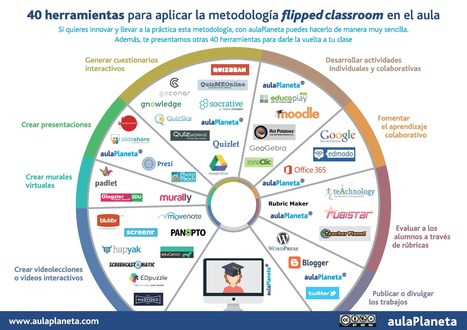
Si quieres innovar y llevar a la práctica esta metodología flipped classroom, te recomendamos 40 herramientas que te servirán para poner del revés tu clase.
Via José Giráldez
|
|
Scooped by
Alfredo Calderón
August 23, 2015 8:23 AM
|
|
|
Scooped by
Alfredo Calderón
August 22, 2015 7:35 AM
|
Sin duda se trata de un tema muy controvertido.
Les invitamos a dar su opinión. Estamos seguros que del debate saldrán muy buenas ideas.
Lic. Pablo Sibaja Moji…
|
|
Scooped by
Alfredo Calderón
August 21, 2015 10:56 AM
|
Blended learning is evolving — tactics and technology must evolve with it.
|
|
Scooped by
Alfredo Calderón
August 21, 2015 10:10 AM
|
|
|
Scooped by
Alfredo Calderón
August 21, 2015 9:16 AM
|
Are your eLearning courses designed for modern learners?
|
|
Scooped by
Alfredo Calderón
August 21, 2015 7:39 AM
|
The power of edtech is defined by what great teachers can do with the technology. Educators who transform classroom learning experiences are changing how they plan, communicate, provide feedback, and collaborate with their students. All of this is thanks to some powerful and clever edtech tools and
|
|
Scooped by
Alfredo Calderón
August 21, 2015 7:10 AM
|
The posting below is the second part of the previous posting that examines gender considerations in online learning. It is from Chapter 12, Gender Issues in Online Learning, by Colin Latchem in the book, Culture and Online Learning: Global Perspectives and Research, edited by Insung Jung and Charlotte Nirmalani Gunawardena. Published by Stylus Publishing, LLC. 22883 Quicksilver Drive Sterling, Virginia 20166-2102. Copyright @2014 by Stylus Publishing, LLC. [https://styluspub.presswarehouse.com/Books/Features.aspx] All rights reserved. Reprinted with permission.
|
|
Scooped by
Alfredo Calderón
August 21, 2015 6:52 AM
|
Cada uno debe construir su propia estructura de conocimientos y significados basados en sus experiencias previas. Las estructuras de los aprendices son propias
|
|
Scooped by
Alfredo Calderón
August 18, 2015 8:24 PM
|
Flipped classrooms require students to take responsibility for their own learning outside of class. Our favorite method for motivating students to engage in out-of-class work is Just-in-Time Teach...
|
|
Scooped by
Alfredo Calderón
August 18, 2015 1:55 PM
|
What is blended learning, what are the different blended learning models and best practices? Education consultants dive into Blended by Michael Horn and Heather Staker
|
|
Scooped by
Alfredo Calderón
August 18, 2015 7:47 AM
|
iOS 9 is Apple's next-generation operating system for iPhone and iPad, and with it comes both polish and intelligence. After the radical redesign of iOS 7, which gave us a cleaner, more physical experience, and the functional revolution of iOS 8, which extended and continued that experience beyond apps and devices, iOS 9 promises us just two simple, profound things—to polish everything...
|


 Scoop.it!














Open education and prersonal learning...2015 08 20 open education and personal learning | @scoopit via @acalderon52 http://sco.lt/...