Colaborando para una mejor educación en línea para adelantar la evolución de la enseñanza y aprendizaje usando la tecnología y pedagogía como estrategias.
Por: Jason Pinto | posteado el: Diciembre 22, 2010 | en: Business, Tips Durante el año pasado, el entusiasmo acerca de los códigos QR se ha convertido aparentemente en una base diaria. Hemos visto ...
Las redes sociales han llegado a captar una gran parte de nuestra atención cada día, afectando nuestras relaciones cara a cara. Simultáneamente van reconfigurando nuestro cerebro físicamente, según afirmó Dan Siegel, profesor de Psicología en la Universidad de California en Los Ángeles.
A comparison of website creation tools. In the chart below I compare five popular tools for building classroom websites. You'll notice that the last column of the chart contains links to tutorials on how to use each service.
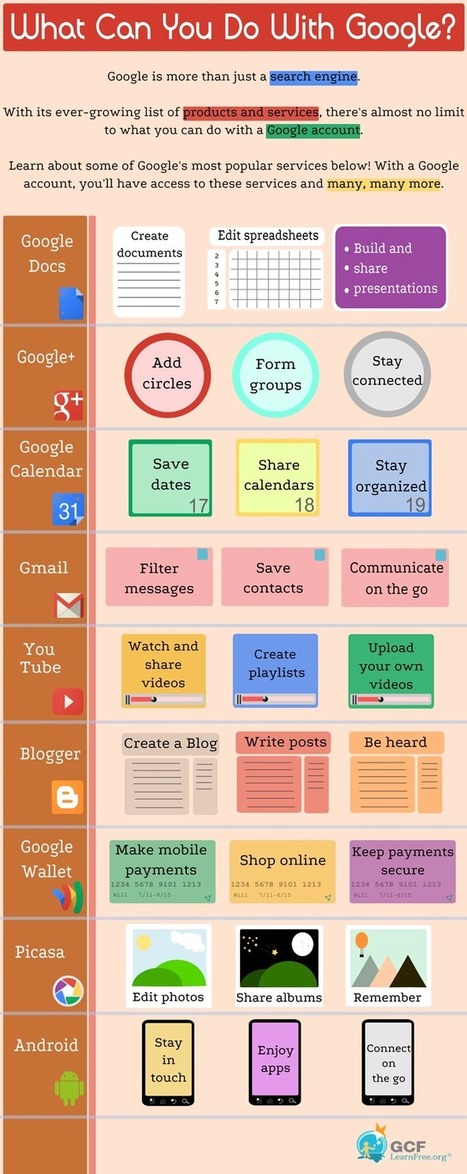
“ Did you know that you can access Google services—including Gmail, Google Docs, and YouTube—from one account? Creating a Google account simply allows you to manage and customize settings for the Google apps and services you use.”
at least part of the picture is becoming a little more clear What's the impact of technology use on education, and on learning? This simple question is rather difficult to answer, for a number of reasons. The quick answer -- that 'it depends on how you are using it, and to what end' -- may be unsatisfying to many, but is nevertheless accurate. That said, before you attempt to assess impact, it can be rather helpful first to understand how technologies are being used (or not used) in actual practice. And before you can do this, it is useful to know what is actually available for use today, as well as some of the key factors which may influence this use. Being able to compare this state of affairs with those found in other countries around the world can help you put this knowledge into some comparative context. (Are we typical, or an outlier? Are we ahead, or behind?) Back in December 2009, the UNESCO Institute for Statistics (UIS), the specialized agency within the UN system responsible for collecting data related to education (the World Bank's EdStats initiative is a close partner of the UIS in this regard) published a very useful Guide to Measuring Information and Communication Technologies (ICT) in Education [pdf] that has since been used to guide regional data collection efforts in much of the world. (The EduTech blog has looked at results from a number of these efforts, including in Asia, the Arab states, and Latin America, as well as more generally about what these efforts tell us about the state of school connectivity around the world; a regional report from the UIS on ICT and education in Africa is due out in the first half of 2015.) Building on these efforts, it is expected that the first comprehensive global initiative will commence next year to regularly collect basic data related to technology use in education in *all* countries, big *and* small, rich *and* poor. What sort of data might be important to collect, and what can be collected in practice? Are the existing set of 'indicators' put forward by the UIS relevant and useful, or should they be reduced/enlarged/amended, based on what has been learned as part of efforts to collect and analyze them in recent years? To help explore such questions, the UIS brought together a 'technical advisory panel' comprising an acronymic soup of organizations (including ADEA, ALECSO, CETIC, European Schoolnet, ITU, KERIS, OECD, TAGI, UNESCO, World Bank) earlier this month to review lessons from the first set of regional data collection efforts and to provide comments on, and suggest possible changes to, a consolidated list of related ICT/education 'indicators' and related questionnaire [pdf]. A new global survey of technology use in education, meant to be part of the regular, on-going data collection efforts of UIS in the education sector coordinated through national statistical offices, is due to launch in September 2015. ---
"Creating a connected classroom has gotten far more affordable now that the major tech companies have begun pouring resources into reaching teachers, students, parents, and school leaders. Aside from the Apple iPad, the biggest player in the world of education technology has to be Google. They regularly unleash new productivity and collaboration tools as part of the Google Apps For Education suite. Many teachers and schools have already ‘gone Google’ so what better way to figure out how to actually get started with the powerful tools than from an effective checklist that lets you quickly discover and check off new ways to use Google Apps For Education in your classroom, school, or district."
Sin embargo, a la necesidad de una constante formación se impone el alto coste que supone estudiar, en la actualidad, cualquier carrera, máster o curso...
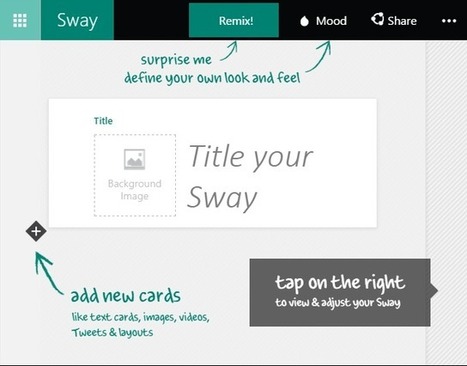
Sway es una novedosa herramienta para la creación de presentaciones basadas en la nube. Sway ofrece una experiencia de diseño rápido, centrándose en la recopilación de imágenes, texto y vídeo, procedente de la web o su equipo. Es un lienzo para sus ideas, para crear rápida y fácil de compartir. Sway es todavía en la vista previa cerrado, pero tuvimos la suerte de haber sido sacado ...
I have used Sway for different presentations and I find it easy to use and intuitive. I still rather use other presentation apps but this one has its uses. I like it.
AnswerGarden is a new minimalistic feedback tool. Use it as a tool for online brainstorming or embed it on your website or blog as a poll or guestbook.
Combining projection mapping and a pop-up book, Marco Tempest tells the visually arresting story of Nikola Tesla -- called “the greatest geek who ever lived” -- from his triumphant invention of alternating current to his penniless last days.
Además de en Google, Bing o Yahoo, se pueden realizar búsquedas en la web mucho más restringidas gracias a los buscadores especializados, que sólo muestran los recursos de cumplen una serie de requisitos: según el tipo de documento, el nivel de la información, la material...
There are people who can quickly memorize lists of thousands of numbers, the order of all the cards in a deck (or ten!), and much more. Science writer Joshua Foer describes the technique -- called the memory palace -- and shows off its most remarkable feature: anyone can learn how to use it, including him.
Core Learning Principles: #1: Every Structured Learning Experience Has Four Elements with the Learner at the Center #2: Every Learning Experience Includes the Environment in which the Learner Interacts #3: We Shape Our Tools and Our Tools Shape Us #4: Faculty are the Directors of the Learning Experience #5: Learners Bring Their Own Personalized Knowledge, Skills, and Attitudes to the Learning Experience #6: Every Learner Has a Zone of Proximal Development That Defines the Space That a Learner is Ready to Develop into Useful Knowledge #7: Concepts are Not Words; Concepts are Organized and Intricate Knowledge Clusters #8: All Learners Do Not Need to Learn All Course Content; All Learners Do Need to Learn the Core Concepts #9: Different Instruction is Required for Different Learning Outcomes #10: Everything Else Being Equal, More Time-on-Task Equals More Learning
To get content containing either thought or leadership enter:
To get content containing both thought and leadership enter:
To get content containing the expression thought leadership enter:
You can enter several keywords and you can refine them whenever you want. Our suggestion engine uses more signals but entering a few keywords here will rapidly give you great content to curate.


 Your new post is loading...
 Scoop.it!