Your new post is loading...

|
Scooped by
Dr. Stefan Gruenwald
February 19, 2012 12:39 PM
|
There may be up to 100,000 compact objects per main sequence star in the galaxy that are greater than the mass of Pluto. The mass function of the lowest-mass nomads is modeled from what we see in the Kuiper Belt and the distribution of diameters in KBOs (Kuiper Belt Objects), while at the higher end (corresponding to masses several times that of Jupiter), evidence exists that nomads in open clusters follow a smooth continuation of the brown dwarf mass function. The larger Earth and larger size objects would also likely have their own moons.
|
|
Scooped by
Dr. Stefan Gruenwald
February 15, 2012 1:38 PM
|
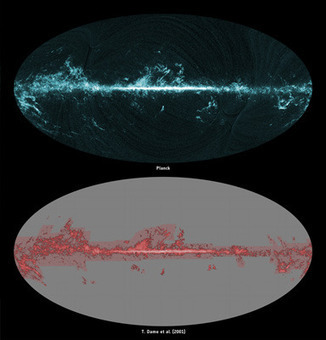
The European Space Agency (ESA)’s Planck mission has revealed that our Galaxy contains previously undiscovered islands of cold gas and a mysterious haze of microwaves. These results give scientists new treasure to mine and take them closer to revealing the blueprint of cosmic structure. These results include the first map of carbon monoxide to cover the entire sky. Carbon monoxide is a constituent of the cold clouds that populate the Milky Way and other galaxies. Predominantly made of hydrogen molecules, these clouds provide the reservoirs from which stars are born.
|
|
Scooped by
Dr. Stefan Gruenwald
February 8, 2012 10:44 AM
|
Steve Vogt is the UC Santa Cruz astrophysicist who discovered Zarmina, the first recorded Earthlike planet outside our solar system. He told io9 what a human colony there would be like, and why he believes the planet already harbors life.
|
|
Scooped by
Dr. Stefan Gruenwald
February 5, 2012 10:40 AM
|
Why does the universe exist? For that matter, why do people? Can you even be sure that you do? 13.7 billion years ago, the universe was born in a cosmic fireball. Roughly 10 billion years later, the planet we call Earth gave birth to life, which eventually led to you. The probability of that sequence of events is absolutely minuscule, and yet it still happened.
|
|
Scooped by
Dr. Stefan Gruenwald
February 4, 2012 12:44 AM
|
Colossal black holes with a mass of up to 50 billion suns could be lurking out there - but that's the limit. Giant black holes sit at the cores of virtually all galaxies, and are thought to have grown from smaller seed black holes that swallowed lots of matter. The biggest well-measured one resides in the galaxy Messier 87 and has the mass of 3 billion suns, a measurement based on the speed of the gas swirling around it.
|
|
Rescooped by
Dr. Stefan Gruenwald
from The virtual life
February 2, 2012 12:08 PM
|
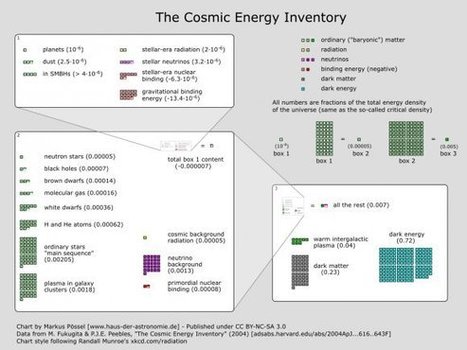
Editor’s Note: Markus Pössel is a theoretical physicist turned astronomical outreach scientist. He is the managing scientist at the Centre for Astronomy Education and Outreach “Haus der Astronomie” in Heidelberg, Germany.
Via Apmel
|
|
Scooped by
Dr. Stefan Gruenwald
February 2, 2012 11:34 AM
|
Phase one of the world's first commercial spaceport, which will be the hub for Virgin's consumer spaceflights, is now 90 per cent complete. The 1,800-acre Spaceport America site, in Las Cruces, New Mexico, is the home base for Virgin Galactic, Richard Branson's most ambitious business venture yet. It already boasts a runway stretching to nearly two miles long, a futuristic styled terminal hanger, and a dome-shaped Space Operations Center.
|
|
Scooped by
Dr. Stefan Gruenwald
February 1, 2012 11:55 AM
|
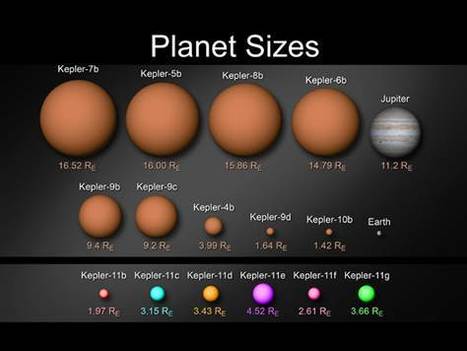
Exoplanet links are here An extrasolar planet, or exoplanet, is a planet outside our solar system. A total of 755 such planets (in 605 planetary systems and 99 multiple planetary systems) have been identified as of January 30, 2012. It is now known that a substantial fraction of stars have planets, including perhaps half of all Sun-like stars. In a 2012 study, each star of the 100 billion or so in our Milky Way Galaxy is estimated to host on average at least 1.6 planets. Accordingly, at least 160 billion star-bound planets may exist in the Milky Way Galaxy alone. Unbound free-floating planetary-mass bodies in the Milky Way may number in the trillions with 100,000 objects larger than Pluto for every main-sequence star.
|
|
Scooped by
Dr. Stefan Gruenwald
February 1, 2012 1:42 AM
|
The Russian sample-return spacecraft will carry a zoo of microbes to Phobos and back to test whether life can survive the interplanetary journey.
|
|
Scooped by
Dr. Stefan Gruenwald
February 1, 2012 12:46 AM
|
NASA software that calculates optical aberrations will sharpen images from space and could redefine perfect vision for humans. The general idea is simple. We're taking advantage of the fact that our future telescopes will include flexible mirrors that bend and move upon command. By understanding the deficiencies in an image, we can compensate for them by remote control—no astronauts needed. The power of this method lies in its ability to use an optical system's existing camera as a sensor to detect its own error, without installing any separate devices. This software-based approach has already extended our telescopes' ability to peer into the darkness of the universe. On Earth, we believe the software could enable vision scientists to enhance human eyesight beyond "perfect" 20/20 vision, opening up the possibility of "superhuman" vision. Most adults don't have 20/20 vision. Imperfect vision is caused by aberrations in the way the lens of the eye transmits light to the retina. Those deviations occur in an important aspect of light called the wavefront, a set of points that are all in the same phase. You might be familiar with the term from ads for LASIK eye surgery. The vision-correcting procedure uses a beam of laser light that penetrates the eye, reflects off the retina, and travels back through the eye, capturing and mapping the errors in the way the wavefront strikes the eye. What causes the wavefront to become distorted? Objects emit or reflect light in spherical waves. Our eyes intercept a small portion of that wave surface, and at great distances this surface is considered basically flat. To form a perfect image on your retina, your eye forces these flat waves to curve inward, so that the waves converge at one point on the focal plane behind your eye's lens. If the converging waves are not perfectly curved, not all of the light will come into focus at a single point on your retina. The result is a blurry or distorted image. All the points of deviation from the perfect spherical wave shape are called wavefront error. Plotted on a 2-D map, the error would look like mountainous terrain, with peaks and valleys corresponding to each deviation from the ideal flat surface.
|
|
Scooped by
Dr. Stefan Gruenwald
January 31, 2012 11:30 PM
|
The Northern Lights have lit up the skies above Scotland, Canada and Norway after the biggest solar storm in more than six years bombarded Earth with radiation. Solar storms video collection: http://tinyurl.com/7pamtq3
|
|
|
Scooped by
Dr. Stefan Gruenwald
February 15, 2012 8:39 PM
|
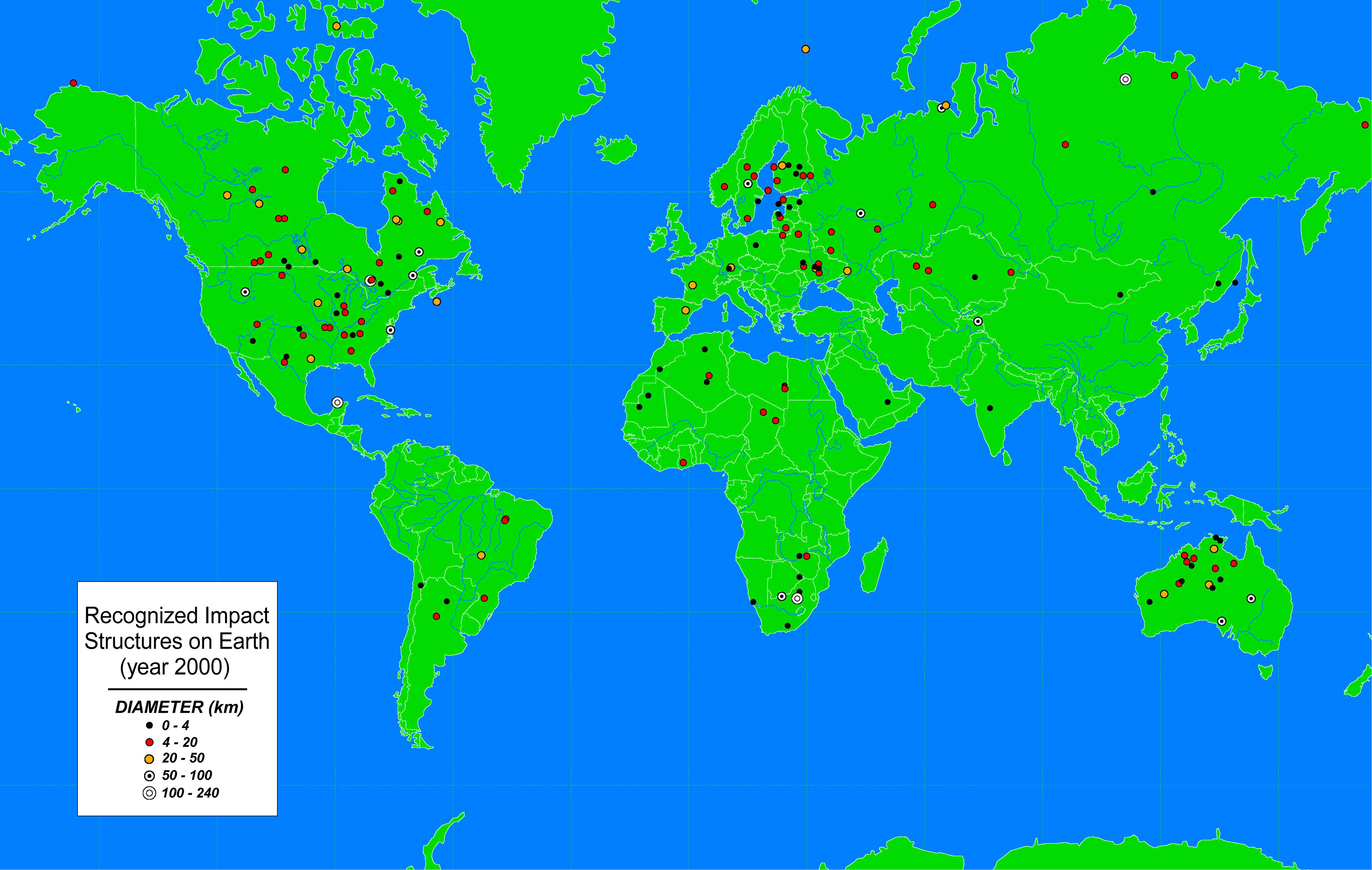
Recognized impact structures throughout the world
|
|
Scooped by
Dr. Stefan Gruenwald
February 8, 2012 4:16 PM
|
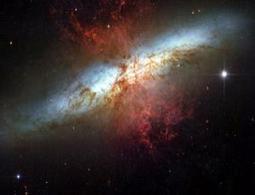
An unknown object in a nearby galaxy is emitting radio waves unlike anything seen before, and it's baffling astronomers... The object is still a puzzle, says co-discoverer Tom Muxlow. "It was still there the last time we looked, so its lifetime is now well over a year," he says. "We are continuing to monitor this object."There is something strange in the cosmic neighbourhood. An unknown object in the nearby galaxy M82 has started sending out radio waves, and the emission does not look like anything seen anywhere in the universe before.
|
|
Scooped by
Dr. Stefan Gruenwald
February 5, 2012 11:01 AM
|
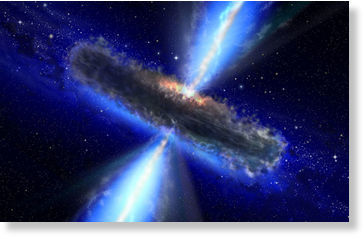
Two teams of astronomers have discovered the largest and farthest reservoir of water ever detected in the universe. Looking from a distance of 30 billion trillion miles away into a quasar - one of the brightest and most violent objects in the cosmos - the researchers, led by scientists at the California Institute of Technology (Caltech), have found a mass of water vapour that's at least 140 trillion times that of all the water in the world's oceans combined, and 100,000 times more massive than the sun. Because the quasar is so far away, its light has taken 12 billion years to reach Earth. The observations therefore reveal a time when the universe was just 1.6 billion years old.
|
|
Rescooped by
Dr. Stefan Gruenwald
from Science News
February 4, 2012 10:03 AM
|
Mars may have been arid for more than 600 million years, making it too hostile for any life to survive on the planet's surface, according to researchers who have been carrying out the painstaking task of analysing individual particles of Martian...
Via Sakis Koukouvis
|
|
Scooped by
Dr. Stefan Gruenwald
February 2, 2012 12:13 PM
|
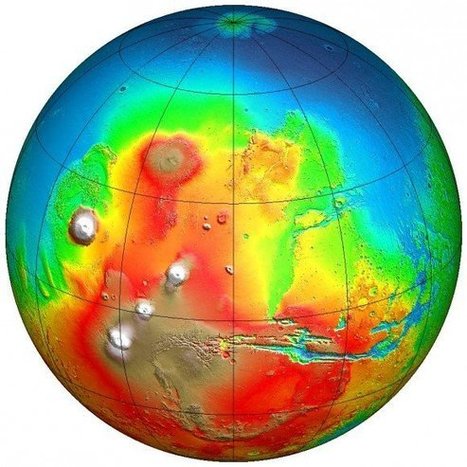
For a long time now, evidence has continued to indicate that Mars was once a water world – near-surface groundwater, lakes, rivers, hot springs and, according to some planetary models, even an ancient ocean in the northern hemisphere.
|
|
Rescooped by
Dr. Stefan Gruenwald
from The virtual life
February 2, 2012 12:07 PM
|
Like part of a cosmic Russian doll, our universe may be nested inside a black hole that is itself part of a larger universe. In turn, all the black holes found so far in our universe—from the microscopic to the supermassive—may be doorways into alternate realities. In a recent paper published in the journal Physics Letters B, Indiana University physicist Nikodem Poplawski presents new mathematical models of the spiraling motion of matter falling into a black hole. His equations suggest such wormholes are viable alternatives to the "space-time singularities" that Albert Einstein predicted to be at the centers of black holes. According to Einstein's equations for general relativity, singularities are created whenever matter in a given region gets too dense, as would happen at the ultradense heart of a black hole. Einstein's theory suggests singularities take up no space, are infinitely dense, and are infinitely hot—a concept supported by numerous lines of indirect evidence but still so outlandish that many scientists find it hard to accept. If Poplawski is correct, they may no longer have to. According to the new equations, the matter black holes absorb and seemingly destroy is actually expelled and becomes the building blocks for galaxies, stars, and planets in another reality. The notion of black holes as wormholes could explain certain mysteries in modern cosmology, Poplawski said. For example, the big bang theory says the universe started as a singularity. But scientists have no satisfying explanation for how such a singularity might have formed in the first place. If our universe was birthed by a white hole instead of a singularity, Poplawski said, "it would solve this problem of black hole singularities and also the big bang singularity." Wormholes might also explain gamma ray bursts, the second most powerful explosions in the universe after the big bang. Gamma ray bursts occur at the fringes of the known universe. They appear to be associated with supernovae, or star explosions, in faraway galaxies, but their exact sources are a mystery. Poplawski proposes that the bursts may be discharges of matter from alternate universes. The matter, he says, might be escaping into our universe through supermassive black holes—wormholes—at the hearts of those galaxies, though it's not clear how that would be possible. "It's kind of a crazy idea, but who knows?" he said. There is at least one way to test Poplawski's theory: Some of our universe's black holes rotate, and if our universe was born inside a similarly revolving black hole, then our universe should have inherited the parent object's rotation.
Via Apmel
|
|
Scooped by
Dr. Stefan Gruenwald
February 1, 2012 11:57 AM
|
Scientists within the New York Center for Astrobiology at Rensselaer Polytechnic Institute have compiled years of research to help locate areas in outer space that have extreme potential for complex organic molecule formation. The scientists searched for methanol, a key ingredient in the synthesis of organic molecules that could lead to life. Their results have implications for determining the origins of molecules that spark life in the cosmos.
|
|
Scooped by
Dr. Stefan Gruenwald
February 1, 2012 1:58 AM
|
Why does the universe exist? For that matter, why do people? Can you even be sure that you do? 13.7 billion years ago, the universe was born in a cosmic fireball. Roughly 10 billion years later, the planet we call Earth gave birth to life, which eventually led to you. The probability of that sequence of events is absolutely minuscule, and yet it still happened. Take a step back from the unlikeliness of your own personal existence and things get even more mind-boggling. Why does the universe exist at all? Why is it fine-tuned to human life? Why does it seem to be telling us that there are other universes out there, even other yours?
|
|
Scooped by
Dr. Stefan Gruenwald
February 1, 2012 1:19 AM
|
There's still a lot of mystery surrounding Jupiter's moon Europa, but researchers at NASA seem fairly certain that there's a watery ocean lurking beneath its icy exterior. Their theories may finally be put to the test later this decade, thanks to a concept mission crafted by astronomers at the Jet Propulsion Laboratory. According to Space.com, JPL researchers have come up with a plan that would send a pair of landers to Europa by 2026, in the hopes of finding out whether the rock has ever supported life forms. The endeavor certainly wouldn't be easy, since Jupiter blankets its moon in heavy radiation, but researchers think they can mitigate these risks by sending in an extra lander as backup, and by keeping the mission short and sweet. Under the plan, each 700-pound robot would use a mass spectrometer, seismometers and a slew of cameras to search for any organic chemicals that may be lodged within the moon's ice. Neither craft will sport a protective shield, so they'll only stay around the planet for about seven days, so as to avoid any radiation damage. At this point, the mission is still in the concept phase, though the JPL is hoping to launch both landers by 2020. JPL researcher Kevin Hand was quick to point out, however, that this would be a "habitability mission," and that NASA doesn't expect to find any signs of current life on Europa.
|
|
Scooped by
Dr. Stefan Gruenwald
February 1, 2012 12:23 AM
|
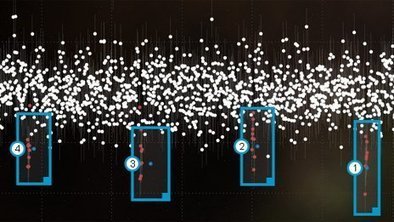
Volunteers can go to the Planethunters website to see time-lapsed images of 150,000 stars, taken by the Kepler space telescope. They will be advised on the signs that indicate the presence of a planet and how to alert experts if they spot them. "We know that people will find planets that are missed by the computer," said Chris Lintott from Oxford University.
|
|
Rescooped by
Dr. Stefan Gruenwald
from Science News
December 24, 2012 7:28 PM
|
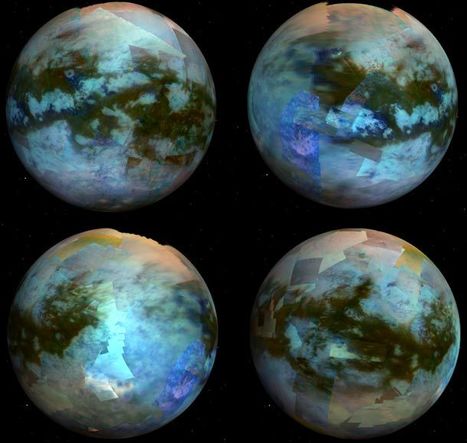
Not every world gives up its secrets easily, and perhaps none has been so difficult to probe than Titan, Saturn’s largest moon. Bigger than Mercury, second only to Jupiter’s Ganymede, Titan has an atmosphere of nitrogen so thick it has twice the Earth’s air pressure at its surface. That thick, hazy atmosphere is impenetrable by optical light… but infrared light can pierce that veil, and the Cassini space probe is well-equipped with detectors that can see in that part of that spectrum. And after 7 years, and 78fly-by passes of the huge moon, there are enough images for scientists to make an amazing global map. Cassini passed at different times of day for the local regions, so the sunlight angle changed, making illumination and shadowing different. The atmosphere of Titan is dynamic, changing with time, so again compensations must be made. It’s painstaking work, but the results are truly incredible.
In this false-color map, what’s shown as blue is actually light at a wavelength of 1.27 microns — very roughly twice the wavelength the human eye can detect. Green is 2 microns, and red is 5 microns, well out into the infrared. When the final images are combined, what show up as brown regions near the equator are actually vast dune fields, grains of frozen hydrocarbons rolling across the plains in the relentless Titanian winds. White areas are elevated terrain. Near the north pole, only barely visible, are smudges on the map that have been shown to be lakes — literally, giant lakes of liquid methane! So Titan has air, lakes, and weather. Sound familiar? It’s not exactly Earth-like, since the temperature there is roughly -180°C (-300°F), but the similarities are compelling. And Titan is loaded with organic compounds like methane, ethane, and more. A complex chemistry is certainly possible there, but complex enough to have formed life? No one knows. Just a few years ago I don’t think anyone would’ve taken the possibility seriously, but now… well, nobody really rules it out completely.
Via Sakis Koukouvis
|