Your new post is loading...

|
Scooped by
Dr. Stefan Gruenwald
March 23, 2012 2:09 PM
|
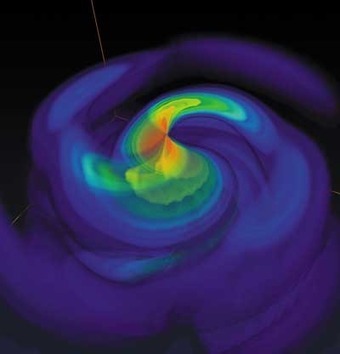
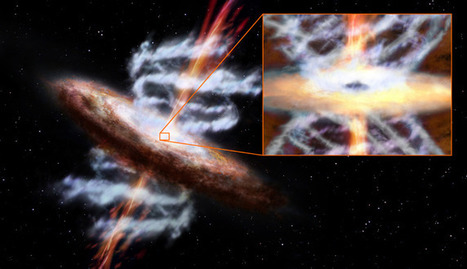
Astronomers from the UK and Australia have put forward a new theory about why black holes become so hugely massive, some growing to a size billions of times heavier than the sun. Almost every galaxy has an enormously massive black hole in its center. Our own galaxy, the Milky Way, has one about four million times heavier than the sun. But some galaxies have black holes a thousand times heavier still which grew very quickly after the Big Bang. http://www.stfc.ac.uk/News+and+Events/38787.aspx
|
|
Scooped by
Dr. Stefan Gruenwald
March 21, 2012 4:22 PM
|
First detailed map of the volcano-covered surface of Io, the innermost of Jupiter's four Galilean moons. Io, discovered by Galileo Galilei on January 7–13, 1610, is the innermost of the four Galilean satellites of the planet Jupiter (Galilei, 1610). It is the most volcanically active object in the Solar System, as recognized by observations from six National Aeronautics and Space Administration (NASA) spacecraft: Voyager 1 (March 1979), Voyager 2 (July 1979), Hubble Space Telescope (1990–present), Galileo (1996–2001), Cassini (December 2000), and New Horizons (February 2007). The lack of impact craters on Io in any spacecraft images at any resolution attests to the high resurfacing rate (1 cm/yr) and the dominant role of active volcanism in shaping its surface. Original vector map is here: http://pubs.usgs.gov/sim/3168/sim3168_sheet.pdf
|
|
Scooped by
Dr. Stefan Gruenwald
March 20, 2012 11:43 AM
|
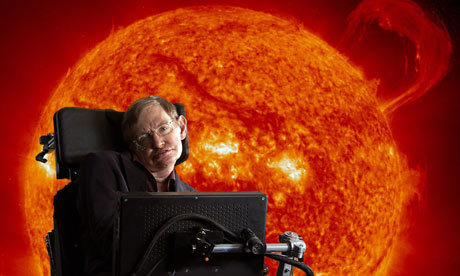
A belief that heaven or an afterlife awaits us is a “fairy story” for people afraid of death, Stephen Hawking (http://www.guardian.co.uk/science/hawking) has said. “I regard the brain as a computer which will stop working when its components fail. There is no heaven or afterlife for broken down computers; that is a fairy story for people afraid of the dark,” he said. In a lecture at the Google Zeitgeist meeting he addressed the question: “Why are we here?” He argued that tiny quantum fluctuations in the very early universe became the seeds from which galaxies, stars, and ultimately human life emerged. “Science predicts that many different kinds of universe will be spontaneously created out of nothing. It is a matter of chance which we are in,” he said. http://tinyurl.com/45x2bnp
|
|
Scooped by
Dr. Stefan Gruenwald
March 12, 2012 1:44 PM
|
A neutron star is the closest thing to a black hole that astronomers can observe directly, crushing half a million times more mass than Earth into a sphere no larger than a city. http://tinyurl.com/744ma4v
|
|
Scooped by
Dr. Stefan Gruenwald
March 9, 2012 11:10 PM
|
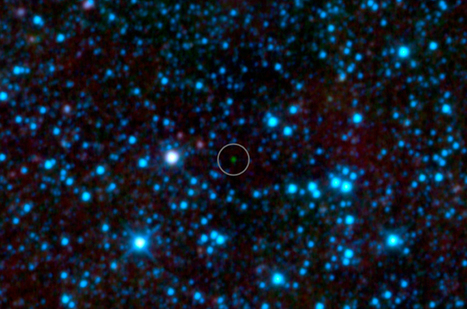
Asteroid 2011 AG5 has been receiving a lot of attention lately because of a very unlikely scenario which would place it on an Earth-interception course 28 years from now. Asteroid 2011 AG5 has a one in 625 chance of hitting the earth in 2040 with the force of 100 megatons of TNT. Asteroid 2011 AG5 is a 460 feet (140 meter) wide space rock and researchers are calling for deflection plans. http://www.jpl.nasa.gov/news/news.cfm?release=2012-051
|
|
Scooped by
Dr. Stefan Gruenwald
March 9, 2012 8:47 PM
|
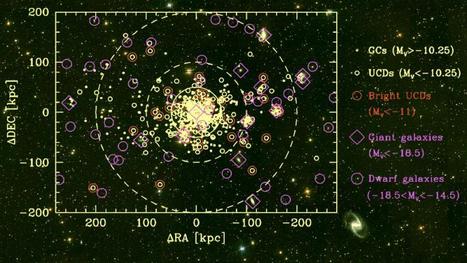
Astronomy & Astrophysics is publishing the results of a detailed investigation of how many 'ultra-compact dwarf galaxies' (UCDs) can be found in nearby galaxy clusters. UCDs were recognized as a populous and potentially distinct class of stellar systems about a decade ago. But they are still mysterious objects that are characterized by a compact morphology (30-300 light-years in size) and high masses (more than one million solar masses). More generally, their properties (e.g., their size, shape, or luminosity) are similar to those of both star clusters and dwarf galaxies. Several hundred UCDs have been found to date. Two main formation channels for these puzzling objects have been proposed so far. UCDs might either be very massive star clusters or be 'normal' dwarf galaxies transformed by tidal effects. http://tinyurl.com/6omxmyv
|
|
Scooped by
Dr. Stefan Gruenwald
March 9, 2012 12:47 PM
|
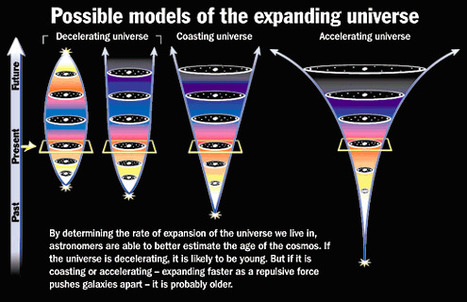
Some scientists call the cosmological constant the "worst prediction of physics." And when today’s theories give an estimated value that is about 120 orders of magnitude larger than the measured value, it’s hard to argue with that title. In a new study, a team of physicists has taken a different view of the cosmological constant, Λ, which drives the accelerated expansion of the universe. While the cosmological constant is usually interpreted as a vacuum energy, here the physicists provide evidence to support the possibility that the mysterious force instead emerges from a microscopic quantum theory of gravity, which is currently beyond physicists’ reach. http://tinyurl.com/6o8ulbu
|
|
Scooped by
Dr. Stefan Gruenwald
March 5, 2012 8:43 PM
|
Two new types of ultra-hard carbon crystals have been found by researchers investigating the ureilite class Haverö meteorite that crashed to Earth in Finland in 1971. http://tinyurl.com/ykzkjfc
|
|
Scooped by
Dr. Stefan Gruenwald
March 3, 2012 11:45 AM
|
Astronomers believe they’ve found something never before detected in the universe: a black hole of intermediate size. These middleweights, at about 500 times the mass of the sun, could represent a missing link between common stellar black holes, created by the death of a single star, and the supermassive variety that can pack the mass of millions or even billions of suns.
|
|
Scooped by
Dr. Stefan Gruenwald
February 27, 2012 6:13 PM
|
A curious correlation between the mass of a galaxy's central black hole and the velocity of stars in a vast, roughly spherical structure known as its bulge has puzzled astronomers for years.
|
|
Rescooped by
Dr. Stefan Gruenwald
from Science News
February 25, 2012 6:26 PM
|
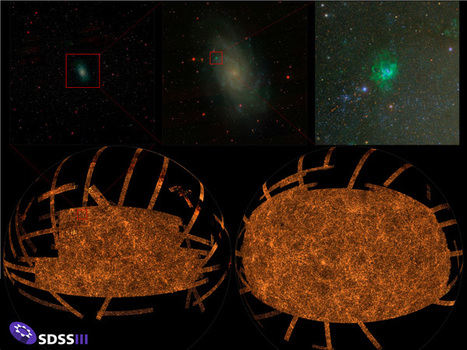
More than a trillion pixels from a million-plus images, combined to create the most detailed map of the universe ever created—one that would require a wall of a half-million HDTVs to properly appreciate.
Via Sakis Koukouvis
|
|
Scooped by
Dr. Stefan Gruenwald
February 24, 2012 2:17 PM
|
Astronomers using data from NASA's Spitzer Space Telescope have, for the first time, discovered buckyballs in a solid form in space. Prior to this discovery, the microscopic carbon spheres had been found only in gas form in the cosmos. Formally named buckminsterfullerene, buckyballs are named after their resemblance to the late architect Buckminster Fuller's geodesic domes. They are made up of 60 carbon atoms arranged into a hollow sphere, like a soccer ball. Their unusual structure makes them ideal candidates for electrical and chemical applications on Earth, including superconducting materials, medicines, water purification and armor.
|
|
Scooped by
Dr. Stefan Gruenwald
February 21, 2012 3:48 PM
|
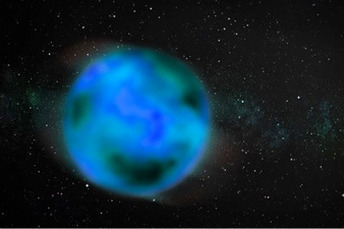
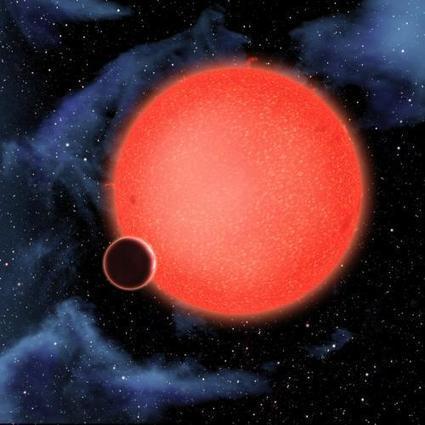
An international team of astronomers led by Zachory Berta of the Harvard-Smithsonian Center for Astrophysics (CfA) made the observations of the planet GJ 1214b. GJ1214b, shown in this artist's view, is a super-Earth orbiting a red dwarf star 40 light-years from Earth. New observations from the NASA/ESA Hubble Space Telescope show that it is a water world enshrouded by a thick, steamy atmosphere. GJ 1214b represents a new type of planet, like nothing seen in the solar system or any other planetary system currently known.
|
|
|
Scooped by
Dr. Stefan Gruenwald
March 21, 2012 7:32 PM
|
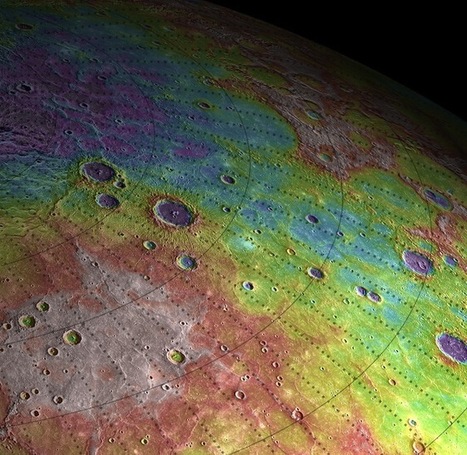
New data suggests that Mercury has undergone much more dynamic processes than previously believed and that its core is unlike any of the other rocky planets in our solar system. NASA’s MESSENGER spacecraft, which has been in orbit around the solar system’s smallest and innermost planet for just over a year, has beamed back plenty of surprises for scientists here on Earth. http://tinyurl.com/7586bra
|
|
Scooped by
Dr. Stefan Gruenwald
March 20, 2012 11:50 AM
|
The biggest 3-D map of the distant universe ever made, using light from 14,000 quasars — supermassive black holes at the centers of galaxies many billions of light years away — has been constructed by scientists at the Berkeley Lab with the third Sloan Digital Sky Survey (SDSS-III). The map is the first major result from the Baryon Oscillation Spectroscopic Survey (BOSS), SDSS-III’s largest survey. BOSS is the first attempt to use baryon acousticoscillation (BAO) as a precision tool to measure dark energy. http://tinyurl.com/7d8zokg
|
|
Scooped by
Dr. Stefan Gruenwald
March 13, 2012 12:35 PM
|
Our galaxy, the Milky Way, is composed of billions of stars and planets, dust and gas. According to school textbooks, everything works like clockwork; stars are born from clouds of gas (known as nebulae) and the disk of gas and dust surrounding newborn stars agglomerate to build the planets. Brown dwarfs and so-called "nomad planets" could effectively be "rest stops" in future interstellar travel. http://tinyurl.com/7984vtq
|
|
Scooped by
Dr. Stefan Gruenwald
March 12, 2012 11:45 AM
|
The Earth could soon have a second sun, at least for a week or two. The cosmic phenomenon will happen when one of the brightest stars in the night sky explodes into a supernova. And, according to a report yesterday, the most stunning light show in the planet’s history could happen as soon as this year. http://tinyurl.com/4o3cf4z
|
|
Scooped by
Dr. Stefan Gruenwald
March 9, 2012 9:56 PM
|
In recent years the number of large objects tracked by U.S. military sensors and listed in the official government catalogue has reached an all-time high of around 15,000 pieces of debris, plus about 1,000 active satellites. This growth in space debris has become a concern because of the threat posed to satellites and to piloted spacecraft. The very high speed of objects in orbit means that debris as small as a centimeter can seriously damage or destroy a satellite. And debris can linger in orbit for decades or longer at high altitudes so it builds up as more is produced. http://tinyurl.com/7v7fe5t
|
|
Scooped by
Dr. Stefan Gruenwald
March 9, 2012 1:03 PM
|
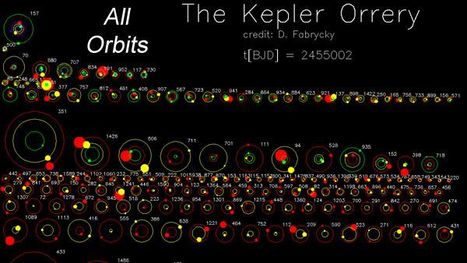
San Francisco CA (SPX) Mar 08, 2012 - Last week, the Kepler science team released its list of candidate planets based on the data collected during the mission's first sixteen months. The last comparable publication summarized the mission's first four months of data. Overall, our solar system is qualitatively typical in placing larger planets farther out than smaller planets. However, it is quantitatively atypical: While Kepler shows us that there are almost certainly several planets for every star, it shows us that our solar system is distributed freakishly outwards, in comparison to more typical planetary systems in other parts of the universe http://tinyurl.com/86vqmsh
|
|
Scooped by
Dr. Stefan Gruenwald
March 9, 2012 11:07 AM
|
A proposed new time-keeping system tied to the orbiting of a neutron around an atomic nucleus could have such unprecedented accuracy that it neither gains nor loses 1/20th of a second in 14 billion years - the age of the Universe. This is nearly 100 times more accurate than the best atomic clocks in existence right now. http://tinyurl.com/7yqb6tq
|
|
Rescooped by
Dr. Stefan Gruenwald
from Science News
March 3, 2012 12:02 PM
|
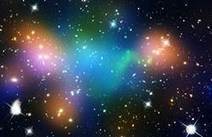
Astronomers using the Hubble Space Telescope are mystified by a merging galaxy cluster known as Abell 520 in which concentrations of visible matter and dark matter have apparently come unglued.
Via Sakis Koukouvis
|
|
Scooped by
Dr. Stefan Gruenwald
March 1, 2012 12:31 AM
|
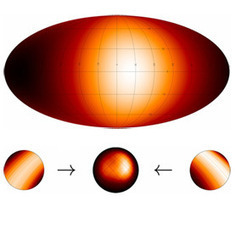
Astronomers have made a crude two-dimensional thermal map of an extrasolar world they cannot yet see, confirming that violent winds rapidly whip around the planet. A mere 60 light-years away, orbiting an orange star called HD 189733, is a giant gas planet, like Jupiter or Saturn, but unlike those familiar worlds this one hugs tightly to its host star, orbiting at about one thirtieth the distance at which Earth circles the sun. The exoplanet, labeled HD 189733 b by astronomical convention, stays mighty toasty under its astronomical broiler, with temperatures upward of 900 degrees Celsius.
|
|
Rescooped by
Dr. Stefan Gruenwald
from Science News
February 25, 2012 6:28 PM
|
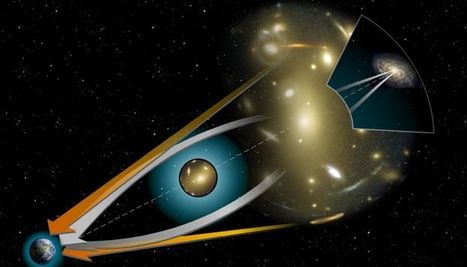
Astronomers have toyed with the idea of using the sun as a gravitational lens for spying on nearby stars.
Via Sakis Koukouvis
|
|
Scooped by
Dr. Stefan Gruenwald
February 24, 2012 2:44 PM
|
Our galaxy may be awash in homeless planets, wandering through space instead of orbiting a star, according to a new study by researchers at the Kavli Institute for Particle Astrophysics and Cosmology.
|
|
Rescooped by
Dr. Stefan Gruenwald
from GOSSIP, NEWS & SPORT!
February 22, 2012 12:24 PM
|
Back in 2011, ground-breaking research by scientists at the University of York provided a new perspective on the physics of black holes. Black holes are objects in space that are so massive and compact they were described by Einstein as...
Via Sakis Koukouvis, Jimi Paradise
|







![A Minefield in Earth Orbit: How Space Debris Is Spinning Out of Control [Interactive] | Amazing Science | Scoop.it](https://img.scoop.it/bBd7UGZT4eoQEJLXoRkwGDl72eJkfbmt4t8yenImKBVvK0kTmF0xjctABnaLJIm9)