The exotic theory of everything could shed light on the behaviour of real materials, thanks to an unexpected mathematical connection with condensed-matter physics. String theory is mathematically rich and has an undeniable aesthetic appeal. But it is all about what physics might be like at scales of 10−35 metres — the idea being that seemingly point-like elementary particles such as quarks and electrons will actually turn out to be tiny, vibrating threads of energy when viewed at such scales.
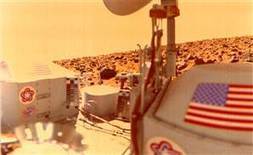
New analysis of 36-year-old data, resuscitated from printouts, shows that NASA detected traces of life on Mars, an international team of mathematicians and scientists conclude in a paper published this week.
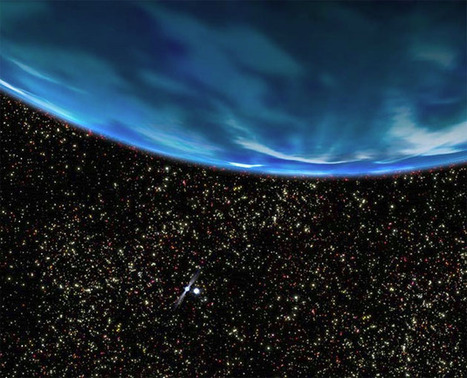
Astronomers have photographed planets from other solar systems for the first time in 2004 (super Jupiters). Here is a little summary video from the Challenger Center for Space Science Education.
The asteroid that killed the dinosaurs must have ejected billions of tons of life-bearing rock into space. Now physicists have calculated what must have happened to it.
The position of the Earth around the sun, the presence of organic materials and water and a warm climate — all make life on our planet possible. Yet, with perhaps 100 billion solar systems in our galaxy alone, with ubiquitous water, carbon and hydrogen, it isn't surprising that these conditions would arise somewhere. And as to the diversity of life on Earth — as Darwin described more than 150 years ago and experiments ever since have validated — natural selection in evolving life forms can establish both diversity and order without any governing plan.
TIDES evoke the sea, but they may dry out what would otherwise be habitable planets around small stars, making them hostile to life.
Scientists from the University of Washington in Seattle and his colleagues calculated what would happen to Earth-like planets orbiting the most common type of star in the galaxy: red dwarfs.
These stars are much cooler and fainter than the sun, meaning the habitable zones around them - in which planets can have liquid water on their surface - are much closer in. Any planets orbiting in those zones feel very strong gravitational tugs from the star.
If the universe manufactured carbon so early in its history, then advanced ancient alien minds should be out there, somewhere. The announcement of a pair of planets orbiting a 12.5 billion-year old star flies in the face of conventional wisdom that the earliest stars to be born in the Universe shouldn't possess planets at all.
12.5 billion years ago, the primeval universe was just beginning to make heavier elements beyond hydrogen and helium, in the fusion furnace cores of the first stars. It follows that there was very little if any material for fabricating terrestrial worlds or the rocky seed cores of gas giant planets.
Earth usually has more than one moon, according to a team of astronomers from the University of Helsinki, the Paris Observatory and the University of Hawaii at Manoa. Our 2,000-mile-diameter Moon, so beloved by poets, artists and romantics, has been orbiting Earth for over 4 billion years. Its much smaller cousins, dubbed “minimoons,” are thought to be only a few feet across and to usually orbit our planet for less than a year before resuming their previous lives as asteroids orbiting the Sun.
Mikael Granvik (formerly at UH Manoa and now at Helsinki), Jeremie Vaubaillon (Paris Observatory) and Robert Jedicke (UH Manoa) calculated the probability that at any given time Earth has more than one moon. They used a supercomputer to simulate the passage of 10 million asteroids past Earth. They then tracked the trajectories of the 18,000 objects that were captured by Earth’s gravity.
A ground-breaking Russian nuclear space-travel propulsion system will be ready by 2017 and will power a ship capable of long-haul interplanetary missions by 2025, giving Russia a head start in the outer-space race.
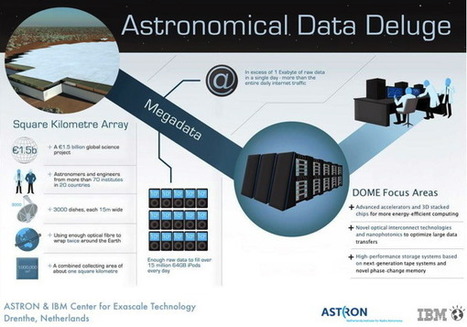
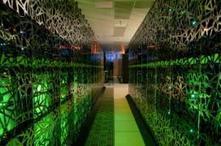
ASTRON has enlisted the help of IBM to lead a five-year, $43 million project to develop and build a supercomputer for the new Square Kilometer Array. The SKA is a $2.1 billion initiative to construct the world's largest radio telescope across a 3,000km strip of Australia or South Africa. It's hoped to be around 50 times as powerful as the dishes we currently point heavenward and will be used to examine the deepest reaches of space to learn more about the formation of the universe. When it goes live in 2024, it'll produce an Exabyte of data each day: twice as much information as there is traffic on the internet in the same period. Of course, no existing computer could handle the job, so Big Blue has a slim 12 years in which to turn nascent technologies like Nanophotonics, 3D chip stacking and phase change memory amongst others into a practical, workable Exascale computer. Its either that, or somehow daisy-chain 100 million PCs with enough power and cooling fans to keep it all working and hope for the best.
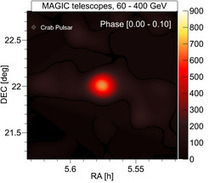
The pulsar at the centre of the famous Crab Nebula is a veritable bundle of energy. This was now confirmed by the two MAGIC Telescopes on the Canary island of La Palma. They observed the pulsar in the very high energy gamma radiation from 25 up to 400 gigaelectronvolts (GeV), a region that was previously difficult to access with high energy instruments, and discovered that it actually emits pulses with the maximum measurable energy of up to 400 GeV – at least 50 to 100 times higher than theorists thought possible. These latest observations are difficult for astrophysicists to explain. "There must be processes behind this that are as yet unknown", says Razmik Mirzoyan, project head at the Max Planck Institute for Physics.
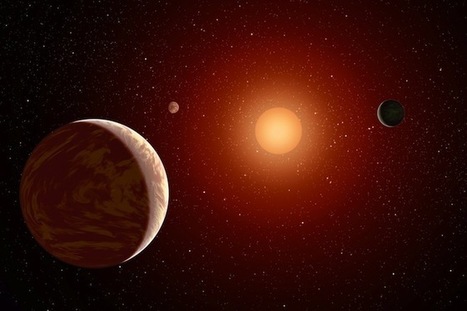
About 40 percent of red dwarf stars may have Earth-sized planets orbiting them that have the right conditions for life.
Red dwarfs – which are smaller and cooler than our sun – are extremely common, making up 80 percent of stars in the galaxy. Their ubiquity suggests that there are tens of billions of possible places to look for life beyond Earth, with at least 100 such planets located nearby. The new estimate comes from a team of astronomers using the European Southern Observatory’s HARPS planet-hunting telescope to look at a sample of 102 nearby red dwarfs over a six-year period. The telescope checked for a characteristic wobble from the star, indicating that at least one planet was tugging on it while orbiting around.
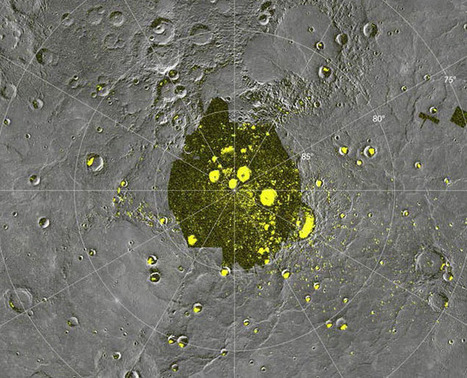
Mercury is the closest planet to the sun; it must therefore be the least likely place to find a reservoir of water ice. However, according to observations made by the Mercury Dual Imaging System (MDIS) aboard NASA's MESSENGER spacecraft and radio telescope data from the 1990s, a supply of water may be held inside Mercury's shady craters in the planet's polar regions.
A team of researchers from the Laboratoire Univers et Theorie (France) coordinated by Jean-Michel Alimi has performed the first-ever computer model simulation of the structuring of the entire observable universe, from the Big Bang to the present day.
The simulation has made it possible to follow the evolution of 550 billion particles. This is the first of three runs which are part of an exceptional project called Deus: full universe run, carried out using GENCI’s new supercomputer CURIE at the CEA's Très Grand Centre de Calcul (TGCC). This simulation, along with the two additional runs expected by late May 2012, will provide outstanding support for future projects dedicated to the observation and mapping of the universe. These simulations will shed light on the nature of dark energy and its effects on cosmic structure formation, and hence on the distribution of dark matter and galaxies in the universe.
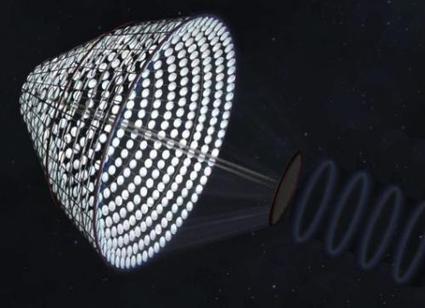
Artemis Innovation Management Solutions has been given some seed money by NASA to look deeper into a project the company first proposed last summer; namely, building a satellite that could collect energy from the sun and beam it back down to Earth to add to the electrical grid. Building such a satellite has been bantered about for several decades by various groups and scientists, but until now, no one had come up with a design that would work given all the constraints of the time. But now, an idea proposed by longtime NASA engineer John Mankins, now with Artemis, has clearly created enough interest within NASA that some money to investigate the idea is being offered.
An international team of researchers led by Masamune Oguri at Kavli IPMU and Naohisa Inada at Nara National College of Technology conduced an unprecedented survey of gravitationally lensed quasars, and used it to measure the expansion history of the universe. The result provides strong evidence that the expansion of the universe is accelerating. There were several observations that suggested the accelerated cosmic expansion, including distant supernovae for which the 2011 Nobel Prize in Physics was awarded. The team's result confirms the accelerated cosmic expansion using a completely different approach, which strengthens the case for dark energy.
Dr Adrienne Erickcek, from the California Institute of Technology (Caltech), and colleagues believe fluctuations contain hints that our Universe "bubbled off" from a previous one.
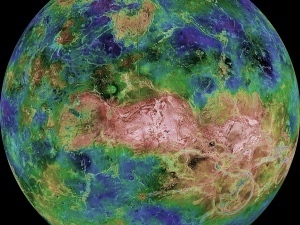
When magnetic fields of opposite polarity collide and merge, they unleash a torrent of energy. The process, known as magnetic reconnection, can cause flares on the Sun and magnetic storms and shimmering auroras on magnetized planets with substantial atmospheres, such as Earth, Jupiter and Saturn. Now scientists have discovered that magnetic reconnection also happens on Venus, a planet with no intrinsic magnetic field. The finding, reported today in Science1, suggests that magnetic reconnection may generate auroras on Venus, and could have contributed to the loss of a thick, water-rich atmosphere that scientists believe surrounded the planet during its early history, some 4 billion years ago.
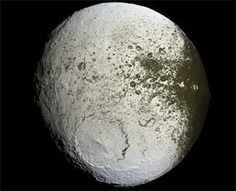
Saturn's bizarre two-tone moon, Iapetus, wears a six-mile high chain of mountains around its equator. Now scientists have a theory that explains why. It turns out the moon may have had its own moon. A new study shows that after a billion years or so, the moon's moon lost a gravitational tug-of-war with Iapetus and got shredded into a debris ring. Over time, the chunks were pulled to the surface of Iapetus, where they neatly piled up along the equator.
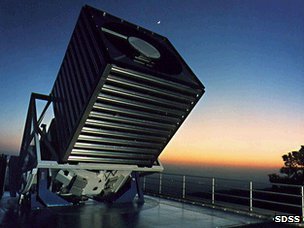
Just 30,000 years after the Big Bang, the universe started singing. Vast soundwaves rang out and expanded through the primordial cosmos, their ripples determining the universe's large-scale structure. And this all fits perfectly with one particularly theory of dark energy. The Baryon Oscillation Spectroscopic Survey, or BOSS, has just completed a massive survey of a whopping 327,349 galaxies. These galaxies are on average about six billion light-years away, which was quite possibly the most momentous time in the universe's history since the Big Bang itself. Six billion years ago, the universe reached a tipping point, where the matter in the universe became spread out enough that the force of gravity could no longer slow down the universe's attraction. Instead, the repulsive force of dark energy took hold, and the universe has been speeding up its expansion ever since.
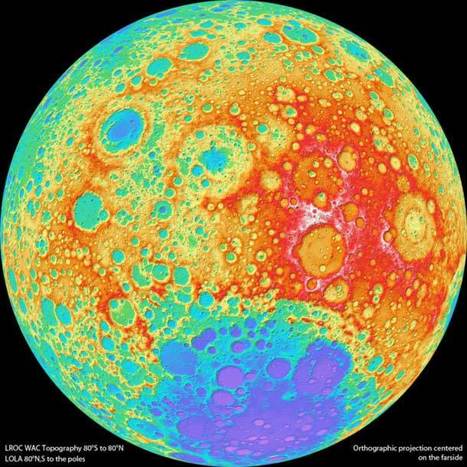
The Lunar Reconnaissance Orbiter takes amazing high-res pictures of the lunar surface. But more than that, it can map the elevations of lunar features using shadows as a guide. Knowing the angles of the Sun, the Moon, and its viewing position, it can accurately gauge the elevations of the Moon’s surface as it takes image after image, orbit after orbit.
The scientists on LRO used that information to put together a wild topographic map of the Moon’s far side. In this map, red represents stuff higher up, blue lower down. The resolution is decent: 100 meters across the surface (NSEW) and 20 meters vertically. Not enough to keep you from stubbing your toe if you’re walking across Mare Orientale, but enough to get pretty good info on the geological history of our nearby cosmic neighbor.
Solar tornadoes several times as wide as the Earth can be generated in the solar atmosphere. The Atmospheric Imaging Assembly saw superheated gases as hot as 50 000 – 2 000 000 Kelvin sucked from the root of a dense structure called prominence, and spiral up into the high atmosphere and travel about 200 000 kilometres along helical paths for a period of at least three hours. The tornadoes were observed on 25 September 2011.
Scientists have discovered an ‘ordinary’ black hole in the 12 million light year-distant galaxy Centaurus A. This is the first time that a normal-size black hole has been detected away from the immediate vicinity of our own Galaxy.
Two huge planets found orbiting a star 375 light-years away are the oldest alien worlds yet discovered, scientists say.
With an estimated age of 12.8 billion years, the host star—and thus the planets—most likely formed at the dawn of the universe, less than a billion years after the big bang. "The Milky Way itself was not completely formed yet," said study leader Johny Setiawan, who conducted the research while at the Max-Planck Institute for Astronomy in Heidelberg, Germany.
To get content containing either thought or leadership enter:
To get content containing both thought and leadership enter:
To get content containing the expression thought leadership enter:
You can enter several keywords and you can refine them whenever you want. Our suggestion engine uses more signals but entering a few keywords here will rapidly give you great content to curate.


 Your new post is loading...