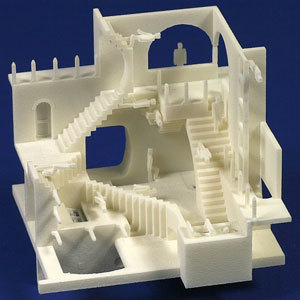
A new, significant milestone has been reached in the world of 3D printing. Objet, French for “Object,” of course, entered into a 3D printing merger with Stratasys earlier this year. That has boosted the company’s ability to rapidly expand its research and development to the point where, recently, it announced that it now has the technology to use 107 different materials in 3D printing applications. Most low-level commercial 3D printers only focus on one kind of plastic or similar substance.
But for industrial-grade purposes, there needs to be a lot more flexibility. Objet allows printing of flexible and rigid materials, opaque and transparent, and all manner of colors and shades. “Objet has become the first 3D printing company to break the 100 materials barrier. Considering that we had half this number just a few short years ago, this growth in material choice confirms our commitment to consistently deliver new and enhanced material properties to our customer,” the company said in a statement.
Anthony Atala is the director of the Wake Forest Institute for Regenerative Medicine, where his work focuses on growing and regenerating tissues and organs. His team engineered the first lab-grown organ to be implanted into a human - a bladder - and is developing experimental fabrication technology that can "print" human tissue on demand.
In 2007, Atala and a team of Harvard University researchers showed that stem cells can be harvested from the amniotic fluid of pregnant women. This and other breakthroughs in the development of smart bio-materials and tissue fabrication technology promises to revolutionize the practice of medicine.
One of the problems with 3D printing is getting a hold of things to print. You can of course download pre-made objects from a variety of places like Thingiverse; but if you want something unique and made by you, that’s where things get a little difficult. Here are 9 quick and easy apps for making something a little more unique.
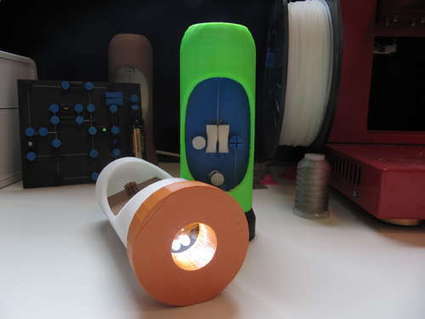
What is an instructable? Given the schematic for a simple circuit, make it a real circuit with the base components, some conductive thread, and a 3D printer. No solder, no etching chemicals, no sending away for anything.
This Instructable is to serve as the how-to guide for a 3D-printed electronic circuit library implemented in OpenSCAD, 3D-PCB. Full replication process is given of a simple analog circuit of a blinking LED made from a few transistors, capacitors, and resistors, a single LED, and a AAA battery, including a detailed review on how to import the library, and use it to place components in OpenSCAD in a grid, plus basic wrapping techniques for all the included features.
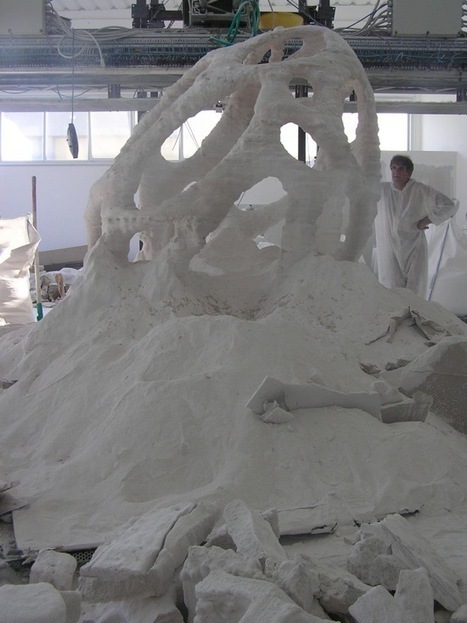
Contour Crafting is a form of 3D printing that uses robotic arms and nozzles to squeeze out layers of concrete or other materials, moving back and forth over a set path in order to fabricate a large component. It is a construction technology that has great potential for low-cost, customized buildings that are quicker to make and can therefore reduce energy and emissions.
The Pirate Bay (TPB), which allows users to share media files via BitTorrent, plans to avoid shutdown by Hollywood by putting some of its servers in GPS controlled drones hovering over international waters, the TPB team told TorrentFreak.
“With the development of GPS controlled drones, far-reaching cheap radio equipment and tiny new computers like the Raspberry Pi, we’re going to experiment with sending out some small drones that will float some kilometers up in the air,” TPB revealed in a blog post.
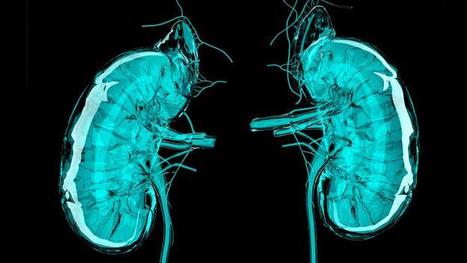
Surgeon Anthony Atala demonstrates an early-stage experiment that could someday solve the organ-donor problem: a 3D printer that uses living cells to output a transplantable kidney. Using similar technology, Dr. Atala's young patient Luke Massella received an engineered bladder 10 years ago; we meet him onstage.
It's exciting to see the development of 3D printing move from little objects to human organs. This advancement illustrates soon many objects will be printable from home - with a printer we drop resources into, or even a sorter that breaks apart other objects to salvage resources for new products.
Researchers are hopeful that new advances in tissue engineering and regenerative medicine could one day make a replacement liver from a patient’s own cells, or animal muscle tissue that could be cut into steaks without ever being inside a cow. Bioengineers can already make 2D structures out of many kinds of tissue, but one of the major roadblocks to making the jump to 3D is keeping the cells within large structures from suffocating; organs have complicated 3D blood vessel networks that are still impossible to recreate in the laboratory.
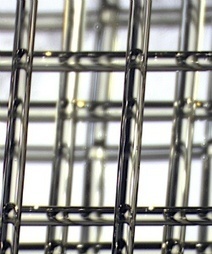
Now, University of Pennsylvania researchers have developed an innovative solution to this perfusion problem: they’ve shown that 3D printed templates of filament networks can be used to rapidly create vasculature and improve the function of engineered living tissues.
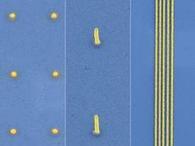
A line appears on the monitor and becomes longer within seconds. It bends off at a right angle, changes direction several times and crosses itself on a couple of occasions until a tangle of lines emerges. Then the line grows more slowly, appears darker, stops and darkens further in a dot of a consistent size. Then it continues: a line, another dot, line, dot, line, dot.
What may sound a bit like Morse code is actually a demonstration of a new technique that ETH-Zurich researchers have developed at the Laboratory of Thermodynamics in Emerging Technologies. The method enables them to print the tiniest of structures on a micro- and nanoscale.
Using this printing method, ultrafine particles are transferred onto a surface from a capillary in a targeted fashion with the aid of an electrical field. Depending on how long material accumulates at the same spot, the structure grows taller, producing a nano-tower.
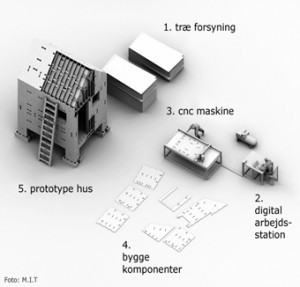
A house designed and built with a computer, printer, and plywood might be the home of the future. Danish architects Frederik Agdrup and Nicholas Bjorndal of Eentileen used just a computer, a “printer” — actually, a computer numerical control (CNC) machine — and 820 sheets of plywood to build a 125 square meter (1,345 square foot) home in four weeks.
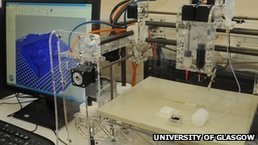
Efforts to create customised medicines using 3D printer-based technology are being developed in Glasgow. Researchers have used a £1,250 system to create a range of organic compounds and inorganic clusters - some of which are used to create cancer treatments. Longer term, the scientists say the process could be used to make customised medicines. It is predicted that this technique will be used by pharmaceutical firms within five years, and by the public within 20.
3D printing will soon allow digital object storage and transportation, as well as personal manufacturing and very high levels of product customization. This video by Christopher Barnatt of ExplainingTheFuture.com illustrates 3D printing today and in the future.
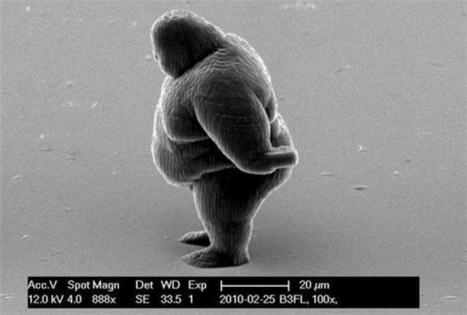
This overweight human figure is a 3D nano object printed by the Vienna University of Technology's recently announced 3D printer. The printer, which uses a technology called "two-photon lithography," prints with liquid resin that is hardened by a focused laser beam. The printer can fabricate tiny nanometer scale structures, like the human figure above, that are the size of a grain of sand at speeds up to five meters per second.
Paleontologist Kenneth Lacovara is looking to print out some robot dinosaurs.
He wants to use a 3-D printer to create dinosaur bones, based on real fossils, to use in scaled-down robo-saurs. In the same way that document programs can shrink a page to 50 or 20 or 2 percent of its original size, a 3-D printing program can shrink a blueprint for 100-foot-long skeletons to a more manageable size for study.
An 83 year-old woman in Belgium had a severely infected jawbone, and researchers and doctors were able to replace it with the world's first 3D printed jaw. 3D printing is an innovative process that allows engineers to essentially spray layers of a material (a plastic or metal for instance) on top of each other in order to create a solid 3D form. 3D printing has allowed engineers to make beautiful art pieces, airplanes and food replacements but until now they’ve not been able to create a bone replacement that was ready to be tested in an actual person — though research is underway at many institutes using a plethora of materials.
To get content containing either thought or leadership enter:
To get content containing both thought and leadership enter:
To get content containing the expression thought leadership enter:
You can enter several keywords and you can refine them whenever you want. Our suggestion engine uses more signals but entering a few keywords here will rapidly give you great content to curate.


 Your new post is loading...