Amazing Science
1.1M views | +15 today
Amazing Science
Amazing science facts - 3D_printing • aging • AI • anthropology • art • astronomy • bigdata • bioinformatics • biology • biotech • chemistry • computers • cosmology • education • environment • evolution • future • genetics • genomics • geosciences • green_energy • language • map • material_science • math • med • medicine • microscopy • nanotech • neuroscience • paleontology • photography • photonics • physics • postings • robotics • science • technology • video
Your new post is loading...
Rescooped by Dr. Stefan Gruenwald from Singularity Scoops
February 5, 2012 11:09 PM
Scoop.it!

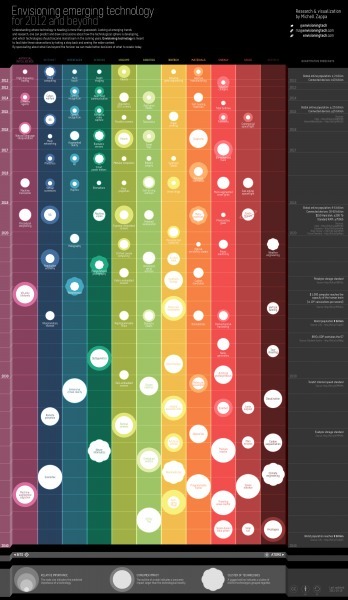
Technology areas to watch in 2012 through 2016

Technology areas to watch in 2012 through 2016 | Amazing Science | Scoop.it

1. Energy Revolution - Mass produced fission, fusion, and maybe cold fusion
2. Memristors and other significant computing and electronic improvements.
3. Robotics
4. Urbanization Broad Group skyscrapers, Tata flat packed buildings
5. Space
6. Supersmartphones, exoskeletons and wearable systems
7. Hyperbroadband
8. Energy Efficiency - superconductors, thermoelectrics, improved grid
9. Additive manufacturing
10. Not so mundane - neuromorphic chips, quantum computers, photonics
11. Automated transportation (leading to robotic cars and planes)
12. Supermaterials
13. Improve medicine and public health
14. Synthetic biology and recombineering
15. Sensors everywhere
16. Education transformed and accelerated innovation


Further reading: http://siliconangle.com/blog/2012/01/13/see-the-future-through-big-data/


Via Frederic Emam-Zade Gerardino
No comment yet.
Rescooped by Dr. Stefan Gruenwald from Web 3.0
February 2, 2012 12:11 PM
Scoop.it!

What Comes After Web 2.0?

What Comes After Web 2.0? | Amazing Science | Scoop.it

It seems fitting that the Internet itself is rife with speculation about what form the successor to Web 2.0 will take. Are we nearing a new age for the Internet? Will Web 3.0 be a revolutionary shift and what exactly will its central features be?


Via Pierre Tran
No comment yet.
Rescooped by Dr. Stefan Gruenwald from The virtual life
February 2, 2012 12:07 PM
Scoop.it!

Does Every Black Hole Contain Another Universe?

Does Every Black Hole Contain Another Universe? | Amazing Science | Scoop.it

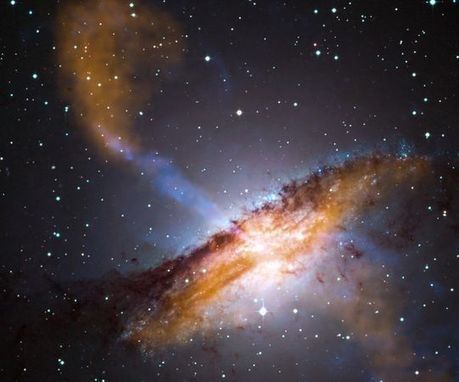
Like part of a cosmic Russian doll, our universe may be nested inside a black hole that is itself part of a larger universe. In turn, all the black holes found so far in our universe—from the microscopic to the supermassive—may be doorways into alternate realities.


In a recent paper published in the journal Physics Letters B, Indiana University physicist Nikodem Poplawski presents new mathematical models of the spiraling motion of matter falling into a black hole. His equations suggest such wormholes are viable alternatives to the "space-time singularities" that Albert Einstein predicted to be at the centers of black holes.


According to Einstein's equations for general relativity, singularities are created whenever matter in a given region gets too dense, as would happen at the ultradense heart of a black hole.  Einstein's theory suggests singularities take up no space, are infinitely dense, and are infinitely hot—a concept supported by numerous lines of indirect evidence but still so outlandish that many scientists find it hard to accept.


If Poplawski is correct, they may no longer have to.

According to the new equations, the matter black holes absorb and seemingly destroy is actually expelled and becomes the building blocks for galaxies, stars, and planets in another reality.

(Related: "Dark Energy's Demise? New Theory Doesn't Use the Force.")


Wormholes Solve Big Bang Mystery?

The notion of black holes as wormholes could explain certain mysteries in modern cosmology, Poplawski said. For example, the big bang theory says the universe started as a singularity. But scientists have no satisfying explanation for how such a singularity might have formed in the first place.  If our universe was birthed by a white hole instead of a singularity, Poplawski said, "it would solve this problem of black hole singularities and also the big bang singularity."


Wormholes might also explain gamma ray bursts, the second most powerful explosions in the universe after the big bang.

Gamma ray bursts occur at the fringes of the known universe. They appear to be associated with supernovae, or star explosions, in faraway galaxies, but their exact sources are a mystery.


Poplawski proposes that the bursts may be discharges of matter from alternate universes. The matter, he says, might be escaping into our universe through supermassive black holes—wormholes—at the hearts of those galaxies, though it's not clear how that would be possible.


"It's kind of a crazy idea, but who knows?" he said. There is at least one way to test Poplawski's theory: Some of our universe's black holes rotate, and if our universe was born inside a similarly revolving black hole, then our universe should have inherited the parent object's rotation.


Via Apmel
No comment yet.
Rescooped by Dr. Stefan Gruenwald from Tracking the Future
February 4, 2012 12:17 AM
Scoop.it!

Driverless Cars: A Driving Force Coming to a Future Near You

Driverless Cars: A Driving Force Coming to a Future Near You | Amazing Science | Scoop.it

Keep in mind that the first wave of driverless vehicles will be luxury vehicles that allow you to kick back, listen to music, have a cup of coffee, stop wherever you need to along the way, stay productive with connections to the Internet, make phone calls, and even watch a movie or two, for roughly the same price. If you think this vision is far off, think again. Over the next 10 years we will see the first wave of autonomous vehicles hit the roads, with some of the first inroads made with vehicles that deliver packages, groceries, and fast-mail envelopes.


Via Szabolcs Kósa
No comment yet.
Rescooped by Dr. Stefan Gruenwald from The virtual life
February 2, 2012 12:08 PM
Scoop.it!

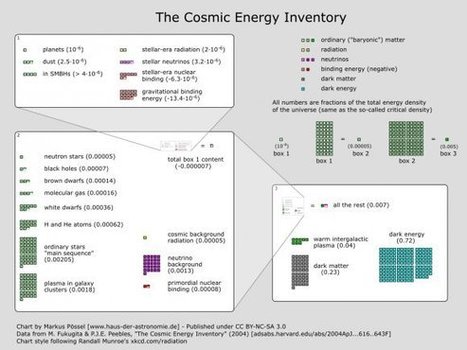
The Cosmic Energy Inventory - Ordinary Matter vs. Dark Matter

The Cosmic Energy Inventory - Ordinary Matter vs. Dark Matter | Amazing Science | Scoop.it
Editor’s Note: Markus Pössel is a theoretical physicist turned astronomical outreach scientist. He is the managing scientist at the Centre for Astronomy Education and Outreach “Haus der Astronomie” in Heidelberg, Germany.

Via Apmel
No comment yet.