Last year, astronomers discovered a quiescent black hole in a distant galaxy that erupted after shredding and consuming a passing star. Now researchers have identified a distinctive X-ray signal observed in the days following the outburst that comes from matter on the verge of falling into the black hole.
This tell-tale signal, called a quasi-periodic oscillation or QPO, is a characteristic feature of the accretion disks that often surround the most compact objects in the universe -- white dwarf stars, neutron stars and black holes. QPOs have been seen in many stellar-mass black holes, and there is tantalizing evidence for them in a few black holes that may have middleweight masses between 100 and 100,000 times the sun's.
Oceans represent an important global carbon sink, absorbing 25% of annual man-made CO2 emissions and helping to slow the rate of climate change. The Southern Ocean in particular is known to be a significant oceanic sink, and accounts for 40% of all carbon entering the deep oceans. And yet, until now, no-one could quite work out how the carbon gets there from the surface waters.
A team of scientists from the UK and Australia has shed new light on the mysterious mechanism by which the Southern Ocean sequesters carbon from the atmosphere. Winds, vast whirlpools and ocean currents interact to produce localized funnels up to 1000 km across, which plunge dissolved carbon into the deep ocean and lock it away for centuries.
Ramesh Raskar presents femto-photography, a new type of imaging so fast it visualizes the world one trillion frames per second, so detailed it shows light itself in motion. This technology may someday be used to build cameras that can look "around" corners or see inside the body without X-rays.
Science and photography studied by an MIT group. This is fascinating. I am going to keep it and share it with my students because he mentions one of the photographers we study throughout the year.
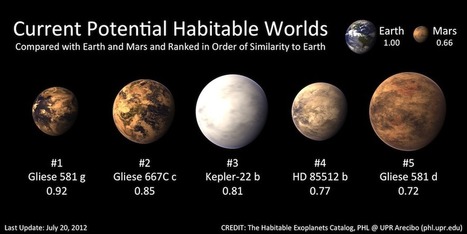
The Habitable Exoplanets Catalog (HEC) is an online database for scientists, educators, and the general public focused on potential habitable exoplanets discoveries. The catalog uses various habitability indices and classifications to identify, rank, and compare exoplanets, including potential satellites, or exomoons. Check the NEWS section for news and updates. A full database of exoplanets is available in the DATA section. The catalog is updated as new data is available. Latest entry is Gliese 581g.
DNA stores and replicates information. Special sequences of different nucleic acids (adenine, cytosine, guanine, thymine) encode life's blueprints. These nucleic acids can be divided into a classical part (massive core) and a quantum part (electron shell and single protons). The laws of quantum mechanics map the classical information (A,C,G,T) onto the configuration of electrons and position of single protons. Although DNA replication requires perfect copies of the classical information, the core that constitutes this information does not directly interact with the copying machine. Instead, only the quantum degrees of freedom are measured. Thus successful copying requires a correct translation of classical to quantum to classical information. It has been shown that the electronic system is well shielded from thermal noise. This leads to entanglement inside the DNA helix. It is an open question if this entanglement influences the genetic information processing. In this talk I will discuss possible consequences of entanglement for the information flow and the similarities and differences between classical computing, quantum computing and DNA information processing.
Scientists have created an ‘early signs timeline’ for Alzheimer’s disease that they believe could help experts detect the condition up to 25 years before it strikes. The study, published in the New England Journal of Medicine, looked at 128 people with a family history of early Alzheimer’s.
The participants were all selected from the Dominantly Inherited Alzheimer's Network, a research centre for those who are genetically predestined to develop the degenerative disease, and considered to have (at least) a 50% chance of inheriting one of three gene mutations that cause the disease.
Join leading researchers Dr. Eric Horvitz of Microsoft Research and Dr. Peter Norvig of Google for an intriguing discussion about the past, present, and future of artificial intelligence, moderated by KQED's Tim Olson.
Machines, as you’ve probably noticed, have been getting smarter. The most recent advance: Google's "Cat Experiment", in which 16,000 computers hooked up to a vast neural network learned to recognize the concept of a “cat” after being shown over 10 million digital photos of cats. This marks a fundamental breakthrough in artificial intelligence for one simple reason: the computers were never told what a “cat” was before the experiment started and were not given a series of human rules for recognizing cats. The computers arrived at an abstract conceptualization of “cat” the same way an infant might arrive at an abstract conceptualization of “cat” before knowing what the word means. It’s the difference between teaching a computer the rules of how to play chess, and a bunch of computers spontaneously arriving at the very concept of chess — and then coming up with a way to win.
Yes, the machines are, for all intents and purposes, alive.
Just as the machines are getting smarter and showing signs of a distributed consciousness, man and machine are starting to co-evolve. In some cases, humans are using machines in order to improve their own functioning. For example, consider Stephen Hawking and iBrain or the new 3D printing technologies that enable the printing of biological organs. Do you need a new kidney or liver? You can now print one on-demand. One day you may be able to go to the Thingiverse — where you can currently order physical-world designs the same way you might order takeout food. For now, body parts are not available, but you can still get digital designs for things like robot hands. In a June 22 report for NPR, Ira Flatow joked that you might be able to order a new nose if you don't like the one you currently have. But it’s easy to see that this is no laughing matter. Imagine being able to re-design your own body using parts that have been created by, ahem, machines.
Finally, these machines are learning how to evolve themselves in a new way without the help of humans. This means that what was “dead matter” now has a new chance to become “living matter.” In a fascinating July 2011 TED Talk, chemist Lee Cronin suggested the theoretical possibility of "evolvable matter" that’s not even based on carbon. What does that even mean? As Cronin suggested in his TED Talk, it’s as if the pen in your hand found a way to start generating other pens, and then these new pens started to evolve. (Yikes!) And that’s not all — it means that non-carbon life may be possible and could conceivably follow the same rules of evolution as carbon-based life forms. Think of the possibilities: At some point in the near future — maybe even within the next two years — these non-carbon life forms would be able to interact with carbon-based life forms.
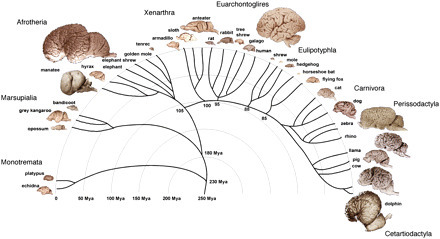
Neuroscientists have become used to a number of “facts” about the human brain: It has 100 billion neurons and 10- to 50-fold more glial cells; it is the largest-than-expected for its body among primates and mammals in general, and therefore the most cognitively able; it consumes an outstanding 20% of the total body energy budget despite representing only 2% of body mass because of an increased metabolic need of its neurons; and it is endowed with an overdeveloped cerebral cortex, the largest compared with brain size. These facts led to the widespread notion that the human brain is literally extraordinary: an outlier among mammalian brains, defying evolutionary rules that apply to other species, with a uniqueness seemingly necessary to justify the superior cognitive abilities of humans over mammals with even larger brains. These facts, with deep implications for neurophysiology and evolutionary biology, are not grounded on solid evidence or sound assumptions, however. The recent development of a method that allows rapid and reliable quantification of the numbers of cells that compose the whole brain has provided a means to verify these facts. With 86 billion neurons and just as many nonneuronal cells, the human brain is a scaled-up primate brain in its cellular composition and metabolic cost, with a relatively enlarged cerebral cortex that does not have a relatively larger number of brain neurons yet is remarkable in its cognitive abilities and metabolism simply because of its extremely large number of neurons.
Tammet has been "studied repeatedly" by researchers in Britain and the United States, and has been the subject of several peer-reviewed scientific papers.Professor Allan Snyder at the Australian National University has said of Tammet: "Savants can't usually tell us how they do what they do. It just comes to them. Daniel can describe what he sees in his head.
That's why he's exciting. He could be the 'Rosetta Stone'
to science." In his mind, he says, each positive integer up to 10,000 has its own unique shape, color, texture and feel. He has described his visual image of 289 as particularly ugly, 333 as particularly attractive, and pi as beautiful.
The number 6 apparently has no distinct image yet what he describes as an almost small nothingness, opposite to the number 9 which he calls large and towering. Tammet has described 25 as energetic and the "kind of number you would invite to a party". In his memoir, Tammet states experiencing a synaesthetic and emotional response for words and numbers, but not letters in algebraic contexts.
Tammet holds the European record for reciting pi from memory to 22,514 digits in five hours and nine minutes on 14 March 2004. Tammet has reportedly learned 10 languages, including Romanian, Gaelic, Welsh, and Icelandic which he learned in a week for a TV documentary.
The "impossible" discovery, spearheaded by Stanford Professor Kevin Arrigo, is a harbinger of major changes in Arctic ecosystems as the planet warms. A massive phytoplankton bloom has been found underneath the Arctic pack ice in the Chukchi Sea. The under-ice bloom, previously thought impossible, will require a complete rethinking of Arctic ecosystems – and is a potent indicator of global warming's effects on the far north. Unlike most Arctic research teams, ICESCAPE headed deep into the Chukchi Sea ice pack, north of the Bering Strait. The research cruise, consisting of prominent scientists in the fields of oceanography, biology, chemistry and optics, was intended to improve NASA's remote monitoring of the Arctic's changing conditions.
Drilling of the seabed off Antarctica has revealed that rainforest grew on the frozen continent 52 million years ago, scientists discovered, warning it could be ice-free again within decades.
The study of sediment cores drilled from the ocean floor off Antarctica's east coast revealed fossil pollens that had come from a "near-tropical" forest covering the continent in the Eocene period, 34-56 million years ago.
Kevin Welsh, an Australian scientist who travelled on the 2010 expedition, said analysis of temperature-sensitive molecules in the cores had showed it was "very warm" 52 million years ago, measuring about 20 degrees Celsius (68 F).
Welsh said higher levels of carbon dioxide in the atmosphere were thought to be the major driver of the heat and ice-free conditions on Antarctica, with CO2 estimates of anywhere between 990 to "a couple of thousand" parts per million.
CO2 is presently estimated at about 395ppm, and Welsh said the most extreme predictions by the Intergovernmental Panel on Climate Change (IPCC) would see ice again receding on Antarctica "by the end of the century".
We're no strangers to infrared photography, yet the visual results of the technology never cease to amaze us. Photographer Oleg Stelmach, aka Elektraua, tackles the art of using infrared film to transform viridescent landscapes into mesmerizing expanses of white, icy foliage. His location of choice is the newly reopened part of Kiev called "Andrew's Descent." The urban setting with a healthy dose of towering trees and plant life is given a brand new, wintery look, boasting ivory leaves against a sapphire sky.
Measles, mumps, pneumonia, influenza and encephalitis in man, Carré's disease in dogs, Ovine Rinderpest (PPR)… all of these diseases are caused by viruses from the same family: Paramyxoviridae.
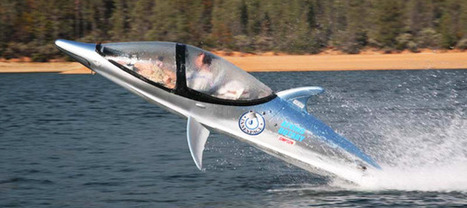
Just like a real dolphin, this motorboat that can travel on the water surface as well as below water surface and can dive, jump and spin over 360 degrees. The dolphin-like Seabreacher is built by a Californian-based company -- Innespace Productions -- and its price tag ranges from US $ 65,000 to US $ 85,000. It comes with Rotax 1500 cc 4 stroke engines in 175 hp and 155 hp standard variants and 215 hp supercharge variant. This water-proof boat is 16 ft in length and 3 ft wide and weighs nearly 566 kg with 14 gallons fuel storage capacity. Additional features include the on-board communication system, snorkel mounted video cameraand dash mounted display. Maximum surface speed is 50 mph, while submerged speed an go up to 20mph. It can dive up to 5 feet for brief durations, can leap 12 feet in air while jumping and rolling 360 degrees.
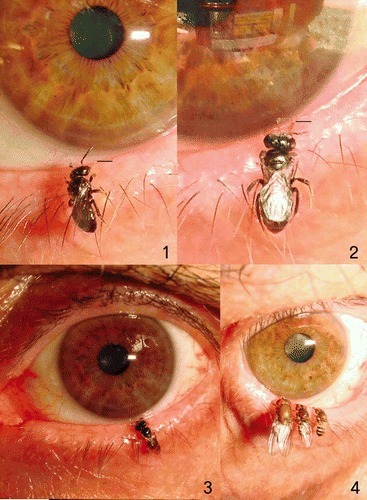
Have you ever thought about how nutritious your bodily fluids are? Full of goodies like salts and proteins…Wild bees know all about it, feeding human sweat and tears as a source of nutrition.
Urban sweat bees, for example, use humans like a salt lick. “These bees prefer sweaty people—over most animals—because the human diet usually is so salty that their perspiration is saturated with the essential nutrient,” according to a recent feature in the Wall Street Journalon sweat bees. A new species (Lasioglossum gotham) of these bees was recently identified from a specimen netted in the heart of Brooklyn.
Although they are as a group fairly common, they’re tiny and they don’t sting, which is why you probably haven’t heard New Yorkers complaining about them. “Most people never notice when the tiny bees alight on a bare arm or leg,” says the WSJ. But what about a bee in your eye, you’d probably notice that right?
Scientists have investigated different families of bees in Thailand that drink tears, both human and animal. Eyes wide open, the researchers used themselves as bee bait. They also used meat, Ovaltine, cheese, and other foods but the bees preferred human tears.
These bees were persistent too: On landing, automatic blinking with the eye often prevented the bee from getting a firm hold, causing it to fall off the eyelashes. If so, the bee persistently tried again and again until it was successful, or finally gave up and flew off. In a very few cases the approach was so gentle that the host (H.B.) did not realize he had a Lisotrigona attached to his lid, imbibing his tears. After landing and whilst sucking tears, H.B. often could barely feel the presence of a bee; indeed, checking by mirror was then req
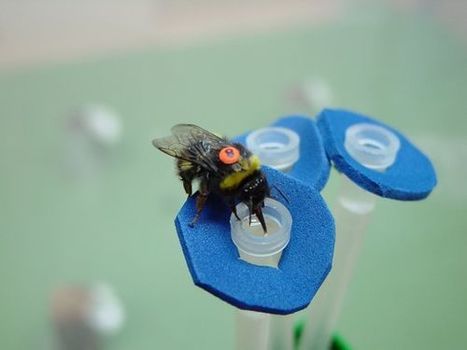
In a landmark 2010 study, researchers found that bumblebees were able to figure out the most efficient routes among several computer-controlled "flowers," quickly solving a complex problem that even stumps supercomputers. We already know bees are pretty good at facial recognition, and researchers have shown they can also be effective air-quality monitors.
Bumblebees can solve the classic "traveling salesman" problem, which keeps supercomputers busy for days. They learn to fly the shortest possible route between flowers even if they find the flowers in a different order, according to the British study.
The traveling salesman problem is a problem in computer science; it involves finding the shortest possible route between cities, visiting each city only once. Bees are the first animals to figure this out, according to Queen Mary University of London researchers.
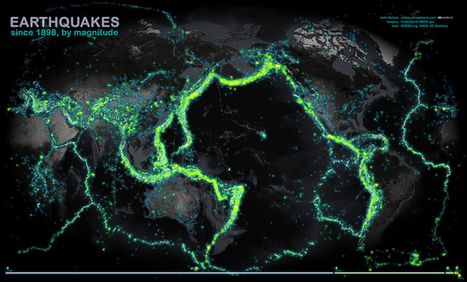
This map of all the world's recorded earthquakes between 1898 and 2003 is stunning. As you might expect, it also creates a brilliant outline of the plates of the Earth's crust—especially the infamous "Ring of Fire" around the Pacific Plate.
The plate boundaries are amazingly vivid in this geovisualization of the all the earthquakes over a 105 year span. How did scientist orginally come up with the theory of plate tectonics? How did spatial thinking and mapping play a role in that scientific endeavor?
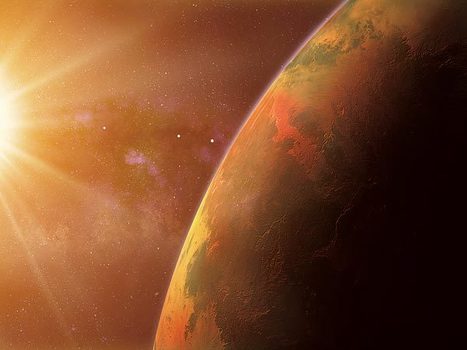
Dubbed GJ676A, the system has two rocky planets orbiting close to its host star, and two gas giants orbiting far away. This means the system is arranged like our system—though in GJ676A, everything is much larger. For instance, the smallest rocky planet in GJ676A is at least four times the mass of Earth, while the largest gas giant is five times the size of Jupiter.
Other multiple-planet systems have been discovered, such as HD10180, which has been called the richest exoplanetary find ever because of the seven to nine planets orbiting its host star.
In the fall of 2011 Peter Norvig taught a class with Sebastian Thrun on artificial intelligence at Stanford attended by 175 students in situ -- and over 100,000 via an interactive webcast. He shares what he learned about teaching to a global classroom.
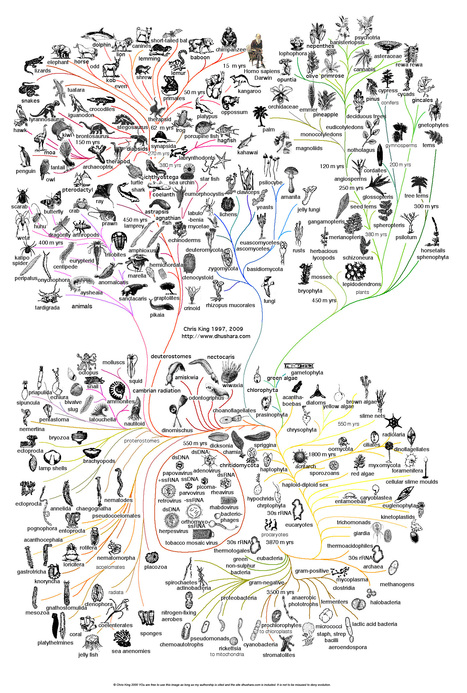
The Tree of Life, in biological terms, has come to be identified with the evolutionary tree of biological diversity. It is this tree which represents the climax fruitfulness of the biosphere and the genetic foundation of our existence, embracing not just higher Eukaryotes, plants, animals and fungi, but Protista, Eubacteria, and Archaea, the realm, including the extreme heat and salt-loving organisms, which appears to lie almost at the root of life itself.
To get content containing either thought or leadership enter:
To get content containing both thought and leadership enter:
To get content containing the expression thought leadership enter:
You can enter several keywords and you can refine them whenever you want. Our suggestion engine uses more signals but entering a few keywords here will rapidly give you great content to curate.


 Your new post is loading...