Your new post is loading...

|
Scooped by
Dr. Stefan Gruenwald
May 20, 2015 4:46 PM
|
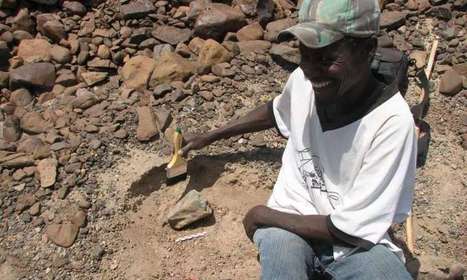
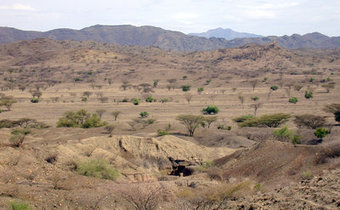
Scientists working in the desert badlands of northwestern Kenya have found stone tools dating back 3.3 million years, long before the advent of modern humans, and by far the oldest such artifacts yet discovered. The tools, whose makers may or may not have been some sort of human ancestor, push the known date of such tools back by 700,000 years; they also may challenge the notion that our own most direct ancestors were the first to bang two rocks together to create a new technology.
Hominins are a group of species that includes modern humans, Homo sapiens, and our closest evolutionary ancestors. Anthropologists long thought that our relatives in the genus Homo - the line leading directly to Homo sapiens - were the first to craft such stone tools. But researchers have been uncovering tantalizing clues that some other, earlier species of hominin, distant cousins, if you will, might have figured it out.
The researchers do not know who made these oldest of tools. But earlier finds suggest a possible answer: The skull of a 3.3-million-year-old hominin, Kenyanthropus platytops, was found in 1999 about a kilometer from the tool site. A K. platyops tooth and a bone from a skull were discovered a few hundred meters away, and an as-yet unidentified tooth has been found about 100 meters away.
The precise family tree of modern humans is contentious, and so far, no one knows exactly how K. platyops relates to other hominin species. Kenyanthropus predates the earliest known Homo species by a half a million years. This species could have made the tools; or, the toolmaker could have been some other species from the same era, such as Australopithecus afarensis, or an as-yet undiscovered early type of Homo.
|
|
Scooped by
Dr. Stefan Gruenwald
April 20, 2015 11:13 AM
|
Bodies found in a 200 year-old Hungarian crypt have revealed the secrets of how tuberculosis (TB) took hold in 18th century Europe, according to a research team involving UCL scientists.
A new study published in Nature Communications details how samples taken from naturally mummified bodies found in an 18th century crypt in the Dominican church of Vác in Hungary have yielded 14 TB genomes, suggesting that mixed infections were common when TB was at peak prevalence in Europe.
The research team included collaborators from the Universities of Warwick and Birmingham, UCL, the Hebrew University in Jerusalem and the Hungarian Natural History Museum in Budapest. Lead author Professor Mark Pallen, from Warwick Medical School, said the discovery was significant for current and future infection control and diagnosis.
Professor Pallen said: “Microbiological analyses of samples from contemporary TB patients usually report a single strain of TB per patient. By contrast, five of the eight bodies in our study yielded more than one type of TB – remarkably from one individual we obtained evidence of three distinct strains.”
The team used a technique called “metagenomics” to identify TB DNA in the historical specimens—that is direct sequencing of DNA from samples without growing bacteria or deliberately fishing out TB DNA. This approach draws on the remarkable throughput and ease of use of modern DNA sequencing technologies.
|
|
Scooped by
Dr. Stefan Gruenwald
March 19, 2015 1:40 PM
|
Once upon a time, 4,000 to 8,000 years after humanity invented agriculture, something very strange happened to human reproduction. Across the globe, for every 17 women who were reproducing, passing on genes that are still around today—only one man did the same.
"It wasn't like there was a mass death of males. They were there, so what were they doing?" asks Melissa Wilson Sayres, a computational biologist at Arizona State University, and a member of a group of scientists who uncovered this moment in prehistory by analyzing modern genes.
Another member of the research team, a biological anthropologist, hypothesizes that somehow, only a few men accumulated lots of wealth and power, leaving nothing for others. These men could then pass their wealth on to their sons, perpetuating this pattern of elitist reproductive success. Then, as more thousands of years passed, the numbers of men reproducing, compared to women, rose again. "Maybe more and more people started being successful," Wilson Sayres says. In more recent history, as a global average, about four or five women reproduced for every one man.
Physically driven natural selection shaped many human traits. Ethnic Africans and Europeans had to evolve to digest milk, for example, while most ethnic Tibetans have adaptations to deal with the lower oxygen levels at high altitudes. But if Wilson Sayres' team's hypothesis is correct, it would be one of the first instances that scientists have found of culture affecting human evolution.
The team uncovered this dip-and-rise in the male-to-female reproductive ratio by looking at DNA from more than 450 volunteers from seven world regions. Geneticists analyzed two parts of the DNA, Y-chromosome DNA and mitochondrial DNA. These don't make up a large portion of a person's genetics, but they're special because people inherit Y-chromosome DNA exclusively from their male ancestors and mitochondrial DNA exclusively from their female ancestors. By analyzing diversity in these parts, scientists are able to deduce the numbers of female and male ancestors a population has. It's always more female.
|
|
Scooped by
Dr. Stefan Gruenwald
March 5, 2015 11:17 AM
|
A 2.8 million-year-old jawbone may be the oldest human fossil in existence,according to two papers published simultaneously in Science. Researchers now suspect that Homo (the genus that includes modern humans) dates back at least 400,000 years earlier than previously thought.
For decades scientists have been scouring Africa for ancient human remains. Archaeologists think Homo habilis, the first truly “human-like” primate, lived about 2.5 million years ago, and Lucy, the human-ape mashup who is perhaps our most famous ancestor, lived about 3.2 million years ago.
But this particular fossil, found in the Afar region of Ethiopia and temporarily named LD 350-1, appears to be a new type of Homo that falls right between Lucy and Homo habilis. The fossil’s slim molars and proportionate jaw are hallmarks of habilis, for instance, but its primitive chin looks a lot more like Lucy’s. For now, the researchers are calling their discovery “Homo species indeterminate,” as they still aren’t exactly sure what it is.
Most 2.8 million-year-old fossils are too ancient to date by conventional means, so the researchers sampled volcanic ash above and below the jawbone and then used argon40 dating to determine the age of the eruption that formed each sample. The results give us the youngest and oldest dates that the hominin who owned LD 350-1 could have lived—2.5 and 2.8 million years ago, respectively.
|
|
Scooped by
Dr. Stefan Gruenwald
February 27, 2015 10:50 AM
|
Hunter-gatherers may have brought agricultural products to the British Isles by trading wheat and other grains with early farmers from the European mainland. That’s the intriguing conclusion of a new study of ancient DNA from a now submerged hunter-gatherer camp off the British coast. If true, the find suggests that wheat made its way to the far edge of Western Europe 2000 years before farming was thought to have taken hold in Britain.
The work confronts archaeologists “with the challenge of fitting this into our worldview,” says Dorian Fuller, an archaeobotanist at University College London who was not involved in the work.
For decades, archaeologists had thought that incoming farmers from the Middle East moved into Europe beginning about 10,500 years ago and replaced or transformed hunter-gatherer populations as they moved west, not reaching Britain until about 6000 years ago. But that worldview had already undergone some modifications. Recent discoveries, for example, have shown some incoming farmers coexisted with the hunter-gatherers already living in Europe rather than quickly replacing them. In 2013, researchers reported that, beginning about 6000 years ago, farmers and hunter-gatherers had both buried their dead in the same cave in Germany and continued to do so for 800 years, suggesting that the two groups were in close contact. More controversially, researchers claimed that about 6500 years ago hunter-gatherers in Germany and Scandinavia may have acquired domesticated pigs from nearby farmers.
|
|
Scooped by
Dr. Stefan Gruenwald
February 19, 2015 12:06 PM
|
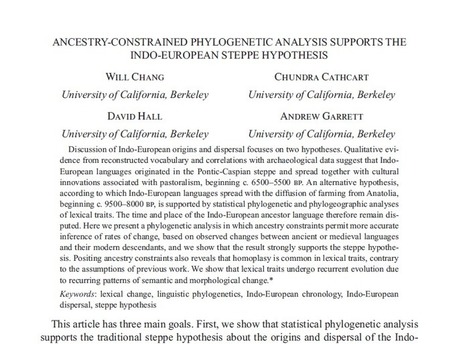
Linguists have long agreed that languages from English to Greek to Hindi, known as 'Indo-European languages', are part of a language family which first emerged from a common ancestor spoken thousands of years ago. Now, a new study gives us more information on when and where it was most likely used. Using data from over 150 languages, linguists at the University of California, Berkeley provide evidence that this ancestor language originated 5,500 - 6,500 years ago, on the Pontic-Caspian steppe stretching from Moldova and Ukraine to Russia and western Kazakhstan.
"Ancestry-constrained phylogenetic analysis supports the Indo-European steppe hypothesis", by Will Chang, Chundra Cathcart, David Hall and Andrew Garrett, will appear in the March issue of the academic journal Language. This article is available on the LSA website.
The article provides new support for the "steppe hypothesis" or "Kurgan hypothesis", which proposes that Indo-European languages first spread with cultural developments in animal husbandry around 4500 - 3500 BCE. An alternate theory proposes that they spread much earlier, around 7500 - 6000 BCE, in Anatolia in modern-day Turkey.
Chang et al. examined over 200 sets of words from living and historical Indo-European languages; after determining how quickly these words changed over time through statistical modeling, they concluded that the rate of change indicated that the languages which first used these words began to diverge approximately 6,500 years ago, in accordance with the steppe hypothesis.
This is one of the first quantitatively-based academic papers in support of the steppe hypothesis, and the first to use a model with "ancestry constraints" which more directly incorporate previously discovered relationships between languages. Discussion of prior studies in favor of and against the steppe hypothesis can be found in the paper.
|
|
Scooped by
Dr. Stefan Gruenwald
January 29, 2015 11:40 AM
|
An ancient human skull fragment found in Israel may come from a close relative of the first modern humans to colonize Europe, researchers say. The finding sheds light on the migration of modern humans out of Africa, and could provide insights into when modern humans first interbred with Neanderthals, scientists added.
Modern humans first arose between 150,000 and 200,000 years ago in Africa. Scientists have suggested the African exodus of modern humans started between 60,000 and 70,000 years ago, but much remains a mystery about this dispersal because of the scarcity of human fossils from this time.
Now, researchers have discovered a 55,000-year-old partial skull in Israel, from about the time when modern humans expanded out of Africa. The investigators say the anatomy of this fossil may offer clues about what the first modern human Europeans were like.
The fossil was discovered accidentally in 2008, when a bulldozer unearthed a cave during a construction project at the modern settlement of Manot, in northern Israel. The original entrance to the cave was sealed off by a rockfall about 30,000 years ago, making it a relatively pristine time capsule, according to co-lead study author Ofer Marder, an archaeologist at Ben-Gurion University of the Negev in Israel.
|
|
Scooped by
Dr. Stefan Gruenwald
December 15, 2014 11:46 AM
|
When early humans discovered how to purposefully create fire and make the most of it for their survival, it was a feat comparable to modern day milestones of sending men to the moon, but while the mastery of fire is hailed as among the most crucial developments in human history and evolution, researchers are not certain when this happened.
Some anthropologists believe that early humans started to exploit fire as early as 1.5 million years ago, but much of the evidence supporting this claim such as the heated clays and charcoal fragments is disputed because they can be attributed to natural bush fires. Many experts also think that the early uses of fire were opportunistic, meaning early humans used natural bush fires instead of starting the fire themselves.
A group of archeologists studying artifacts from an ancient cave, however, claims to have figured out when humans learned to master fire. For their study published in the journal Science on Oct. 19, Ron Shimelmitz, from the Zinman Institute of Archaeology of the University of Haifa in Israel, and colleagues examined artifact, most of which were flint tools and debris excavated from Israel's Tabun Cave. The archeological site, which was declared as having universal value by UNESCO two years ago, documents half a million years of human history and provided the researchers with the opportunity to study how the use of fire evolved in the cave.
By examining the cave's sediment layers, the researchers found that most of the flints were not burned in layers that were older than 350,000 years old. Burned-up flints, however, started to show up more regularly after this with most of the flints characterized by cracking, red or black coloration, and small round depressions where fragments called pot lids flaked off the stone, indicating exposure to fire.
Shimelmitz and colleagues said that while fire had been in use for a long time, it took a while before humans learned how to control and start it with the study indicating that habitual use of fire in Israel's Tabun Cave started just between 350,000-320,000 years ago. "While hominins may have used fire occasionally, perhaps opportunistically, for some million years, we argue here that it only became a consistent element in behavioral adaptations during the second part of the Middle Pleistocene," the researchers wrote.
|
|
Scooped by
Dr. Stefan Gruenwald
December 5, 2014 12:02 PM
|
New genetic research reveals that a small group of hunter-gatherers now living in Southern Africa once was so large that it comprised the majority of living humans during most of the past 150,000 years. Only during the last 22,000 years have the other African ethnicities, including the ones giving rise to Europeans and Asians, become vastly most numerous. Now the Khoisan (who sometimes call themselves Bushmen) number about 100,000 individuals, while the rest of humanity numbers 7 billion. Their lives and ways have remained unaltered for hundreds of generations, with only recent events endangering their hunter-gatherer lifestyles. The study's findings is published in Nature Communications on 4 December 2014.
|
|
Scooped by
Dr. Stefan Gruenwald
November 29, 2014 6:54 PM
|
Why do humans drink milk? Archaeologists and geneticists have been puzzling over this question since they discovered that the mutations allowing adults to drink milk are under the strongest selection of any in the human genome. These mutations cause the human body to produce the intestinal enzyme lactase, which digests lactose milk sugar during infancy, long after weaning. This lactase persistence is prevalent only in some populations around the world, such as in Northern Europe.
In most other people of the world, the lactose cannot be properly digested and can cause diarrhea or other symptoms of lactose intolerance resulting from the gases produced by fermentation by the gut bacteria. Some dairy products, such as yogurt and cheese, have had their lactose content reduced or removed through processing. In the case of cheese, the lactose ends up in the whey, where it is often fed to pigs and other animals. If it is so easy to remove milk sugars, and the mutation is only required for drinking raw milk or whey, why is it under such strong selection?
An international team of researchers has shed new light on this puzzling question through an unusual source: calcified dental plaque on ancient human teeth. Now a breakthrough by the international team, reported in the journal Scientific Reports, provides the first direct evidence of milk drinking from human dental calculus, a mineralized form of dental plaque. Using the latest mass spectrometry-based techniques, the team detected a milk protein, beta-lactoglobulin (which they had previously reported from a modern dental plaque sample), in ancient remains.
“It seemed too good to be true; beta-lactoglobulin is the dominant whey protein—the one used by bodybuilders to build muscle mass—and therefore the ideal marker for milk consumption,” says Jessica Hendy from the University of York’s BioArCh research facility and the study’s co-lead author. The new research provides direct protein evidence that cattle, sheep, and goat whey has been consumed by human populations for at least 5,000 years. This corroborates previous isotopic evidence for milk fats identified on pottery and cooking utensils in early farming communities.
|
|
Scooped by
Dr. Stefan Gruenwald
November 4, 2014 11:41 AM
|
People overrate the chances of dying in a plane crash and guess incorrectly at the odds that a coin toss will yield 'heads' after a string of several 'tails'. Yet humans have an innate sense of chance, a study of indigenous Maya people suggests. Adults in Guatemala who have never learned a formal number system or a written language did as well as formally educated adults and children at estimating the probability of chance events1, the researchers found.
Children are born with a sense of number, and the roots of our mathematical abilities seem to exist in monkeys, chickens and even salamanders. But evidence has suggested that the ability to assess the chances of a future event is not as innate. In a 1972 study, Daniel Kahneman, a psychologist at Princeton University in New Jersey, and the late psychologist Amos Tversky found that educated adults incorrectly judged the sequence of coin tosses 'heads-heads-heads-tails-tails-tails' as less probable than 'heads-tails-heads-tails-tails-heads'2. Any such sequence has the same exact probability, 1/64, of occurring.
Other researchers have pointed to the fact that the mathematics of probability were not worked out until the seventeenth century to argue that probabilistic reasoning is not innate and relies on formal education.
More recent research has pointed to a primitive sense of probability. In a study published in December 2013 and titled “Apes are intuitive statisticians”, researchers found that chimpanzees, gorillas and other great apes made decisions on the basis of the chances of receiving a preferred treat such as a banana over a less-coveted carrot3.
Vittorio Girotto, a cognitive scientist at the University IUAV of Venice, Italy, and his colleagues have found in past work that young children have some grasp of probability, albeit with limits4.
|
|
Scooped by
Dr. Stefan Gruenwald
October 27, 2014 12:21 PM
|
The analysis of artifacts from a 325,000-year-old site in Armenia shows that human technological innovation occurred intermittently throughout the Old World, rather than spreading from a single point of origin, as previously thought.
The study, published today in the journal Science, examines thousands of stone artifacts retrieved from Nor Geghi 1, a unique site preserved between two lava flows dated to 200,000-400,000 years ago. Layers of floodplain sediments and an ancient soil found between these lava flows contain the archaeological material. The dating of volcanic ash found within the sediments and detailed study of the sediments themselves allowed researchers to correlate the stone tools with a period between 325,000 and 335,000 years ago when Earth's climate was similar to today's.
The stone tools provide early evidence for the simultaneous use of two distinct technologies: biface technology, commonly associated with hand axe production during the Lower Paleolithic, and Levallois technology, a stone tool production method typically attributed to the Middle Stone Age in Africa and the Middle Paleolithic in Eurasia. Traditionally, Archaeologists use the development of Levallois technology and the disappearance of biface technology to mark the transition from the Lower to the Middle Paleolithic roughly 300,000 years ago.
Archaeologists have argued that Levallois technology was invented in Africa and spread to Eurasia with expanding human populations, replacing local biface technologies in the process. This theory draws a link between populations and technologies and thus equates technological change with demographic change. The co-existence of the two technologies at Nor Geghi 1 provides the first clear evidence that local populations developed Levallois technology out of existing biface technology.
"The combination of these different technologies in one place suggests to us that, about 325,000 years ago, people at the site were innovative," says Daniel Adler, associate professor of Anthropology at the University of Connecticut, and the study's lead author. Moreover, the chemical analysis of several hundred obsidian artifacts shows that humans at the site utilized obsidian outcrops from as far away as 120 kilometers (approximately 75 miles), suggesting they must also have been capable of exploiting large, environmentally diverse territories.
|
|
Scooped by
Dr. Stefan Gruenwald
September 26, 2014 11:57 AM
|
Ashkenazi Jews (AJ), identified as Jewish individuals of Central- and Eastern European ancestry, form the largest genetic isolate in the United States. AJ demonstrate distinctive genetic characteristics1, 2, including high prevalence of autosomal recessive diseases and relatively high frequency of alleles that confer a strong risk of common diseases, such as Parkinson’s disease3and breast and ovarian cancer4. Several recent studies have employed common polymorphisms5,-13 to characterize AJ as a genetically distinct population, close to other Jewish populations as well as to present-day Middle Eastern and European populations. Previous analyses of recent AJ history highlighted a narrow population bottleneck of only hundreds of individuals in late medieval times, followed by rapid expansion12, 14.
The AJ population is much larger and/or experienced a more severe bottleneck than other founder populations, such as Amish, Hutterites or Icelanders15, whose demographic histories facilitated a steady stream of genetic discoveries. This suggests the potential for cataloguing nearly all founder variants in a large extant population by sequencing a limited number of samples, who represent the diversity in the founding group (for example, ref. 16). Such a catalogue of variants can make a threefold contribution: First, it will enable clinical interpretation of personal genomes in the sizeable AJ population by distinguishing between background variation and recent, potentially more deleterious mutations. Second, it will improve disease mapping in AJ by increasing the accuracy of imputation. Third, the ability to extensively sample a population with ancient roots in the Levant is expected to provide insights regarding the histories of both Middle Eastern and European populations.
Now a team of scientists report high-depth sequencing of 128 complete genomes of AJ controls. Compared with European samples, our AJ panel has 47% more novel variants per genome and is eightfold more effective at filtering benign variants out of AJ clinical genomes. Reconstruction of recent AJ history from such data confirms a recent bottleneck of merely ≈350 individuals. Modeling of ancient histories for AJ and European populations using their joint allele frequency spectrum determines AJ to be an even admixture of European and likely Middle Eastern origins. The researchers date the split between the two ancestral populations to ≈12–25 Kyr, suggesting a predominantly Near Eastern source for the repopulation of Europe after the Last Glacial Maximum.
|
|
|
Scooped by
Dr. Stefan Gruenwald
April 27, 2015 2:29 PM
|
By comparing the genes of current-day North and South Americans with African and European populations, an Oxford University study has found the genetic fingerprints of the slave trade and colonization that shaped migrations to the Americas hundreds of years ago.
The study published in Nature Communications found that: - While Spaniards provide the majority of European ancestry in continental American Hispanic/Latino populations, the most common European genetic source in African-Americans and Barbadians comes from Great Britain.
- The Basques, a distinct ethnic group spread across current-day Spain and France, provided a small but distinct genetic contribution to current-day Continental South American populations, including the Maya in Mexico.
- The Caribbean Islands of Puerto Rico and the Dominican Republic are genetically similar to each other and distinct from the other populations, probably reflecting a different migration pattern between the Caribbean and mainland America.
- Compared to South Americans, people from Caribbean countries (such as the Barbados) had a larger genetic contribution from Africa.
- The ancestors of current-day Yoruba people from West Africa (one of the largest African ethnic groups) provided the largest contribution of genes from Africa to all current-day American populations.
- The proportion of African ancestry varied across the continent, from virtually zero (in the Maya people from Mexico) to 87% in current-day Barbados.
- South Italy and Sicily also provided a significant European genetic contribution to Colombia and Puerto Rico, in line with the known history of Italian emigrants to the Americas in the late 19th and early 20th century.
- One of the African-American groups from the USA had French ancestry, in agreement with historical French immigration into the colonial Southern United States.
- The proportion of genes from European versus African sources varied greatly from individual to individual within recipient populations.
The team, which also included researchers from UCL (University College London) and the Universita' del Sacro Cuore of Rome, analysed more than 4,000 previously collected DNA samples from 64 different populations, covering multiple locations in Europe, Africa and the Americas. Since migration has generally flowed from Africa and Europe to the Americas over the last few hundred years, the team compared the 'donor' African and European populations with 'recipient' American populations to track where the ancestors of current-day North and South Americans came from.
'We found that the genetic profile of Americans is much more complex than previously thought,' said study leader Professor Cristian Capelli from the Department of Zoology. The research team analyzed DNA samples collected from people in Barbados, Columbia, the Dominican Republic, Ecuador, Mexico, Puerto Rico and African-Americans in the USA. They used a technique called haplotype-based analysis to compare the pattern of genes in these 'recipient populations' to 'donor populations' in areas where migrants to America came from.
|
|
Scooped by
Dr. Stefan Gruenwald
April 16, 2015 12:02 PM
|
Scientists working in East Africa say they've unearthed the oldest stone tools ever found. They were apparently made 500,000 years before the human lineage evolved. A team led by Sonia Harmand from Stony Brook University in New York found the tools in Kenya, near Lake Turkana. It's an area that's yielded numerous fossils and tools from early humans. These newly discovered tools have been reliably dated to 3.3 million years ago, according to scientists who've reviewed the research. That's 700,000 years older than the previous record for the oldest stone tools ever found.
That's remarkable because it's well before the human genus, Homo, emerged 2.8 million years ago. So clearly these early humans didn't make these tools. The team presumes they were made by an early ancestor of humans, probably a member of a genus called Australopithecus. The famous ape-like creature known as Lucy was from that genus and first appeared in Africa about four million years ago.
Leading stone tool experts who've seen the tools say they have the markings of a process called "knapping." Knapping a piece of stone produces flakes that can have sharp edges and are useful for working with plants, nuts or meat. These flakes can be distinguished from naturally occurring pieces of rock. Knapping also leaves characteristic marks on the rock from which the flakes are chipped.
Richard Potts, head of the Human Origins Program at the Smithsonian Institution, has examined the tools. He tells NPR they're a "mixed bag," with some quite crude and others a little more sophisticated. Potts says they're not as advanced as most early human-made tools, but "there's no doubt it's purposeful" tool-making. And it's more sophisticated than the kind of tool-making that chimpanzees do, he adds, such as shaping sticks to probe for termites in their underground mounds.
|
|
Scooped by
Dr. Stefan Gruenwald
March 12, 2015 11:33 AM
|
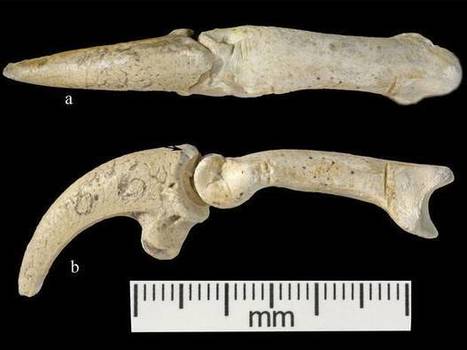
Neanderthals were making jewellery from the talons of the white-tailed eagle – one of the largest birds of prey in Europe – 80,000 years before the first members of our own species Homo sapiens arrived on the continent, scientists have discovered.
A study has revealed that eight claws from at least three different eagles had been made into a necklace or bracelet worn by Neanderthal people when they were the only humans in Europe 150,000 years ago. The scientists said that the discovery shows that Neanderthal man was not the brutish species he is frequently depicted, but someone who was capable of careful planning and an ability to recognise the symbolic beauty of body ornaments.
“Homo sapiens was not so unique in expressions of symbolism. A lot of evidence emerging in the last few years provides new information about the sophistication of Neanderthals, despite all the decades of prehistoric bias and discrimination against them,” said David Frayer, emeritus professor anthropology at the University of Kansas.
“Neanderthals are often thought of to be simple-minded mumbling, bumbling, stumbling fools. But the more we know about them, the more sophisticated they’ve become,” Professor Frayer said.
The eight talons and a foot bone were once attached to one another by a string or thread, the scientists believe. In addition to 21 individual cut marks, the talons have polished surfaces caused by one talon rubbing against another, said Professor Frayer, who was part of the team that identified the jewellery.
“These are the oldest [eagle talons] found and there are eight, all showing signs of wear, polish and/or manipulation, suggesting they were part of a jewellery composition, maybe a necklace, maybe a bracelet,” Professor Frayer said.
|
|
Scooped by
Dr. Stefan Gruenwald
March 3, 2015 10:49 AM
|
Analysis of the genomes of 69 ancient Europeans has revealed that herders moved en masse from Russia into Central Europe around 4,500 years ago. These migrants may be responsible for the expansion of Indo-European languages, which make up the majority of spoken tongues in Europe today.
Data from the genomes of 69 ancient individuals suggest that herders moved en masse from the continent's eastern periphery into Central Europe. These migrants may be responsible for the expansion of Indo-European languages, which make up the majority of spoken tongues in Europe today.
An international team has published the research in the journal Nature. Prof David Reich and colleagues extracted DNA from remains found at archaeological sites around the continent. They used a new DNA-enrichment technique that greatly reduces the amount of sequencing needed to obtain genome-wide data.
Their analyses show that 7,000-8,000 years ago, a closely related group of early farmers moved into Europe from the Near East, confirming the findings of previous studies. The farmers were distinct from the indigenous hunter-gatherers they encountered as they spread around the continent. Eventually, the two groups mixed, so that by 5,000-6,000 years ago, the farmers' genetic signature had become melded with that of the indigenous Europeans.
But previous studies show that a two-way amalgam of farmers and hunters is not sufficient to capture the genetic complexity of modern Europeans. A third ancestral group must have been added to the melting pot more recently.
Prof Reich and colleagues have now identified a likely source area for this later diaspora. The Bronze Age Yamnaya pastoralists of southern Russia are a good fit for the missing third genetic component in Europeans. The team analysed nine genomes from individuals belonging to this nomadic group, which buried their dead in mounds known as kurgans.
The scientists contend that a group similar to the Yamnaya moved into the European heartland after the invention of wheeled vehicles, contributing up to 50% of ancestry in some modern north Europeans. Southern Europeans on the whole appear to have been less affected by the expansion.
|
|
Scooped by
Dr. Stefan Gruenwald
February 25, 2015 1:49 PM
|
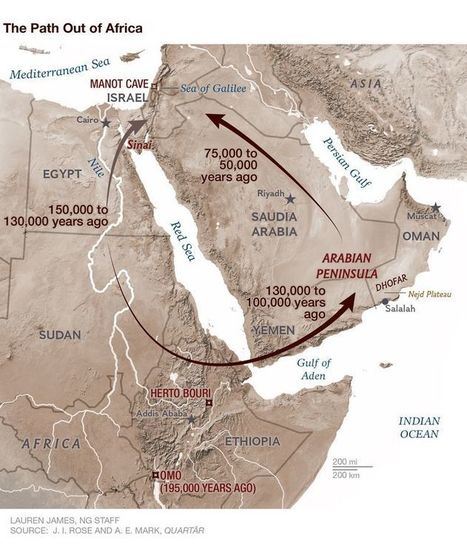
Where did our species come from, and how did we get from there to everywhere? A 55,000-year-old partial skull found in Manot Cave in western Galilee in January 2015 suggests that modern humans were in the Levant around the same time as Neanderthals.
Now, a pair of American archaeologists claim to have uncovered the route those early Homo sapiens took on their way to populating the planet. By following the broken trail of stone tools that modern humans left behind like bread crumbs marking their path, researchers propose that our ancestors took a circuitous path through Arabia, pausing there for some 50,000 years when it was a green oasis. Then they journeyed on to the Middle East, where they first encountered Neanderthals.
Stylistic and manufacturing similarities, the archaeologists say, connect the dots between tools made first in the Nile Valley of Egypt, then in the Arabian Peninsula, and, finally, in Israel. Those tools became progressively smaller and more sophisticated, similar to the evolution of mobile phones today.
"Archaeologists have always focused so much on 'out of Africa and into the Middle East' that we've missed an entire chapter of the human expansion in Arabia," says archaeologist Jeffrey Rose of the Ronin Institute, based in New Jersey, co-author of a new report published this month in Quartär.
|
|
Scooped by
Dr. Stefan Gruenwald
February 9, 2015 2:11 PM
|
Researchers have mapped all 61 tattoos of Ötzi, the 5,300-year-old glacier mummy discovered by hikers in the Ötztal Alps near the Italian-Austrian border in 1991.
Previous studies have already detected fifty or so tattoos, but because they’re difficult to spot—since his skin has darkened over time—researchers haven’t agreed on the final count. Now, an Italian team led by Marco Samadelli of EURAC Research has turned to a non-invasive imaging technique, borrowed from the art world, that can capture light at different wavelengths, ranging from infrared to the ultraviolet. Their technique revealed never-before-seen tattoos.
The 45-year-old male’s 61 tattoos, some of the world’s most ancient examples, take on the form of crosses (or plus signs) and groupings of parallel lines that look like tallies of two to four. They’re all black, and some were as long as four centimeters. Unlike modern tattooing methods that use needles, these were made by rubbing charcoal into fine incisions.
The tattoos were divided into 19 groups across his body, including groups of lines to the left and right of the spinal column, the left calf, the right instep, on the inner and outer ankle joint, and on the chest at the height of the lowermost right rib. (This last one is the newest one discovered.) Two lines lie across his left wrist, and a cross appears on the back of his right knee and next to the left Achilles tendon.
Furthermore, many of his tattoos are located on parts (such as the lower back and joints) that may have caused him pain due to degeneration or disease—suggesting how the tattoos may have been therapeutic, and not symbolic.
“Many people think that it was a kind of treatment because most of the tattoos are very close to areas where he probably suffered from pain," study co-author Albert Zink of EURAC Research tells Live Science. And many of these inked spots even seem to correspond to skin acupuncture lines, the consequence of a form of healing that originated in Asia thousands of years after Ötzi’s time.
A few years ago, researchers sequenced Ötzi’s genome and found that he had O-type blood and was lactose intolerant. Then, last summer, a team analyzing the non-human sequences on the remains found evidence of an oral pathogen involved in gum disease.
Additionally, his arteries were hardened, he had healed rib fractures, a cyst-like growth on his toe, and based on his fingernails, his immune system had been subjected to multiple attacks of severe stress. He’s believed to have died from an arrowhead wound in his left shoulder. Ötzi is housed at the South Tyrol Museum of Archaeology in Italy. The findings were published in Journal of Cultural Heritage.
|
|
Scooped by
Dr. Stefan Gruenwald
January 25, 2015 12:57 PM
|
Some of the morphological characteristics of the human hand are different from that of other primates enabling us to grab objects with precision and use them exerting a force. Yet, how did our early human ancestors use their hands? This question was long debated among scientists. Anthropologists from the University of Kent, working with researchers from University College London, the Max Planck Institute for Evolutionary Anthropology in Leipzig, Germany and the Vienna University of Technology in Austria, have produced the first research findings to support archaeological evidence for stone tool use among fossil Australopiths three to two million years ago and found that Australopithecus africanus used their hands the way modern humans do.
The distinctly human ability for forceful precision (e.g., when turning a key) and power “squeeze” gripping (e.g., when using a hammer) is linked to two key evolutionary transitions in hand use: a reduction in arboreal climbing and the manufacture and use of stone tools. However, it is unclear when these locomotory and manipulative transitions occurred.
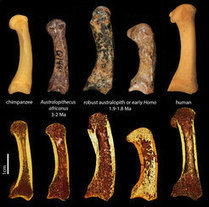
Matthew Skinner and Tracy Kivell of the Max Planck Institute for Evolutionary Anthropology and the University of Kent used new techniques to reveal how fossil species were using their hands by examining the internal spongey structure of bone called trabeculae. Trabecular bone remodels quickly during life and can reflect the actual behaviour of individuals in their lifetime. “Over time these structures adapt in a way that enables them to handle the daily loads in the best way possible“, says Dieter Pahr of the Institute of Lightweight Design and Structural Biomechanics at the Vienna University of Technology where special computer algorithms for the analysis of the computer tomography images of the bones had been developed.
The researchers first examined the trabeculae of hand bones of humans and chimpanzees. They found clear differences between humans, who have a unique ability for forceful precision gripping between thumb and fingers, and chimpanzees, who cannot adopt human-like postures. This unique human pattern is present in known non-arboreal and stone tool-making fossil human species, such as Neandertals.
The research shows that Australopithecus africanus, a three to two million-year-old species from South Africa traditionally considered not to have engaged in habitual tool manufacture, has a human-like trabecular bone pattern in the bones of the thumb and palm (the metacarpals) consistent with forceful opposition of the thumb and fingers typically adopted during tool use. “This new evidence changes our understanding of the behaviour of our early ancestors and, in particular, suggests that in some aspects they were more similar to humans than we previously thought”, says Matthew Skinner of the Max Planck Institute for Evolutionary Anthropology and the University of Kent.
|
|
Scooped by
Dr. Stefan Gruenwald
December 10, 2014 11:34 AM
|
Parchment represents an invaluable cultural reservoir. Retrieving an additional layer of information from these abundant, dated livestock-skins via the use of ancient DNA (aDNA) sequencing has been mooted by a number of researchers. However, prior PCR-based work has indicated that this may be challenged by cross-individual and cross-species contamination, perhaps from the bulk parchment preparation process.
A group of scientists now applied next generation sequencing to two parchments of seventeenth and eighteenth century northern English provenance. Following alignment to the published sheep, goat, cow and human genomes, it is clear that the only genome displaying substantial unique homology is sheep and this species identification is confirmed by collagen peptide mass spectrometry. Only 4% of sequence reads align preferentially to a different species indicating low contamination across species. Moreover, mitochondrial DNA sequences suggest an upper bound of contamination at 5%. Over 45% of reads aligned to the sheep genome, and even this limited sequencing exercise yield 9 and 7% of each sampled sheep genome post filtering, allowing the mapping of genetic affinity to modern British sheep breeds. The scientists conclude that parchment represents an excellent substrate for genomic analyses of historical livestock.
|
|
Scooped by
Dr. Stefan Gruenwald
December 1, 2014 7:19 PM
|
The ability to break down alcohol likely helped human ancestorsmake the most out of rotting, fermented fruit that fell onto the forest floor, the researchers said. Therefore, knowing when this ability developed could help researchers figure out when these human ancestors began moving to life on the ground, as opposed to mostly in trees, as earlier human ancestors had lived. "A lot of aspects about the modern human condition — everything from back pain to ingesting too much salt, sugar and fat — goes back to our evolutionary history," said lead study author Matthew Carrigan, a paleogeneticist at Santa Fe College in Gainesville, Florida. "We wanted to understand more about the modern human condition with regards to ethanol," he said, referring to the kind of alcohol found in rotting fruit and that's also used in liquor and fuel.
To learn more about how human ancestors evolved the ability to break down alcohol, scientists focused on the genes that code for a group of digestive enzymes called the ADH4 family. ADH4 enzymes are found in the stomach, throat and tongue of primates, and are the first alcohol-metabolizing enzymes to encounter ethanol after it is imbibed. The researchers investigated the ADH4 genes from 28 different mammals, including 17 primates. They collected the sequences of these genes from either genetic databanks or well-preserved tissue samples.
The scientists looked at the family trees of these 28 species, to investigate how closely related they were and find out when their ancestors diverged. In total, they explored nearly 70 million years of primate evolution. The scientists then used this knowledge to investigate how the ADH4 genes evolved over time and what the ADH4 genes of their ancestors might have been like.
Then, Carrigan and his colleagues took the genes for ADH4 from these 28 species, as well as the ancestral genes they modeled, and plugged them into bacteria, which read the genes and manufactured the ADH4 enzymes. Next, they tested how well those enzymes broke down ethanol and other alcohols. This method of using bacteria to read ancestral genes is "a new way to observe changes that happened a long time ago that didn't fossilize into bones," Carrigan said.
The results suggested there was a single genetic mutation 10 million years ago that endowed human ancestors with an enhanced ability to break down ethanol. "I remember seeing this huge difference in effects with this mutation and being really surprised," Carrigan said. The scientists noted that the timing of this mutation coincided with a shift to a terrestrial lifestyle. The ability to consume ethanol may have helped human ancestors dine on rotting, fermenting fruit that fell on the forest floor when other food was scarce.
|
|
Scooped by
Dr. Stefan Gruenwald
November 29, 2014 6:51 PM
|
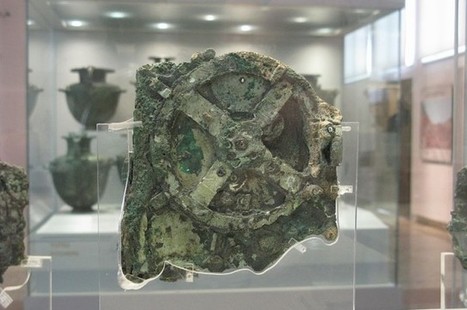
The astonishing Antikythera mechanism is even older than previously suspected, new research suggests. Instead of being "1500 years ahead of its time," it may have been closer to 1800.
The mechanism was found in 1901 in the wreck of a ship that sank in the Aegean Sea around 60 BC. Though its origins are unknown, it could be used to calculate astronomical motion, making it a sort of forerunner to computers.
The sheer sophistication of the device makes it mysterious, being more advanced than any known instrument of its day – or for centuries thereafter. Even with parts missing after spending such a long time in the briny deep, it was examined to have at least 30 gears. This is perhaps why for many, it represents the pinnacle of technology of the ancient world and what was lost during the Dark Ages.
If devices such as this had survived, Kepler might have found the task of explaining the orbits of the planets far easier to achieve. Although the makers likely would not have understood why the moon slowed down and sped up in its orbit, they were sufficiently aware of the phenomenon. In fact, the mechanism mimics it precisely. One of the mechanism's functions was to predict eclipses, and a study of these dials indicates it was operating on a calender starting from 205 BC.
Estimates of the mechanism's date of manufacture have gradually been pushed back, starting with the year in which it sank. The device was housed in a box, which has engravings dated to 80 to 90BC, but the lettering appears consistent with a date of 100 to 150 BC.
However, in The Archive of History of Exact Sciences, Dr. Christian Carman of Argentina's National University of Quilmes and Dr. James Evans of the University of Puget Sound believe they have identified the solar eclipse that occurs in the 13th month of the mechanism's calender. If so, this would make its start date, when the dials are set to zero, May 205 BC.
|
|
Scooped by
Dr. Stefan Gruenwald
October 30, 2014 11:41 AM
|
Archaeologists are known for getting their hands—and everything else—dirty. However, in April 2012, archaeologist Damian Evans boarded a helicopter and spent hours being flown over the dense foliage surrounding Angkor Wat, Cambodia’s legendary complex of ancient stone temples. The heat inside the helicopter was intense, reaching upward of 40 °C, but Evans, a faculty member of the University of Sydney based in Cambodia, much preferred flying over the trees than trudging through the vegetation beneath them. The visible, known temples in Angkor were well-trodden and populated with visitors from all over the world. However, the outlying forest beneath Evans’s ride, lush and green from the air, hid land mines left over from Cambodia’s tumultuous past.
In recent years, archaeologists have used this technology, called LiDAR (a portmanteau of “light” and “radar”), to find ruins of structures—roads, canals, temples, reservoirs—long overgrown with vegetation and hidden from easy observation. LiDAR is revolutionizing what scientists think about the size of ancient cities and how ancient civilizations used the land. It has accelerated the pace of surveying nearly impenetrable areas to a rate that would have been unthinkable just a few years ago.
After 20 hours of flying over two days, the helicopter carrying Evans had surveyed 370 square kilometers (91,400 acres) and Evans had as much data about Angkor’s hidden landforms as he might have gathered during his entire career.
“To achieve the same number of data points as we did with LiDAR would have taken decades on the ground,” Evans says. In addition, Evans says he and his colleagues suspected that previous studies of the area were incomplete. “Our concerns were that previous research had missed three-quarters of the downtown metropolitan part of Angkor.”
The urban sprawl around the temples of Angkor had already been identified as the largest integrated settlement complex of the preindustrial world. However, Evans’s LiDAR map confirmed that existing surveys had been vastly underestimating the size of the formally planned street grid in the central area of the city. In a 2007 PNAS study (1) that combined ground surveys with airborne radar mapping, Evans and his colleagues first found a chaotic, urban sprawl beyond the city walls of the Angkor Wat complex, and the temples were the center of large, urban landscapes.
In a study based on LiDAR maps, published in PNAS in July 2013 (2), Evans et al. reported that the lasers illuminated in exceptional detail that the now-tangled land outside the temple walls had once, 1,000 years ago, been divided into neat rectangles like city blocks, with canals, ponds, and residences. The urban grids found inside the walls had been built outside, too, covering an area of 36 square kilometers. “It’s relatively easy to draw a line around temples, but the revelation from LiDAR is that you find this web of subtle traces of urban networks,” Evans says.
The new study suggests the Angkor capitals were much more densely populated than was previously believed, offering more evidence to a growing idea that the Khmer civilization grew so large that it couldn’t grow enough crops to keep up. Overpopulation, combined with the lack of sustainable agricultural methods, may have left the cities vulnerable to decades-long droughts that struck in the 14th and 15th centuries, the same time the Khmer kings abandoned Angkor.
|
|
Scooped by
Dr. Stefan Gruenwald
October 23, 2014 12:47 PM
|
New research on a 45,000-year-old Siberian thighbone has narrowed the window of time when humans and Neanderthals interbred to between 50,000 and 60,000 years ago, and has shown that modern humans reached northern Eurasia substantially earlier than some scientists thought.
Qiaomei Fu, a postdoctoral fellow at Harvard Medical School (HMS) and first author of a paper describing the research, said the sample had a long history before making its way into her hands.
The bone was found eroding out of a Siberian riverbank, but no one knows precisely where. The bone changed hands several times before finding its way to the Max Planck Institute for Evolutionary Anthropology in Germany, where Fu was working with professors Janet Kelso and Svante Pääbo. Fu put the finishing touches on the research after she started in the laboratory of David Reich, HMS genetics professor.
Carbon dating and molecular analysis filled in many of the blanks about the sample. Testing determined that the sample was from an individual who lived 45,000 years ago on a diet that included plants or plant eaters and fish or other aquatic life.
Reich and Fu said the sample was remarkable because of the extraordinary preservation of its DNA, which allowed Fu, using the latest techniques for ancient DNA analysis, to extract a high-quality genome sequence. The sequence, Reich said, is significantly higher in quality than most genome sequences of present-day people generated for analysis of disease risk.
The sequence revealed that the bone came from a modern human, a man whose remains are the oldest ever found and carbon-dated outside of Africa and the Middle East. Comparison to diverse humans around the world today showed that the man was a member of one of the most ancient non-African populations.
|