Your new post is loading...

|
Rescooped by
Dr. Stefan Gruenwald
from Weird Science
April 4, 2012 2:31 PM
|
Larry Page and Sergey Brin have long had the dream of a hands-free, mobile Google, where search was a seamless process as you moved around the world. As the years progressed the vision did, too, expanding beyond search to persistent connections with the people in your lives.
Via Daniel House
|
|
Scooped by
Dr. Stefan Gruenwald
March 15, 2012 6:31 PM
|
|
|
Scooped by
Dr. Stefan Gruenwald
March 12, 2012 1:31 PM
|
Cyber security is an ever changing and growing concern. Nearly twice as much cyber security funding proposed in the 2013 budget underscores the need for improved computer network defenses. Inadequate security configurations are blamed for 80 percent of the United States Air Force network vulnerabilities. Now Wake Forest University researchers are fighting the continual evolution of viruses, worms and malware with evolution by developing the first-ever automated computer configurations that adjust as quickly as the threats. http://tinyurl.com/7ym382v
|
|
Rescooped by
Dr. Stefan Gruenwald
from Singularity Scoops
February 23, 2012 12:42 PM
|
|
|
Scooped by
Dr. Stefan Gruenwald
February 15, 2012 8:37 PM
|
The breakthrough technology announced by IBM researchers has been long sought: a way to use pulses of light in waveguides instead of electrons in wires for chip connections. Electrons generate heat, which limits has fast chips can work and requires a lot of power for cooling. Light has no such limitations. The new technology could accelerate the performance of supercomputers a thousand times, taking us from the current 2.6 petaflops (10E15 or quadrillion operations per second) Chinese Tianhe-1A supercomputer to an exaflop (10E18 or a quintillion operations per second) supercomputer in just 8 years (“flops” stands for “floating point operations per second”).
A Japanese-developed robot that mimics the movements of its human controller is bringing the Hollywood blockbuster 'Avatar' one step closer to reality.
Via Amanda Stoel
|
|
Scooped by
Dr. Stefan Gruenwald
February 8, 2012 11:18 AM
|
Scientists have developed a “biological computer” capable of deciphering images encrypted on DNA chips. As a proof of concept, the scientists encrypted the Scripps Research and Technion logos on a single DNA chip and, using software, decrypted the separate fluorescent images.
|
|
Scooped by
Dr. Stefan Gruenwald
February 6, 2012 1:10 PM
|
Humanity’s advances to date have been accompanied by great leaps in the density, diversity, and virtuality of our societies, and in the miniaturization and efficiency of our technologies. Among these and other variables determining social progress, two stand out as particularly special. The more our intelligence gains access to “Inner Space,” both to the domain of very small size scales (“Physical Inner Space”), and to the domain of very powerful brain-based and computer-based simulations (“Virtual Inner Space”) the faster we learn to generate major new economic, social, and adaptation benefits for civilization. This “race to Inner Space” may turn out to be the dominant developmental trend for our species.
|
|
Rescooped by
Dr. Stefan Gruenwald
from Singularity Scoops
February 5, 2012 11:10 PM
|
|
|
Rescooped by
Dr. Stefan Gruenwald
from BS2040: Bioinformatics
February 4, 2012 11:49 AM
|
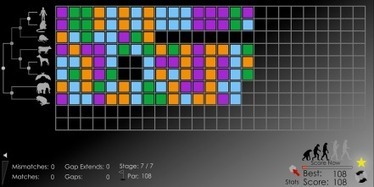
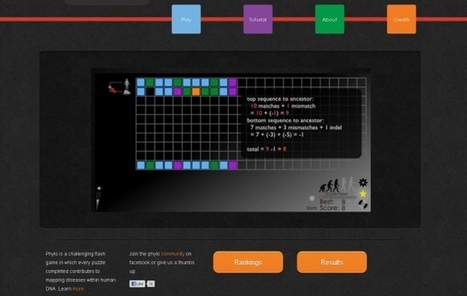
Roughly 17,000 registered players of the DNA sequencing game Phylo have helped solve more than 350,000 problems since November 2010. Read this blog post by Elizabeth Armstrong Moore on Health Tech.
Via Dr Richard Badge
|
|
Scooped by
Dr. Stefan Gruenwald
February 2, 2012 11:46 AM
|
For the first time ever, scientists are using computers and genomic information to predict new uses for existing medicines. “Bringing a new drug to market typically takes about $1 billion, and many years of research and development,” said Rochelle M. Long, Ph.D., who directs the NIH Pharmacogenomics Research Network. “If we can find ways to repurpose drugs that are already approved, we could improve treatments and save both time and money.”
|
|
Scooped by
Dr. Stefan Gruenwald
February 1, 2012 4:40 PM
|
Puzzles have this paradoxical appeal where no matter how much they give the human mind fits, people can’t seem to put them down. Part of this is a testament to the degree in which we pride ourselves as relentless problem-solvers. But for some of life’s most perplexing problems, it’s becoming more apparent that we’re better off handing them off to computers. A recent demonstration of this can be seen in a video released last week in which a smartphone-powered robot solved the legendary Rubik’s cube in 5.352 second flat, beating the world record of 5.66 seconds set by Feliks Zemdegs (a human).
|
|
Scooped by
Dr. Stefan Gruenwald
February 1, 2012 1:51 AM
|
Life must have begun with a simple molecule that could reproduce itself – and now we think we know how to make one.
|
|
|
Scooped by
Dr. Stefan Gruenwald
April 2, 2012 10:33 AM
|
Imagine that you have a big box of sand in which you bury a tiny model of a footstool. That may sound like a scene from a Harry Potter novel, but it’s the vision animating a research project at the Distributed Robotics Laboratory (DRL) at MIT’s Computer Science and Artificial Intelligence Laboratory. At the IEEE International Conference on Robotics and Automation in May — the world’s premier robotics conference — DRL researchers will present a paper describing algorithms that could enable such “smart sand.” They also describe experiments in which they tested the algorithms on somewhat larger particles — cubes about 10 millimeters to an edge, with rudimentary microprocessors inside and very unusual magnets on four of their sides.
|
|
Scooped by
Dr. Stefan Gruenwald
March 13, 2012 5:07 PM
|
Computer game crowdsources DNA sequence alignments across different species. The hope that swarms of gamers can help to solve difficult biological problems has been given another boost by a report in the journal PLoS One1, showing that data gleaned from the online game Phylo are helping to untangle a major problem in comparative genomics. The game was created to address the 'multiple sequence alignment (MSA) problem', which refers to the difficulty of aligning roughly similiar sequences of DNA in genes common to many species. A DNA sequence that is conserved across species suggests that it plays an important role in the ultimate function of that particular gene. http://tinyurl.com/72lxreb
|
|
Scooped by
Dr. Stefan Gruenwald
March 12, 2012 12:07 PM
|
LifeNaut is a free online service (and experiment) for personal data storage and avatar interactivity. It allows people to build a rich personal profile that preserves their essential, unique qualities as ‘mindfiles.’ You can also store your DNA. Mindfiles are database files with uploaded digital information (videos, pictures, documents, and audio recordings) about a person’s unique characteristics (such as mannerisms, attitudes, values, and beliefs). Future AI programs will use a mindfile and a person’s DNA to create a digital clone of that person that can interact with future family members and others. http://www.kurzweilai.net/welcome-to-your-future-clone
|
|
Rescooped by
Dr. Stefan Gruenwald
from innovation and diversity
February 17, 2012 4:47 PM
|
The afternoon of May 6, 2010 was among the strangest in economic history. Starting at 2:42 p.m. EDT, the Dow Jones stock index fell 600 points in just 6 minutes. Its nadir represented the deepest single-day decline in that ...
Via Jacek Rajewski
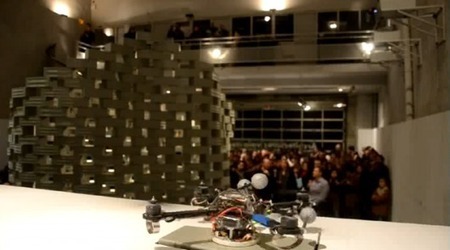
France's FRAC Center is hosting an exhibition featuring flying robots.
Via Amanda Stoel
|
|
Scooped by
Dr. Stefan Gruenwald
February 14, 2012 11:42 AM
|
The stock price of a company continuously changes, going up or down depending on the collective activity of a large number of investors. Although this process seems fairly straightforward, no one fully understands how this collective trading activity finds the "correct" price of a stock. Some theoretical models have been proposed to describe how different investment strategies affect price dynamics, but challenges such as investor confidentiality and complicated data mining make it difficult to gather empirical support for these models.
|
|
Scooped by
Dr. Stefan Gruenwald
February 8, 2012 10:42 AM
|
Wolfram Alpha Pro’s creator wants his “computational knowledge engine” to appeal to more than math and science enthusiasts.
|
|
Rescooped by
Dr. Stefan Gruenwald
from Singularity Scoops
February 6, 2012 1:05 PM
|
|
|
Scooped by
Dr. Stefan Gruenwald
February 5, 2012 10:38 AM
|
Automated genetic tinkering is just the start – this machine could be used to rewrite the language of life and create new species of humans Say hello to the evolution machine. It can achieve in days what takes genetic engineers years. So far it is just a prototype, but if its proponents are to be believed, future versions could revolutionise biology, allowing us to evolve new organisms or rewrite whole genomes with ease. It might even transform humanity itself.
|
|
Rescooped by
Dr. Stefan Gruenwald
from Web 3.0
February 2, 2012 12:11 PM
|
It seems fitting that the Internet itself is rife with speculation about what form the successor to Web 2.0 will take. Are we nearing a new age for the Internet? Will Web 3.0 be a revolutionary shift and what exactly will its central features be?
Via Pierre Tran
|
|
Scooped by
Dr. Stefan Gruenwald
February 1, 2012 5:47 PM
|
For decades our options for interacting with the digital world have been limited to keyboards, mice, and joysticks. Now with a new generation of exciting new interfaces in the pipeline our interaction with the digital world will be forever changed. In this post we will look at some amazing demonstrations, mostly videos, that showcase new ways of interacting with the digital world.
|
|
Scooped by
Dr. Stefan Gruenwald
February 1, 2012 2:06 PM
|
A genetic algorithm (GA) is a search heuristic that mimics the process of natural evolution. This heuristic is routinely used to generate useful solutions to optimization and search problems. Genetic algorithms belong to the larger class of evolutionary algorithms (EA), which generate solutions to optimization problems using techniques inspired by natural evolution, such as inheritance, mutation, selection, and crossover. Annual GECCO conferences are arranged to award the best genetic algorithms.
|