Your new post is loading...

|
Scooped by
Dr. Stefan Gruenwald
October 30, 2015 1:17 PM
|
As of this month, over 4,000 Americans are on the waiting list to receive a heart transplant. With failing hearts, these patients have no other options; heart tissue, unlike other parts of the body, is unable to heal itself once it is damaged. Fortunately, recent work by a group at Carnegie Mellon could one day lead to a world in which transplants are no longer necessary to repair damaged organs.
"We've been able to take MRI images of coronary arteries and 3-D images of embryonic hearts and 3-D bioprint them with unprecedented resolution and quality out of very soft materials like collagens, alginates and fibrins," said Adam Feinberg, an associate professor of Materials Science and Engineering and Biomedical Engineering at Carnegie Mellon University. Feinberg leads the Regenerative Biomaterials and Therapeutics Group, and the group's study was published in the October 23 issue of the journal Science Advances. A demonstration of the technology can be viewed online.
"As excellently demonstrated by Professor Feinberg's work in bioprinting, our CMU researchers continue to develop novel solutions like this for problems that can have a transformational effect on society," said Jim Garrett, Dean of Carnegie Mellon's College of Engineering. "We should expect to see 3-D bioprinting continue to grow as an important tool for a large number of medical applications."
Traditional 3-D printers build hard objects typically made of plastic or metal, and they work by depositing material onto a surface layer-by-layer to create the 3-D object. Printing each layer requires sturdy support from the layers below, so printing with soft materials like gels has been limited.
"3-D printing of various materials has been a common trend in tissue engineering in the last decade, but until now, no one had developed a method for assembling common tissue engineering gels like collagen or fibrin," said TJ Hinton, a graduate student in biomedical engineering at Carnegie Mellon and lead author of the study.
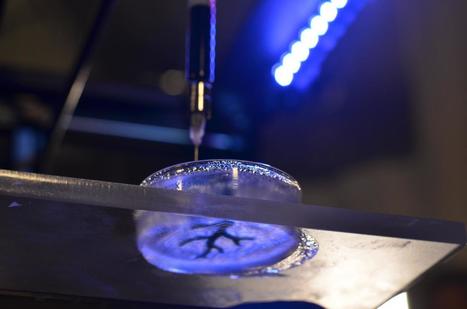
"The challenge with soft materials -- think about something like Jello that we eat -- is that they collapse under their own weight when 3-D printed in air," explained Feinberg. "So we developed a method of printing these soft materials inside a support bath material. Essentially, we print one gel inside of another gel, which allows us to accurately position the soft material as it's being printed, layer-by-layer."
One of the major advances of this technique, termed FRESH, or "Freeform Reversible Embedding of Suspended Hydrogels," is that the support gel can be easily melted away and removed by heating to body temperature, which does not damage the delicate biological molecules or living cells that were bioprinted. As a next step, the group is working towards incorporating real heart cells into these 3-D printed tissue structures, providing a scaffold to help form contractile muscle.
Bioprinting is a growing field, but to date, most 3-D bioprinters have cost over $100,000 and/or require specialized expertise to operate, limiting wider-spread adoption. Feinberg's group, however, has been able to implement their technique on a range of consumer-level 3-D printers, which cost less than $1,000 by utilizing open-source hardware and software.
|
|
Scooped by
Dr. Stefan Gruenwald
September 14, 2015 2:02 PM
|
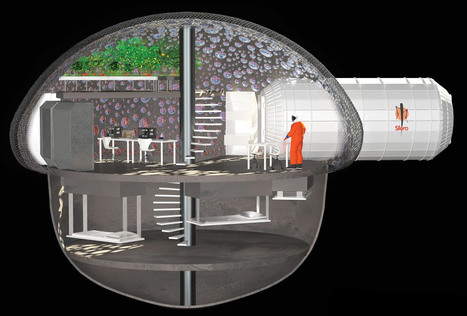
French 3D-printing company Fabulous has brought together a team of scientists and architects to imagine a bubble-shaped habitat for Mars that can be printed on the red planet. The Sfero house features an internal and external dome, with a protective pocket of water between the two. A single corridor rests on the planet's surface and allows access to the interior, which would have an upper and lower level linked by a spiral staircase.
Conceptual drawings show plants being grown indoors, with workstations upstairs and suspended sleeping areas downstairs. Led by Fabulous, the project team united a range of disciplines, with scientists, architects, image specialists and 3D-printing specialists all contributing to the Sfero habitat design.
The house would start off as a central drilling rod that burrows several metres into the planet's soil to extend two robotic arms, which would harvest materials to be used for 3D-printing the habitat's internal and external dome-shaped shells. The spherical shape has been designed to offer high resistance to Mars' low atmospheric density.
The design aims to use the red planet's abundance of iron oxide – discovered in dust samples and rocks brought back by NASA's Pathfinder rovers – which would form the raw material for 3D printing. The powdered iron particles would then be fused together by laser, and the levels of the habitat printed layer by layer. The arms would also seek out permafrost – soil that has been at or below freezing for at least two years – to be melted and used as a 30-centimetre-wide water pocket in between the two shells to protect against solar radiation. Fabulous founder Arnault Coulet believes the water layer could be a "permanent psychological reminder of the main element of the mother planet – water constituting a sort of protective amniotic fluid for humans."
|
|
Scooped by
Dr. Stefan Gruenwald
August 22, 2015 9:05 PM
|
An additive-manufacturing glass-printing process called G3DP (Glass 3D Printing) has been developed by researchers in the Mediated Matter Group at the MIT Media Lab in collaboration with the Glass Lab at MIT.
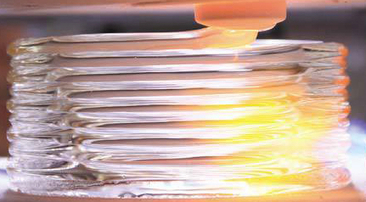
The platform is based on a dual heated-chamber concept. The upper chamber acts as a Kiln Cartridge (a thermally insulated heater) operating at about 1900°F to melt the glass, while the lower chamber serves to anneal (form) the structures. The molten material gets funneled through an alumina-zircon-silica nozzle, which extrudes the material onto a build platform, where it cools and hardens. By tuning the form, transparency, and color variation, the process can drive, limit, or control light transmission, reflection and refraction in the final material.
The G3DP project was created in collaboration between the Mediated Matter group at the MIT Media Lab, the Mechanical Engineering Department, the MIT Glass Lab, and the Wyss Institute. A selection of Glass pieces will appear in an exhibition at Cooper Hewitt, Smithsonian Design Museum, New York City in 2016. An “Additive Manufacturing of Optically Transparent Glass” patent application was filed on April 25, 2014.
References:
|
|
Scooped by
Dr. Stefan Gruenwald
July 28, 2015 12:38 PM
|
By now the thought of a 3D printed structure like a home or an apartment building doesn’t surprise most of us. After all, we know for a fact that several ambitious projects to construct such structures are currently underway. With that said, the majority of these buildings only utilize 3D printing for their exterior walls, as sort of a replacement for the use of concrete block or wood framing.
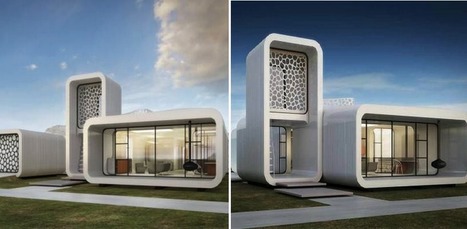
Recently, however, the United Arab Emirates National Innovation Committee has revealed a project which will take things a step or two further. The committee, as well as Shaikh Mohammad Bin Rashid Al Maktoum, UAE Vice-President and Prime Minister and Ruler of Dubai, wants to transform the UAE into a technological center of the world when it comes to architecture and design, and has set forth a plan to 3D print an entire office building. Not only will the exterior walls be printed, but so too will the interior walls, and furniture.
Leading this project will be WinSun Global, a company who has 3D printed an apartment building as well as a home late last year in China, as well as Gensler, Thornton Thomasetti, and Syska Hennessy, all which are leading engineering and architecture firms.
To print the 2,000 square foot building, engineers will use a 20-foot tall 3D printer, which will be assembled on the build site, located at a busy intersection right in the heart of Dubai. They will use Special Reinforced Concrete (SRC), Fiber Reinforced Plastic (FRP), and Glass Fiber Reinforced Gypsum (GRG) to fabricate the various structural and decorative components of the structure. Total construction time will be just a few weeks, while labor costs will be reduced by 50-80% and construction waste will be reduced between 30-60%.
Once completed, the building, will be used for a variety of purposes and will feature its very own 3D printing exhibition inside. This is the first major project undertaken by the ‘Museum of the Future‘, a museum that began construction earlier in the year, with the promise that 3D printing will be utilized in its creation.
|
|
Scooped by
Dr. Stefan Gruenwald
May 27, 2015 2:52 PM
|
A French company better known for designing aircraft systems announced Wednesday that, on May 29, it will release the world’s first commercially available, scientifically accurate, simulated 3-dimensional (3D) model of a whole, healthy heart. The model may, with fine-tuning and additional development, help to revolutionize the way that cardiologists match treatments to individual heart patients.
The culmination of the first phase of Dassault Systemes' “Living Heart Project,” the simulation may soon allow physicians, medical device manufacturers and others to understand disease states and test innovative treatments without resorting to animal testing.
According to Living Heart Project director Steve Levine, it will soon be possible for cardiologists to rehearse difficult procedures using the company’s 3D modeling. Starting on May 29, when the heart model is released, doctors can use the baseline healthy heart to study congenital defects or heart disease by modifying the shape and tissue properties through the use of a software editor.
Levine says that doctors have developed models and simulations of different sections of the heart, but until now, no one had been able to put these pieces together into an holistic simulation.
“What we can now do for devices that go inside the heart is you can test it on the computer the same way you can test planes,” Levine told Mashable in an interview. The project involves 45 medical professionals, organizations and regulatory agencies, including the Food and Drug Administration (FDA), which oversees the U.S. medical industry. The FDA signed a five-year collaborative research agreement with Dassault to help oversee the development of a heart model that can be used for regulatory science.
|
|
Scooped by
Dr. Stefan Gruenwald
May 15, 2015 3:57 PM
|
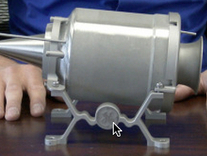
GE engineers have made a simple proof-of-concept 3D-printed mini jet engine that operates at 33,000 rotations per minute. The backpack-sized jet engine was built over the course of several years to test the technology’s abilities and to work on a side project together.
“We wanted to see if we could build a little engine that runs almost entirely out of additive manufacturing parts,” says one of the engineers.
The GE team couldn’t build the complexity of a whole commercial aircraft engine into their working model. Instead, they got plans for a simpler engine developed for remote control model planes and customized them for their 3D printing machines. Their final product measures around a foot long by about eight inches tall.
The team also designed and developed a fuel nozzle that will be additively manufactured for inclusion in the CFM LEAP jet engine for commercial single-aisle aircraft. The FAA recently approved the first 3D printed component for a version of the GE90 jet engine.
|
|
Scooped by
Dr. Stefan Gruenwald
March 25, 2015 12:10 PM
|
With 3D printers everywhere, making everything from Yoda statues to bionic body parts, this company is using 3D printing to make new body tissue. BioBots, a team from the University of Pennsylvania, does just that. They’ve developed a $5,000 3D printer that actually prints functional living tissue. The company just snagged the Most Innovative Company at SXSW’s Accelerator Awards.
And while most of the living tissue BioBots is creating these days is for drug research — to make it less expensive and take animals out of the mix — one day, it could print new organs for transplants. “If we could somehow reveal the failures before testing drugs on people, we would be able to identify false positives much earlier in the drug development process,” CEO and co-founder Danny Cabrera told Forbes. “The problem is in animal testing – mice are not humans, and tests on animals often fail to mimic human diseases or predict how the human body responds to new drugs.
“The Holy Grail is to develop fully functioning replacement organs out of a patient’s own cells, eliminating the organ waiting list, but in the meantime we’ll settle for getting more drugs approved by the FDA at a significantly lower cost on an accelerated time scale, improving the quality of life for millions of people around the world.”
|
|
Scooped by
Dr. Stefan Gruenwald
March 17, 2015 11:42 AM
|
In an iconic scene in the movie "Terminator 2," the robotic villain T-1000 rises fully formed from a puddle of metallic goo. The newest innovation in 3-D printing looks pretty similar, and that's no mistake: Its creators were inspired by that very scene.
The company Carbon3D came out of two years of stealth mode Monday night with a simultaneous TED Talk and Science paper publication. Their new tech, which they say could be used in industrial applications within the next year, makes coveted 3-D printers the likes of those sold by MakerBotlook like child's play.
"We think that popular 3-D printing is actually misnamed — it's really just 2-D printing over and over again," said Joseph DeSimone, a professor of chemistry at University of North Carolina and North Carolina State as well as one of Carbon3D's co-founders. "The strides in that area have mostly been driven by mechanical engineers figuring our how to make things layer by layer to precisely create an object. We're two chemists and a physicist, so we came in with a different perspective."
Just as the evil T-1000 rises from its puddle of metal alloys, objects created by the new printer seem to ooze into existence from the ether. They come out fast, too: 25 to 100 times faster than anything on the market now, according to the study published in Science.
|
|
Scooped by
Dr. Stefan Gruenwald
January 17, 2015 12:46 PM
|
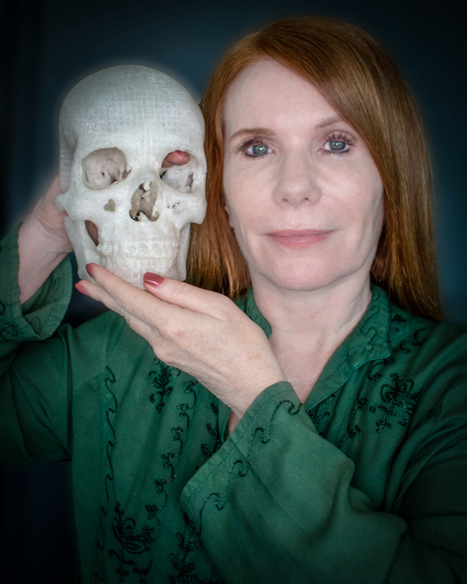
Two highly motivated stakeholders (the patient and her husband) had access to the patient’s medical data and were able to enhance its value using new era tools (software and 3D printing) and bring it to the docs – clearer – so they could better apply their clinical skills. Specifically, the physicians who read the scans before had not seen the situation clearly. With the tumor printed, a better picture emerged. That is adding value in medicine.
Want to print your medical image? Ask your doctor for your DICOM files and download 3D Slicer (slicer.org). Then use the Region Growing tool to segment the image. Extract a 3D mesh of the surface, save as an STL, and use ParaView (paraview.org) to simplify it to a manageable number of triangles. To see more details, check out Make: volume 42, page 83, or visit makezine.com/ projects/3d-print-your-medical-scan.
Full story is here: http://tinyurl.com/nal2oac
|
|
Scooped by
Dr. Stefan Gruenwald
December 28, 2014 7:58 PM
|
Additive manufacturing — or 3D printing — is 30 years old this year. Today, it’s found not just in industry but in households, as the price of 3D printers has fallen below US$1,000. Knowing you can print almost anything, not just marks on paper, opens up unlimited opportunities for us to manufacture toys, household appliances and tools in our living rooms.
But there’s more that can be done with 3D printed materials to make them more flexible and more useful: structures that can transform in a pre-programmed way in response to a stimulus. Recently given the popular science name of “4D printing,” perhaps a better way to think about it is that the object transforms over time.
These sorts of structural deformations are not new — researchers have already demonstrated “memory” and “smart material” properties. One of the most popular technologies is known as shape memory alloy, where a change of temperature triggers a shape change. Other successful approaches use electroactive polymers, pressurised fluids or gasses, chemical stimulus and even in response to light.
In a paper published in Nature Scientific Reports, we looked at the design of complex self-deformations in objects that have been printed from multiple materials as a means to customize the object into specific forms.
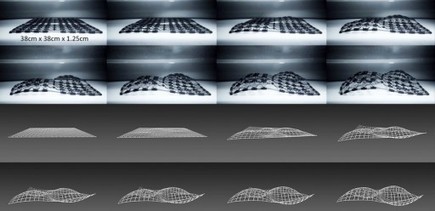
Unlike many others who have demonstrated how to bend simple paper-like shapes, we constructed a two-dimensional grid structure that deforms itself by stretching or shrinking across a complex three-dimensional surface.
Imagine dropping a flat stretchable cloth onto a randomly shaped object, where the cloth molds over the shape beneath it. In geometrical terms, as the curvature of the cloth changes to fit the object, the distances and areas alter. We took this into account by providing a solution that copes with bending and also expansion in size, and came up with several designs that demonstrated that this is possible.
Head of the MIT’s Self-Assembly Laboratory, Skylar Tibbits, started this line of research a few years ago with expanding materials and simple deformations. The collaboration of researchers from MIT’s Camera Culture group and Self-Assembly Laboratory and the companies Stratasys and Autodesk Inc took this further.
Our approach was to print 3D structures using materials with different properties: one that remained rigid and another that expanded up to 200% of its original volume. The expanding materials were placed strategically on the main structure to produce joints that stretched and folded like a bendy straw when activated by water, forming a broad range of shapes. For example, a 3D-printed shape that resembled the initials “MIT” was shown to evolve into another formation that looks like the initials “SAL.”
|
|
Scooped by
Dr. Stefan Gruenwald
December 3, 2014 12:19 PM
|
Surgeons are using new, highly accurate 3D printers to guide face transplantation operations, making the procedures faster and improving outcomes, according to a new report. The face replicas made on these printers take into account bone grafts, metal plates and the underlying bone structure of the skull. They improve surgical planning, which ultimately makes the surgery much shorter, the report authors said.
The new technique has already been used in several patients, including two high-profile face transplant patients — Carmen Tarleton, who was maimed by her husband and received a face transplant in 2013, and Dallas Wiens, who was the first person in the U.S. to receive a full face transplant, in 2011. The surgeries have dramatically improved the lives of the patients, the researchers said.
Having a better understanding of the facial anatomy can also improve outcomes in less dramatic types of facial reconstruction, said Dr. Edward Caterson, a plastic surgeon at Brigham and Women's Hospital who is part of the same face transplant team. For example, when someone's jaw is destroyed, doctors typically harvest a piece of rib or leg bone to replace the missing jaw. Because the tibia, or leg bone, is quite straight, it's tricky to cut it for a perfect fit. 3D printing allows that cut to be done more precisely, Caterson said.
Recently, 3D printing enabled Caterson to harvest bone from a completely new location — the femur, or thigh bone. Though doctors often use rib grafts to replace jawbone, ribs don't have their own blood supply, so they typically collapse after a few years. 3D modeling allowed Caterson to use a portion of the femur that has its own blood supply, which should last much longer, he said.
|
|
Scooped by
Dr. Stefan Gruenwald
November 20, 2014 11:57 AM
|
When the robots of the future are set to extract minerals from other planets, they need to be both self-learning and self-repairing. Researchers at Oslo University have already succeeded in producing self-instructing robots on 3D printers.
“In the future, robots must be able to solve tasks in deep mines on distant planets, in radioactive disaster areas, in hazardous landslip areas and on the sea bed beneath the Antarctic. These environments are so extreme that no human being can cope. Everything needs to be automatically controlled. Imagine that the robot is entering the wreckage of a nuclear power plant. It finds a staircase that no-one has thought of. The robot takes a picture. The picture is analyzed. The arms of one of the robots is fitted with a printer. This produces a new robot, or a new part for the existing robot, which enables it to negotiate the stairs,” hopes Associate Professor Kyrre Glette who is part of the Robotics and intelligent systems research team at Oslo University’s Department of Informatics.
Even if Glette’s ideas remain visions of the future, the robotics team in the Informatics Building have already developed three generations of self-learning robots.
Professor Mats Høvin was the man behind the first model, the chicken-robot named “Henriette”, which received much media coverage when it was launched ten years ago. Henriette had to teach itself how to walk, and to jump over obstacles. And if it lost a leg, it had to learn, unaided, how to hop on the other leg.
A few years later, Masters student Tønnes Nygaard launched the second generation robot. At the same time, the Informatics team developed a simulation program that was able to calculate what the body should look like. Just as for Henriette, its number of legs was pre-determined, but the computer program was at liberty to design the length of the legs and the distance between them.
The third generation of robots brings even greater flexibility. The simulation programme takes care of the complete design and suggests the optimal number of legs and joints.
Simulation is not enough. In order to test the functionality of the robots, they need to undergo trials in the real world. The robots are produced as printouts from a 3D printer. “Once the robots have been printed, their real-world functionalities quite often prove to be different from those of the simulated versions. We are talking of a reality gap. There will always be differences. Perhaps the floor is more slippery in reality, meaning that the friction coefficient will have to be changed. We are therefore studying how the robots deteriorate from simulation to laboratory stage,” says Mats Høvin.
|
|
Scooped by
Dr. Stefan Gruenwald
November 11, 2014 12:48 PM
|
The European Space Agency (ESA) is currently exploring the possibility of establishing a permanent lunar base with the aid of 3D printing technology. The space agency and Foster + Partners, the London-based architecture firm that worked closely with the agency in the exploration of the project, have released a video outlining how they envision a future mission to construct a moonbase may unfold.
Whilst the idea of a frontier settlement on Mars has captured the imagination of the general public, establishing a base on the Moon would be a much more attainable prospect and could even serve as a proving ground for a mission to the Red Planet.
For mankind to establish a permanent outpost beyond low-Earth orbit, certain safeguards are required to protect us from the harsh conditions that prevail beyond the defensive shield of our planet's atmosphere. On a body such as the Moon that only has a minimal atmosphere, an outpost would be exposed to a plethora of dangers including solar radiation and micro-meteoroid impacts.
To mitigate these dangers, ESA has been investigating the potential of using rover-like automatons to 3D print a moonbase around an inflatable habitat dome located at the lunar south pole. Previous experiments carried out by the agency and its partners have already demonstrated that 3D printing such an outpost is indeed viable with lunar materials.
The experiment used basaltic rock extracted from a volcano in central Italy to mimic the qualities of lunar soil with a fidelity of 99.8 percent. Using this material, the team printed a 1.5 tonne (1.7 ton) building block with a hollow closed-cell structure. It is hoped that such building blocks may one day be instrumental in creating a permanent outpost on the Moon.
"3D printing offers a potential means of facilitating lunar settlement with reduced logistics from Earth," states Scott Hovland of ESA’s Human Spaceflight Team. "The new possibilities this work opens up can then be considered by international space agencies as part of the current development of a common exploration strategy."
The process of transforming the "lunar" material into a usable building block began by mixing the basaltic rock with magnesium oxide. This created a paper-like substance that was then manipulated by a 6 m (20 ft) mobile printing array supplied by Monolite UK Ltd. The block was then built up layer by layer and sprayed with a salt-based binding solution that turned the sand-like construction rock hard.
Italian firm Alta SpA, working in conjunction with engineering university Scuola Superiore Sant'Anna, took the project one step further, examining how the terrestrial based 3D printing technique would fare in a vacuum. "The [3D printing] process is based on applying liquids but, of course, unprotected liquids boil away in vacuum," explains Giovanni Cesaretti of Alta. To remedy the issue, the team inserted nozzles distributing the binding solution inside the lunar soil, dispensing 2 mm droplets, small enough to bind the material without boiling away. ESA and its partners are now looking to refine the process, including exploring the possibility of using concentrated sunlight to melt the lunar material into a solid state, which would remove the need to use a binding solution.
|
|
|
Scooped by
Dr. Stefan Gruenwald
October 22, 2015 12:18 PM
|
Children with under-formed or missing ears can undergo surgeries to fashion a new ear from rib cartilage, as shown in the photo. But aspiring surgeons lack lifelike practice models.
A University of Washington (UW) otolaryngology resident and a bioengineering student have used 3-D printing to create a low-cost pediatric rib cartilage model that more closely resembles the feel of real cartilage, which is used in an operation called auricular reconstruction (ear replacement).
The innovation could make it possible for aspiring surgeons to become proficient in the sought-after but challenging procedure. And because the UW models are printed from a CT scan, they mimic an individual’s specific unique anatomy. That offers the opportunity for even an experienced surgeon to practice a particular tricky surgery ahead of time on a patient-specific rib model.
As part of the study, three experienced surgeons practiced carving, bending, and suturing the UW team’s silicone models, which were produced from a 3-D printed mold modeled from a CT scan of an 8-year-old patient. They compared their firmness, feel, and suturing quality to real rib cartilage, and to a more expensive material made out of dental impression material. They preferred the 3-D printed versions.
|
|
Rescooped by
Dr. Stefan Gruenwald
from Research Workshop
September 14, 2015 12:40 PM
|
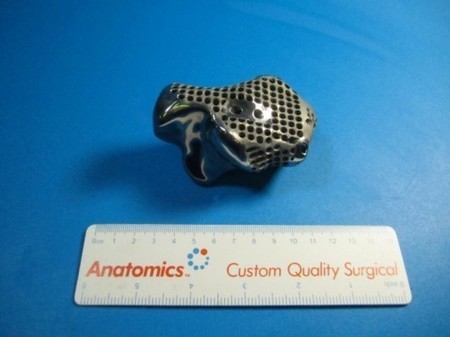
Following a 3D-printed heel bone, a 3D-printed mouth guard for sleep apnea sufferers and the world's first 3D-printed jet engine, Lab 22 at Australia's CSIRO has added to the growing list of 3D-printed medical implants by designing and printing a replacement titanium sternum and rib cage for a 54-year-old cancer patient.
The sternum and rib cage features a complex geometry that means the flat and plate implants traditionally used for this part of the chest can come loose over time. For this reason, the surgical team at the Salamanca University Hospital in Spain thought a custom 3D-printed implant would be a better option for a Spanish man suffering from a chest wall sarcoma – a condition that had resulted in a cancerous tumor growing around his rib cage, requiring certain sections to be removed.
Via Flora Moon, Jocelyn Stoller
|
|
Scooped by
Dr. Stefan Gruenwald
August 16, 2015 12:27 PM
|
Artificial-intelligence researchers have long struggled to make computers perform a task that is simple for humans: picking out one person’s speech when multiple people nearby are talking simultaneously. It is called the ‘cocktail-party problem’. Typical approaches to solving it have either involved systems with multiple microphones, which distinguish speakers based on their position in a room, or complex artificial-intelligence algorithms that try to separate different voices on a recording. But the latest invention, described in this week’s Proceedings of the National Academy of Sciences1, is a simple 3D-printed device that can pinpoint the origin of a sound without the need for any sophisticated electronics.
The device is a thick plastic disk, about as wide as a pizza. Openings around the edge channel sound through 36 passages towards a microphone in the middle. Each passage modifies the sound in a subtly different way as it travels towards the center — roughly as if an equalizer with different settings were affecting the sound in each slice, explains senior author Steven Cummer, an electrical engineer at Duke University in Durham, North Carolina.
The way the disk works is simple, he says. If you speak across the top of a bottle that is partially filled with water, the air inside will resonate with the sound of the voice and attenuate certain frequencies, depending on the amount of water in the bottle. In the plastic disk, the innards of each sector are patterned with a honeycomb-shaped structure in which each hexagonal cell is cut to a different height. The result, Cummer says, is like having an array of bottles filled with different amounts of water.
The human ear is not able to distinguish how the sound is altered by different passages, says lead author Yangbo Xie, also at Duke. But the team wrote an algorithm that, by analysing each sound, can almost always tell which direction it came from.
The device is an 'acoustic metamaterial’: a structure patterned with smaller features and designed to affect the acoustic waves that pass through it. Bruce Drinkwater, a mechanical engineer at the University of Bristol, UK, calls the idea “a really nice one”. He says that the device’s bulk could be a limitation to its practical use, and that this version works only at relatively high frequencies. However, he adds that “there could be plenty of room to optimize the design for size in the future”.
|
|
Scooped by
Dr. Stefan Gruenwald
July 26, 2015 6:58 PM
|
In 2017, Dutch designer Joris Laarman will wheel a robot to the brink of a canal in Amsterdam. He'll hit an "on" button. He'll walk away. And when he comes back two months later, the Netherlands will have a new, one-of-a-kind bridge, 3-D printed in a steel arc over the waters. This isn't some proof-of-concept, either: when it's done, it will be as strong and as any other bridge. People will be able to walk back and forth over it for decades.
That's the plan, anyway. To make his dream a reality, Laarman has created a new research and development company called MX3D, which specializes in building six-axis robots that can 3-D print metal and resin in mid-air. The tech allows for large-scale objects like infrastructure to be printed in the exact spot where they'll live, which has radical implications for the construction industry and opens up a wealth of new design possibilities.
MX3D isn't some high-tech concept; it actually works. In February 2014, Laarman showed off the MX3D system's ability to 3-D printgravity-defying metal sculptures in mid-air. But printing out a bridge on location is a decidedly different challenge than 3-D printing something in a lab.
"We thought to ourselves: what is the most iconic thing we could print in public that would show off what our technology is capable of?" Laarman says in a phone interview. "This being the Netherlands, we decided a bridge over an old city canal was a pretty good choice. Not only is it good for publicity, but if MX3D can construct a bridge out of thin air, it can construct anything."
The finished bridge will be around 24 feet long, support normal Amsterdam foot traffic, and feature a beautiful, intricate design that looks far more handcrafted than the detailing on most bridges. Because 3-D printing allows for a granular control of detail that industrial manufacturing does not, designs can be much more ornate, and almost bespoke in appearance.
Most 3-D printers use resin or plastic to construct objects. MX3D's bridge will be made of a new steel composite that the University of Delft created. As strong as regular steel, it can be dolloped out by a 3-D printer, drop by drop. The result? A 3-D printed bridge as strong as any other, Laarman says.
As for the printer: it isn't much like a Makerbot or any other desktop 3-D printer. For one thing, it has no printer bed. Instead, it works like a train. Except instead of running along existing tracks, it can actually print out its own tracks as it goes along. An additive printing technology that is more like welding than squirting out drops of plastic means that the tracks can go in any direction: not just horizontally, but vertically and diagonally as well. That allows the MX3D to cross gaps, like the empty space between walls, or the banks on a river, just by printing its way across them. A useful skill for a robot to have if it wants to 3-D print a bridge, or any other large structure, for that matter.
|
|
Scooped by
Dr. Stefan Gruenwald
May 22, 2015 9:08 PM
|
Working with researchers at Zhejiang University in China, Changxi Zheng, assistant professor of computer science at Columbia Engineering, has developed a technique that enables hydrographic printing, a widely used industrial method for transferring color inks on a thin film to the surface of manufactured 3D objects, to color these surfaces with the most precise alignment ever attained. Using a new computational method they developed to simulate the printing process, Zheng and his team have designed a model that predicts color film distortion during hydrographic immersion, and uses it to generate a colored film that guarantees exact alignment of the surface textures to the object. The research will be presented at SIGGRAPH 2015, August 9 to 13, in Los Angeles.
"Attaining precise alignment of the color texture onto the surface of an object with a complex surface, whether it's a motorcycle helmet or a 3D-printed gadget, has been almost impossible in hydrographic printing until now," says Zheng. "By incorporating -- for the first time -- a computational model into the traditional hydrographic printing process, we've made it easy for anyone to physically decorate 3D surfaces with their own customized color textures."
Used in mass production for transferring repeated color patterns to a 3D surface, hydrographic printing can be applied to various materials including metal, plastic, wood, and porcelain. The process uses a PVA film with printed color patterns placed on top of water. An activator chemical is then sprayed on the film, softening the color film to make it easily stretchable. Next, a physical object is slowly dipped into the water through the floating film. Once the film touches the object, it gets stretched, wrapping the object's surface, and adhering to it. Throughout the process, the color ink printed on the PVA film is transferred to the surface. But the process has a fundamental limitation in that it is almost impossible to precisely align a color pattern to the object surface, because the object stretches the color film. With complex surfaces, the stretch can be severe and even tear the film apart.
"So current hydrographic printing has been limited to transferring repetitive color patterns," Zheng explains. "But there are many times when a user would like to color the surface of an object with particular color patterns, to decorate a 3D-printed mug with specific, personalized images or just to color a toy."
Building upon previous work on fluid and viscous sheet simulation also done at Columbia Computer Graphics Group, Zheng has developed a new viscous sheet simulation method to model the color film stretch during the hydrographic printing process. This model predicts the stretch and distortion of color films and creates a map between the locations on the film and the surface locations to which they are transferred. With the map, he can compute a color image for printing on the PVA film and then, after the hydrographic immersion, it forms the desired color pattern on the object's surface.
|
|
Scooped by
Dr. Stefan Gruenwald
April 22, 2015 11:34 AM
|
A team from Disney Research, Carnegie Mellon University and Cornell University have devised a 3-D printer that layers together laser-cut sheets of fabric to form soft, squeezable objects such as phone cases and toys. These objects can have complex geometries and incorporate circuitry that makes them interactive.
“Today’s 3-D printers can easily create custom metal, plastic, and rubber objects,” said Jim McCann, associate research scientist at Disney Research Pittsburgh. “But soft fabric objects, like plush toys, are still fabricated by hand. Layered fabric printing is one possible method to automate the production of this class of objects.”
The fabric printer is similar in principle to laminated object manufacturing, which takes sheets of paper or metal that have each been cut into a 2-D shape and then bonds them together to form a 3-D object. Fabric presents particular cutting and handling challenges, however, which the Disney team has addressed in the design of its printer.
The latest soft printing apparatus includes two fabrication surfaces: an upper cutting platform and a lower bonding platform. Fabric is fed from a roll into the device, where a vacuum holds the fabric up against the upper cutting platform while a laser cutting head moves below. The laser cuts a rectangular piece out of the fabric roll, then cuts the layer’s desired 2-D shape or shapes within that rectangle. This second set of cuts is left purposefully incomplete so that the shapes receive support from the surrounding fabric during the fabrication process.
Once the cutting is complete, the bonding platform is raised up to the fabric and the vacuum is shut off to release the fabric. The platform is lowered and a heated bonding head is deployed, heating and pressing the fabric against previous layers. The fabric is coated with a heat-sensitive adhesive, so the bonding process is similar to a person using a hand iron to apply non-stitched fabric ornamentation onto a costume or banner.
Once the process is complete, the surrounding support fabric is torn away by hand to reveal the 3-D object. The researchers demonstrated this technique by using 32 layers of 2-millimeter-thick felt to create a 2 ½-inch bunny. The process took about 2 ½ hours.
Two types of material can be used to create objects by feeding one roll of fabric into the machine from left to right, while a second roll of a different material is fed front to back. If one of the materials is conductive, the equivalent of wiring can be incorporated into the device. The researchers demonstrated the possibilities by building a fabric starfish that serves as a touch sensor, as well as a fabric smartphone case with an antenna that can harvest enough energy from the phone to light an LED.
|
|
Scooped by
Dr. Stefan Gruenwald
March 18, 2015 10:41 PM
|
General Electric and Lawrence Livermore National Laboratory(LLNL) recently received $540,000 to develop open-source algorithms that will improve additive manufacturing (3D printing) of metal parts. The award is from America Makes, the National Additive Manufacturing Innovation Institute that’s focused on helping the U.S. grow capabilities and strength in 3D printing.
The project intends to develop and demonstrate software algorithms that will allow selective laser melting (SLM) to produce metal parts that are high quality and durable. SLM is a metal powder-based, additive manufacturing process where a 3D part is produced, layer by layer, using a focused, high-energy laser beam to fuse the metal powder particles together.
Currently, there is no common approach to SLM that comprehensively reduces problems associated with this method such as surface roughness, residual stress, porosity and micro-cracking. Without careful optimization of the process, these issues may cause parts to fail.
“With the SLM processes in place now, you don’t always end up with a part that is structurally sound,” said Ibo Matthews, a researcher with LLNL’s Accelerated Certification of Additively Manufactured Metals (ACAMM) Strategic Initiative team who is leading the Lab’s effort on the joint project. “It’s critical to have mechanically robust parts, especially for applications in industries such as aerospace and energy, where part failure could lead to major problems.”
To print a 3D part using the SLM process, the user must enter data into the printer using a stereolithography (STL) file, which is a digitized 3D representation of the desired build.
“Ideally, you would send the STL file to an arbitrary 3D printer and it will print out parts that are consistent in terms of dimensions and material properties,” Matthews said. “Currently, that doesn’t happen.” That’s partly because errors appear during the initial translation of the STL file, requiring the user to fill in missing information as well as specify the type of powder material used. To further complicate matters, traditional printer designs treat every layer of powder the same, without giving consideration to the thermal properties of the powder. Some printer systems provide more control than others.
In an ideal system, different layers would demand different laser scanning speeds and powers because the powder environment is changing as the layer-by-layer buildup proceeds.
|
|
Scooped by
Dr. Stefan Gruenwald
March 16, 2015 11:40 AM
|
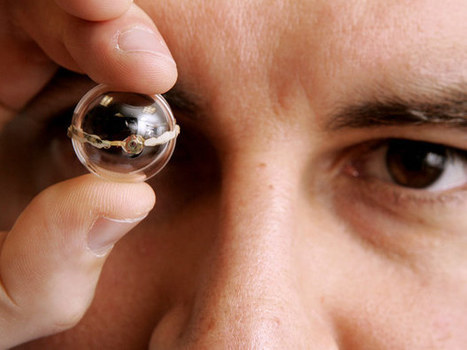
While the research may have only aimed to demonstrate what is possible for 3D printing of electronic devices, researchers at Princeton University have used 3D printing to create an entire contact lens with light-emitting diodes (LEDs) embedded into it.
For the contact lens to actually work, it would require an external energy source, making it impractical as a real-world device. However, the real point for the Princeton team was to show that it’s possible to produce electronic devices into complex shapes using equally complex materials.
"This shows that we can use 3D printing to create complex electronics including semiconductors," said Michael McAlpine, an assistant professor of mechanical and aerospace engineering, in a press release. "We were able to 3D print an entire device, in this case an LED."
The LED was made out of the somewhat exotic nanoparticles known as quantum dots. Quantum dots are a nanocrystal that have been fashioned out of semiconductor materials and possess distinct optoelectronic properties, most notably fluorescence, which makes them applicable in this case for the LEDs of the contact lens.
"We used the quantum dots [also known as nanoparticles] as an ink," McAlpine said. "We were able to generate two different colors, orange and green."
This latest work builds on the Princeton team’s previous work in producing a bionic ear using 3D printing. That research was aimed at demonstrating how electronics and biological materials could be merged using 3D printing.
In this latest research, which was published in the journal Nano Letters, the aim was to show that active electronics could be printed using diverse materials.
|
|
Scooped by
Dr. Stefan Gruenwald
January 9, 2015 12:36 PM
|
3D silicon microstructures formed using concepts similar to those in children's pop-up books, shown here based on a colorized scanning electron micrograph.
Researchers at Northwestern University and the University of Illinois at Urbana-Champaign have developed a simple new fabrication technique to create beautiful, complex 3D micro- and nanostructures with advantages over 3D printing for a variety of uses. The technique mimics the action of a children’s pop-up book — starting as a flat two-dimensional structure and popping up into a more complex 3D structure. Using a variety of advanced materials, including silicon, the researchers produced more than 40 different geometric designs, including shapes resembling a peacock, flower, starburst, table, basket, tent, and starfish.
“In just one shot you get your structure,” said Northwestern’s Yonggang Huang, one of three co-corresponding authors on the study. “We first fabricate a two-dimensional structure on a stretched elastic material. Then we release the tension, and up pops a 3-D structure. The 2-D structure must have some place to go, so it pops up.”
The pop-up assembly technique is expected to be useful in building biomedical devices, sensors and electronics. It is the current cover story in the Jan. 9 issue of the journal Science.
References:
|
|
Scooped by
Dr. Stefan Gruenwald
December 17, 2014 2:35 PM
|
Though printing items like chocolate and pizza might be satisfying enough for some, 3D printing still holds a lot of unfulfilled potential. Talk abounds of disrupting manufacturing, changing the face of construction and even building metal components in space. While it is hard not to get a little bit excited by these potentially world-changing advances, there is one domain where 3D printing is already having a real-life impact. Its capacity to produce customized implants and medical devices tailored specifically to a patient's anatomy has seen it open up all kinds of possibilities in the field of medicine, with the year 2014 having turned up one world-first surgery after another. Let's cast our eye over some of the significant, life-changing procedures to emerge in the past year made possible by 3D printing technology.
|
|
Scooped by
Dr. Stefan Gruenwald
November 25, 2014 10:57 AM
|
When a medication enters the bloodstream, it ends up being concentrated in the liver – after all, one of the organ's main functions is to cleanse the blood. This means that if a drug is going to have an adverse effect on any part of the body, chances are it will be the liver. It would seem to follow, therefore, that if a pharmaceutical company wanted to test the safety of its products, it would be nice to have some miniature human livers on which to experiment – which is just what San Diego-based biotech firm Organovo is about to start selling.
Known as exVive3D, the three-dimensional liver models measure just a few millimeters across, and are created using a 3D bioprinter. The device incorporates two print heads, one of which deposits a support matrix, and the other of which precisely places human liver cells in it.
The resulting models are composed of living human liver tissue, and incorporate hepatocytes, stellate, and endothelial cells – just like a real, full-sized liver. They also produce liver proteins such as albumin, fibrinogen and transferrin, plus they synthesize cholesterol.
Additionally, the cells are arranged in a 3D orientation relative to one another, as they would be naturally. By contrast, the liver cell cultures currently used to test pharmaceuticals are two-dimensional, and thus may not always function in the same manner as the actual organ.
|
|
Scooped by
Dr. Stefan Gruenwald
November 14, 2014 11:32 AM
|
Designed and built in Italy, it will be put to the test as part as ESA astronaut Samantha Cristoforetti’s Futura mission, and is set to reach orbit in the first half of next year. Samantha herself will be launched on her six-month Station assignment on 23 November.
“The POP3D Portable On-Board Printer is a small 3D printer that requires very limited power and crew involvement to operate,” explained Luca Enrietti of Altran, prime contractor for the compact printer.
The unit is a cube with 25 cm sides and prints with biodegradable and harmless plastic using a heat-based process.
“Part of the challenge of designing a 3D printer for the Station was to ensure its operation does not affect the crew environment,” added Giorgio Musso of Thales Alenia Space Italy, principal investigator for the project.
Funded by Italy’s ASI space agency, POP3D should take about half an hour to produce a single plastic part, which will eventually be returned to Earth for detailed testing, including comparison with an otherwise identical part printed on the ground.
The project was presented during a workshop on 3D printing for space held at ESA’s technical centre in Noordwijk, the Netherlands. More than 350 experts from across Europe came together to discuss the potential of 3D printing for space, both in orbit and in ground manufacturing.
|