


MIT neuroscientist Sebastian Seung believes mapping of of the human brain's 100 billion neurons can be done --- one cubic millimeter of brain tissue at a time (http://www.connectomethebook.com/).

 Your new post is loading... Your new post is loading...
 Scoop.it!
MIT neuroscientist Sebastian Seung believes mapping of of the human brain's 100 billion neurons can be done --- one cubic millimeter of brain tissue at a time (http://www.connectomethebook.com/). 
No comment yet.
Sign up to comment
Scoop.it!

In its "5 in 5" forecast, IBM predicts the power to control things with thoughts will be common in five years. Via Frederic Emam-Zade Gerardino
Scoop.it!

Scientists have succeeded in decoding electrical activity in the brain’s temporal lobe — the seat of the auditory system — as a person listens to normal conversation. Based on this correlation between sound and brain activity, they then were able to predict the words the person had heard solely from the temporal lobe activity. Stroke victims or paralyzed people unable to speak will someday be able to communicate via synthesizers that decode their internal speech and play it back.
Scoop.it!

Humans are storytelling machines. We don’t passively perceive the world – we tell stories about it, translating the helter-skelter of events into tidy narratives. This is often a helpful habit, helping us make sense of mistakes, consider counterfactuals and extract a sense of meaning from the randomness of life. But our love of stories comes with a serious side-effect: like all good narrators, we tend to forsake the facts when they interfere with the plot. We’re so addicted to the anecdote that we let the truth slip away until, eventually, those stories we tell again and again become exercises in pure fiction.
Scoop.it!

Caenorhabditis elegans, as the roundworm is properly known, is a tiny, transparent animal just a millimeter long. In nature, it feeds on the bacteria that thrive in rotting plants and animals. It is a favorite laboratory organism for several reasons, including the comparative simplicity of its brain, which has just 302 neurons and 8,000 synapses, or neuron-to-neuron connections. These connections are pretty much the same from one individual to another, meaning that in all worms the brain is wired up in essentially the same way. Such a system is considerably easier to understand than the human brain, a structure with billions of neurons, 100,000 miles of biological wiring and 100 trillion synapses.
|
Scoop.it!

Want to find out why mind uploading is not science fiction? Watch Randal Koene’s interview for www.SingularityWeblog.com to find out! Via Frederic Emam-Zade Gerardino
Scoop.it!
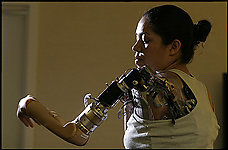
Claudia Mitchell, who lives in Ellicott City, is the fourth person -- and first woman -- to receive a "bionic" arm, which allows her to control parts of the device by her thoughts alone. The device, designed by physicians and engineers at the Rehabilitation Institute of Chicago, works by detecting the movements of a chest muscle that has been rewired to the stumps of nerves that once went to her now-missing limb.
Scoop.it!

Molecular imaging allows molecules in a living organism to be visualized, and provides a means of observing the distribution and behavior of molecules.
“The biggest advantage of molecular imaging using positron emission tomography lies in its applicability to humans.” says Yosky Kataoka, team leader of the Cellular Function Imaging Laboratory at the RIKEN Center for Molecular Imaging Science. Molecular imaging using positron emission tomography (PET) is expected to contribute to the diagnosis of disease, as well as to our understanding of pathologic conditions and therapeutic effects, and to the development of new drugs. It is already being used to diagnose Alzheimer’s disease and cancer. In October 2009, Kataoka’s laboratory announced a groundbreaking achievement that could lead to the development of a diagnostic method for migraine. While many people suffer from migraine, no objective method for diagnosis or treatment has been found so far. Their achievement is attracting attention as a discovery that should dramatically change this situation. Via Diana Cobbe
Scoop.it!
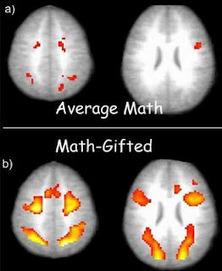
"Most mathematicians did not just take up math as a "job"...(most) get more pleasure out of mathematics than almost any other activity. And they often discovered this pleasure when they were young". While most people would agree that "math people" are not like "non-math people", it's not always easy for non-mathematical minds to recognize (and appropriately nurture) mathematical ones.
|




