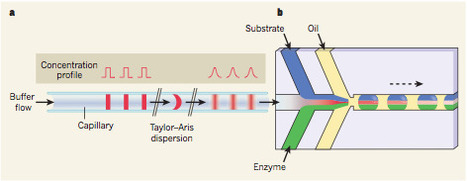
A critical early step in drug discovery is the screening of a chemical library. Typically, promising compounds are identified in a primary screen and then more fully characterized in a dose–response analysis with 7–10 data points per compound. Recently, at team of scientists have introduced a robust microfluidic approach that increases the number of data points to approximately 10,000 per compound. The system exploits Taylor–Aris dispersion to create concentration gradients, which are then segmented into picoliter microreactors by droplet-based microfluidics. The large number of data points results in IC50 values that are highly precise (± 2.40% at 95% confidence) and highly reproducible (CV = 2.45%, n = 16). In addition, the high resolution of the data reveals complex dose–response relationships unambiguously.
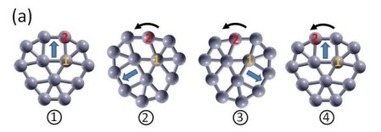
One of the great discoveries of biology is that the engines of life are molecular motors--tiny machines that create, transport and assemble all living things. A couple of year ago, chemists discovered that groups of 13 or 19 boron molecules form into concentric rings that can rotate independently, rather like the piston in a rotary Wankel engine. Because of this, they quickly picked up the moniker "molecular Wankel engines". The only question was how to power them. Now Zhang and his team have calculated that this should be relatively easy -- just zap them with circularly polarised infrared light. That sets the inner ring counter-rotating relative the outer one, like a Wankel engine. Of course, nanotechnologists have identified many molecular motors and even a few rotary versions (ATP springs to mind). What makes this technology special is that the polarised light doesn't excite the molecule's electronic ground state, leaving it free to be chemically active.
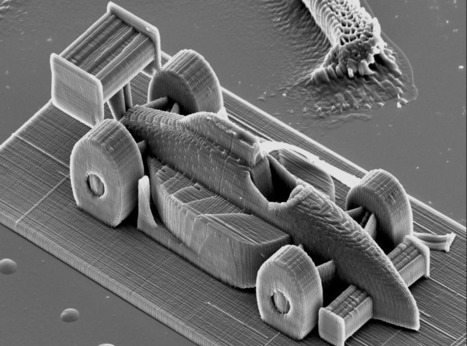
In the video, a race car with dimensions of 330x130x100µm3 is fabricated. The structure consists of 100 layers, each made of an average of 200 polymer lines. It is finished in 4 minutes and resembles the CAD file at a precision of ±1µm.
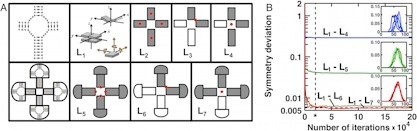
A key element of both biotechnology and nanotechnology is – perhaps unsurprisingly – computational modeling. Frequently, in silico nanostructure design and simulation precedes actual experimentation. Moreover, the ability to use modeling to predict biomolecular structure lays the foundation for the subsequent design of biomolecules. Historically, the problem has been that most modeling software presents a tradeoff between being general purpose (in being able to model systems at high/atomic resolution) but limited in scope (i.e., only explores a small fraction conformational space around the initial structure). Recently, however, Stanford University scientists have developed an algorithm – implemented in a modeling program known as MOSAICS (Methodologies for Optimization and SAmpling In Computational Studies) – that achieves nanoscale modeling at the resolution required without being limited by the scope/size dilemma. In addition, the researchers successfully modeled – and benchmarked the new computation modeling technique with – RNA-based nanostructures.
By bringing long-dead proteins back to life, researchers have worked out the process by which evolution added a component to a cellular machine. Cells rely on “machines” made of multiple different protein components to carry out many vital functions in the cell, and molecular and evolutionary biologists have puzzled about how they evolved.
Joe Thornton at the University of Oregon in Eugene and his team chose to study a particular machine called the V-ATPase proton pump, which channels protons across membranes and is vital for keeping cell compartments at the right acidity. They first scoured databases and pulled out 139 genetic sequences that encode the ring’s component proteins in a range of eukaryotic organisms. They then used computational methods to work backwards and find the most likely sequences of these proteins hundreds of millions of years ago, at key branching points on the evolutionary tree: just before and just after the ring increased in complexity. The team synthesized DNA that encoded these “ancestral” proteins and put it into yeast, which had had parts of its own proton pump deleted. The technique allowed Thornton’s team to test in yeast whether various combinations of ancestral proteins produced a working, proton-pumping machine.
Printing three-dimensional objects with incredibly fine details is now possible using “two-photon lithography”. With this technology, tiny structures on a nanometer scale can be fabricated.
Titanium dioxide breaks down dirt and kills microbes when exposed to some types of light. It already has found uses in self-cleaning windows, kitchen and bathroom tiles, odor-free socks and other products. Self-cleaning cotton fabrics have been made in the past, but they self-clean thoroughly only when exposed to ultraviolet rays. This new cotton fabric, however, cleans itself when exposed to ordinary sunlight.
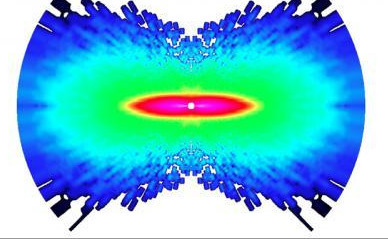
Researchers at Ohio State University and Kansas State University have captured the first-ever images of atoms moving in a molecule. Shown here is molecular nitrogen. The researchers used an ultrafast laser to knock one electron from the molecule, and recorded the diffraction pattern that was created when the electron scattered off the molecule. The image highlights any changes the molecule went through during the time between laser pulses: one quadrillionth of a second. The constituent atoms' movement is shown as a measure of increasing angular momentum, on a scale from dark blue to pink, with pink showing the region of greatest momentum.
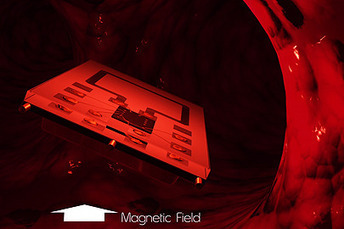
For 50 years, scientists searched for the secret to making tiny implantable devices that could travel through the bloodstream. Engineers at Stanford have demonstrated just such a device.
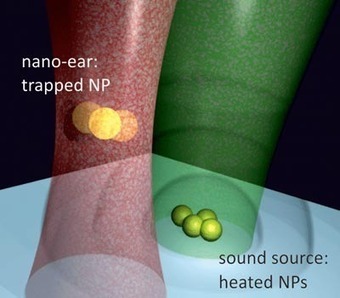
Physicists in Germany have developed the first-ever "nano-ear" capable of detecting sound on microscopic length scales with an estimated sensitivity that is six orders of magnitude below the threshold of human hearing. The device is based on an optically trapped gold nanoparticle, and its inventors claim that it could be used to "listen" to biological micro-organisms as well as investigate the motion and vibrations in tiny machines.
The “miracle material” graphene is the world’s thinnest known coating for protecting metals against corrosion. In the study, Dhiraj Prasai and colleagues point out that rusting and other corrosion of metals is a serious global problem, and intense efforts are underway to find new ways to slow or prevent it. Corrosion results from contact of the metal’s surface with air, water or other substances. One major approach involves coating metals with materials that shield the metal surface, but currently used materials have limitations. The scientists decided to evaluate graphene as a new coating. Graphene is a single layer of carbon atoms, many layers of which are in lead pencils and charcoal, and is the thinnest, strongest known material. That’s why it is called the miracle material. In graphene, the carbon atoms are arranged like a chicken-wire fence in a layer so thin that is transparent, and an ounce would cover 28 football fields.
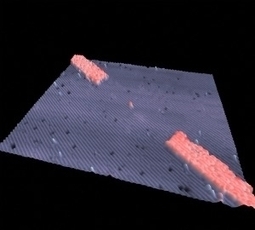
Physicists at the University of New South Wales have created a transistor composed of a single atom, which is an amazing feat of nanoengineering, and could provide a better foundation for scalable quantum computing.
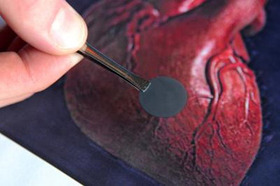
In the future, implantable computerized dispensaries will replace trips to the pharmacy or doctor’s office, automatically leaching drugs into the blood from medical devices embedded in our bodies. These small wireless chips promise to reduce pain and inconvenience, and they’ll ensure that patients get exactly the amount of drugs they need, all at the push of a button.
Acquista Online La Prescrizione Di Perdita Di Peso Crediamo che i farmaci a volte possano essere molto urgenti da assumere. Se hai urgente bisogno di farmaci, possiamo anche fornirti una consegna espressa,
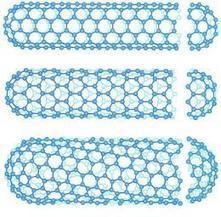
Researchers at Rice University and Penn State University have discovered that adding a dash of boron to carbon while creating nanotubes turns them into solid, spongy, reusable blocks that have an astounding ability to absorb oil spilled in water.
That's one of a range of potential innovations for the material created in a single step. The team found for the first time that boron puts kinks and elbows into the nanotubes as they grow and promotes the formation of covalent bonds, which give the sponges their robust qualities.
A team of University of Maryland scientists have discovered that when electric current is run through carbon nanotubes, objects nearby heat up while the nanotubes themselves stay cool, like a toaster that burns bread without getting hot. Understanding this completely unexpected new phenomenon could lead to new ways of building computer processors that can run at higher speeds without overheating.
When scientists from Umea University and Aalto University tried to perform a reaction between hydrogen gas and fullerene molecules encapsulated in nanotubes something very unlikely suddenly appeared possible. They discovered direct evidence that molecules inside of SWNts can be reacted with gases. This finding opens enormous possibilities for synthesis of novel hybrid materials and chemical modification of encapsulated molecules and materials.
Large patches of an extremely strong new adhesive, inspired by geckos, can be used over and over again. For years scientists have tried to make strong, reusable adhesives by mimicking the microscopic hair-like structures on gecko toes that give the lizard its climbing ability. But those structures are hard to make, limiting the adhesives' size to a few centimeters. Now researchers from the University of Massachusetts, Amherst, have come up with a different gecko-inspired structure that works even better. They have created a reusable adhesive fabric that can be easily and cheaply made tens of centimeters wide and is three times stronger than gecko feet.
By depositing atoms on one side of a grid of the "miracle material" graphene, researchers ave engineered piezoelectricity into a nanoscale material for the first time. The implications could yield dramatic degree of control in nanotechnology.
While there have been major advances in the detection, diagnosis, and treatment of tumors within the brain, brain cancer continues to have a very low survival rate in part to high levels of resistance to treatment. New research published in BioMed Central's open access journal Journal of Nanobiotechnology has used Sendai virus to transport Quantum Dots (Qdots) into brain cancer cells and to specifically bind Qdots to epidermal growth factor receptor (EGFR) which is often over-expressed and up-regulated in tumors. By molecular-labeling cancer cells this nanoparticle technology could be used to aid diagnosis.
An international research team has succeeded in manufacturing on a polymeric film the world’s first flexible organic transistor that is robust enough under high temperature medical sterilization process.
A variety of spider silks – particularly the draglines that anchor webs in place – conduct heat better than most materials, including very good conductors such as silicon, aluminum and pure iron. Spider silk also conducts heat 1,000 times better than woven silkworm silk and 800 times better than other organic tissues.
How can you mend a broken heart? Cardiologists have been wrestling with this question for years. The difficulty is that when one suffers a myocardial infarction (heart attack), the lack of blood supply to certain parts of the heart can eventually cause myocardial scarring. Myocardial scarring can lead to potentially life-threatening arrhythmias and increase the risk of a ventricular aneurism. Moreover, the loss of this healthy heart tissue is essentially permanent. Part of the heart literally dies.
In his first public presentation since the dramatic announcement of a next-gen sequencing (NGS) breakthrough by Oxford Nanopore last week, Stefan Roever, CEO of rival nanopore sequencing company Genia Technologies, said his company was targeting the launch of a sequencing device with up to 1 million nanopores in 2013.
For years, biologists have been amazed by the power of gecko feet, which let these 5-ounce lizards produce an adhesive force roughly equivalent to carrying nine pounds up a wall without slipping. Now, a team of polymer scientists and a biologist at the University of Massachusetts Amherst have discovered exactly how the gecko does it, leading them to invent "Geckskin," a device that can hold 700 pounds on a smooth wall. Doctoral candidate Michael Bartlett in Alfred Crosby's polymer science and engineering lab at UMass Amherst is the lead author of their article describing the discovery in the current online issue of Advanced Materials ("Looking Beyond Fibrillar Features to Scale Gecko-Like Adhesion").
To get content containing either thought or leadership enter:
To get content containing both thought and leadership enter:
To get content containing the expression thought leadership enter:
You can enter several keywords and you can refine them whenever you want. Our suggestion engine uses more signals but entering a few keywords here will rapidly give you great content to curate.


 Your new post is loading...