Your new post is loading...

|
Scooped by
Dr. Stefan Gruenwald
April 30, 2012 11:09 AM
|
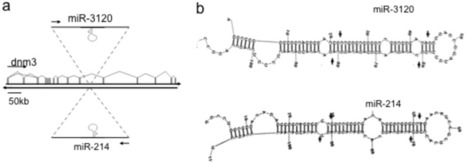
University of Bristol researchers have discovered a new group of molecules called called mirror-microRNAs that control some of the fundamental processes behind memory function and may hold the key to developing new therapies for treating neurodegenerative diseases. MicroRNAs are non-coding genes that often reside within “junk DNA” and regulate the levels and functions of multiple target proteins that are responsible for controlling cellular processes in the brain. Two microRNA genes with different functions can be produced from the same piece (sequence) of DNA, the research found — one from the top strand and another from the bottom complementary “mirror” strand. Videos about micro RNA: http://tinyurl.com/7ylynd4
|
|
Scooped by
Dr. Stefan Gruenwald
April 27, 2012 2:31 PM
|
Researchers have spotted a group of 53 cells within pigeons' brains that respond to the direction and strength of the Earth's magnetic field. The question of how birds navigate using - among other signals - magnetic fields is the subject of much debate. These new "GPS neurons" seem to show how magnetic information is represented in birds' brains.
|
|
Scooped by
Dr. Stefan Gruenwald
April 25, 2012 6:19 PM
|
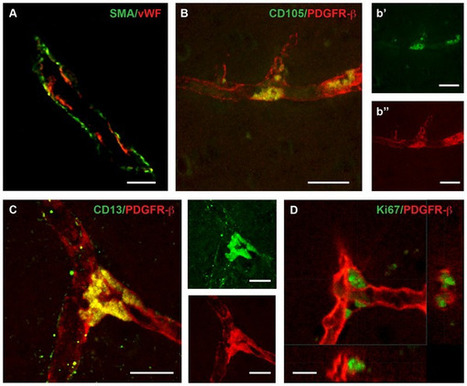
Researchers at Lund University in Sweden have discovered a new stem cell in the adult brain. These cells can proliferate and form several different cell types — most importantly, new brain cells. Scientists hope to take advantage of the finding to develop methods to heal and repair disease and injury in the brain. Analyzing brain tissue from biopsies, the researchers for the first time found stem cells located around small blood vessels in the brain. The cell’s specific function is still unclear, but its plastic properties suggest great potential.
|
|
Scooped by
Dr. Stefan Gruenwald
April 20, 2012 11:45 AM
|
PureDiscovery, a Dallas-based big data startup, thinks it has the has the answer to outdated enterprise search technology, and it’s called BrainSpace. The company claims BrainSpace can learn just about everything about how pieces of content are related to one another. That means users will become less dependent on searching for information because the platform will feed them what they want to know as they interact with other content.
|
|
Scooped by
Dr. Stefan Gruenwald
April 18, 2012 10:01 PM
|
Patient TN was, by his own account, completely blind. Two consecutive strokes had destroyed the visual cortex of his brain, and consequently, his ability to see. Researchers began examining him and discovered that despite his blindness, he had maintained the ability to detect emotion on a person’s face. He responded appropriately — with emotions such as joy, fear, and anger — to a variety of facial expressions. Observed activity in his amygdala — the part of the brain responsible for processing emotions — confirmed the curious results. TN’s rare condition is known as blindsight. Because his stroke damaged only his visual cortex, his eyes remain functional and as a result can still gather information from his environment. He simply lacks the visual cortex to process and interpret it. Sight has changed for TN from a conscious to a largely subconscious experience. He no longer has a definitive picture of his surroundings, but he has retained an innate awareness of his position in the world. He is, to some degree, able to see without being aware that he is seeing.
|
|
Scooped by
Dr. Stefan Gruenwald
April 18, 2012 9:55 PM
|
Scientists funded by the Medical Research Council (MRC) have shown for the first time that transplanting light-sensitive photoreceptors into the eyes of visually impaired mice can restore their vision.
|
|
Scooped by
Dr. Stefan Gruenwald
April 18, 2012 10:49 AM
|
A study of peripheral vision has given clues on how our brain stitches together high quality 'video' from the limited input we get from our eyes. Our vision is really quite poor yet the representation that we actually see in our mind's eye, that lovely 'video' that we get, is much better than the input that we actually receive.
|
|
Scooped by
Dr. Stefan Gruenwald
April 17, 2012 11:04 AM
|
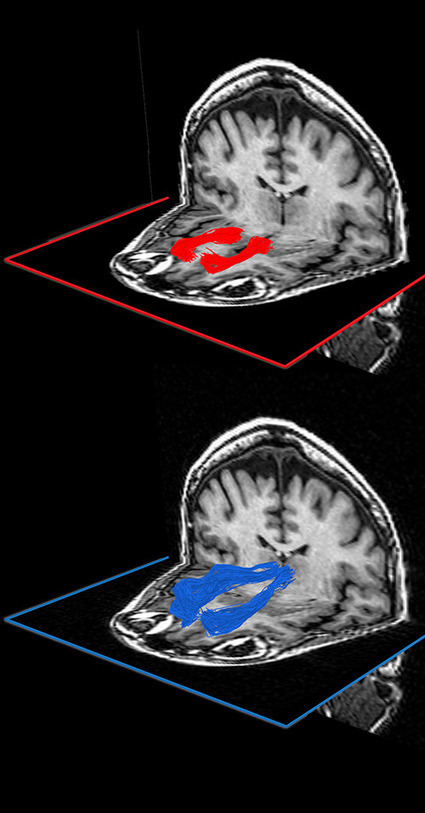
A Vanderbilt University brain-mapping study has found that people’s ability to make decisions in novel situations decreases with age and is associated with a reduction in the integrity of two specific white-matter pathways. The pathways connect an area in the cerebral cortex called the medial prefrontal cortex (involved with decision making) with two other areas deeper in the brain: the thalamus (a highly connected relay center in the brain) and ventral striatum (associated with the emotional and motivational aspects of behavior).
|
|
Scooped by
Dr. Stefan Gruenwald
April 15, 2012 11:06 PM
|
Networks are everywhere. The brain is a network of nerve cells connected by axons, and cells themselves are networks of molecules connected by biochemical reactions. Societies, too, are networks of people linked by friendships, familial relationships and professional ties. On a larger scale, food webs and ecosystems can be represented as networks of species. And networks pervade technology: the Internet, power grids and transportation systems are but a few examples. Even the language we are using to convey these thoughts to you is a network, made up of words connected by syntactic relationships.
|
|
Scooped by
Dr. Stefan Gruenwald
April 12, 2012 10:40 AM
|
Ecole Polytechnique Fédérale de Lausanne (EPFL) researchers have discovered rules that relate the genes that a neuron switches on and off to the shape of that neuron, its electrical properties, and its location in the brain. The discovery, using state-of-the-art computational tools, increases the likelihood that it will be possible to predict much of the fundamental structure and function of the brain without having to measure every aspect of it. That in turn makes modeling the brain in silico — the goal of the proposed Human Brain Project — a more realistic, less Herculean, prospect.
|
|
Scooped by
Dr. Stefan Gruenwald
April 11, 2012 4:10 PM
|
Unlike scanning techniques such as electroencephalography (EEG), which detects electrical activity at the skull's surface, fMRI produces measurements from deep inside the brain. It is also non-invasive, which makes it safer and more comfortable than positron emission tomography (PET), in which radioactive compounds are injected and traced as they flow around the body. fMRI has been applied to almost every aspect of brain science ever since. It has shown that the brain is highly compartmentalized, with specific regions responsible for tasks such as perceiving faces and weighing up moral responsibility; that the resting brain is in fact humming with activity; and that it may be possible to communicate with patients in a vegetative state by monitoring their brain activity. In 2010, neuroscientists used fMRI in more than 1,500 published articles.
|
|
Scooped by
Dr. Stefan Gruenwald
April 11, 2012 12:19 PM
|
Humans and animals with large, complex brains benefit from the need and ability to cooperate. In fact, researchers believe that "intelligence" is correlated with the size of a brain’s neural network, in our species and others may have been an adaption for tool use, for social learning, and for the accumulation of culture. Intelligence might also be the result of sexual selection. Digital organisms that evolved "brains" reveal that cooperation can drive the evolution of intelligence. These findings could explain why humans and certain other animals have such large, complex brains. Global networking could result in the evolution of ever more brainy humans in future.
|
|
Rescooped by
Dr. Stefan Gruenwald
from Science News
April 6, 2012 11:59 AM
|
Sagi and colleagues have provided the first evidence that rapid structural plasticity can be detected in humans after just 2 hr of playing a video game. Articles about NEUROSCIENCE: http://tinyurl.com/c9jmo3y
Via Sakis Koukouvis
|
|
|
Rescooped by
Dr. Stefan Gruenwald
from Science News
April 28, 2012 11:24 PM
|
Jason Padgett, 41, was repeatedly kicked in the head outside a karaoke club in Tacoma, in the U.S. state of Washington.
Via Sakis Koukouvis
|
|
Scooped by
Dr. Stefan Gruenwald
April 25, 2012 10:05 PM
|
Cultivation of an active cognitive lifestyle through lifespan engagement in a rich array of mentally stimulating activities may help reduce dementia risk, according to a major study of more than 13,000 individuals aged over 65 years and followed for 14 years. An active cognitive lifestyle score (CLS) in men was associated with less cerebrovascular disease, and in women was associated with greater brain weight. In both men and women, a high score was associated with greater neuronal density and cortical thickness in the frontal lobe.
|
|
Scooped by
Dr. Stefan Gruenwald
April 25, 2012 10:59 AM
|
Nanoparticles that can be imaged three different ways at once have enabled Stanford University School of Medicine scientists to remove brain tumors from mice with unprecedented accuracy.
|
|
Scooped by
Dr. Stefan Gruenwald
April 20, 2012 10:07 AM
|
A new memory game has revived the tantalizing notion that people can work their way to a higher I.Q. Psychologists have long regarded intelligence as coming in two flavors: crystallized intelligence, the treasure trove of stored-up information and how-to knowledge (the sort of thing tested on “Jeopardy!” or put to use when you ride a bicycle); and fluid intelligence. Crystallized intelligence grows as you age; fluid intelligence has long been known to peak in early adulthood, around college age, and then to decline gradually. And unlike physical conditioning, which can transform 98-pound weaklings into hunks, fluid intelligence has always been considered impervious to training. That, after all, is the premise of I.Q. tests, or at least the portion that measures fluid intelligence: we can test you now and predict all sorts of things in the future, because fluid intelligence supposedly sets in early and is fairly immutable. While parents, teachers and others play an essential role in establishing an environment in which a child’s intellect can grow, even Tiger Mothers generally expect only higher grades will come from their children’s diligence — not better brains.
|
|
Scooped by
Dr. Stefan Gruenwald
April 18, 2012 9:56 PM
|
When a listener tunes in to one voice and ignores another, his or her brain discards the information coming from the superfluous speaker, researchers have found. The findings, from a study using electrodes implanted into human brains, could help scientists to design better hearing aids and cochlear implants, and to understand how the process breaks down in ageing or degenerative disorders such as Alzheimer’s disease.
|
|
Scooped by
Dr. Stefan Gruenwald
April 18, 2012 11:24 AM
|
By analyzing the expression of approximately 1,000 genes in the brain, scientists at the Allen Institute for Brain Science have identified similarities and differences among regions of the human brain among the brains of human individuals and between humans and mice. The study sheds light on the human brain in general and also serves as an introduction to what the associated publicly available dataset can offer the scientific community.
|
|
Scooped by
Dr. Stefan Gruenwald
April 17, 2012 1:51 PM
|
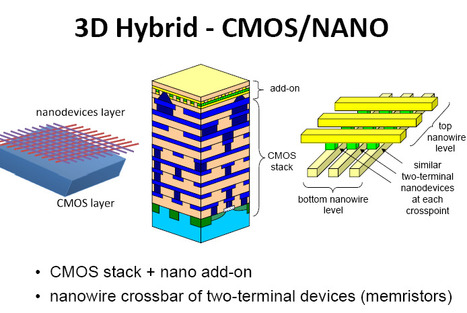
Hybrid reconfigurable logic circuits were fabricated by integrating memristor-based crossbars onto a foundry-built CMOS (complementary metal-oxide-semiconductor) platform using nanoimprint lithography, as well as materials and processes that were compatible with the CMOS. Titanium dioxide thin-film memristors served as the configuration bits and switches in a data routing network and were connected to
gate-level CMOS components that acted as logic elements, in a manner similar to a field programmable gate array. Memristors Symposium [VIDEO]: http://tinyurl.com/86lvkv5
|
|
Scooped by
Dr. Stefan Gruenwald
April 17, 2012 10:47 AM
|
A smile and a frown mean the same thing everywhere—or so say many anthropologists and evolutionary psychologists, who for more than a century have argued that all humans express basic emotions the same way. But a new study of people's perceptions of computer-generated faces suggests that facial expressions may not be universal and that our culture strongly shapes the way we read and express emotions.
|
|
Scooped by
Dr. Stefan Gruenwald
April 13, 2012 12:24 PM
|
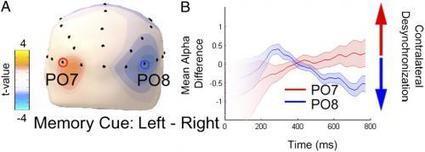
Rather than being a passive state, perception is an active process fueled by predictions and expectations about our environment. In the latter case, memory must be a fundamental component in the way our brain generates these precursors to the perceptual experience – but how the brain integrates long-term memory with perception has not been determined. Recently, however, researchers in the Department of Experimental Psychology at the University of Oxford, by devising a method for integrating memory and attention, showed how LTM optimizes perception by varying brain states associated with anticipation of spatial localization in the visual field. The scientists also used fMRI to articulate a neural network involving a number of cortical areas likely to be active in the predictive use of memory in the visual cortex.
|
|
Scooped by
Dr. Stefan Gruenwald
April 11, 2012 4:15 PM
|
By using ‘genetic programming’ to crossbreed algorithms, researchers help flavor companies figure out what their customers like. The design of aromas — the flavors of packaged food and drink and the scents of cleaning products, toiletries and other household items — is a multibillion-dollar business. The big flavor companies spend tens of millions of dollars every year on research and development, including a lot of consumer testing.
|
|
Scooped by
Dr. Stefan Gruenwald
April 11, 2012 12:56 PM
|
Scientists turn off the need to cough but then you can't feel heat anymore. The resone for this unexpected phenomenon is due to the fact that the same cellular receptors that sense temperature and pain also control coughing. The cool relief of a cough drop is no coincidence, as the menthol receptor both suppresses coughs and produces the cool feeling in your throat. There’s a molecular on-switch for coughing, too: a receptor called TRPV1. Unfortunately for researchers looking for a cough cure, inactivating TRPV1 also makes it dangerously difficult to feel heat. Mundane tasks like eating a hot meal or running a bath become hazardous if you don’t reflexively shrink away from scalding heat.
|
|
Scooped by
Dr. Stefan Gruenwald
April 11, 2012 11:07 AM
|
It is thought alcohol hinders analytical thinking and allows 'creative' thoughts that might otherwise by stifled to take root, allowing test subjects to come up with more imaginative solutions. Psychologists at the University of Illinois set 40 healthy young men a series of brain teasers. They involved being given three words, such as coin, quick and spoon, and coming up with a fourth word that links the three - in this case, silver. Half the group drank the equivalent of two pints of beer before doing the tests, while the rest carried them out sober. The drinking group solved nearly 40 per cent more problems than the others, and took an average of 12 seconds compared to the 15.5 seconds needed by sober subjects.
|