



Nanosys and 3M are joining technologies to provide wide color gamut technology for consumer electronic displays, allowing LCDs to display 50 percent more color.

 Your new post is loading... Your new post is loading...
 Scoop.it!
Nanosys and 3M are joining technologies to provide wide color gamut technology for consumer electronic displays, allowing LCDs to display 50 percent more color. 
No comment yet.
Sign up to comment
Scoop.it!
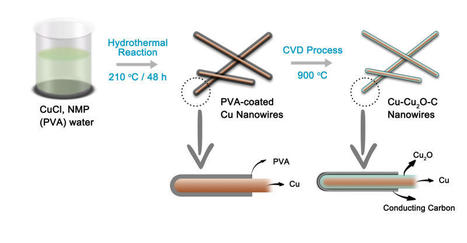
Thanks to a little serendipity, researchers at Rice University have created a tiny coaxial cable that is about a thousand times smaller than a human hair and has higher capacitance than previously reported microcapacitors. The three-layer coaxial nanocable contains a solid copper wire surrounded by a layer of copper oxide that is encased a layer of carbon just a few atoms thick.
Scoop.it!

From
phys

One of the biggest challenges facing the silicon photovoltaic industry is making solar cells that are economically viable. To meet this goal, the module cost, which is currently about $1/watt, needs to be decreased to just half that.
Scoop.it!

From
phys
For more than three decades scientists have been investigating magnetic nanoparticles as a method of drug delivery. Now by combining three metals - iron, gold and platinum - pharmacists at the University of Sydney believe they have discovered a method for magnetically directing drugs through the body.
Scoop.it!
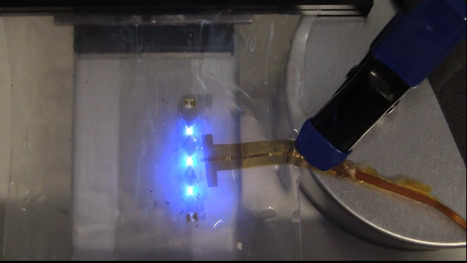
Startup company MC10 is commercializing stretchable silicon for smart surgical tools and wearable sensors. One of its first products will be a surgical tool that can quickly map and treat electrical map and treat electrical problems in the heart.
Scoop.it!
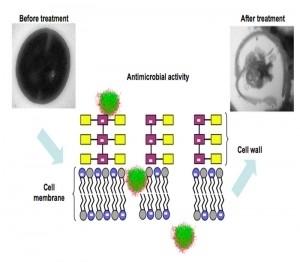
Using nanotechnology based on its semiconductor research, IBM has developed polymers that can seek out and attack MRSA. Once these polymers come into contact with water in or on the body, they self assemble into a new polymer structure that is designed to target bacteria membranes based on electrostatic interaction and break through their cell membranes and walls. The physical nature of this action prevents bacteria from developing resistance to these nanoparticles. The electric charge naturally found in cells is important because the new polymer structures are attracted only to the infected areas while preserving the healthy red blood cells the body needs to transport oxygen throughout the body and combat bacteria.
Unlike most antimicrobial materials, these are biodegradable, which enhances their potential application because they are naturally eliminated from the body (rather than remaining behind and accumulating in organs).
Scoop.it!
From
www
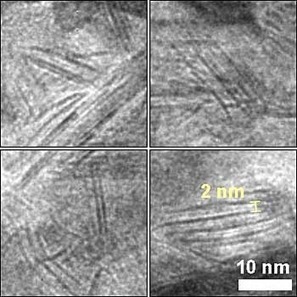
Hydrogen gas offers one of the most promising sustainable energy alternatives to limited fossil fuels. But traditional methods of producing pure hydrogen face significant challenges in unlocking its full potential, either by releasing harmful carbon dioxide into the atmosphere or requiring rare and expensive chemical elements such as platinum.
Now, scientists at the U.S. Department of Energy’s (DOE) Brookhaven National Laboratory have developed a new electrocatalyst that addresses one of these problems by generating hydrogen gas from water cleanly and with much more affordable materials. The novel form of catalytic nickel-molybdenum-nitride – described in a paper published online May 8, 2012 in the journal Angewandte Chemie International Edition – surprised scientists with its high-performing nanosheet structure, introducing a new model for effective hydrogen catalysis.
Scoop.it!
From
www
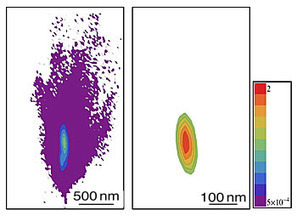
NIST researchers’ new approach to trapping nanoparticles uses a control and feedback system that nudges them only when needed, lowering the average intensity of the beam and increasing the lifetime of the nanoparticles while reducing their tendency to wander. In the picture on the left, 100-nanometer gold nanoparticles quickly escape from a static trap while gold nanoparticles trapped using the NIST method remained strongly confined.
Scientists routinely trap and move nanoparticles in a solution with "optical tweezers"—a laser focused to a very small point. The tiny dot of laser light creates a strong electric field, or potential well, that attracts particles to the center of the beam. Although the particles are attracted into the field, the molecules of the fluid they are suspended in tend to push them out of the well. This effect only gets worse as particle size decreases because the laser's influence over a particle's movement gets weaker as the particle gets smaller. One can always turn up the power of the laser to generate a stronger electric field, but doing that can fry the nanoparticles too quickly to do anything meaningful with them—if it can hold them at all.
Using a refined technique for trapping and manipulating nanoparticles, researchers at the National Institute of Standards and Technology (NIST) have extended the trapped particles' useful life more than tenfold.* This new approach, which one researcher likens to "attracting moths," promises to give experimenters the trapping time they need to build nanoscale structures and may open the way to working with nanoparticles inside biological cells without damaging the cells with intense laser light.
Scoop.it!
From
www
Researchers at the MIT and Brigham and Women’s Hospital have developed a nanoparticle designed to evade the immune system and home in on infection sites, then unleash a focused antibiotic attack. The researchers designed antibiotic-carrying nanoparticles that can switch their charge depending on their environment. While they circulate in the bloodstream, the particles have a slight negative charge. However, when they encounter an infection site, the particles gain a positive charge, allowing them to tightly bind to bacteria and release their drug payload.
Scoop.it!
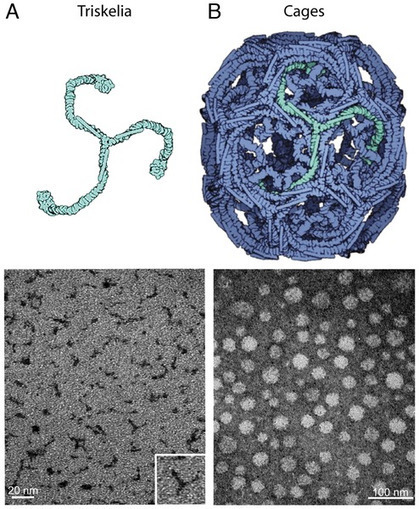
Researchers at Harvard-affiliated McLean Hospital have developed a new category of non-toxic, protein-based ”green” nanoparticles that can non-invasively cross the blood brain barrier and transport various types of drugs. The nanoparticles are based on clathrin, a ubiquitous protein found in human, animal, plant, bacteria and fungi cells, can be modified for use as a nanoparticle for in-vivo studies. Clathrin is the body’s primary delivery vehicle responsible for delivering many different types of molecules into cells. Vitaliano suggested that the protein’s naturally potent transport capabilities might be put to practical medical use for drug delivery and medical imaging.

george sperco's curator insight,
February 7, 2023 10:36 AM
https://farmaciadicura.com https://farmaciadicura.com/Prodotto/acquista-metaqualone-in-linea/ https://farmaciadicura.com/Prodotto/acquista-ossicodone-10-mg-sandoz/ https://farmaciadicura.com/Prodotto/acquista-ossicodone-15-mg-sandoz/ https://farmaciadicura.com/Prodotto/acquista-ossicodone-20-mg-sandoz/ https://farmaciadicura.com/Prodotto/acquista-ossicodone-30-mg-sandoz/ https://farmaciadicura.com/Prodotto/acquista-ossicodone-5-mg-sandoz/ https://farmaciadicura.com/Prodotto/acquista-ossicodone-60-mg-sandoz/ https://farmaciadicura.com/Prodotto/acquista-ossicodone-80-mg-sandoz/ https://farmaciadicura.com/Prodotto/acquista-quaalude-online/ https://farmaciadicura.com/Prodotto/acquista-adderall-in-linea-italia/ https://farmaciadicura.com/Prodotto/acquista-ambien-in-linea-italia/ https://farmaciadicura.com/Prodotto/acquista-buprenorfina-in-linea-italia/ https://farmaciadicura.com/Prodotto/acquista-cocaina-boliviana-in-linea/ https://farmaciadicura.com/Prodotto/acquista-cocaina-a-squame-di-pesce/ https://farmaciadicura.com/Prodotto/acquista-desoxyn-in-linea-italia/ https://farmaciadicura.com/Prodotto/acquista-dilaudid-in-linea-italia/ https://farmaciadicura.com/Prodotto/acquistare-eroina-in-linea-italia/ https://farmaciadicura.com/Prodotto/acquista-fentanil-in-linea-italia/ https://farmaciadicura.com/Prodotto/acquista-fentermina-in-linea-italia/ https://farmaciadicura.com/Prodotto/acquista-la-morfina-iniettabile-italia/ https://farmaciadicura.com/Prodotto/acquista-morfina-in-linea-italia/ https://wereldwijdeapotheek.com/ https://wereldwijdeapotheek.com/product/ketamine-poeder-kopen/ https://wereldwijdeapotheek.com/product/koop-4-aco-dmt-online/ https://wereldwijdeapotheek.com/product/koop-adderall-online/ https://wereldwijdeapotheek.com/product/koop-boliviaanse-cocaine-online/ https://wereldwijdeapotheek.com/product/koop-bruine-heroine-online/ https://wereldwijdeapotheek.com/product/koop-codeine-linctus-online/ https://wereldwijdeapotheek.com/product/koop-crack-cocaine-online/ https://wereldwijdeapotheek.com/product/koop-desoxyn-online/ https://wereldwijdeapotheek.com/product/koop-dexedrine-online09/ https://wereldwijdeapotheek.com/product/koop-fentanyl-citrate-online-09/ https://wereldwijdeapotheek.com/product/koop-fentanyl-poeder-online/ https://wereldwijdeapotheek.com/product/koop-fentanyl-pleister-online09/ https://wereldwijdeapotheek.com/product/koop-fishscale-cocaine-online/ https://wereldwijdeapotheek.com/product/koop-flakka-a-pvp-online/ https://wereldwijdeapotheek.com/product/koop-gouden-leraar-paddenstoelen-online1/ https://wereldwijdeapotheek.com/product/koop-heroine-online/ https://wereldwijdeapotheek.com/product/koop-hydromorphone-online/ https://wereldwijdeapotheek.com/product/koop-morfine-online/ https://wereldwijdeapotheek.com/product/koop-natriumcyanide-100-mg-online/ https://wereldwijdeapotheek.com/product/koop-nembutal-pentobarbital-online1g/ https://wereldwijdeapotheek.com/product/koop-oxycodon-hcl-online/ https://wereldwijdeapotheek.com/product/koop-oxycodon-nachts-online/ https://wereldwijdeapotheek.com/product/koop-oxycontin-online/ https://wereldwijdeapotheek.com/product/koop-psilocybe-cubensis-b-online/ https://farmaciadicura.com/Prodotto/acquista-ossicodone-in-linea-italia/ https://farmaciadicura.com/Prodotto/acquista-ossicodone-pillole-in-linea-italia/ https://farmaciadicura.com/Prodotto/acquista-percocet-in-linea-italia/ https://farmaciadicura.com/Prodotto/acquista-ritalin-in-linea-italia/ https://farmaciadicura.com/Prodotto/acquista-stilnox-in-linea-italia/ https://farmaciadicura.com/Prodotto/acquista-strisce-di-suboxone-italia/ https://farmaciadicura.com/Prodotto/acquista-subutex-in-linea-italia/ https://farmaciadicura.com/Prodotto/acquista-vyvanse-in-linea-italia/ https://farmaciadicura.com/Prodotto/acquista-xanax-in-linea-italia/ https://wereldwijdeapotheek.com/product/koop-ritalin-online/ https://wereldwijdeapotheek.com/product/koop-seconal-sodium-online/ https://wereldwijdeapotheek.com/product/koop-stilnox-online/ https://wereldwijdeapotheek.com/product/koop-suboxone-online/ https://wereldwijdeapotheek.com/product/koop-suboxone-strips/ https://wereldwijdeapotheek.com/product/koop-subutex-online/ https://wereldwijdeapotheek.com/product/koop-ultram-online/ https://wereldwijdeapotheek.com/product/koop-vicodin-online/ https://wereldwijdeapotheek.com/product/koop-vyvanse-online/ https://wereldwijdeapotheek.com/product/koop-witte-heroine-online/ https://wereldwijdeapotheek.com/product/koop-xanax-online/ https://wereldwijdeapotheek.com/product/koop-percocet-online1/ https://wereldwijdeapotheek.com/product/koop-phentermine-adipex-online09/ https://healthmartpsychedelics.com/ https://healthmartpsychedelics.com/produit/acheter-acxion-fentermina-30mg/ https://healthmartpsychedelics.com/produit/acheter-adderall-en-ligne/ https://healthmartpsychedelics.com/produit/achetez-ambien-en-ligne/ https://healthmartpsychedelics.com/produit/achetez-des-bandes-de-suboxone/ https://healthmartpsychedelics.com/produit/acheter-buprenorphine-en-ligne/ https://healthmartpsychedelics.com/produit/acheter-contrave-en-ligne/ https://healthmartpsychedelics.com/produit/acheter-desoxyn-en-ligne/ https://healthmartpsychedelics.com/produit/acheter-du-dilaudid-en-ligne/ https://healthmartpsychedelics.com/produit/acheter-duromine-en-ligne/ https://healthmartpsychedelics.com/produit/acheter-de-lephedrine-en-ligne/ https://healthmartpsychedelics.com/produit/acheter-fentanyl-en-ligne/ https://healthmartpsychedelics.com/produit/acheter-de-la-morphine-injectable/ https://healthmartpsychedelics.com/produit/achetez-du-cyanure-de-sodium-en-ligne/ https://healthmartpsychedelics.com/produit/acheter-meratrim-en-ligne/ https://healthmartpsychedelics.com/produit/acheter-morphine-en-ligne/ https://healthmartpsychedelics.com/produit/acheter-de-loxycodone-en-ligne/ https://healthmartpsychedelics.com/produit/acheter-80-mg-doxycodone-en-ligne/ https://healthmartpsychedelics.com/produit/achetez-ozempic-en-ligne/ https://healthmartpsychedelics.com/produit/acheter-du-percocet-en-ligne/ https://healthmartpsychedelics.com/produit/acheter-phentermine-en-ligne/ https://healthmartpsychedelics.com/produit/acheter-qsymia-en-ligne/ https://healthmartpsychedelics.com/produit/acheter-ritaline-en-ligne/ https://healthmartpsychedelics.com/produit/acheter-rybelsus-en-ligne/ https://healthmartpsychedelics.com/produit/acheter-saxenda-en-ligne/ https://healthmartpsychedelics.com/produit/acheter-stilnox-en-ligne/ https://healthmartpsychedelics.com/produit/acheter-subutex-en-ligne/ https://healthmartpsychedelics.com/produit/acheter-trulicity-en-ligne/ https://healthmartpsychedelics.com/produit/acheter-victoza-en-ligne/ https://healthmartpsychedelics.com/produit/acheter-vyvanse-en-ligne/ https://healthmartpsychedelics.com/produit/acheter-wegovy-en-ligne/ https://healthmartpsychedelics.com/produit/acheter-xanax-en-ligne/ https://healthmartpsychedelics.com/produit/acheter-du-xanax-vert-en-ligne/ https://healthmartpsychedelics.com/produit/acheter-xenical-en-ligne/ https://farmaciadesalud.com/tienda/comprar-dexedrina-en-linea/ https://farmaciadesalud.com/tienda/comprar-heroina-blanca-en-linea/ https://farmaciadesalud.com/tienda/comprar-heroina-de-alquitran-negro/ https://farmaciadesalud.com/tienda/comprar-heroina-lobo-artico/ https://farmaciadesalud.com/tienda/comprar-heroina-marron-en-linea/ https://farmaciadesalud.com/tienda/comprar-makatussin-en-linea/ https://farmaciadesalud.com/tienda/comprar-oxicodona-10-mg-sandoz/ https://farmaciadesalud.com/tienda/comprar-oxicodona-15-mg-sandoz/ https://farmaciadesalud.com/tienda/comprar-oxicodona-20-mg-sandoz/ https://farmaciadesalud.com/tienda/comprar-oxicodona-30-mg-sandoz/ https://farmaciadesalud.com/tienda/comprar-oxicodona-5-mg-sandoz/ https://farmaciadesalud.com/tienda/comprar-oxicodona-60-mg-sandoz/ https://farmaciadesalud.com/tienda/comprar-oxicodona-80-mg-sandoz/ https://farmaciadesalud.com/tienda/comprar-pastillas-de-nembutal/ https://farmaciadesalud.com/tienda/compre-polvo-de-nembutal-en-linea/ https://farmaciadesalud.com/tienda/comprar-crack-de-cocaina-en-linea/ https://farmaciadesalud.com/tienda/comprar-desoxyn-en-linea/ https://farmaciadesalud.com/tienda/comprar-dilaudid-en-linea/ https://farmaciadesalud.com/tienda/comprar-efedrina-hcl-en-linea/ https://farmaciadesalud.com/tienda/comprar-fentanilo-en-linea/ https://farmaciadesalud.com/tienda/comprar-fentermina-en-linea/ https://farmaciadesalud.com/tienda/comprar-heroina-en-linea/ https://farmaciadesalud.com/tienda/comprar-morfina-inyectable-en-linea/ https://farmaciadesalud.com/tienda/comprar-morfina-en-linea/ https://farmaciadesalud.com/tienda/comprar-pastillas-de-oxicodona-en-linea/ https://farmaciadesalud.com/tienda/comprar-oxycodone-en-linea/ https://farmaciadesalud.com/tienda/comprar-oxycontin-en-linea/ https://farmaciadesalud.com/tienda/comprar-percocet-en-linea/ https://farmaciadesalud.com/tienda/comprar-ritalin-en-linea/ https://farmaciadesalud.com/tienda/comprar-nembutal-inyectable-en-linea/ https://farmaciadesalud.com/tienda/comprar-stilnox-en-linea/ https://farmaciadesalud.com/tienda/comprar-tiras-de-suboxone-en-linea/ https://farmaciadesalud.com/tienda/comprar-suboxone-en-linea/ https://farmaciadesalud.com/tienda/comprar-subutex-en-linea/ https://farmaciadesalud.com/tienda/comprar-viagra-en-linea/ https://farmaciadesalud.com/tienda/comprar-vyvanse-en-linea/ https://farmaciadesalud.com/tienda/comprar-xanax-en-linea/ https://acquistaossicodoneitalia.com/ https://acquistaossicodoneitalia.com/negozio/acquista-ossicodone-10-mg-sandoz-italia/ https://acquistaossicodoneitalia.com/negozio/acquista-ossicodone-15-mg-sandoz-italia/ https://acquistaossicodoneitalia.com/negozio/acquista-ossicodone-20-mg-sandoz-italia/ https://acquistaossicodoneitalia.com/negozio/acquista-ossicodone-30-mg-sandoz-italia/ https://acquistaossicodoneitalia.com/negozio/acquista-ossicodone-5-mg-sandoz-italia/ https://acquistaossicodoneitalia.com/negozio/acquista-ossicodone-60-mg-sandoz-italia/ https://acquistaossicodoneitalia.com/negozio/acquista-ossicodone-80-mg-sandoz-italia/ https://acquistaossicodoneitalia.com/negozio/acquista-adderall-in-linea-italia/ https://acquistaossicodoneitalia.com/negozio/acquista-ambien-in-linea-italia/ https://acquistaossicodoneitalia.com/negozio/acquista-buprenorfina-in-linea-italia/ https://acquistaossicodoneitalia.com/negozio/acquista-cocaina-boliviana-in-linea/ https://acquistaossicodoneitalia.com/negozio/acquista-cocaina-a-squame-di-pesce/ https://acquistaossicodoneitalia.com/negozio/acquista-cocaina-crack-in-linea/ https://acquistaossicodoneitalia.com/negozio/acquista-desoxyn-in-linea-italia/ https://acquistaossicodoneitalia.com/negozio/acquista-dilaudid-in-linea-italia/ https://acquistaossicodoneitalia.com/negozio/acquistare-eroina-in-linea-italia/ https://acquistaossicodoneitalia.com/negozio/acquista-fentanil-in-linea-italia/ https://acquistaossicodoneitalia.com/negozio/acquista-fentermina-in-linea-italia/ https://acquistaossicodoneitalia.com/negozio/acquista-la-morfina-iniettabile-italia/ https://acquistaossicodoneitalia.com/negozio/acquista-morfina-in-linea-italia/ https://acquistaossicodoneitalia.com/negozio/acquista-ossicodone-in-linea-italia/ https://acquistaossicodoneitalia.com/negozio/acquista-ossicodone-pillole-in-linea-italia/ https://acquistaossicodoneitalia.com/negozio/acquista-oxycontin-in-linea-italia/ https://acquistaossicodoneitalia.com/negozio/acquista-percocet-in-linea-italia/ https://acquistaossicodoneitalia.com/negozio/acquista-ritalin-in-linea-italia/ https://acquistaossicodoneitalia.com/negozio/acquista-stilnox-in-linea-italia/ https://acquistaossicodoneitalia.com/negozio/acquista-strisce-di-suboxone-italia/ https://acquistaossicodoneitalia.com/negozio/acquista-subutex-in-linea-italia/ https://acquistaossicodoneitalia.com/negozio/acquista-viagra-in-linea-italia/ https://acquistaossicodoneitalia.com/negozio/acquista-vyvanse-in-linea-italia/ https://acquistaossicodoneitalia.com/negozio/acquista-xanax-in-linea-italia/ https://acquistaossicodoneitalia.com/negozio/acquista-laudano-droga-online/ https://acquistaossicodoneitalia.com/negozio/acquista-metaqualone-in-linea/ https://acquistaossicodoneitalia.com/negozio/acquista-quaaludes-in-linea/ https://pharmacieanglaise.com/ https://pharmacieanglaise.com/shop/acheter-adderall-en-ligne-canada/ https://pharmacieanglaise.com/shop/achetez-ambien-en-ligne-canada/ https://pharmacieanglaise.com/shop/achetez-des-bandes-de-suboxone-canada/ https://pharmacieanglaise.com/shop/acheter-buprenorphine-en-ligne-canada/ https://pharmacieanglaise.com/shop/acheter-desoxyn-en-ligne-canada/ https://pharmacieanglaise.com/shop/acheter-du-dilaudid-en-ligne-canada/ https://pharmacieanglaise.com/shop/acheter-fentanyl-en-ligne-canada/ https://pharmacieanglaise.com/shop/acheter-de-la-morphine-injectable-canada/ https://pharmacieanglaise.com/shop/achetez-du-cyanure-de-sodium-en-ligne/ https://pharmacieanglaise.com/shop/acheter-morphine-en-ligne-canada/ https://pharmacieanglaise.com/shop/acheter-de-loxycodone-en-ligne-canada/ https://pharmacieanglaise.com/shop/acheter-80-mg-doxycodone-en-ligne-canada/ https://pharmacieanglaise.com/shop/acheter-de-loxycontin-en-ligne-canada/ https://pharmacieanglaise.com/shop/acheter-du-percocet-en-ligne-canada/ https://pharmacieanglaise.com/shop/acheter-phentermine-en-ligne-canada/ https://pharmacieanglaise.com/shop/acheter-ritaline-en-ligne-canada/ https://pharmacieanglaise.com/shop/acheter-stilnox-en-ligne-canada/ https://pharmacieanglaise.com/shop/acheter-subutex-en-ligne-canada/ https://pharmacieanglaise.com/shop/acheter-le-viagra-en-ligne-canada/ https://pharmacieanglaise.com/shop/acheter-vyvanse-en-ligne-canada/ https://pharmacieanglaise.com/shop/acheter-xanax-en-ligne-canada/ https://pharmacieanglaise.com/shop/acheter-du-xanax-vert-en-ligne-canada/
Scoop.it!

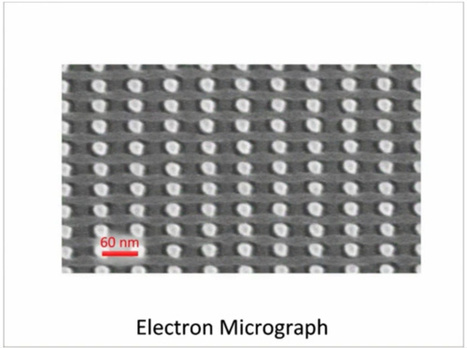
Picture a really big library. Imagine that it contains 2.5 million books, and that each of those books is 400 pages long. Now imagine that you could fit ALL of those books onto a computer chip the size of your thumbnail. Researchers just figured out how to do exactly that. The trick is to use something called a nanodot.
Nanodots are incredibly tiny magnets. They can be as small as six nanometers in diameter, which is over 10,000 times narrower than a human hair. Since they are so small, you can fit a lot of nanodots onto a single computer chip.
Scoop.it!
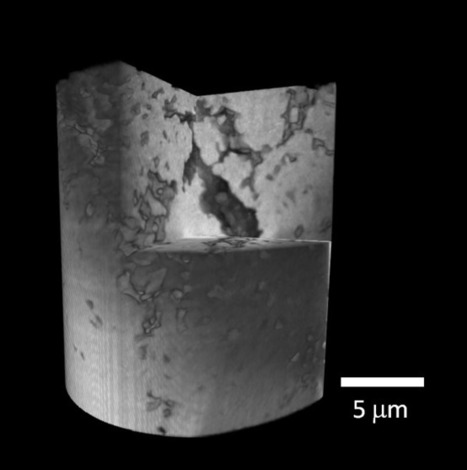
A new x-ray microscope probes the inner intricacies of materials smaller than human cells and creates unparalleled high-resolution 3D images at 25 nm.
By integrating unique automatic calibrations, scientists at the U.S. Department of Energy’s Brookhaven National Laboratory are able to capture and combine thousands of images with greater speed and precision than any other microscope. The direct observation of structures spanning 25 nanometers will offer fundamental advances in many fields, including energy research, environmental sciences, biology, and national defense.
This innovative full field transmission x-ray microscope (TXM) was developed at Brookhaven Lab’s National Synchrotron Light Source (NSLS), which provides the x-ray source needed to capture images on the nanoscale.
Scoop.it!

The solution does not coat the paper as such but creates a soft shell around each of the paper's fibres, which means the paper can still be used as normal.
|
Scoop.it!
From
phys
Researchers at MIT have found a new way of making complex three-dimensional structures using self-assembling polymer materials that form tiny wires and junctions.
Scoop.it!

Glass as thin and as flexible as a sheet of paper that can be printed on rolls just like a newspaper will be available to phone makers as soon as this month, said Dipak Chowdhury, head of Corning’s ultra-flexible thin-glass project Willow.
Since layers of glass are stacked inside smart phones, this technology will make smart phones up to 7 fold thinner.
Scoop.it!
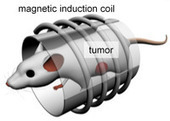
The idea of killing cancer with heat isn't new. Researchers know that, like normal cells, cancer cells start to die when the mercury rises above 43˚C. The trick is figuring out how to kill the cancer without harming the body's own cells. One promising idea, known as magnetic hyperthermia, involves injecting minuscule "nanoparticles," basically microscopic lumps of iron oxide or other compounds, into tumors to make them magnetic. The patient is put into a magnetic field that reverses direction thousands of times every second. The magnetic nanoparticles are excited by the applied field and begin to get hot, heating and potentially destroying the surrounding cancer tissue. Because healthy tissue is not altered by the magnetic field, it does not heat up and is not damaged.
But the therapy has yet to make its way to the clinic, with only a single reported trial in humans (with modest success). This is largely because conventional nanoparticles interact only weakly with the applied field, so quite a large dose is needed to generate enough heat to damage the tumor. Although nanoparticles aren't particularly toxic, in large quantities they can trigger the body's immune system to attack them, causing allergic reactions.
Nanoscientist Jinwoo Cheon of Yonsei University in Seoul and colleagues created nanoparticles that would get hotter than traditional nanoparticles - so that not as many would need to be injected into the body. They made two-layer nanoparticles, each containing a core of one magnetic mineral inside a shell of another. Because of an esoteric interaction between the two minerals, called exchange coupling, these "core-shell" nanoparticles interacted far more strongly with the magnetic field than do traditional nanoparticles and released up to 10 times as much heat. That means one would need to give only 10% of the original dose to patients to achieve the same degree of hyperthermia as with traditional nanoparticles.
Scoop.it!

A substantial addition has been made to the toolkit for structural DNA nanotechnology. Currently the only general way to build arbitrarily complex 100-nm-scale DNA objects is scaffolded DNA origami, in which a long (about 7000 bases), biological single stranded DNA molecule is folded into a pre-determined shape through binding to a specially designed set of short, synthetic “staple” strands. A new method now programs self-assembly of arbitrarily complex 150-nm DNA objects from hundreds of distinct single-stranded tiles, each a 42-base strand folded into a 3nm by 7nm tile and attached to four neighboring tiles. With each tile a pixel, the tiles assemble to form a 310-pixel, 150nm-square canvas.
Researchers at the Wyss Institute have developed a method for building complex nanostructures out of short synthetic strands of DNA. Called single-stranded tiles (SSTs), these interlocking DNA "building blocks," akin to Legos®, can be programmed to assemble themselves into precisely designed shapes, such as letters and emoticons. Further development of the technology could enable the creation of new nanoscale devices, such as those that deliver drugs directly to disease sites.
Scoop.it!
From
phys
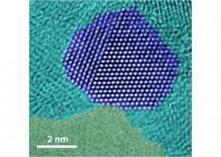
This image, made with a high-resolution transmission electron microscope, shows atoms on the surface of an industrial catalyst used in methanol production. A study by scientists from SLAC, Stanford and Germany reveals that the catalyst’s copper surface (dark blue) is folded into “steps” and decorated with particles of zinc oxide (turquoise). These defects increase its activity, while other defects in the copper nanoparticle stabilize this highly efficient configuration. Understanding the catalyst in all its complexity is a step toward improving the process for manufacturing methanol, an important industrial chemical that could become the basis for a clean energy economy.
Scoop.it!
Fermi paradox: Our universe is fairly old - where are all the aliens?
The Fermi paradox is the contrast between the high estimate of the likelihood of extraterritorial civilizations, and the lack of visible evidence of them. But what sort of evidence should we expect to see? This is what exploratory engineering can tell us, giving us estimates of what kind of cosmic structures are plausibly constructable by advanced civilizations, and what traces they would leave. Based on our current knowledge, it seems that it would be easy for such a civilization to rapidly occupy vast swathes of the universe in a visible fashion. There are game-theoretic reasons to suppose that they would do so. This leads to a worsening of the Fermi paradox, reducing the likelihood of "advanced but unseen" civilizations, even in other galaxies. Oxford University physicist Stuart Armstrong has devised a rather ingenious and startling simple plan for doing so-one which he claims is almost within humanity's collective skill-set. Armstrong's plan sees five primary stages of construction, which when used in a cyclical manner, would result in increasingly efficient, and even exponentially growing, construction rates such that the entire project could be completed within a few decades. Broken down into five basic steps, the construction cycle looks like this:
The idea is to build the entire swarm in iterative steps and not all at once. We would only need to build a small section of the Dyson sphere to provide the energy requirements for the rest of the project. Thus, construction efficiency will increase over time as the project progresses. "We could do it now," says Armstrong. It's just a question of materials and automation. And yes, you read that right: we're going to have to mine materials from Mercury. Actually, we'll likely have to take the whole planet apart. The Dyson sphere will require a horrendous amount of material-so much so, in fact, that, should we want to completely envelope the sun, we are going to have to disassemble not just Mercury, but Venus, some of the outer planets, and any nearby asteroids as well. Why Mercury first? According to Armstrong, we need a convenient source of material close to the sun. Moreover, it has a good base of elements for our needs. Mercury has a mass of 3.3x10^23 kg. Slightly more than half of its mass is usable, namely iron and oxygen, which can be used as a reasonable construction material (i.e. hematite). So, the useful mass of Mercury is 1.7x10^23 kg, which, once mined, transported into space, and converted into solar captors, would create a total surface area of 245g/m2. This Phase 1 swarm would be placed in orbit around Mercury and would provide a reasonable amount of reflective surface area for energy extraction. There are five fundamental, but fairly conservative, assumptions that Armstrong relies upon for this plan. First, he assumes it will take ten years to process and position the extracted material. Second, that 51.9% of Mercury's mass is in fact usable. Third, that there will be 1/10 efficiency for moving material off planet (with the remainder going into breaking chemical bonds and mining). Fourth, that we'll get about 1/3 efficiency out of the solar panels. And lastly, that the first section of the Dyson sphere will consist of a modest 1 km2 surface area. And here's where it gets interesting: Construction efficiency will at this point start to improve at an exponential rate. Consequently, Armstrong suggests that we break the project down into what he calls "ten year surges." Basically, we should take the first ten years to build the first array, and then, using the energy from that initial swarm, fuel the rest of the project. Using such a schema, Mercury could be completely dismantled in about four ten-year cycles. In other words, we could create a Dyson swarm that consists of more than half of the mass of Mercury in forty years! And should we wish to continue, if would only take about a year to disassemble Venus. And assuming we go all the way and envelope the entire sun, we would eventually have access to 3.8x10^26 Watts of energy.

marcel blattner's curator insight,
February 2, 2014 4:13 AM
Speculative but worth thinking about seriously.
Scoop.it!

From
www
Nanotransistors just got a lot more nano. A new chip construction process cooked up by Applied Materials in Santa Clara creates transistors so small they can be measured in smatterings of atoms.
The company can now coax a few dozen of the little guys to assemble themselves into a base layer that helps control the flow of electricity on computer chips. The biggest development is the manufacturing process: Applied Materials devised a way to keep several interconnected manufacturing machines in a near-total vacuum—at this level, a single stray nanoparticle can ruin everything.
Scoop.it!

Researchers have remotely activated genes inside living animals, a proof of concept that could one day lead to medical procedures in which patients’ genes are triggered on demand.
Jeffrey Friedman, a molecular geneticist at the Rockefeller University in New York and his colleagues coated iron oxide nanoparticles with antibodies that bind to a modified version of the temperature-sensitive ion channel TRPV1, which sits on the surface of cells. They injected these particles into tumours grown under the skins of mice, then used the magnetic field generated by a device similar to a miniature magnetic-resonance-imaging machine to heat the nanoparticles with low-frequency radio waves. In turn, the nanoparticles heated the ion channel to its activation temperature of 42 °C. Opening the channel allowed calcium to flow into cells, triggering secondary signals that switched on an engineered calcium-sensitive gene that produces insulin.
Scoop.it!
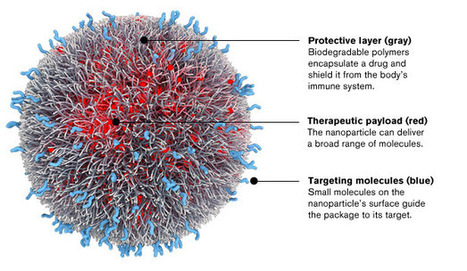
The results of the human trials are startling. Even at a lower-than-usual dose, multiple lung metastases shrank or even disappeared after one patient received only two-hour-long intravenous infusions of an experimental cancer drug. Another patient saw her cervical tumor reduce by nearly 60 percent after six months of treatment. Though the drug trial—by Bind Biosciences in Cambridge, Massachusetts—of an experimental nanotechnology-based technique was designed simply to show whether the technology is safe, the encouraging results revive hopes that nanomedicine could realize its elusive promise.
Scoop.it!

Engineers at Brown University and QD Vision Inc. have created nanoscale single crystals that can produce the red, green, or blue laser light needed in digital displays. The size determines color, but all the pyramid-shaped quantum dots are made the same way of the same elements. In experiments, light amplification required much less power than previous attempts at the technology. The team’s prototypes are the first lasers of their kind.
Scoop.it!

Nanoparticles that can be imaged three different ways at once have enabled Stanford University School of Medicine scientists to remove brain tumors from mice with unprecedented accuracy.
Scoop.it!
Cerebral palsy refers to a group of incurable disorders characterized by impairments in movement, posture and sensory abilities. By tacking drugs onto molecules targeting rogue brain cells, Johns Hopkins University School of Medicine researchers have alleviated symptoms in newborn rabbits that are similar to those of cerebral palsy in children.
|




