Your new post is loading...

|
Scooped by
Dr. Stefan Gruenwald
April 19, 2012 12:33 PM
|
The battle amongst theorists to predict the structure of a new form of carbon is heating up. The battle amongst theorists to predict the structure of a new form of carbon is hotting up. Chaoyu He and his team at the Institute for Quantum Engineering and Micro-Nano Energy Technology in Xiangtan, China, propose two new superhard structures, which they call S-carbon and H-carbon.
|
|
Scooped by
Dr. Stefan Gruenwald
April 15, 2012 8:05 PM
|
Researchers at the Imperial College London have now enabled tiny nano-sized magnets to behave like magnetic monopoles, by arranging them in a honeycomb structure. In late 2009, various teams of scientists reported they had created monopole-like behaviour in a material called ‘spin ice’. In these materials, monopoles form only at extremely low temperatures of -270 degrees Celsius. The Imperial researchers’ structure contains magnetic monopoles at room temperature. Video is here: http://www2.imperial.ac.uk/imedia/videos/view/663
|
|
Scooped by
Dr. Stefan Gruenwald
April 4, 2012 12:39 PM
|
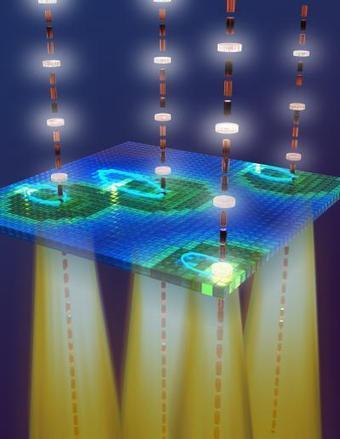
By aiming high- and low-frequency laser beams at a semiconductor, physicists at UC Santa Barbara have produced multiple frequencies of light simultaneously, with the potential to significantly increase the speed of data communication. The above picture shows near-infrared (amber rods) and terahertz (yellow cones) radiation interact with a semiconductor quantum well (tiles). The near-IR radiation creates excitons (green tiles) consisting of a negative electron and a positive hole (dark blue tile at center of green tiles) bound in an atom-like state. Intense terahertz fields pull the electrons (white tiles) first away from the hole and then back towards it (electron paths represented by blue ellipses). Electrons periodically recollide with holes, creating periodic flashes of light (white disks between amber rods) that are emitted and detected as sidebands.
|
|
Scooped by
Dr. Stefan Gruenwald
March 27, 2012 12:04 PM
|
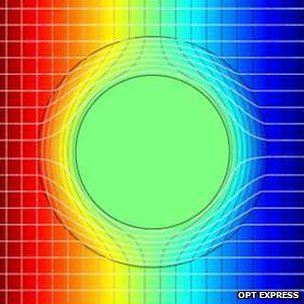
The range of physical phenomena that scientists are trying to "cloak" objects from has a new entry - heat. French researchers have shown how to apply the ideas of "optical cloaking" - the endeavour to make a Harry Potter-style cloak - to the thermal world.
|
|
Scooped by
Dr. Stefan Gruenwald
March 19, 2012 9:38 PM
|
Large patches of an extremely strong new adhesive, inspired by geckos, can be used over and over again. For years scientists have tried to make strong, reusable adhesives by mimicking the microscopic hair-like structures on gecko toes that give the lizard its climbing ability. But those structures are hard to make, limiting the adhesives' size to a few centimeters. Now researchers from the University of Massachusetts, Amherst, have come up with a different gecko-inspired structure that works even better. They have created a reusable adhesive fabric that can be easily and cheaply made tens of centimeters wide and is three times stronger than gecko feet. http://tinyurl.com/7dak2q4
|
|
Scooped by
Dr. Stefan Gruenwald
March 9, 2012 8:56 PM
|
Titanium dioxide breaks down dirt and kills microbes when exposed to some types of light. It already has found uses in self-cleaning windows, kitchen and bathroom tiles, odor-free socks and other products. Self-cleaning cotton fabrics have been made in the past, but they self-clean thoroughly only when exposed to ultraviolet rays. This new cotton fabric, however, cleans itself when exposed to ordinary sunlight. http://tinyurl.com/73lfkx8
|
|
Scooped by
Dr. Stefan Gruenwald
March 5, 2012 8:43 PM
|
Two new types of ultra-hard carbon crystals have been found by researchers investigating the ureilite class Haverö meteorite that crashed to Earth in Finland in 1971. http://tinyurl.com/ykzkjfc
|
|
Scooped by
Dr. Stefan Gruenwald
February 17, 2012 4:53 PM
|
For years, biologists have been amazed by the power of gecko feet, which let these 5-ounce lizards produce an adhesive force roughly equivalent to carrying nine pounds up a wall without slipping. Now, a team of polymer scientists and a biologist at the University of Massachusetts Amherst have discovered exactly how the gecko does it, leading them to invent "Geckskin," a device that can hold 700 pounds on a smooth wall. Doctoral candidate Michael Bartlett in Alfred Crosby's polymer science and engineering lab at UMass Amherst is the lead author of their article describing the discovery in the current online issue of Advanced Materials ("Looking Beyond Fibrillar Features to Scale Gecko-Like Adhesion").
|
|
|
Scooped by
Dr. Stefan Gruenwald
April 18, 2012 10:41 AM
|
The solution does not coat the paper as such but creates a soft shell around each of the paper's fibres, which means the paper can still be used as normal.
|
|
Scooped by
Dr. Stefan Gruenwald
April 8, 2012 11:17 AM
|
The sneaky science of "cloaking" just keeps getting richer. Physicists and engineers had already demonstrated rudimentary invisibility cloaks that can hide objects from light, sound, and water waves. Now, they've devised an "antimagnet" cloak that can shield an object from a constant magnetic field without disturbing that field. If realized, such a cloak could have medical applications, researchers say. Videos on cloaking technologies: http://tinyurl.com/bpbkjqa
|
|
Scooped by
Dr. Stefan Gruenwald
March 28, 2012 10:59 AM
|
When scientists from Umea University and Aalto University tried to perform a reaction between hydrogen gas and fullerene molecules encapsulated in nanotubes something very unlikely suddenly appeared possible. They discovered direct evidence that molecules inside of SWNts can be reacted with gases. This finding opens enormous possibilities for synthesis of novel hybrid materials and chemical modification of encapsulated molecules and materials.
|
|
Scooped by
Dr. Stefan Gruenwald
March 23, 2012 2:12 PM
|
Physicists have already unveiled invisibility cloaks that can hide objects from light, sound, seismic and even water waves. Now researchers report a cloak that can hide objects from static magnetic fields. This 'antimagnet' could have medical applications, but might also subvert airport security. http://tinyurl.com/85znya9
|
|
Scooped by
Dr. Stefan Gruenwald
March 16, 2012 1:59 PM
|
By depositing atoms on one side of a grid of the "miracle material" graphene, researchers ave engineered piezoelectricity into a nanoscale material for the first time. The implications could yield dramatic degree of control in nanotechnology. http://tinyurl.com/7u6zrsm
|
|
Scooped by
Dr. Stefan Gruenwald
March 5, 2012 9:56 PM
|
A variety of spider silks – particularly the draglines that anchor webs in place – conduct heat better than most materials, including very good conductors such as silicon, aluminum and pure iron. Spider silk also conducts heat 1,000 times better than woven silkworm silk and 800 times better than other organic tissues. http://tinyurl.com/6sgp6hx
|
|
Scooped by
Dr. Stefan Gruenwald
February 24, 2012 2:14 PM
|
The “miracle material” graphene is the world’s thinnest known coating for protecting metals against corrosion. In the study, Dhiraj Prasai and colleagues point out that rusting and other corrosion of metals is a serious global problem, and intense efforts are underway to find new ways to slow or prevent it. Corrosion results from contact of the metal’s surface with air, water or other substances. One major approach involves coating metals with materials that shield the metal surface, but currently used materials have limitations. The scientists decided to evaluate graphene as a new coating. Graphene is a single layer of carbon atoms, many layers of which are in lead pencils and charcoal, and is the thinnest, strongest known material. That’s why it is called the miracle material. In graphene, the carbon atoms are arranged like a chicken-wire fence in a layer so thin that is transparent, and an ounce would cover 28 football fields. Videos about Graphene: http://tinyurl.com/74eelyy
|
|
Scooped by
Dr. Stefan Gruenwald
February 11, 2012 12:42 PM
|
Spray-on liquid glass is transparent, non-toxic, and can protect virtually any surface against almost any damage from hazards such as water, UV radiation, dirt, heat, and bacterial infections.
|