 Your new post is loading...

|
Scooped by
Dr. Stefan Gruenwald
August 29, 2012 5:27 PM
|
An ancient living laboratory of our planet's past in Antarctica may have provided a preview of what we can expect to find deep below the barren surface of Mars and in the ice-shrouded seas of Jupiter's Europa. Lake Vostok, believed to harbor ancient life that has been isolated from open exchange with the atmosphere for several million years, is the largest subglacial lake on Earth, discovered in 1996 by Russian and British scientists underneath the Russian station Vostok in Antarctica -- one of 140 subglacial lakes located beneath the Antarctic ice-sheet. At 250km long and 50km wide, some 4000 meters underneath the surface ice, and could be one of the most important scientific finds of the last several decades. In lake Vostok nitrifying bacteria with low but active metabolisms have been found encased in liquid veins at minus 40 degrees F for more than 140,000 years. And, it takes about 108 years for carbon to turn over in the cells. No other natural lake environment on Earth has this much oxygen as Lake Vostok -- an oligotrophic extreme environment, one that is supersaturated with oxygen, with oxygen levels 50 times higher than those typically found in ordinary freshwater lakes. The sheer weight of the continental icecap sitting on top of Lake Vostok is believed to contribute to the high oxygen concentration. Microbial organisms in Lake Vostok must be capable of overcoming very high oxygen stress, and may have had to evolve special adaptations, such as high concentrations of protective enzymes, in order to survive.
|
|
Scooped by
Dr. Stefan Gruenwald
August 24, 2012 11:33 AM
|
According to data just now available, the total surface area of the summertime Arctic Sea that is covered in ice has reached the lowest point ever recorded. Every (northern) summer the sea ice in the Arctic melts to some degree, reaching a minimum around the middle of September. Over the last several years, the amount of ice at this minimal point has been lower than previously recorded. Accurate records go back only a few decades, so this shift in ice cover reflects only the most recent period of Anthropocentric Global Warming (AGW).
|
|
Scooped by
Dr. Stefan Gruenwald
August 17, 2012 11:59 AM
|
Harvard scientists have discovered that intense summer storms can force water vapor into the dry and cold stratosphere through a process called convective injection. The presence of such water vapor, which normally stops at the tropopause (the boundary between the troposphere and the stratosphere), changes the threshold temperature at which ozone is destroyed by chemistry dependent on manmade chlorofluorocarbons (CFCs), which are still present in the atmosphere despite an international ban on their use. The chemical reactions that destroy ozone typically occur only at very cold temperatures. The presence of water vapor raises the temperature at which ozone loss takes place, to the point that threshold conditions for ozone destruction are routinely crossed during the summer above the United States and possibly elsewhere. The frequency and intensity of these summer storms is expected to increase with climate forcing due to increasing levels of heat-trapping atmospheric carbon dioxide and methane. Reductions in stratospheric ozone would allow more DNA-damaging ultraviolet radiation to reach Earth, with potential biological effects on human beings, animals, and plants.
|
|
Scooped by
Dr. Stefan Gruenwald
August 11, 2012 12:10 AM
|
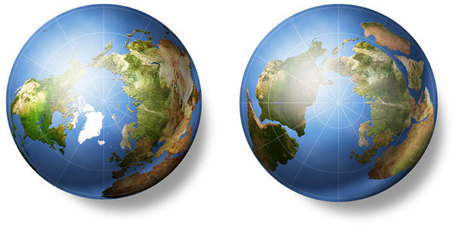
Earth’s modern continents are the fragments of a single, 300-million-year-old supercontinent called Pangaea. This vast landmass once rested on the equator, near where Africa is today. During the age of dinosaurs, tectonic forces slowly tore Pangaea apart. Now geologists predict those same forces will reassemble the pieces into a new supercontinent, named Amasia, about 100 million years in the future.
Ancient rocks and mountain ranges show that the constant movement of Earth’s crust has assembled and ripped apart supercontinents several times before, in a roughly half-billion-year cycle. But pinpointing where the past ones formed has proven difficult, which in turn clouded attempts to forecast the next great smashup.
A team of Yale geologists say they have cracked the problem, providing the best look yet at the planet of a.d. 100,000,000. Led by graduate student Ross Mitchell, the researchers first looked back beyond Pangaea and determined the location of supercontinents Rodinia, which formed about a billion years earlier, and Nuna, 700 million years before that. The team found that during the last two cycles, each supercontinent formed a quarter of the way around the globe from where the previous supercontinent had been. Using that insight, they calculated that Amasia will form over the North Pole.
|
|
Scooped by
Dr. Stefan Gruenwald
July 23, 2012 11:13 AM
|
How did the Earth get its oceans? The primordial Earth was a seething ball of magma, so the water that it began with would have evaporated into space. As a result, planetary scientists have long debated which of two types of objects, comets or asteroids, were more responsible for delivering Earth’s water. A new study says that asteroids were the source. The authors analyzed the isotopic abundances of nitrogen and hydrogen in 86 primitive meteorites, and found that they coordinate with Earth’s. Asteroids had already been the favored source. Studies of solar system dynamics suggest that there was a period of time around 3.9 billion years ago, called the Late Heavy Bombardment, during which the Earth would have been barraged, mostly by asteroids.
|
|
Scooped by
Dr. Stefan Gruenwald
July 18, 2012 9:29 PM
|
An iceberg twice the size of Manhattan has broken off from a north Greenland's glacier, illustrating another dramatic change to the warming island. For several years, scientists had been watching a long crack near the tip of the northerly Petermann Glacier. On Monday, NASA satellites showed it had broken completely, freeing an iceberg measuring 46 square miles. A massive ice sheet covers about four-fifths of Greenland. Petermann Glacier is mostly on land, but a segment sticks out over water like a frozen tongue, and that's where the break occurred. The same glacier spawned an iceberg twice that size two years ago. Together, the breaks made a large change that's got the attention of researchers.
|
|
|
Scooped by
Dr. Stefan Gruenwald
August 29, 2012 11:55 AM
|
Japanese could become extinct in 1,000 years if current population trends continue, according to researchers. Researchers at Tohoku University Graduate School of Economics in Sendai unveiled a population clock — available on the university's website — that showed the nation ending up with no children aged under 15 by May 18, 3011. The calculation is based on the fact that the current population of children aged up to 14 — 16.6 million — is shrinking at the rate of one every 100 seconds, Agence France-Presse reported. The researchers reportedly did not take into account potential disasters, wars, or other global changes. "If the rate of decline continues, we will be able to celebrate the Children's Day public holiday on May 5, 3011 as there will be one child," AFP cited Hiroshi Yoshida, an economics professor at Tohoku University, as saying. "But 100 seconds later there will be no children left. The overall trend is towards extinction, which started in 1975 when Japan's fertility rate fell below two."
|
|
Scooped by
Dr. Stefan Gruenwald
August 19, 2012 12:23 PM
|
In a surprising turnaround, the amount of carbon dioxide being released into the atmosphere in the U.S. has fallen dramatically to its lowest level in 20 years, and government officials say the biggest reason is that cheap and plentiful natural gas has led many power plant operators to switch from dirtier-burning coal.
Many of the world's leading climate scientists didn't see the drop coming, in large part because it happened as a result of market forces rather than direct government action against carbon dioxide, a greenhouse gas that traps heat in the atmosphere.
Michael Mann, director of the Earth System Science Center at Penn State University, said the shift away from coal is reason for "cautious optimism" about potential ways to deal with climate change. He said it demonstrates that "ultimately people follow their wallets" on global warming.
While conservation efforts, the lagging economy and greater use of renewable energy are factors in the CO2 decline, the drop-off is due mainly to low-priced natural gas, the agency said. Both government and industry experts said the biggest surprise is how quickly the electric industry turned away from coal. In 2005, coal was used to produce about half of all the electricity generated in the U.S. The Energy Information Agency said that fell to 34 percent in March, the lowest level since it began keeping records nearly 40 years ago. How much further the shift from coal to natural gas can go is unclear. Bentek says that power companies plan to retire 175 coal-fired plants over the next five years. That could bring coal's CO2 emissions down to 1980 levels. However, the EIA predicts prices of natural gas will start to rise a bit next year, and then more about eight years from now.
|
|
Scooped by
Dr. Stefan Gruenwald
August 17, 2012 11:39 AM
|
The eastern edge of the Namib Desert of southwestern Africa (the pro-Namib) is home to a mysterious phenomenon called “fairy circles”–nearly circular barren patches within a sparse matrix of small short-lived grass species. In Namibia of southwestern Africa, the sparse grasslands that develop on deep sandy soils under rainfall between 50 and 100 mm per annum are punctuated by thousands of quasi-circular bare spots, usually surrounded by a ring of taller grass. The causes of these so-called “fairy circles” are unknown, although a number of hypotheses have been proposed.
|
|
Scooped by
Dr. Stefan Gruenwald
July 26, 2012 12:56 PM
|
A pair of NASA satellite images taken just four days apart tells a potentially worrying story of melting ice in the polar summer. The first, snapped from orbit on July 8, shows about 40 percent of the Greenland ice sheet shaded in pink or red to illustrate probable or confirmed surface melting. The second photo, taken on July 12, shows nearly the entire land mass — 97 percent — blotched in a red hue. In a typical year, only about half of the Greenland ice sheet undergoes this kind of melting before it later refreezes. But the rapidity and extent of the July change is what has caught scientists off guard, said Thomas Mote, a professor at the University of Georgia, who helped confirm the data from three satellites. Scientists note that besides covering a large area, the melting is happening at the top of the ice cap, where temperatures are coldest. They blame a massive heat dome parked over the island that has set up perfect conditions for melting high-altitude snow and ice. Alarming? "I wouldn't use that word," say Mote. "We know from looking at ice cores that melt at the highest levels of elevation in Greenland has occurred in the past — not in our lifetimes, and not since the era of satellites, but it certainly has occurred." The last time it happened was about 150 years ago, in 1889, according to ice core records. But the Greenland melt roughly coincides with a giant chunk of ice described as "twice the size of Manhattan," breaking off the Petermann Glacier in northern Greenland.
|
|
Scooped by
Dr. Stefan Gruenwald
July 19, 2012 10:51 AM
|
Looking at Earth's picture from space, one may think that Earth is a water world. But the fact is that she is 99-percent dry rock. According to our current solar system formation model, this is impossible—a mystery that has puzzled scientists until now.
|
|
Scooped by
Dr. Stefan Gruenwald
May 17, 2012 11:43 AM
|
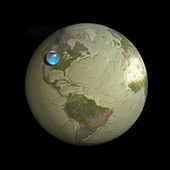
How much of planet Earth is made of water? Very little, actually. Although oceans of water cover about 70 percent of Earth's surface, these oceans are shallow compared to the Earth's radius. The above illustration shows what would happen if all of the water on or near the surface of the Earth were bunched up into a ball. The radius of this ball would be only about 700 kilometers, less than half the radius of the Earth's Moon, but slightly larger than Saturn's moon Rhea which, like many moons in our outer Solar System, is mostly water ice. How even this much water came to be on the Earth and whether any significant amount is trapped far beneath Earth's surface remain topics of research.
|




![NASA: How much water is on Planet Earth? Visualization: All water bunched up to a single ball [photo] | Amazing Science | Scoop.it](https://img.scoop.it/8nmxanc8RrXwGvIhyYuj1Tl72eJkfbmt4t8yenImKBVvK0kTmF0xjctABnaLJIm9)




