Fruit flies infected with a blood-borne parasite consume alcohol to self-medicate, a behavior that greatly increases their survival rate, an Emory University study finds.
"These results are the first to show that alcohol consumption can have a protective effect against infectious disease, and in particular against blood-borne parasites. These findings raise an important question: Could humans control blood-borne parasites, such as malaria, through high doses of alcohol? For more info: http://www.emory.edu/esciencecommons
A species of chameleon small enough to easily perch on a match head has been discovered on a tiny island off Madagascar. Brookesia micra may represent the limit of miniaturization possible for a vertebrate with complex eyes
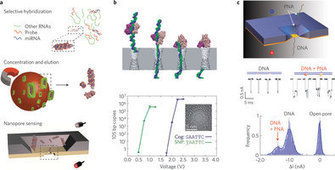
Nanopore analysis is an emerging technique that involves using a voltage to drive molecules through a nanoscale pore in a membrane between two electrolytes, and monitoring how the ionic current through the nanopore changes as single molecules pass through it. This approach allows charged polymers (including single-stranded DNA, double-stranded DNA and RNA) to be analysed with subnanometre resolution and without the need for labels or amplification. Recent advances suggest that nanopore-based sensors could be competitive with other third-generation DNA sequencing technologies, and may be able to rapidly and reliably sequence the human genome for under $1,000. In this article we review the use of nanopore technology in DNA sequencing, genetics and medical diagnostics.
The Max Planck Institute for Evolutionary Anthropology, in Leipzig, Germany, has completed the genome sequence of a Denisovan, a representative of an Asian group of extinct humans related to Neandertals.
As sequencing source, 10 milligram of a small finger bone fragment that was used, found in the Denisova-Cave in Southern Sibiria.
Circos is a software package conceived and created by Martin Krzywinski to visualize large amounts of data in a circular layout.
Circos is ideal for creating publication-quality infographics and illustrations with a high data-to-ink ratio, richly layered data and pleasant symmetries.
(You will need Perl to run Circos. Perl is an interpretive language, like Python or Ruby. It is available for nearly every operating system and if you're on UNIX or Mac OS X, you very likely already have it installed. Perl 5.8.x, or newer, is recommended.)
A massive database cataloging the human genome's functional elements -- including genes, RNA transcripts, and other products -- is being made available as an open resource to the scientific community, classrooms, science writers, and the public, thanks to an international team of researchers.
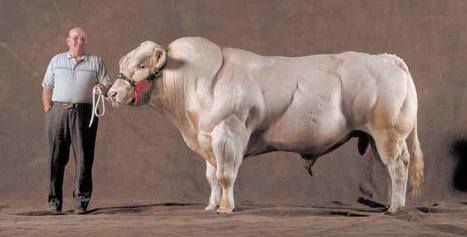
Myostatin (also known as growth differentiation factor 8 or GDF8) is a secreted TGF beta protein family member that inhibits muscle differentiation and growth. Myostatin is produced primarily in skeletal muscle cells, circulates in the blood and acts on muscle tissue, by binding a cell-bound receptor called the activin type II receptor.
Animals lacking myostatin or animals treated with substances such as follistatin that block the binding of myostatin to its receptor have significantly larger muscles. Thus, reduction of myostatin could potentially benefit the livestock industry, with even a 20 percent reduction in myostatin levels potentially having a large effect on the development of muscles.
Bacteria found on the bottom of the Arctic Ocean might have the longest life-cycle on Earth, surviving for as much as 100 million years in hibernation while waiting for the ice to thaw enough for them to be viable again.
Antarctica makes up more than 10 percent of the world's land mass, but it was long assumed that -- except for some hardy penguins -- it had virtually no life. With ice and snow blanketing virtually the entire continent, the environment was believed to be just too harsh and barren to support anything beyond occasional human visitors.
Do the principles of quantum mechanics apply to biological systems? Until now, both biologists and physicists have considered quantum systems and biological molecules to be like apples and oranges. Do the principles of quantum mechanics apply to biological systems? Newest research conducted in Germany, which appeared recently in Science, shows that a biological molecule -- DNA -- can discern between certain quantum states like spin.
EVER felt a little incoherent? Or maybe you've been in two minds about something, or even in a bit of delicate state. Well, here's your excuse: perhaps you are in thrall to the strange rules of quantum mechanics.
We tend to think that the interaction between quantum physics and biology stops with Schrödinger's cat. Not that Erwin Schrödinger intended his unfortunate feline - suspended thanks to quantum rules in a simultaneous state of being both dead and alive - to be anything more than a metaphor. Indeed, when he wrote his 1944 book What is Life?, he speculated that living organisms would do everything they could to block out the fuzziness of quantum physics.
Two potent human antibodies that can stop more than 90 percent of known global HIV strains from infecting human cells in the laboratory have been discovered. These antibodies could be used to design improved HIV vaccines, or could be further developed to prevent or treat HIV infection. Moreover, the method used to find these antibodies could be applied to isolate therapeutic antibodies for other infectious diseases as well.
Researchers, pet owners and cat chow manufacturers have long recognized that cats, in stark contrast to their canine counterparts, show no particular attraction to sugar. Having sampled two dishes of water, one spiked with sugar and the other not, a cat is as likely to lap from one as the other. But why? The sweetness receptor in mammals consists of two different proteins attached to each other on the surface of a cell. The two are manufactured under the direction of two genes, then embrace to make a single receptor that fires a nerve signal to the brain when sugar is present. In cats, one of those genes, called Tas1r2, is missing a stretch of 247 bases -- a deletion that prevents the gene from making a proper protein. With only one of the two crucial proteins, the cats have no way to taste sweetness.
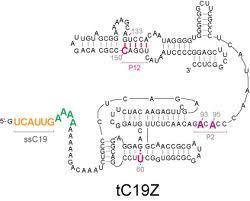
It doesn't have a very sexy name, but tC19Z, synthesised in a lab in Cambridge, UK, could be a version of one of the first enzymes that ever existed on our planet - and a clue to how life itself got started.
A prominent theory of how life started involves the appearance of a self-replicator - some kind of simple molecule that was capable of making copies of itself without relying on other molecules. The trouble is, if this self-replicating molecule ever did exist, it doesn't any more. The vast majority of organisms around today use DNA to store their genetic information, and DNA does not copy itself - other enzymes do that bit for it.
Enter tC19Z. Built by Philipp Holliger and colleagues, it is an RNA enzyme that functions like a self-replicator. RNA is structurally similar to DNA and can also be used to store genetic information. Some RNA molecules can act as enzymes, driving important chemical reactions in cells, but an RNA enzyme that can reliably copy other RNA segments, let alone self-replicate, has proved elusive.
Until now, the only known RNA-copying RNA was a molecule called R18, which can only copy RNA segments up to 14 "letters" long, and only works on certain sequences. It's like a word processor that can copy-and-paste "turnip" but not "swede".
Holliger, who is based at the MRC Laboratory of Molecular Biology in Cambridge, UK, has now set out to improve R18.
He made a vast library of thousands of different versions of the molecule and screened them to see which ones made more copies. After several rounds of copying variants and looking for new improvements, he found several useful tweaks, which he incorporated into his final patchwork enzyme, tC19Z.
In reality, tC19Z can reliably copy RNA sequences up to 95 letters long, a near-sevenfold increase on R18. Its performance varies depending on the sequence it's copying, but it is much less picky than R18. Holliger compares R18 to a sports car that works only on a smooth, flat road. "We have fitted a four-wheel drive, so it can go off-road a bit," he says.
Crucially, tC19Z can copy pieces of RNA that are almost half as long (48 per cent) as itself. If an RNA enzyme is to copy itself, it has to be able to copy sequences as long as itself, and tC19Z is closing in on that goal.
In a neat twist, Holliger's team also showed that tC19Z can make copies of another RNA enzyme, which then worked correctly. That suggests that, once the first self-replicating RNA had appeared, it would have been able to surround itself with additional molecular equipment, kick-starting the evolution of more complex life.
Scientists at Harvard University have harnessed the ability of fast-replicating bacterial viruses to accelerate the evolution of biomolecules in the laboratory.
The research exploited the continuous culture and selection of bacterial viruses to enable the continuous directed evolution of proteins and nucleic acids. This phage-assisted continuous evolution (PACE) is roughly 100 times faster than conventional laboratory evolution, and far less labor-intensive for scientists.
Humanity’s advances to date have been accompanied by great leaps in the density, diversity, and virtuality of our societies, and in the miniaturization and efficiency of our technologies. Among these and other variables determining social progress, two stand out as particularly special. The more our intelligence gains access to “Inner Space,” both to the domain of very small size scales (“Physical Inner Space”), and to the domain of very powerful brain-based and computer-based simulations (“Virtual Inner Space”) the faster we learn to generate major new economic, social, and adaptation benefits for civilization. This “race to Inner Space” may turn out to be the dominant developmental trend for our species.
Albinism (from Latin albus, white) is a form of hypopigmentary congenital disorder, characterized by a partial lack or total absence of melanin pigment in the eyes, skin and hair, or more rarely in the eyes alone. Due to this, animals (and humans too) are unusually pale. The eyes of an animal with albinism occasionally appear red because of the underlying retinal blood vessels showing through where there is not enough pigment to cover them.
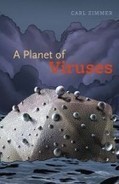
Viruses are the smallest living things known to science, and yet they hold the entire planet in their sway. We’re most familiar with the viruses that give us colds or the flu, but viruses also cause a vast range of other diseases, including one disorder that makes people sprout branch-like growths as if they were trees. Viruses have been a part of our lives for so long, in fact, that we are actually part virus: the human genome contains more DNA from viruses than our own genes. Meanwhile, scientists are discovering viruses everywhere they look: in the soil, in the ocean, even in deep caves miles underground. The world’s oceans alone are home to an astonishing
In many ways, life is like a computer. An organism's genome is the software that tells the cellular and molecular machinery—the hardware—what to do. But instead of electronic circuitry, life relies on biochemical circuitry—complex networks of reactions and pathways that enable organisms to function. Now, researchers at the California Institute of Technology (Caltech) have built the most complex biochemical circuit ever created from scratch, made with DNA-based devices in a test tube that are analogous to the electronic transistors on a computer chip.
The Faculty of 1000 (F1000), in London, has announced an experiment in online science publishing, aimed at sharing research results widely and rapidly, and using open peer review to check postings afterwards.
"Now we are in the 6th mass extinction event, which is a result of a competition for resources between one species on the planet – humans – and all others. The process towards extinction is mainly caused by habitat degradation, whose effect on biodiversity is worsened by the ongoing human-induced climate change."
A fundamental, previously unknown property of microbial nanowires in the bacterium Geobacter sulfurreducens allows electron transport across long distances. In the laboratory, Geobacter will grow on electrodes, producing thick, electrically conductive biofilms. In a series of studies with genetically modified strains, the researchers found the metallic-like conductivity in the biofilm could be attributed to a network of nanowires spreading throughout the biofilm.
Researchers recently compared 29 genomes of different mammals in an effort to understand our own genomic mysteries. By looking across species, they have cast new light on the molecular components of all life and have taken an important step toward decrypting the information locked in our own DNA.
To get content containing either thought or leadership enter:
To get content containing both thought and leadership enter:
To get content containing the expression thought leadership enter:
You can enter several keywords and you can refine them whenever you want. Our suggestion engine uses more signals but entering a few keywords here will rapidly give you great content to curate.


 Your new post is loading...