Your new post is loading...

|
Scooped by
Dr. Stefan Gruenwald
April 20, 2012 11:50 AM
|
Altaeros Energies shows how an airborne wind turbine, held in a tethered blimp, can generate power at high altitudes and automatically reattach to its launcher. The wind energy startup released a video this week of its prototype airborne wind turbine during its first test run in Maine earlier this year. The donut-shaped blimp has a spinning fan at its center, and it's tethered to a base station by cables that carry electricity from the blimp to the local grid.
|
|
Scooped by
Dr. Stefan Gruenwald
April 17, 2012 10:35 AM
|
NASA is clearly looking far into the future for a way to handle both human waste and a need for fuel on either long space flights or when attempting to colonize another planet. To that end, they’ve assigned life support engineer Jonathan Trent the task of coming up with a way to use algae to solve both problems at once. His solution is to use plastic bags floating in seawater as small bioreactors, containing wastewater, sunlight and carbon dioxide to grow algae that can be used as a means to create biofuel. Offshore Membrane Enclosures for Growing Algae (OMEGA) is an innovative method to grow algae, clean wastewater, capture carbon dioxide and ultimately produce biofuel. Using treated sewage as a growth medium, OMEGA would not compete with agriculture for water, fertilizer or land. NASA’s OMEGA system consists of large flexible plastic tubes, called photobioreactors. Floating in seawater, the photobioreactors contain freshwater algae growing in wastewater. These algae are among the fastest growing plants on Earth.
|
|
Scooped by
Dr. Stefan Gruenwald
April 13, 2012 1:00 PM
|
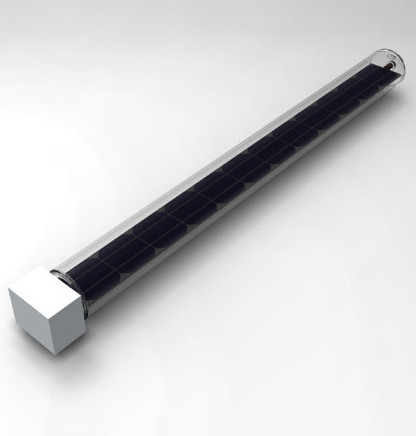
A British company, Guildford-based Naked Energy, has come up with a “hybrid” solar panel that has generated much interest in the past weeks because of its design, function, and test results, comparing favorably to traditional solar panels. The solar panel is of the “hybrid” variety because it does two jobs at the same time. The product, called Virtu, can generate both electricity and hot water simultaneously. The company believes that with Virtu they have invented the right design and process to achieve an effective thermal transfer system.
|
|
Scooped by
Dr. Stefan Gruenwald
April 10, 2012 10:49 PM
|
While the largest contributor to anthropogenic greenhouse gas emissions is the power industry, the second largest is the more often overlooked cement industry, which accounts for 5-6% of all anthropogenic CO2 emissions. For every 10 kg of cement produced, the cement industry releases a full 9 kg of CO2. Since the world consumes about 3 trillion kg of cement annually, this sector has one of the highest potentials for CO2 emission reductions. But while processes are being explored to sequester the CO2 from cement production, so far no process can completely eliminate it.
|
|
Scooped by
Dr. Stefan Gruenwald
April 4, 2012 4:24 PM
|
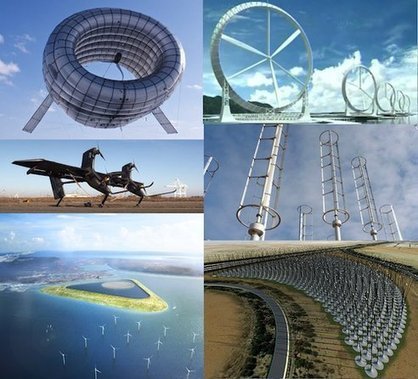
Innovations in wind technology keep bringing us more efficient ways to harvest clean renewable energy from the air above us. Here's a collection of the new and exciting in the wind power revolution.
|
|
Scooped by
Dr. Stefan Gruenwald
April 4, 2012 12:41 PM
|
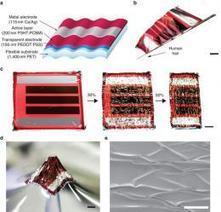
Austrian and Japanese researchers on Wednesday unveiled solar cells thinner than a thread of spider silk that are flexible enough to be wrapped around a single human hair. Stretchable solar cells are made by attaching the ultrathin solar cell to a pre-stretched elastomer. The device is attached to the elastomeric support, under three-dimensional deformation by pressure from a 1.5 mm-diameter plastic tube.
|
|
Scooped by
Dr. Stefan Gruenwald
March 28, 2012 10:43 AM
|
Innovative 3-D designs from an MIT team can more than double the solar power generated from a given area. Two small-scale versions of three-dimensional photovoltaic arrays were among those tested by Jeffrey Grossman and his team on an MIT rooftop to measure their actual electrical output throughout the day.
|
|
Rescooped by
Dr. Stefan Gruenwald
from Tracking the Future
February 14, 2012 12:01 PM
|
The combined effects of climate change, energy scarcity, and water paucity require that we radically rethink our agricultural systems. Countries can and must reorient their agricultural systems toward modes of production that are not only highly productive, but also highly sustainable. Following the 2008 global food price crisis, many developing countries have adopted new food security policies and have made significant investments in their agricultural systems. Global hunger is also back on top of the international agenda. However, the question is not only how much is done, but also how it is done—and what kinds of food systems are now being rebuilt.
Via Szabolcs Kósa
|
|
Rescooped by
Dr. Stefan Gruenwald
from Singularity Scoops
February 9, 2012 6:20 PM
|
Chinese manufacturers make about 50 million solar panels a year --- over half the world's supply in 2010 --- and include four of the world's top five.
Via Frederic Emam-Zade Gerardino
|
|
Scooped by
Dr. Stefan Gruenwald
February 6, 2012 4:46 PM
|
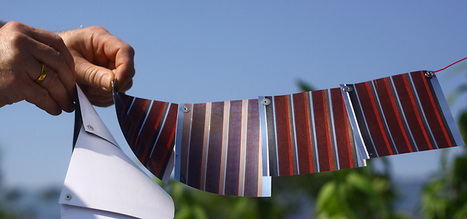
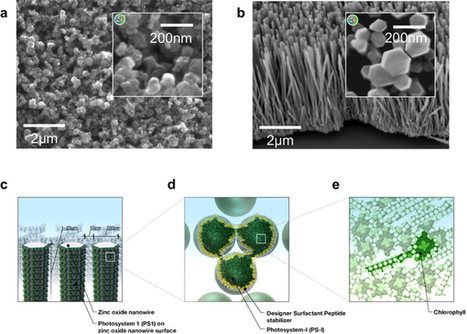
Enough solar energy strikes the earth in one hour to power our civilization for a year, and futurists like Ray Kurzweil see us moving to an all-solar civilization in the span of a single human lifetime. Leaves are the ultimate solar panel. If we're going to power more of the world with the sun, we're going to need to imitate plants, one way or another. There are a number of competing visions for how a solar leaf will work and what it might be made from. Daniel Nocera at MIT is working on a combination of catalysts that use sunlight to--like a leaf--directly convert water into hydrogen. Another group of MIT researchers have successfully printed solar cells onto paper, conjuring visions of a future in which solar cells are as cheap as the morning paper.
|
|
|
Scooped by
Dr. Stefan Gruenwald
April 18, 2012 10:36 AM
|
Low cost solar cells suitable for rooftop panels could reach a record-breaking 40 percent efficiency following an early stage breakthrough by a University of Sydney researcher and his German partners.
|
|
Scooped by
Dr. Stefan Gruenwald
April 17, 2012 10:28 AM
|
Scientists in Sweden have developed a molecular catalyser with the ability to quickly oxidise water to oxygen. Presented in the journal Nature Chemistry, the results are a significant contribution to the future use of solar energy and other renewable energy sources, especially since gasoline prices continue to soar.
|
|
Scooped by
Dr. Stefan Gruenwald
April 12, 2012 10:55 AM
|
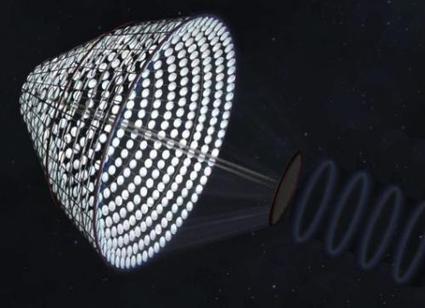
Artemis Innovation Management Solutions has been given some seed money by NASA to look deeper into a project the company first proposed last summer; namely, building a satellite that could collect energy from the sun and beam it back down to Earth to add to the electrical grid. Building such a satellite has been bantered about for several decades by various groups and scientists, but until now, no one had come up with a design that would work given all the constraints of the time. But now, an idea proposed by longtime NASA engineer John Mankins, now with Artemis, has clearly created enough interest within NASA that some money to investigate the idea is being offered.
|
|
Scooped by
Dr. Stefan Gruenwald
April 5, 2012 11:19 AM
|
French scientist has invented a light powered by algae that absorbs CO2 from the air--1 ton per year! The microalgae streetlamp has the potential to provide significantly cleaner air in urban areas and revolutionize the cityscape.
|
|
Scooped by
Dr. Stefan Gruenwald
April 4, 2012 1:05 PM
|
It took Thomas Edison two years and over 3,000 experiments to develop a marketable light bulb. It has taken 10 times that long and who-knows-how-many experiments to develop a system that is far more complicated: the inner workings of a reliable, marketable hydrogen fuel cell.
|
|
Scooped by
Dr. Stefan Gruenwald
April 2, 2012 10:31 AM
|
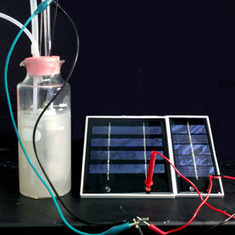
By pairing biology and photovoltaics, a new "electrofuel" system could build alternative fuels. A new "bioreactor" could store electricity as liquid fuel with the help of a genetically engineered microbe and copious carbon dioxide. The idea—dubbed "electrofuels" by a federal agency funding the research—could offer electricity storage that would have the energy density of fuels such as gasoline. If it works, the hybrid bioelectric system would also offer a more efficient way of turning sunlight to fuel than growing plants and converting them into biofuel.
|
|
Scooped by
Dr. Stefan Gruenwald
March 21, 2012 3:14 PM
|
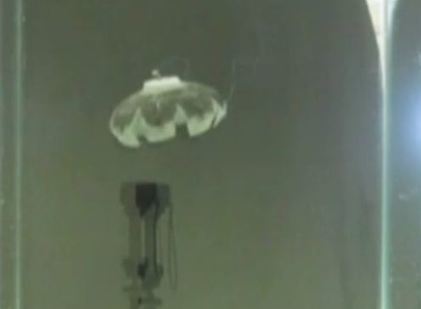
Virginia Tech engineers have invented a hydrogen-powered robot nicknamed Robojelly that moves through water like a jellyfish, intended for underwater rescue operations. A jellyfish moves using circular muscles in the inside of its umbrella-like bell. As they contract, the bell closes in on itself and ejects water to propel itself forward. When the muscles relax, the bell regains its original shape. http://tinyurl.com/7enjj2m
|
|
Rescooped by
Dr. Stefan Gruenwald
from Tracking the Future
February 14, 2012 11:59 AM
|
Dutch agricultural company PlantLab wants to change almost everything you know about growing plants. Instead of outdoors, they want farms to be in skyscrapers, warehouses, or underground using hydroponics or other forms of controlled environments. Instead of sunlight they use red and blue LEDs. Water? They need just 10% of the traditional requirements.
Via Szabolcs Kósa
|
|
Scooped by
Dr. Stefan Gruenwald
February 8, 2012 11:00 AM
|
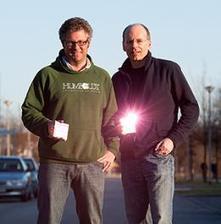
Within a few years, people in remote villages in the developing world may be able to make their own solar panels, at low cost, using otherwise worthless agricultural waste as their raw material. The new system’s efficiency is 10,000 times greater than in the previous version — although in converting just 0.1 percent of sunlight’s energy to electricity, it still needs to improve another tenfold or so to become useful.
|
|
Scooped by
Dr. Stefan Gruenwald
February 1, 2012 2:11 PM
|
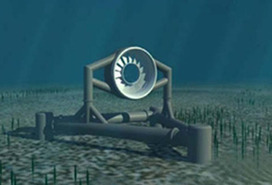
Wind energy continues to be an important part of renewable resources. However, other promising forms of renewable energy exist. Coastal states have a potential source of renewable energy in waves and tidal currents. Snohomish PUD is evaluating the use of tidal energy as a renewable energy source and detailed studies have been performed at seven locations in and around Puget Sound for tidal generators. These devices are similar to windmills but generate energy by using tidal currents to drive turbines located on the seabed. Collection of videos on tidal energy: http://tinyurl.com/dxc2b7p
|