


Nov 05, 2026


 Your new post is loading...
 Scoop.it! 
Investing.com -- About 600,000 Nvidia artificial intelligence chips are stored in Hong Kong waiting for shipment to mainland China, Reuters reported Thursday citing people familiar with the matter. Beijing has not approved large-scale imports of the H200 chips despite demand from technology companies.

Scoop.it!

Titan OS has raised $110 million in funding to date.
Scoop.it!

Sentra secures $150M led by Capital One Ventures to expand AI data security, with the investor joining its board as competition with Cyera intensifies.
Scoop.it!

Data center in Italia: 104,7 miliardi di progetti monitorati, oltre 100 GW richiesti a Terna e la sfida di energia, territori e tempi
Scoop.it!

From
github

:dog: The open-source Gauge CLI. Hillclimb your Skills, CLI, SDK, MCP, API, or Docs to make something agents want. - gauge-sh/gauge-cli
Scoop.it!

The 2026 Startup Radar presents innovative young companies developing hardware, software, and business models for the next generation of commercial robotics.
Scoop.it!
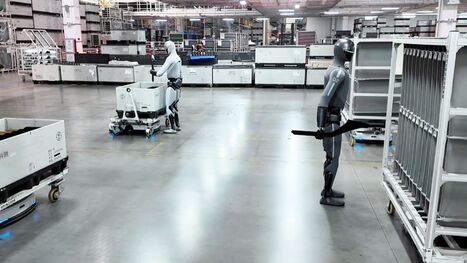
Xiaomi's humanoid robots sort automotive components in an eight-hour factory test, demonstrating extended operation and autonomous fault detection.
Scoop.it!
From
x
Dim is now open source.
An agent paradigm built on an event-driven timeline and a fully plugin-based runtime — it grows and iterates within the environment it runs in. Explore Dim and the source : https://t.co/Lq0KFAuuhv
Scoop.it!
From
x
Axion 1.0 is an open agent model from ByteDance and university authors, and the data, prompts, training code and eval protocol are all released.
The 35B version is a mixture of experts with about 3B active parameters. It trains on roughly 18K SFT examples in three stages: two SFT stages, then rein…
Scoop.it!

From
arxiv
Computer-use agents (CUAs) have recently achieved superhuman performance on several long-horizon benchmarks. However, their computational cost limits their use in long-horizon tasks and real-time domains such as video games. A key bottleneck is representing each screenshot as thousands of visual tokens, which accumulate into long contexts as agents reason over extended interaction histories. We observe that most of these visual tokens are either semantically irrelevant to the agent's next action or temporally redundant across screenshots. Building on this observation, we introduce Visual Token Routing (VTR), a joint training framework for learning sparse visual representations that preserve the information needed for action prediction. In VTR, we train the vision-language model together with a lightweight spatio-temporal router that examines each image region in the current and previous screenshots and decides whether its visual token enters the language model. We optimize the router using an adaptive loss to keep the number of visual tokens as small as possible while minimizing performance degradation. With just 2,000 training steps, VTR matches the performance of the full-resolution model on OSWorld, CUA-World, and video game action prediction, while using 2.5-5.8x fewer visual tokens. These savings reduce inference cost by up to 3.3x and speed up prefill by up to 2.9x. VTR also outperforms lowering the image resolution and other baselines for dropping tokens, by up to 12.8 points on OSWorld. Overall, VTR enables computer-use agents to process only the visual tokens they need, allowing them to be used in long-horizon tasks and real-time domains at a fraction of the computational cost. Code and models are available at https://pranjal2041.github.io/vtr
|
Scoop.it!

Zipline raised $1.5 billion and ramped up its partnership with Walmart.
Scoop.it!

Howsy founders raise £21M for Supa, an AI-powered block management group with seven acquisitions and 20,000 homes. 2150 and OpenOcean co-lead.
Scoop.it!

Berlin fintech Pliant raises $80M led by Seaya Nova and Speedinvest to expand internationally and develop AI agent payments, reporting over $100M ARR.
Scoop.it!

The startup allows software engineers to deploy teams of agents to work on various aspects of a project simultaneously.
Scoop.it!

Raddoppia in un anno la quota di aziende che utilizzano l'IA, ma cresce la distanza tra Nord e Sud e tra piccole e grandi imprese. Lo studio I-Com e TeamSystem fotografa un'Italia a due velocità: la maturità digitale è la condizione per trasformare l'innovazione in competitività
Scoop.it!

Custom memory is about to become mainstream.
Scoop.it!

Americans are saying no to data center developments.
Scoop.it!
From
x
“AI is now improving the systems that run AI.” Thanks to @Forbes for covering Together Compiler and the shift to Polymorphic Inference.
New open models can now get fully optimized for production performance in hours, not weeks. https://t.co/HTGqSwiLdr
Scoop.it!
From
arxiv
Gated-delta linear attention layers such as Gated DeltaNet (GDN), Kimi Delta Attention (KDA), and GDN-2 are tuned for GPUs, where small tensor-core tiles and fast vector registers make per-channel decay rescaling and sequential in-block solves cheap. On Google TPUs, which concentrate compute in wide $256 \times 256$ systolic matrix units backed by a slower vector unit, porting these layers directly leaves half of each matrix tile empty and bottlenecks on vector operations. We present \textbf{Systolic Linear Attention (SLA)}, which reshapes gated delta attention around the matrix unit by widening keys to $256$ with grouped value heads, grouping decay gates into four $64$-channel tiles, and computing the chunk solve entirely with block matrix products in a single fused kernel. On TPU v7x, a full \texttt{SLA-R4} layer runs $1.6\times$--$2.5\times$ faster than the open-source Tokamax KDA kernel ($1.4\times$--$2.4\times$ with exact chunk inversion), driven primarily by head sharing and kernel fusion. Across a $2{,}048$-chip TPU v7x pre-training study of sparse Mixture-of-Experts (MoE) models from $6.5\text{B}$ to $63.1\text{B}$ parameters, SLA trains $11\%$--$24\%$ faster than KDA at similar perplexity, and reaches slightly lower perplexity than KDA in smaller matched-seed runs.
Scoop.it!
From
arxiv
Sample-efficient fluid intelligence requires agents that rapidly form working models of unfamiliar interactive environments. ARC-AGI-3 tests this across uninstructed visual games scored by Relative Human Action Efficiency, which penalizes exploratory waste quadratically. When frontier models read raw integer grids, serialization destroys spatial topology, and they spend hundreds of actions rediscovering basic boundaries and symmetries. We introduce SARBLOH, an open-weight agent built on the premise that spatial perception, not planning capacity, governs interactive reasoning on ARC-AGI-3. A zero-parameter O(HW) perception engine turns each frame, in 35 ms, into an object inventory with bipartite temporal tracking, a geometric briefing that separates proven invariants from affordance hypotheses, and an annotated canvas. Paired with a code-as-action runtime, the agent writes algorithmic hypotheses instead of low-level moves. Across eight presentations, grounded perception raises the rubric score from 3/28 to 25/28 points while cutting token use by 89.4%. On 23 held-out games, geometric invariants generalize with 100% accuracy, while single-frame affordance guesses fall to 6-50%, so active verification probes remain necessary. On the public set, Run A (briefing off) solved 143 of 183 levels in 8.2 hours at 59.4% single-pass efficiency; Run B (briefing on) reached 63.5%. Within the nine-hour budget on one Kaggle RTX PRO 6000 GPU, SARBLOH scored 16.53 on the hidden Kaggle evaluation, 13.7x the first Milestone winner.
|






