


We asked Claude to design three electronic devices: a speakerphone, a voice-assistant hub, and a handheld virtual pet. The prototypes worked without any fixes to their circuitry.


 Your new post is loading...
 Scoop.it!
We asked Claude to design three electronic devices: a speakerphone, a voice-assistant hub, and a handheld virtual pet. The prototypes worked without any fixes to their circuitry.

No comment yet.
Sign up to comment
Scoop.it!

Claude Fable 5.2 and Claude Mythos 5.2, our new models for the hardest technical challenges. Fable 5.2 sets a new bar in coding, finance, and the sciences.
Scoop.it!

Your agents' questions, blockers and finished work, with what needs you first.
Scoop.it!

From
psicode

psi is a portable, extensible coding agent. A small C core, a Lua runtime, and your choice of models. Open source, from the terminal up.
Scoop.it!

From
wccftech
DFRobot’s DX-M1 packs 25 TOPS of INT8 inference into a $139 M.2 stick, sipping just 5W while delivering dedicated 4GB LPDDR5 edge AI power
Scoop.it!

Commanders needed a combat robot to operate in underground gas pipelines, tunnels, trenches, and similar environments.
Scoop.it!

From
github
2B-parameter pixel-space text-to-image model (Pyramid-JiT) trained for $21K - Linum-AI/pjit-21k
Scoop.it!
From
x
step 5 throughput more than tripled as we optimized the serving stack against stepfun’s ttft + tps targets
agents helped search across moe routing, scheduling, kernels, spec decode + sparse attention, with every change benchmarked before moving to the next
Scoop.it!

From
arxiv
LLM-based coding agents such as Claude Code are guided by repository instruction files (also called context files or agent configuration files) like AGENTS.md and CLAUDE.md, which are read in every agent session. As any documentation artifact, these files can fall behind the code and become stale (e.g., a test folder moves, but the file still points to the old one). In technical debt terms, such a stale instruction is documentation debt, and its interest is the cost it adds to every later agent session. Evaluations that check only task success can miss this cost, and the stale file can persist. In this study, we ask what leads agents to act on a stale instruction, how it affects their behavior and at what cost, and how they recover. We study three real-world stale instructions from active open-source repositories in depth, each a different kind of guidance: a test command, a code location, and a procedure for adding a component. Agents fix 22 maintenance tasks under three versions of each instruction (left stale, corrected to the current path, and removed), with the code and the task held fixed, and we analyze 732 trajectories of two models at the level of individual tool calls. We find that agents follow stale guidance when it is relevant to their tasks, sometimes even when correct information is available elsewhere. On the stale test command, Claude Sonnet 5.5 needed about two extra tool calls per run, a third more than with the corrected command; in the other cases, we could not detect a difference. Although agents generally recovered from the immediate failures, none repaired the underlying instruction file. Correcting the instructions eliminated operations on obsolete paths, while removing them prevented most. Our findings show that task success alone can hide the costs of documentation debt, highlighting the need to evaluate agent behavior beyond final outcomes.
Scoop.it!
From
arxiv
The timeline by which quantum computers can solve breakthrough problems in science depends on improved quantum algorithms as much as on better hardware. Such algorithmic advances are typically achieved through many years of expert human collaboration. In mathematics and computer science, large language models have accelerated progress through automated discovery loops. However, quantum algorithms can only be evaluated by classical computers on restricted or small instances. Here we demonstrate automated discovery of quantum programs beyond these regimes including order-of-magnitude improvements on scientific applications. To achieve this, we build a quantum program library in the Lean theorem prover in which large language model agents synthesize novel programs against formal problem specifications and verify their correctness and cost. Agent teams collaborate, sharing results and knowledge through wikis and discussing ideas at organized conferences. Our results improve on prior baselines for parallel search (up to 1.4x), quantum arithmetic (290x), and simulations relevant to fusion, photochemistry and drug-metabolism by 11x, 8x and 2.5x respectively. Combining human and artificial intelligence at scale, under the rigor of mathematical proof, lets researchers design algorithms that today's classical and quantum computers cannot test, shortening the path to practical quantum computation.
Scoop.it!
From
arxiv
Recent work on robot manipulation has focused on specialist policies trained on demonstrations. We show that generalist AI models can control manipulators more reliably than specialist policies such as vision-language-action models (VLAs) and world-action models (WAMs). We systematically analyze agentic manipulation policies (AMPs), in which a generalist AI model commands the manipulator directly, adapting its actions as the task unfolds. We present AMP1, a reference harness that runs unchanged across single-arm, bimanual, and mobile manipulation. AMP1 achieves state-of-the-art results on the RoboLab-120 and CaP-Gym benchmarks, with no demonstrations or task-specific training. On RoboLab-120, AMP1 reaches an 85.6\% success rate zero-shot, compared to 49.2\% and 42.9\% for leading VLA and WAM policies. The agent succeeds zero-shot in 104 of 108 real-world trials spanning twelve tasks and three robot instances, reducing failure rates by 20x and 15x relative to strong VLA and WAM baselines. The basic harness supplies no grasping, pushing, or placing skills; the agent develops its own strategies, such as searching for hidden objects, using objects as tools, and calibrating its cameras. With the addition of a persistent memory store, the agent can also learn from experience: an augmented harness with a memory representation that is carried across episodes lowers the failure rate on RoboDojo bimanual manipulation tasks by 4.6x relative to zero-shot deployment. Our analysis suggests that AMPs are substantially more general and robust than specialist manipulation policies, providing a promising foundation for robot manipulation.
Scoop.it!

NVIDIA, Rebellions and SK Telecom today announced a collaboration to advance Korea’s sovereign AI infrastructure — using NVIDIA NVLink Fusion™ to bring together NVIDIA’s open infrastructure platform, Rebellions’ Korean-designed AI processors and SK Telecom’s AI data center, model and service capabilities.
Scoop.it!

The offices for New Matrix and Maginfra, both approved to receive H200 chips, appear abandoned, and people in the buildings say they're unfamiliar with the companies or have never seen anyone working there.
|
Scoop.it!

From
blog
Google is expanding its eighth-generation TPU portfolio with the new 8tx for secure inference and 8i Max for massive context. Get the details.
Scoop.it!

Free, open-source 3D modeling for woodworking and furniture design. Plan shelves, tables, and cabinets with precise dimensions on Windows, macOS, Linux, or in your browser.
Scoop.it!

From
recto
Build UI, motion and 3D with Claude Code, Codex, Cursor and more. Runs locally: see every change, edit anything or reprompt. Free for Mac, Windows and Linux.
Scoop.it!

From
github
🐋 Run 284B DeepSeek-V4-Flash (<59GiB RAM, 44.4 tok/s pp, 9.1-14.7 tok/s) & 30B MoEs (25-111 tok/s) on a pure 64GB CPU at 256K ctx (0 GPUs). SwiGLU-H2, Stockfish-PVS L3 & 13ms Claude Code restore. - synchopate/llama-modchip
Scoop.it!
From
wccftech
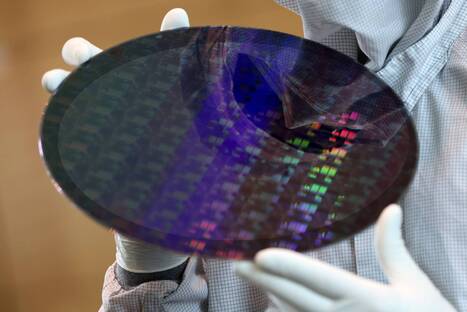
TSMC's 1T1C BEOL memory cell hit an endurance of 10¹⁴ cycles on a test chip, even as it continues to sidestep the 3D DRAM question.
Scoop.it!

NVIDIA is helping Korea’s physical AI ecosystem apply accelerated computing, AI and simulation to everything from semiconductor manufacturing to robotics and autonomous vehicles.
Scoop.it!

Text Generation model with 9B parameters. Download, explore files and run it on Hugging Face.
Scoop.it!

Text Generation model with 2B parameters. Download, explore files and run it on Hugging Face.
Scoop.it!
From
arxiv
Chain-of-thought (CoT) reasoning has emerged as a powerful paradigm for extending the computational capabilities of transformer-based models. A growing body of recent work has begun to uncover the fine-grained computational power of transformers augmented with CoT, as well as their connections to classical complexity theory.
In this work, we advance this line of research by establishing the first hierarchy theorem for CoT-based computation. Our main result shows that for any reasonable resource bound $r(n) \geq n$ and any $\varepsilon > 0$, \[ \mathrm{CoT}(r(n)) \subsetneq \mathrm{CoT}(r(n)^{1+\varepsilon}), \] where $\mathrm{CoT}(r(n))$ denotes the class of decision problems solvable by transformers using $O(r(n))$ CoT reasoning steps on inputs of length $n$. Our result shows that increasing the number of CoT reasoning steps provably yields strictly greater computational power, establishing CoT steps as a fundamental resource in transformer-based computation. Unlike classical hierarchy theorems, which are typically proved via diagonalization, our approach leverages known coarse-grained simulations between CoT-augmented transformers and Turing machines in both directions. Building on these connections, we adapt the classical padding technique from complexity theory to this setting to obtain a tight hierarchy. A key technical contribution of our work is the implementation of padding within the transformer-based CoT model.
Scoop.it!
From
arxiv
Test-time scaling improves the performance of a fixed model by spending more computation at inference. There are two common ways to spend it on agents when a verifier can score every attempt. Best-of-N sampling runs many independent agents and keeps the best result but saturates quickly. One large team of collaborating agents can score higher but stops improving as it grows. Can we get the best of both? Our method, parallel agent teams, does so by sampling many small teams in parallel and keeping the best team's result. We test it on 12 long-horizon tasks from GPU kernels and formal proofs to exploit development. With a 27B model and a budget of 100 agents, parallel teams of ten beat parallel agents on 10 of 12 tasks and beat one team of 100 on all four tasks where we ran such large teams. At equal dollar cost the same parallel teams beat a frontier model on half the tasks. A simple statistical model shows that individual agents lose because their many samples have a low mean and that one large team loses because a single sample gets no gain from variance. Sampling many small teams in parallel balances a high mean with the gain from variance. Parallel agent teams thus offer a more effective way to scale test-time compute.
Scoop.it!
From
x
Hermes Agent can now review your codebase for security bugs with the new official Security plugin by @mark_s.
Hermes first maps what an attacker could reach and which inputs it trusts. It splits the code across parallel subagents, checks every candidate finding against the code, and traces whether…
Scoop.it!

This 200mm single-crystal diamond wafer is designed to efficiently remove heat and prevent hotspots from forming on AI processors.
|




