Your new post is loading...

|
Scooped by
Philippe Gassmann
October 10, 5:02 AM
|
Nvidia-backed Australian AI data center operator Firmus has withdrawn its planned IPO amid market volatility.
|
|
Scooped by
Philippe Gassmann
October 10, 5:02 AM
|
Dal palco di Wave, il suo modello prevede laboratori robotizzati comandati dal cloud, protocolli standardizzati e la fine della separazione tra wet lab e dry l…
|
|
Scooped by
Philippe Gassmann
October 10, 5:02 AM
|
Odyssey-3 is a foundation world model that generates interactive environments from a prompt and predicts in real time how they change as you or an agent act in them. Its Pro version posts the highest reported Physics-IQ Verified video-to-video score (66.1, best-of-8). The same model has been adapted to control robot arms and humanoids, drive a car, and train agents. Try the research preview, or get in touch for API access.x`
|
|
Scooped by
Philippe Gassmann
October 10, 5:02 AM
|
Different agents. One shared base. Busabase is a general-purpose database and workspace for people and AI agents. Keep business records, docs, skills, and apps in one place so the next task can build on them. Connect Claude Code, Codex, and more. Set access, review changes when needed, and see what changed. Busabase is open source, with Cloud, Personal Desktop, and self-hosting options.
|
|
Scooped by
Philippe Gassmann
October 10, 5:02 AM
|
UBTECH and FAW-Volkswagen expand humanoid robot trials from vehicle inspection to logistics at automotive manufacturing facilities.
|
|
Scooped by
Philippe Gassmann
October 10, 5:02 AM
|
Patent images show a bipedal humanoid robot designed for service, education and industrial applications.
|
|
Scooped by
Philippe Gassmann
October 10, 5:02 AM
|
|
|
Scooped by
Philippe Gassmann
October 10, 5:02 AM
|
Test-time training (TTT) adapts an LLM's parameters using signals derived from test inputs, and can make striking improvements in pre-specified settings such as IMO competitions or designated open problems. By turning deployment experience into parameter updates, TTT provides a direct mechanism for model-level self-improvement. Yet TTT is not universally beneficial: each TTT algorithm works in different settings, and applying an ill-suited method could waste test-time compute or even damage model performance. Therefore, such parameter-level self-improvement requires agency: the model must decide when TTT is warranted, which algorithm to invoke, and whether an existing skill can be reused. To fill this gap, we introduce Agentic-TTT, which learns a test-time policy to govern those decisions. Agentic-TTT turns TTT procedures into callable tools, treats accumulated skills as an evolving deployment environment, and trains its policy using the observed utility gains from its decisions. On our benchmark, Agentic-TTT nearly doubles the utility over the backbone model, learns to trade off utility against compute, and generalizes to domains unseen during training. Together, these results point toward autonomous self-improvement: models that can decide how to learn from their own deployment experience.
|
|
Scooped by
Philippe Gassmann
October 10, 5:02 AM
|
LLM developers post-train their models to exhibit prosocial values and behavioral traits, which are enumerated in an alignment target. However, while recent post-training developments have yielded models that score highly on alignment evaluations, training models on sets of narrow behaviors still influences their behavior across unseen contexts and environments in unexpected ways. In this paper, we establish the task of alignment generalization prediction, i.e., predicting how fine-tuning a model to follow a given value changes its behavior across a wide range of held-out values. We conduct a large-scale analysis of alignment generalization effects across 66 values found in modern alignment targets, and benchmark representational techniques on the alignment generalization prediction task. We find that representations based on model activations when applying values in context significantly outperform methods based on textual descriptions of the values. Specifically, the best activations-based methods achieve correlations of 0.45 with our generalization matrix, compared with 0.05 from description-based baselines. We then show the applicability of representations that predict alignment generalization toward downstream tasks by using them to measure how similar the values in a multi-value alignment target are, which we find is significantly correlated with model robustness. Finally, we show initial evidence towards a shared, model-independent value space, which we use to develop the first taxonomy of LLM values grounded in empirical generalization dynamics. Our work demonstrates the importance of studying value generalization in LLMs and its application toward the more empirical design and training of model behavior.
|
|
Scooped by
Philippe Gassmann
October 10, 5:02 AM
|
|
|
Scooped by
Philippe Gassmann
October 10, 5:02 AM
|
Step 5 Preview from @StepFun_ai is free on Nous Portal for the next week
600B total / 27B active MoE, 1M context, with vision
Step 5 Preview scored 33.89 on Hermes Index, the same score as GPT-6 Luna
|
|
Scooped by
Philippe Gassmann
October 9, 6:02 AM
|
OpenAI disrupted two AI-enabled influence operations that used false-front journalists and a think tank to spread geopolitical messaging.
|
|
Scooped by
Philippe Gassmann
October 9, 2:03 AM
|
Startup funding over the past 24 hours has been dominated by a remarkable comeback in the AI agent market, alongside major investments in quantum computing, physical AI, cybersecurity, fusion energy, and financial infrastructure. Manus led the day with more than $500 million in fresh funding, returning to the private capital market after Chinese regulators forced
|
|
|
Scooped by
Philippe Gassmann
October 10, 5:02 AM
|
Digital360 Awards 2026: vincitori premiati a Lazise (VR). CIO e CISO a confronto su intelligenza artificiale e sovranità digitale
|
|
Scooped by
Philippe Gassmann
October 10, 5:02 AM
|
|
|
Scooped by
Philippe Gassmann
October 10, 5:02 AM
|
Google Labs is an experimental hub where Google publicly tests early-stage AI products and features. It includes projects like AI-powered search enhancements, Workspace integrations (e.g. Gmail and Docs assistants), and generative tools such as NotebookLM.
|
|
Scooped by
Philippe Gassmann
October 10, 5:02 AM
|
|
|
Scooped by
Philippe Gassmann
October 10, 5:02 AM
|
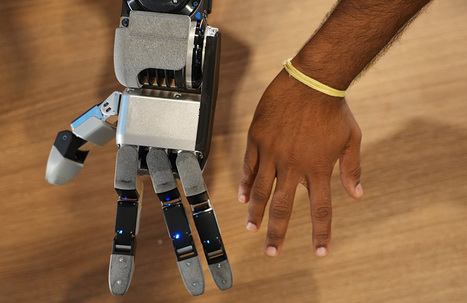
Alberto Rodriguez, the director of robot behavior for Atlas at Boston Dynamics discusses the design behind the humanoid's new hand.
|
|
Scooped by
Philippe Gassmann
October 10, 5:02 AM
|
|
|
Scooped by
Philippe Gassmann
October 10, 5:02 AM
|
Improving a long-horizon LLM agent means evolving the harness around a frozen model or training its weights. We let a self-evolving harness make the system stronger first, then cross seed and evolved harnesses with base and trained weights to learn which gains the trained model keeps and which still need the runtime. We show that the right lever can be read off the agent's failure composition: labelling failed trajectories by the first signal that fires separates process failures (blocked calls, loops, exhausted step budgets) from content failures (a delivered plan that is poor). Harness evolution repairs the former, the behaviour it instils can be trained into the weights, and content failures are what weight training is for. On DeepPlanning, a self-evolving harness loop lifts the held-out score of Qwen3.5-4B from 0.16 to 0.30 and of Qwen3.5-9B from 0.32 to 0.44; for 4B, held-out delivery rises from 55% to 90% while content failures are left for the weights. LoRA adapters trained on evolved-harness trajectories internalise the gain: under the original harness they add +0.13 on held-out tasks for both sizes; on 4B they stack with the harness to more than double the held-out score, and on 9B the adapter alone matches the full evolution line, cutting content failures from a quarter of trajectories to one in twenty. A placebo adapter trained on answer-shuffled trajectories falls below the base model. The loop transfers to WebArena-Lite (+0.09 on 117 unseen tasks), where the gain lives in what the model sees and adapters do not add to it. The result is a diagnose-then-intervene rule applied twice: read the failure composition to choose between harness and weights, then read what the accepted edits changed to decide which gains to train in. Scores are four-rollout means against fresh anchors, same-night except where marked, across eight models from six families and two benchmarks.
|
|
Scooped by
Philippe Gassmann
October 10, 5:02 AM
|
Large language models (LLMs) are commonly post-trained against LLM judges and other cheap surrogates because the true reward, such as human preference, is too expensive to query at scale. This practice often leads to reward hacking, where reinforcement learning against a miscalibrated surrogate leads to undesirable side effects. In this work, we study a setting in which a small number $n$ of model outputs are annotated with ground-truth labels (e.g., from expert review) and used to recalibrate the LLM judge before optimizing against it. Prior approaches to judge recalibration are costly or heuristic, and it is known that on-policy sampling fails when the surrogate is miscalibrated on a rare set of outputs. In this work, we propose envelope sampling, a theoretically-grounded method for judge recalibration that seeks to minimize an upper bound on the regret of the post-trained model under the assumption that the human reward and re-calibrated reward lie in an $L^2$ ball around the judge. We give practical algorithms to sample from the envelope by rejection or by fine-tuning against a modified reward, and experiments on clinical note generation and on a controlled sycophancy task show that recalibrating on envelope samples mitigates reward hacking where recalibrating on base-model samples does not.
|
|
Scooped by
Philippe Gassmann
October 10, 5:02 AM
|
Recent incidents have highlighted the challenge of monitoring LLM agents and the danger of models deceiving people. We show that white-box deception detection via probes can be scaled up to frontier monitoring settings by collecting the largest deception dataset to date for training probes and introducing a novel probe architecture which can aggregate information across many layers and tokens. Our probes achieve 98.8% AUC in SHADE-Arena, surpassing an Opus 5.5 text-monitoring baseline, and show improved efficacy as the underlying model is scaled up. To push our probes to their limit, we test them on several cases where deception cannot be determined from the context alone. In these cases, which we refer to as introspective deception, the ground truth can only be determined through careful elicitation or thorough knowledge of a model's training data. In one such evaluation, we show that probes can distinguish transcripts containing a model's true hidden goal from other goals with an AUC of up to 99.7%. Our probes also readily detect deception on prominent open-weight models which lie about politically sensitive topics, and about their beliefs when put under pressure. We release our training dataset, dubbed FIBS, to help drive frontier deployment of effective probes, and encourage the community to expand upon it with further examples of deception and sabotage.
|
|
Scooped by
Philippe Gassmann
October 10, 5:02 AM
|
We’re beginning a process of publishing more frequent reports on model behavior, beyond what appears in our system cards and regular risk reports.
Today’s report describes four types of behaviors we’ve identified during evaluations and internal use. In each, Claude acted on real websites or system…
|
|
Scooped by
Philippe Gassmann
October 10, 5:02 AM
|
What has users and large corporations so excited about Jev is TypeSafe’s claim that it works significantly faster and uses far fewer tokens than LLMs.
|
|
Scooped by
Philippe Gassmann
October 9, 2:03 AM
|
The new funding will support Verso’s expansion beyond France, alongside further development of its consumer intelligence platform, new data integrations and access for AI agents.
|