 Your new post is loading...
“Read the latest Straight Talk issue for highlights on the impact of Artificial Intelligence in the field of Healthcare and its various implications on the existent landscape.”
Via Florian Morandeau
“Artificial intelligence and machine learning are already proving to be powerful in healthcare, and as the algorithms continue to learn from new data, expect exciting developments in disease diagnosis and prevention, treatment options, the development of cures and drugs and the business of healthcare”
Via Charles Gerth
“Machine learning and artificial intelligence in healthcare are gaining speed as developers increase the accuracy and affordability of their analytics offerings.”
Via Benny Boonen

|
Scooped by
Angela Chammas, M.Ed., M.S., CPC
March 30, 2020 6:23 PM
|
This guest post is part of the Festschrift of the Blogosphere celebrating HealthBlawg’s Tenth Blogiversary. Festschrift posts are appearing throughout the month of June 2016. A recent article in The Commonwealth Fund blog, “Envisioning a Digital Health Adviser,” raises the question of being able to use smartphone apps to get real-time, accurate and personalised guidance for health concerns. While one can envision the convenience, affordability and peace of mind that would result from their use, such services face a number of hurdles before they become reality. As a result, the “digital revolution” has not yet greatly affected most people’s interactions with the health care system. These challenges fall into two main categories: fiscal/policy and technology. Fiscal and policy issues In a fee-for-service environment, the only way that healthcare practitioners get paid is to have face-to-face encounters with patients. This creates heavy bias against promoting technologies that streamline non-face-to-face interactions. However, as we move away from that model and more towards value-based care, where global risk-based payments are made to delivery organisations (hospitals, patient centred medical homes, accountable care organisations, etc.), then there is more incentive to use new technologies that reduce unnecessary in-office encounters. In such an environment, face-to-face encounters are actually a cost centre, not a profit centre, and positive health outcomes of populations are rewarded. We are not yet in a fully value-based environment. Fee-for-service remains dominant, though this will be changing over the next few years, hurried along by the seismic shifts in physician reimbursement policy announced by the Federal government in its draft MACRA rule. Aligning the way that healthcare is paid for with technologies that facilitate self-care and improved care – that is what is needed from a fiscal and policy perspective in order for Digital Health Adviser-style technologies to flourish. Technology issues The biggest technical barrier to achieving this vision is the state of health data. Created by legacy Electronic Health Records (EHR) systems, health data is largely fragmented into institution-centred silos. Sometimes those silos are large, but they are still silos. Exchanging individual records between silos, using increasingly standardised vocabularies (code sets) and message formats (ADT messages, C-CDAs, even FHIR objects), is where much current effort is being spent. But that does not solve the problem of data fragmentation. More and more people in the health information exchange arena are seeing that the next generation of health technology is around aggregating data, not simply exchanging copies of individual records (the traditional query-response approach). Only by collecting the data from all different sources, normalising that data into a consistent structure, resolving the data around unique patient identifiers as well as unique provider identifiers – only then can the data become truly useful. Aggregated data has two additional advantages. (1) It solves the interoperability problem. Systems and institutions no longer need to build data bridges, and translate how the data is structured between two proprietary systems; everyone instead simply connects to a central standard API “plug.” (2) If built right, the aggregated data can be the basis for very effective Artificial Intelligence (AI). Large-scale data in many other domains (that is, other than healthcare) has moved away from traditional relational databases, made up of a collection of tables, with records and fields (rows and columns) in each table, and structured relations that connect a field in one table to some other field in another table in order to carry out queries. What is replacing this way of working with data is a more flexible graphical data structure commonly used in “big data.” Such technology is very fast (consider Google suggestions as-you-type in a search bar, retrieving suggestions from billions of record options). It is also sufficiently flexible to allow machine learning and AI to function in a real-time fashion. A new generation of apps When one has built a data store from all different sources – EHR data, payer data, device and IoT data, patient survey responses, consumer health data – and integrate it into a unified data structure, then AI can yield meaningful insights. AI, after all, is about pattern recognition, and comparing a particular pattern of data around a given individual with similar (not necessarily identical) patterns found elsewhere, and making predictive recommendations based on what happened in those other situations. This is very much what clinicians do when exercising “clinical judgement” – identifying a pattern, taking into account medical problems, medications, labs values, personal and family history, and comparing it to similar patterns from the clinician’s experience. A new generation of apps can be built to make these AI-derived recommendations useful. They need to be easy-to-use, consumer-grade apps that can connect to the aggregated data store and the AI analytics engines that sit on top of that. They can empower consumers / patients, and reduce the demand burden on clinicians. Will they replace clinicians? No, of course not. But they will help filter the demand to those who truly need to be seen, while empowering patients with real-time, believable and personalised guidance for the more common things in day-to-day life. So what stands in the way of Digital Health Advisers? Policy (how we pay for healthcare) needs to encourage self-care and facilitate healthy behaviours, rather than encourage in-office doctor visits. And, simultaneously, health data needs to become reorganised in order to empower AI and drive the emergence of new apps and related technologies. It will be a while before we get there, but we can see the path to that new generation of healthcare technology.
|
|
Scooped by
Angela Chammas, M.Ed., M.S., CPC
March 30, 2020 6:23 PM
|
Artificial intelligence and machine learning are hot technology topics across many industries right now. In particular, the benefits of AI in healthcare has been gaining traction in the last two years and will continue to be popular as the technology grows and evolves. Here are a few of the top ways that healthcare can benefit from AI and machine learning. Connecting Data
Data analysis is a massive topic in healthcare. As a society, we are increasingly adopting digital health, and as that increases, so does the amount of data and a variety of data sources.
This data influx is overloading healthcare systems, and medical professionals are having a hard time finding a way to digest all of this raw data effectively. Processing data from multiple sources and providing predictive analysis from that data is one of the most significant benefits that AI can bring to healthcare. The healthcare industry is constantly plagued with the predicament of having data from multiple different sources and finding a way to consolidate and process that data into useful information for clinicians. AI can take disparate data from things like wearable devices, electronic health records, and lab testing and give doctors suggestions for care based on that analysis. This information can include disease risks, diagnosis suggestions, and pattern notifications in an increasingly efficient and accurate fashion. Improving Patient Care
Predicting the chance of and detecting diseases with AI is a use that could genuinely change patient's lives. Using specialized algorithms with patient data sets and sources can help doctors and other medical professionals screen for diseases with a very high level of accuracy.
The goal is not to replace medical professionals, but for those professionals to use AI as clinical decision support and “another set of eyes” to decrease the chance of errors. For example, using artificial intelligence to process a patient’s medical records and lab records can help predict the chances of diseases, including things like diabetes, cardiovascular disease, etc. Using AI to process this data can also help healthcare professionals understand patient patterns and see where potential patient needs may arise. AI technology can process more data faster than any human, making it a great compliment to any clinician's practice of medicine and a very efficient way of getting actionable data. Enhanced Patient Communication and Access
Promoting patient communication is paramount when looking to improve patient care. Utilizing technologies such as virtual nursing assistants can help to improve communication with healthcare providers and potentially reduce readmissions or unnecessary emergency room visits.
Using AI, virtual nursing assistants can replicate nursing behavior and assist with patient questions, monitoring, reminders, and providing answers. When looking at patient access, especially in rural areas, AI can help to mitigate the impact of resource deficiencies in under-served or rural areas. For example, if a rural area does not have easy access to specialized radiologists, AI can be used to review x-ray’s and provide diagnostic recommendations. AI diagnostic duty assistance can help in various areas of medicine and can assist clinicians in under-resourced regions or locations. Again, this technology is to be used in conjunction with clinicians to help improve the accuracy of diagnoses and provide better care. Healthcare is a very complex world, and as with any new technology, AI in healthcare is still being explored and refined. As AI continues to grow, it will continue to support human providers in providing better and faster care while also reducing costs. This technology will extend to different areas of healthcare in the coming years, transforming healthcare as a whole as well as individual patient care. All healthcare organizations should begin understanding the benefits and capabilities of artificial intelligence now to stay ahead of the curve and be prepared for the abilities to come.
“Artificial Intelligence (AI) is evolving rapidly in healthcare, and various AI applications have been developed to solve some of the most pressing problems that health organizations currentl”
Via Lionel Reichardt / le Pharmageek
Dive Brief: Last quarter saw a record number of investment deals (29) in the healthcare artificial intelligence space, CB Insights reported. The number of deals beat the previous record by three, and 2017 is set "to reach a six-year high." Last year, 88 artificial intelligence investment deals were made in the healthcare space, a 31% year-over-year increase, CB Insights noted.
Via Benny Boonen
|
Artificial intelligence adoption is on the rise, but businesses must improve their adoption strategies, data integrity and leadership training to reap the benefits.For artificial intelligence in healthcare to grow, organizations must improve implementation strategies, data management, and leadership training, according to an Infosys report. The cross-industry survey of more than 1,000 business and IT leaders in seven countries set out to determine the effect of artificial intelligence (AI) on return on investment, employees, and organizational leadership.
Via Giuseppe Fattori
“Technology can transform the way data is handled, and healthcare is delivered with the help of artificial intelligence.”
Via Benny Boonen
It is estimated that AI driven healthcare market would reach $6.6 billion by 2021. The replacement of the human factor with AI has been the topic of concern, especially in healthcare mainly because doctors are likely to be replaced by intelligent machines.
Via Philippe Marchal
“Editor’s Note: Paul Clark, Director of Healthcare Research at Digital Reasoning, an AI-enabled solutions that reduce risk, drive opportunity, and save lives. Previously, Paul served as Vice President of Research & Education at The Health Management Academy leading the research agenda and educational development for C-Suite executives of America’s leading health systems. Artificial Intelligence (AI) holds tremendous potential ... Read More”
Via Benny Boonen
“ Artificial intelligence is rapidly changing the world, as computers are now powerful enough to perform complex AI calculations. Also, machine learning algorithms are becoming more accurate and…”
Via usm systems
“There are several barriers that hinder artificial intelligence adoption in healthcare, including a lack of interoperability with EHRs and a shortage of support staff.”
Via Benny Boonen
“How will artificial intelligence in healthcare best drive clinical and operational improvement? To get real value from predictive and prescriptive models…”
Via Lionel Reichardt / le Pharmageek
|








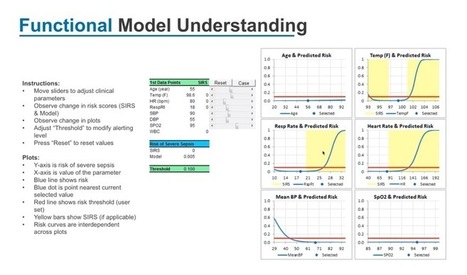





AI can't be ignored in its efforts to revolutionize the healthcare industry.