I met my wife over the radio as I flew World War Two bomber over Germany Mirror.co.uk A few days after they get back together, Mrs Stevens became involved in one of the most famous episodes of the war when she gave radio instructions to Lancaster...

 Your new post is loading...
 Scoop.it! I met my wife over the radio as I flew World War Two bomber over Germany Mirror.co.uk A few days after they get back together, Mrs Stevens became involved in one of the most famous episodes of the war when she gave radio instructions to Lancaster... 
No comment yet.
Sign up to comment
Scoop.it!

A PRICELESS treasure, which documents life in the prisoner of war camp made famous by the movie The Great Escape, has come to light in Loughborough. The amazing wartime log book belonged to the late Flt Sgt Nicholas Alkemade who made history after he dropped 18,000 ft from his burning Lancaster bomber without a parachute and survived. This war camp was made famous in themovie The Great Esacape, which starred Steve McQueen and Richard Attenborough.
Scoop.it!

A project by LINCAIR and the Lightning Association to preserve the history of Royal Air Force Station Binbrook for future generations.( Motto - Nothing ventured, nothing gained )
Scoop.it!

During RAF Wickenby's short active service 1080 lives were lost from the base. This sacrifice is commemorated by a memorial with the form of Icarus on an obelisk at the entrance to the airfield. Today the site is a private airfield used as an aviation school and is home to The RAF Wickenby Memorial Museum.It was the home of 12 Squadron and 626 Squadron of No 1 Group, RAF Bomber Command.
In total the number of sorties flown by 626 Squadron were 2728. Aircraft lost on operations 49 and non-operational losses 11. It bombed 187 targets and laid mines in 18 areas.
Scoop.it!

Peter Isaacson flew more than forty missions with the RAF's Bomber Command, which is the subject of a new exhibition at Melbourne's Shrine of Remembrance.
Scoop.it!

A war veteran has returned to the former RAF Binbrook to plant a tree in the Bomber Command Memorial Park on the site.
Scoop.it!

During RAF Wickenby's short active service 1080 lives were lost from the base. This sacrifice is commemorated by a memorial with the form of Icarus on an obelisk at the entrance to the airfield. Today the site is a private airfield used as an aviation school and is home to The RAF Wickenby Memorial Museum.It was the home of 12 Squadron and 626 Squadron of No 1 Group, RAF Bomber Command.
Peter John Baskerville's insight:
Many bomber command photos with commentary curated by Tom Bint on behalf of 626 Squadron RAF.
Scoop.it!
Bomber Command’s air offensive against the cities of Nazi Germany cost more than 56,000 British and Commonwealth aircrew lives. What began meekly in 1939 ended six years later with 1,600 Lancasters, Halifaxes, and Mosquitoes, equipped with the best of British wartime technology, razing whole German cities in a single night. This book explains how Bomber Command, grew into an effective fighting force.
Scoop.it!

Stephen Evans, the BBC's Berlin correspondent, tells the story of Wynford Vaughan-Thomas's report recorded aboard a Lancaster Bomber during a raid on Berlin. On the night of 3rd September 1943, Vaughan-Thomas recorded for the BBC live from a Lancaster Bomber during a bombing raid over Berlin.
Scoop.it!

Bournemouth Video production company Plato Video have created a special film of the Lancaster.
Scoop.it!
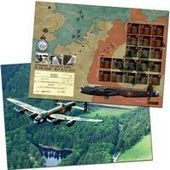
There are literally hundreds of books written about RAF Bomber Command and the Lancaster: below are just a sample that make reference to, or have other connections with, 550 Squadron.
Scoop.it!

From
www

It was a journey which began in the dying days of the Second World War - and will end 68 years later with the honours denied to them in death. When 20-year-olds Sergeant David Raikes, Flight Sergeant David Perkins, Wireless Operator and Air Gunner Flight Sergeant Alexander Bostock and Air Gunner Warrant Officer John Hunt of the Royal Australian Air Force aged 21, took off from Forli near Rimini on April 21, 1945 they had no idea the war in Italy would be over four days later - and their own war would end that night in a field.
Scoop.it!
Brothers Colin and Ewan McGregor follow up their documentary The Battle of Britain with a film exploring Bomber Command, a rarely-told story from the Second ...
|
Scoop.it!

Harold Jellicoe Percival, a last link to the Dambusters raid, never married and had no children. When he died last month aged 99 he had no close friends and it seemed there would be no one to mourn him except a handful of care home staff.
Scoop.it!

460 Squadron RAAF - posted in Air War in Western Europe 1939 - 1945: . . . . . . .The most sorties
Scoop.it!
Short drama film inspired by Bomber Command in Lincolnshire. The film is a tribute to all those who served in Bomber Command during World War II. Inspired by...
Scoop.it!

Young or old, everyone has heard of the Lancaster bomber. Such is the legacy handed down by this aviation icon that although it is not the most numerous aircraft ever built - two are still flying today, one in Britain and another in Canada with many proudly displayed in museums throughout the world - it is up there with the Spitfire and the Flying Fortress in terms of affection, nostalgia and lasting fame.
Scoop.it!

Bomber crew, D for Donald 9 September 1943, No. 460 Squadron, Royal Australian Air Force
Through rare photographic images, uniforms, equipment and personal keepsakes, discover the stories of the Australian airmen who flew raid after raid over Europe in the most dangerous campaign fought by Australians during the Second World War (1939 - 45).
Scoop.it!

Memories of aircrew who were part of Bomber command. The following horrendous statistics were necessary to achieve the victory Winston Church describes as "The Navy can lose us the war, but only the Air Force can win it. The fighters are our salvation, but the bombers alone provide the means of victory".
Taking an example of 100 airmen: 55 were killed on operations or died as result of wounds
Scoop.it!
|

|
Scooped by
Peter John Baskerville
September 22, 2013 4:15 AM
|
Scoop.it!
A recently discovered VHS recording dated June 1979. This was the year that affordable domestic video recorders first became available in the UK. Therefore, this ancient recording must be one of the oldest VHS copy of a live broadcast originating in the UK available anywhere.
|
|
Scooped by
Peter John Baskerville
September 21, 2013 11:17 PM
|
Scoop.it!
THE Prime Minister of New Zealand, John Key, has paid his respects to the heroes of the Bomber Command.
"The visit by the Right Honourable John Key to the Bomber Command Memorial in London is the first by any prime minister representing the Commonwealth and allied nations, which were a key component of Bomber Command during World War Two."
|
|
Scooped by
Peter John Baskerville
August 13, 2013 11:57 PM
|
Scoop.it!

Bravery of our wartime airmen
Herald Scotland
Bomber Command was packed with young flyers from these islands and many from Australia, New Zealand and Canada as well as Poles and Czechs.
|
|
Scooped by
Peter John Baskerville
July 22, 2013 8:47 AM
|
Scoop.it!

Taking off from R.A.F. Binbrook, Lincolnshre at 11.38 on a daylight bombing operation to bomb the Flying Bomb sites at Trossy-St-Maximin. The flying bomb sites / storage areas were attacked for 6 consecutive days, this being the 4th operation. On this day 1114 aircraft took part in the bombing of three sites, Bois de Cassan, Forêt de Nieppe and this one. Weather was described as clear and the raids were classed as successful.