21st Century Learning and Teaching
791.5K views | +15 today
21st Century Learning and Teaching
Related articles to 21st Century Learning and Teaching as also tools...
Curated by Gust MEES
Your new post is loading...

Popular Tags

Scooped by Gust MEES
June 5, 2015 7:17 AM
Scoop.it!

Visible Learning Into Action | eLeadership | eSkills | Teacherpreneurs

Visible Learning Into Action | eLeadership | eSkills | Teacherpreneurs | 21st Century Learning and Teaching | Scoop.it
Discover John Hattie's latest thinking in his new book Visible Learning Into Action as he unveils how schools have used his ideas to improve their schools.


Learn more:


- https://gustmees.files.wordpress.com/2015/05/document_fusionne.pdf


- https://gustmees.wordpress.com/2015/05/26/what-are-the-skills-needed-from-students-in-the-future/


- https://gustmees.wordpress.com/2015/03/04/learning-to-learn-preparation-for-better-learning-how-to/


- http://www.bak-online.de/downloads/Seminar2-2014_S121-130.pdf


Gust MEES's insight:
Discover John Hattie's latest thinking in his new book Visible Learning Into Action as he unveils how schools have used his ideas to improve their schools.


Learn more:


- https://gustmees.files.wordpress.com/2015/05/document_fusionne.pdf


- https://gustmees.wordpress.com/2015/05/26/what-are-the-skills-needed-from-students-in-the-future/


- https://gustmees.wordpress.com/2015/03/04/learning-to-learn-preparation-for-better-learning-how-to/


- http://www.bak-online.de/downloads/Seminar2-2014_S121-130.pdf


Rebecca Wilkins's curator insight, June 27, 2015 10:20 AM

Teachers are educational leaders, both within their classrooms, within their school, and in the community they serve.  These four lessons provide a framework for improvement at all levels of the system.

Scooped by Gust MEES
June 4, 2015 9:24 PM
Scoop.it!

Hybrid roles: Making a whole out of two halves | Teacherpreneur | eLeadership | eSkills

Hybrid roles: Making a whole out of two halves | Teacherpreneur | eLeadership | eSkills | 21st Century Learning and Teaching | Scoop.it

Collaboratively devise a plan for meeting school responsibilities: Though I attend every meeting of my PLC, I do not attend faculty meetings. My principal and I set this expectation at the start of the year. Homeroom meets sporadically in the afternoons, so we arranged for a colleague to meet with my students.

Principals and hybrid teachers must know what to expect of one another when it comes to responsibilities like serving on the school’s council or on committees. Can one hybrid teacher’s numerous leadership responsibilities at school become new opportunities for other teachers?

Clarify and celebrate how a teacherpreneur’s work outside of the classroom benefits students: Most of my colleagues at school have little idea what keeps me busy in the afternoon. If they knew the value of this work, it would likely quell any frustration they experience when they have duties I do not, or temper any jealousy they may feel about my class schedule and “free time.”

Teachers tend toward humility. We must support hybrid teachers by publicly celebrating their work. Offer hybrid teachers a chance to present their work to school and district leaders and include references in publications and regular communications, too.

Find an advocate, mentor and network: Teachers often struggle to advocate for what they need, and expert classroom practitioners may be new to leadership. Designate someone to support teachers in hybrid roles — a person who can advocate for them, coordinate regularly with principals, provide coaching and even watch them teach. Encourage mentorship and participation in a network of other hybrid teachers who face similar challenges and can offer support and advice.

In his book, The Great Influenza, John M. Barry reminds us that scientific discoveries happen on the frontier of our knowledge in a frightening yet necessary confluence of certainty and doubt. Just as scientists battled through urgency and uncertainty to invent the flu vaccine and halt a pandemic, we can only transform education to successfully meet the needs of our students by exhibiting this same kind of courage. Teacher leadership is our frontier, and teacherpreneurs are uniquely suited to discover its riches.


Learn more:


- http://www.scoop.it/t/21st-century-learning-and-teaching/?tag=Teacherpreneur


- https://gustmees.wordpress.com


- https://gustmees.wordpress.com


- https://gustmees.files.wordpress.com/2015/05/document_fusionne.pdf


- https://gustmees.wordpress.com/2015/05/26/what-are-the-skills-needed-from-students-in-the-future/


- https://gustmees.wordpress.com/2015/03/04/learning-to-learn-preparation-for-better-learning-how-to/


Gust MEES's insight:

Learn more:


- http://www.scoop.it/t/21st-century-learning-and-teaching/?tag=Teacherpreneur


- - https://gustmees.wordpress.com


Angela K. Adams's curator insight, October 25, 2015 8:31 PM

administrative support - I chose this resource because it talks about how educators, especially novice ones need mentors to help them through struggles they may have with the profession.  This article discusses how administration can serve as a mentor to their people they supervise.  I hope to share this with other administrators to prove they need to support their staff and guide them to become better educators. 

Scooped by Gust MEES
June 4, 2015 3:09 PM
Scoop.it!

Five Ways Bad Bosses Make Your Look Bad by Dan Rockwell

Five Ways Bad Bosses Make Your Look Bad by Dan Rockwell | 21st Century Learning and Teaching | Scoop.it
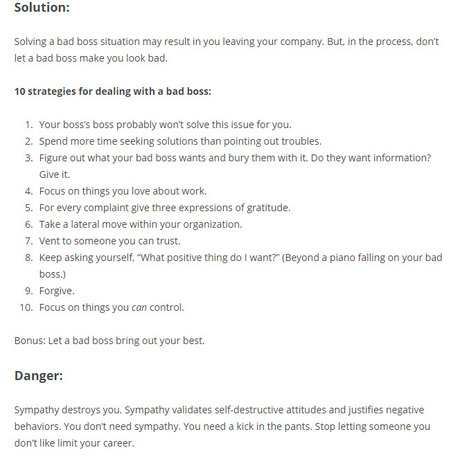
Negative responses to a bad boss hurt you. If you let them, bad bosses control your: speech, attitude, behavior, contribution, and future.


Learn more:


- http://www.scoop.it/t/21st-century-learning-and-teaching/?tag=Success


- http://www.scoop.it/t/21st-century-learning-and-teaching/?tag=Meetings


Gust MEES's insight:
Negative responses to a bad boss hurt you. If you let them, bad bosses control your: speech, attitude, behavior, contribution, and future.


Learn more:


- http://www.scoop.it/t/21st-century-learning-and-teaching/?tag=Success


- http://www.scoop.it/t/21st-century-learning-and-teaching/?tag=Meetings


No comment yet.
Rescooped by Gust MEES from Leadership
June 3, 2015 6:16 PM
Scoop.it!

3 Ways a Leader’s Attitude Impacts the Team | Success | Character | Empathy

3 Ways a Leader’s Attitude Impacts the Team | Success | Character | Empathy | 21st Century Learning and Teaching | Scoop.it
Everyone struggles with keeping their attitude positive, even people in leadership roles. The pressure of leadership, personal issues, and life in general will impact your mood, energy and attitude. And, attitude matters more than you probably realize. When left unchecked your attitude can damage your team.

Without saying a word your attitude permeates from your skin. Even when you think you are hiding it and that no one sees they often do. Here are 3 ways a leader’s attitude impacts the team.

Your attitude sets their attitude

Attitude is contagious especially when you are in a leadership role. Positive or negative your team will soon adopt your attitude. Over time, your attitude sets the tone for the employees and also indicates what is and is not acceptable.

Even when you don’t want your attitude to impact the organization it will.


Learn more:


- http://www.scoop.it/t/21st-century-learning-and-teaching/?tag=Success


Via Anne Leong
Gust MEES's insight:
Everyone struggles with keeping their attitude positive, even people in leadership roles. The pressure of leadership, personal issues, and life in general will impact your mood, energy and attitude. And, attitude matters more than you probably realize. When left unchecked your attitude can damage your team.

Without saying a word your attitude permeates from your skin. Even when you think you are hiding it and that no one sees they often do. Here are 3 ways a leader’s attitude impacts the team.

Your attitude sets their attitude

Attitude is contagious especially when you are in a leadership role. Positive or negative your team will soon adopt your attitude. Over time, your attitude sets the tone for the employees and also indicates what is and is not acceptable.

Even when you don’t want your attitude to impact the organization it will.


Learn more:


- http://www.scoop.it/t/21st-century-learning-and-teaching/?tag=Success


Pamela Perry King's curator insight, June 4, 2015 10:07 AM

Attitude is like a cold....cough on someone and spread the joy!

Dr. Deborah Brennan's curator insight, June 4, 2015 10:39 AM

Leaders have to be self aware.  What they say, do, even think effects the whole school!

Dr. Deborah Brennan's curator insight, June 10, 2015 5:30 PM

Attitude matters!  A teacher's attitude affects the students - a leader's attitude sets the tone for the entire building.  Someone once said, "the principal should be the happiest person in the building" (it is the principal, more than others, who controls so much of what goes on). 

Scooped by Gust MEES
June 2, 2015 2:51 AM
Scoop.it!

How to Deal With a Narcissistic Leader | Leadership

How to Deal With a Narcissistic Leader | Leadership | 21st Century Learning and Teaching | Scoop.it
If you're working under a narcissistic leader, you know that nothing creates a more poisonous work environment. It may seem impossible to overcome, but take heart: It really can be done.


Learn more:


- http://www.scoop.it/t/21st-century-learning-and-teaching/?tag=LeaderShip


Gust MEES's insight:
If you're working under a narcissistic leader, you know that nothing creates a more poisonous work environment. It may seem impossible to overcome, but take heart: It really can be done.


Learn more:


- http://www.scoop.it/t/21st-century-learning-and-teaching/?tag=LeaderShip


Rescooped by Gust MEES from Supports for Leadership
May 19, 2015 1:20 PM
Scoop.it!

12 Habits of Exceptional Leaders | Entrepreneur | Leadership | eLeadership | Virtues

12 Habits of Exceptional Leaders | Entrepreneur | Leadership | eLeadership | Virtues | 21st Century Learning and Teaching | Scoop.it
Great leadership is dynamic. It melds a variety of unique skills into an integrated whole.


Courage is the first virtue that makes all other virtues possible.” —Aristotle


Learn more:


- http://www.scoop.it/t/21st-century-learning-and-teaching/?tag=LeaderShip


Via Mark E. Deschaine, PhD
Gust MEES's insight:
Great leadership is dynamic. It melds a variety of unique skills into an integrated whole.


Courage is the first virtue that makes all other virtues possible.” —Aristotle


Learn more:


- http://www.scoop.it/t/21st-century-learning-and-teaching/?tag=LeaderShip


No comment yet.
Rescooped by Gust MEES from Supports for Leadership
May 16, 2015 11:29 AM
Scoop.it!

Leaders Who Can Read Collective Emotions Are More Effective | Empathy | EQ

Leaders Who Can Read Collective Emotions Are More Effective | Empathy | EQ | 21st Century Learning and Teaching | Scoop.it

Until now, there have been a variety of tools for managers who wish to measure the emotional cues of individuals, such as the Brief Affect Recognition Test to understand cross-cultural facial expressions. Facial expressions provide a wealth of reliable information about how others are making sense of the world around them, and allow us to tailor our responses to the individual in a one-on-one situation.


This represents one of the key measures of emotional intelligence, which evaluates how well individuals perceive and deal with affectively charged interpersonal situations.


Read more at http://knowledge.insead.edu/strategy/leaders-who-can-read-collective-emotions-are-more-effective-4002#VsZzWHkFKKeIo3ac.99
But there are situations in which leaders have to deal with the emotions of large groups of people, not just those of one or a few individuals and most managers don’t have time to operate on a one-on-one basis all the time. Understanding the collective can help leaders respond effectively to the group as a whole. This happens in situations such as dealing with the collective anxiety of executives facing the news of corporate restructuring; or public authorities dealing with the collective anger of large groups of people in the streets; or politicians seeking to inspire large groups of people to win an election. Those with the skill to pick up on the subtle emotional cues of the collective can adapt accordingly and, according to our research, earn more respect as a result. So how can this ability to see the forest for the trees be applied by leaders?


Learn more:


- http://www.scoop.it/t/21st-century-learning-and-teaching/?tag=Empathy


- http://www.scoop.it/t/21st-century-learning-and-teaching/?tag=Daniel+Goleman


- http://www.scoop.it/t/21st-century-learning-and-teaching/?tag=EQ


Via Mark E. Deschaine, PhD
Gust MEES's insight:

Until now, there have been a variety of tools for managers who wish to measure the emotional cues of individuals, such as the Brief Affect Recognition Test to understand cross-cultural facial expressions. Facial expressions provide a wealth of reliable information about how others are making sense of the world around them, and allow us to tailor our responses to the individual in a one-on-one situation.


This represents one of the key measures of emotional intelligence, which evaluates how well individuals perceive and deal with affectively charged interpersonal situations.


Read more at http://knowledge.insead.edu/strategy/leaders-who-can-read-collective-emotions-are-more-effective-4002#VsZzWHkFKKeIo3ac.99But there are situations in which leaders have to deal with the emotions of large groups of people, not just those of one or a few individuals and most managers don’t have time to operate on a one-on-one basis all the time. Understanding the collective can help leaders respond effectively to the group as a whole. This happens in situations such as dealing with the collective anxiety of executives facing the news of corporate restructuring; or public authorities dealing with the collective anger of large groups of people in the streets; or politicians seeking to inspire large groups of people to win an election. Those with the skill to pick up on the subtle emotional cues of the collective can adapt accordingly and, according to our research, earn more respect as a result. So how can this ability to see the forest for the trees be applied by leaders?


Learn more:


- http://www.scoop.it/t/21st-century-learning-and-teaching/?tag=Empathy


- http://www.scoop.it/t/21st-century-learning-and-teaching/?tag=Daniel+Goleman


- http://www.scoop.it/t/21st-century-learning-and-teaching/?tag=EQ


María Dolores Díaz Noguera's curator insight, May 17, 2015 1:00 PM

Inteligencia Emocional y Liderazgo...Leaders Who Can Read Collective Emotions Are More Effective -- INSEAD | @scoopit via @hohhof http://sco.lt/...

Eloquens's curator insight, May 17, 2015 4:37 PM

How does your emotional intelligence help you to implement your strategy?

Miguel Herrera E.'s curator insight, May 18, 2015 8:56 AM

"Los Lideres detectan y re orientan las Emociones colectivas, percibiendo las actitudes de miembros Emergentes de grandes Grupos, quienes tienen Actitudes Significativas, Consistentes y Poderosas, que muestran su Influencia hacia la Mayoría y son respetados por ellas"  -MHE-

Rescooped by Gust MEES from Leadership
May 11, 2015 11:40 AM
Scoop.it!

6 Unexpected Traits Exemplified by Great Leaders

6 Unexpected Traits Exemplified by Great Leaders | 21st Century Learning and Teaching | Scoop.it
Many people are tempted to believe that true leaders are born not made, but when it comes to leaders of historical importance, that adage rarely seems true

.

The best leaders are those whose toughest critics still think highly of their person and character. Being a person who is likeable requires that a person practice honesty and justice in all matters, even when those matters are unpleasant or cost him personally.

.

Great leaders are made, not born, and if you hope to be one someday, practice these six traits.

.

Learn more:

.

- http://www.scoop.it/t/21st-century-learning-and-teaching/?tag=LeaderShip


Via Anne Leong
Gust MEES's insight:
Many people are tempted to believe that true leaders are born not made, but when it comes to leaders of historical importance, that adage rarely seems true

.

The best leaders are those whose toughest critics still think highly of their person and character. Being a person who is likeable requires that a person practice honesty and justice in all matters, even when those matters are unpleasant or cost him personally.

.

Great leaders are made, not born, and if you hope to be one someday, practice these six traits.

.

Learn more:

.

- http://www.scoop.it/t/21st-century-learning-and-teaching/?tag=LeaderShip


Scooped by Gust MEES
May 9, 2015 7:42 PM
Scoop.it!

12 Things That Successful Leaders Never Tolerate | Leadership

12 Things That Successful Leaders Never Tolerate | Leadership | 21st Century Learning and Teaching | Scoop.it
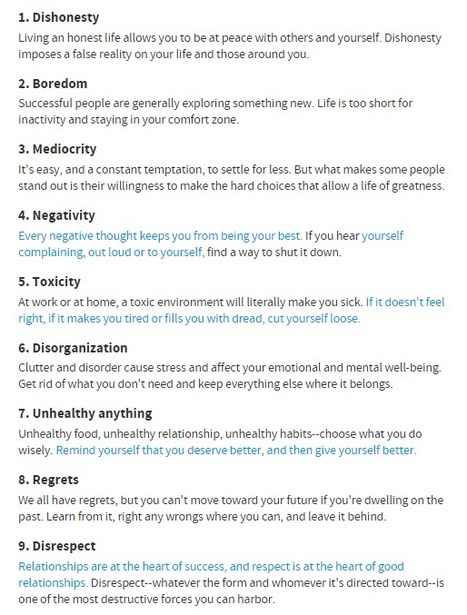
Tolerance is a virtue--most of the time. But some things should never be tolerated. To build a successful career and life as a leader, make sure these are never on your list.


Learn more:


- http://www.scoop.it/t/21st-century-learning-and-teaching/?tag=LeaderShip


Gust MEES's insight:

Tolerance is a virtue--most of the time. But some things should never be tolerated. To build a successful career and life as a leader, make sure these are never on your list.


Learn more:


- http://www.scoop.it/t/21st-century-learning-and-teaching/?tag=LeaderShip


K.I.R.M. God is Business " From Day One"'s curator insight, May 18, 2015 5:20 PM

WELL THIS ARTICLE STEPS ON SEVERAL TOES MAYBE EVEN A FEET OR SO! BUT IT IS ST TRUE! OUCH I PLEAD THE FIFTH OF FIRST I NEED TO GET IT RIGHT THREE SIXTEEN IF YOU FIND THAT ONE IN THE BIBLE CHECK WHO WROTE YOUR BIBLE BUT THE ARTICLE IS ON POINT. WHY NOT LAUGH WHEN YOUR TOES ARE HURTING BECAUSE YOU KNOW THE 12 THINGS A SUCCESSFUL LEADER NEVER TOLERATE" SOME OF THEM WE ARE GUILTY OF! BUT PLEAD THE FIFTH OF, WE HAVE THE RIGHT TO REMAIN SILENT BUT ON THER SERIOUS SIDE THANKS FOR THE ARTICLE IT ENLIGHTENS SOME OF THOSE DARK SECRET PLACES. ITS A BLESSING TO BE A SUCCESS BUT DO WE WANT TO PAY THE PRICE TO GET IT DONE?  JUST ASKING!

Scooped by Gust MEES
April 19, 2015 10:36 AM
Scoop.it!

How To Be A Effective Leader: Top 10 Leadership Tips From Great Leaders

How To Be A Effective Leader: Top 10 Leadership Tips From Great Leaders | 21st Century Learning and Teaching | Scoop.it
How To Be A Effective Leader: Top 10 Leadership Tips From Great Leaders

Source: buzzfed.in


Learn more:


- http://www.scoop.it/t/21st-century-learning-and-teaching/?tag=Frank+SONNENBERG


Gust MEES's insight:
How To Be A Effective Leader: Top 10 Leadership Tips From Great Leaders

Source: buzzfed.in


Learn more:


- http://www.scoop.it/t/21st-century-learning-and-teaching/?tag=Frank+SONNENBERG


Marco Favero's curator insight, April 20, 2015 4:42 PM

aggiungi la tua intuizione ...

Scooped by Gust MEES
April 16, 2015 8:38 AM
Scoop.it!

Trust Me: 55 Ways to Build Trust and Credibility | A GOOD Reminder

Trust Me: 55 Ways to Build Trust and Credibility | A GOOD Reminder | 21st Century Learning and Teaching | Scoop.it
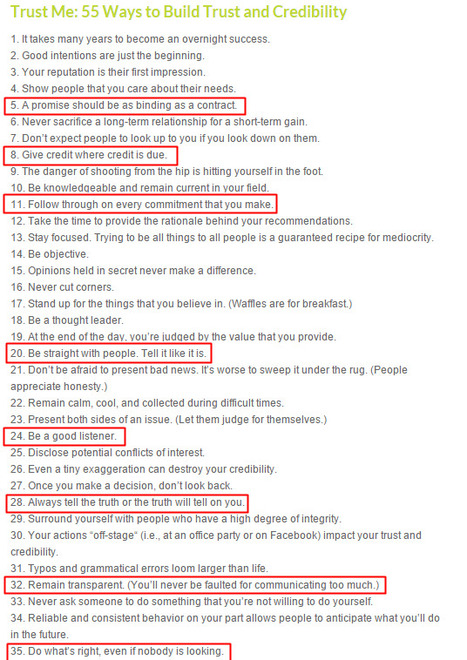
Trust is as valuable as the water that we drink and the air that we breathe. Here are 55 ways to build trust and credibility.
Gust MEES's insight:

Trust is as valuable as the water that we drink and the air that we breathe. Here are 55 ways to build trust and credibility.


Minter Dial's curator insight, April 17, 2015 4:38 AM

Build that trust!

Scooped by Gust MEES
April 11, 2015 9:38 AM
Scoop.it!

EdLeaders for the 21st Century

EdLeaders for the 21st Century | 21st Century Learning and Teaching | Scoop.it
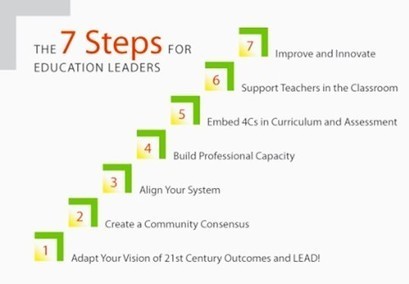
As part of our Preparing Leaders for Deeper Learning, Bonnie brings us P21's ideas about 21st century education leadership.


Learn more:


- http://www.scoop.it/t/21st-century-learning-and-teaching/?tag=LeaderShip


- http://www.scoop.it/t/21st-century-learning-and-teaching/?tag=Great+Teachers


- http://www.scoop.it/t/21st-century-learning-and-teaching/?tag=Rise+of+the+Professional+Educator


Gust MEES's insight:
As part of our Preparing Leaders for Deeper Learning, Bonnie brings us P21's ideas about 21st century education leadership.


Learn more:


- http://www.scoop.it/t/21st-century-learning-and-teaching/?tag=LeaderShip


- http://www.scoop.it/t/21st-century-learning-and-teaching/?tag=Great+Teachers


- http://www.scoop.it/t/21st-century-learning-and-teaching/?tag=Rise+of+the+Professional+Educator


Robert STAHL's curator insight, April 12, 2015 6:17 AM

Ce schéma, que je vous invite à regarder non pas autour du thème du "leader" mais du "professionnel" que vous êtes, rejoint une démarche centrale de ma pratique au quotidien : commencer par avoir une vision, une vision partagée, pour aligner son "système, puis compléter/enrichir ses talents, respecter les 4 C (Communication, Collaboration, Esprit Critique, Créativité), donner du soutien dans l'action, s'améliorer et innover ! Un beau programme... en 7 étapes !

Scooped by Gust MEES
March 29, 2015 8:28 PM
Scoop.it!

Leadership Scorecard | EDUcation4.0 | eSkills | eLeaderShip

Leadership Scorecard | EDUcation4.0 | eSkills | eLeaderShip | 21st Century Learning and Teaching | Scoop.it
What are the qualities of a great leader? Check out the leadership scorecard. How do you rate?


Learn more:


- http://www.scoop.it/t/21st-century-learning-and-teaching/?tag=Rise+of+the+Professional+Educator


- http://www.scoop.it/t/21st-century-learning-and-teaching/?tag=Great+Teachers


- http://gustmees.wordpress.com/2014/07/10/education-collaboration-and-coaching-the-future/


- http://gustmees.wordpress.com/2013/05/25/so-whats-the-change-for-teachers-in-21st-century-education/


- http://www.scoop.it/t/21st-century-learning-and-teaching/?tag=mindset


Gust MEES's insight:
What are the qualities of a great leader? Check out the leadership scorecard. How do you rate?


Learn more:


- http://www.scoop.it/t/21st-century-learning-and-teaching/?tag=Rise+of+the+Professional+Educator


- http://www.scoop.it/t/21st-century-learning-and-teaching/?tag=Great+Teachers


- http://gustmees.wordpress.com/2014/07/10/education-collaboration-and-coaching-the-future/


- http://gustmees.wordpress.com/2013/05/25/so-whats-the-change-for-teachers-in-21st-century-education/


- http://www.scoop.it/t/21st-century-learning-and-teaching/?tag=mindset


María Dolores Díaz Noguera's curator insight, April 27, 2015 11:30 AM

Leadership Scorecard | EDUcation4.0 | eSkills | eLeaderShip | @scoopit via @knolinfos http://sco.lt/...

Scooped by Gust MEES
June 5, 2015 6:57 AM
Scoop.it!

How Teacherpreneurs Spread Good Ideas | eLeadership | eSkills | Creativity

How Teacherpreneurs Spread Good Ideas | eLeadership | eSkills | Creativity | 21st Century Learning and Teaching | Scoop.it
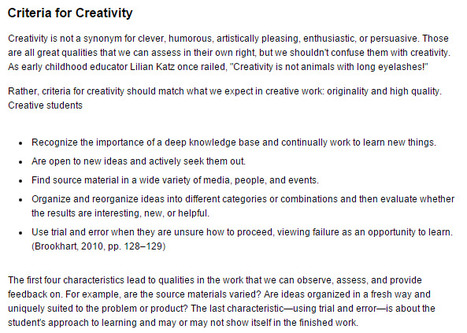
Teacher creativity is nothing new. Good teachers have always found inventive ways to make learning come alive and open opportunities for their students. A persistent challenge facing education has been figuring out how to expand these pockets of innovation so that more students can benefit.

That's why the rise of the teacherpreneur is so promising. Teacherpreneurs use all the tools at their disposal -- such as digital platforms, peer-to-peer professional development, and informal meet-ups -- to help good ideas spread and scale.

As Heather Wolpert-Gawron explained in her post The Era of the Teacherpreneur, these educators are opening new leadership pathways in education. Instead of leaving the classroom to launch new ventures, teacherpreneurs leverage their entrepreneurial spirit to lead change from within the system.


Learn more:


- http://www.scoop.it/t/21st-century-learning-and-teaching/?tag=Teacherpreneur


- https://gustmees.wordpress.com


- https://gustmees.files.wordpress.com/2015/05/document_fusionne.pdf


- https://gustmees.wordpress.com/2015/05/26/what-are-the-skills-needed-from-students-in-the-future/


- https://gustmees.wordpress.com/2015/03/04/learning-to-learn-preparation-for-better-learning-how-to/


Gust MEES's insight:
Teacher creativity is nothing new. Good teachers have always found inventive ways to make learning come alive and open opportunities for their students. A persistent challenge facing education has been figuring out how to expand these pockets of innovation so that more students can benefit.

That's why the rise of the teacherpreneur is so promising. Teacherpreneurs use all the tools at their disposal -- such as digital platforms, peer-to-peer professional development, and informal meet-ups -- to help good ideas spread and scale.

As Heather Wolpert-Gawron explained in her post The Era of the Teacherpreneur, these educators are opening new leadership pathways in education. Instead of leaving the classroom to launch new ventures, teacherpreneurs leverage their entrepreneurial spirit to lead change from within the system.


Learn more:


- http://www.scoop.it/t/21st-century-learning-and-teaching/?tag=Teacherpreneur


- https://gustmees.wordpress.com


- https://gustmees.files.wordpress.com/2015/05/document_fusionne.pdf


- https://gustmees.wordpress.com/2015/05/26/what-are-the-skills-needed-from-students-in-the-future/


- https://gustmees.wordpress.com/2015/03/04/learning-to-learn-preparation-for-better-learning-how-to/


Tony Palmeri's curator insight, October 24, 2015 1:56 PM

I gravitated towards this article because in every school building there are master teachers who's proficiency needs to be tapped - they are an invaluable resource. In our district, "teacher lab" is a peer-to-peer platform for showcasing good teaching or new strategies. As an educational leaders we must find ways to advertise good teaching. Providing these opportunities is incredibly important. 

Scooped by Gust MEES
June 4, 2015 8:16 PM
Scoop.it!

The Era of the Teacherpreneur | eLeadership | eSkills | Creativity

The Era of the Teacherpreneur | eLeadership | eSkills | Creativity | 21st Century Learning and Teaching | Scoop.it
Enter the Teacherpreneur


The teacherpreneur merges the image of the innovative classroom teacher with the risk-taking and entrepreneurial leadership that we commonly associate with those who create their own place in the professional world.

Teacherpreneurs are, first and foremost, imaginative teachers. They have created a classroom culture of creativity and reflection. They think beyond the classroom in terms of how to make lessons meaningful, and in so doing, might see a need elsewhere in school that their innovation can address.

As a result, they might request to go part-time in the classroom in order to use their other untapped skills to meet that need. The district or school itself might fund this "other part" of their job, or it might be funded through grants or other outside agencies. For instance, in California, we have noticeable influx of recent funds from the Local Control and Accountability Plan (LCAP).

As a result, many districts are spending a percentage of that money on creating teacherpreneur positions.

The key here is that the teacher creates a different way of navigating the profession without leaving that profession entirely. Their talents remain in the classroom and on the school site, but they've had the opportunity to shake their dice, try something new, and use their skills in a different way.

It comes down to differentiation. We differentiate our students, but we rarely talk about the need to differentiate our teachers, too. It isn't about one teacher being "better" or "worse" than others on a site. It's about admitting that staff can't be standardized and that the individuals running the classroom might have some strengths that should also be leveraged to improve the school and district culture overall.


Barnett Berry: Teacherpreneurs are classroom experts who teach students regularly, but also have time, space, and reward to incubate and execute their own ideas -- just like entrepreneurs!


Teacherpreneurs are amongst us, and they are, just perhaps, signaling in a new kind of educational system.


Learn more:


- https://gustmees.files.wordpress.com/2015/05/document_fusionne.pdf


- https://gustmees.wordpress.com/2015/05/26/what-are-the-skills-needed-from-students-in-the-future/


- https://gustmees.wordpress.com/2015/03/04/learning-to-learn-preparation-for-better-learning-how-to/


Gust MEES's insight:

Barnett Berry: Teacherpreneurs are classroom experts who teach students regularly, but also have time, space, and reward to incubate and execute their own ideas -- just like entrepreneurs!


Teacherpreneurs are amongst us, and they are, just perhaps, signaling in a new kind of educational system.


Learn more:


- https://gustmees.files.wordpress.com/2015/05/document_fusionne.pdf


- https://gustmees.wordpress.com/2015/05/26/what-are-the-skills-needed-from-students-in-the-future/


- https://gustmees.wordpress.com/2015/03/04/learning-to-learn-preparation-for-better-learning-how-to/


No comment yet.
Scooped by Gust MEES
June 3, 2015 8:28 PM
Scoop.it!

Educational Leadership | Assessing Creativity | eLeadership | eSkills

Educational Leadership | Assessing Creativity | eLeadership | eSkills | 21st Century Learning and Teaching | Scoop.it

Learn more:


- http://www.scoop.it/t/21st-century-learning-and-teaching?tag=Creativity


Gust MEES's insight:

Learn more:


- http://www.scoop.it/t/21st-century-learning-and-teaching?tag=Creativity


Pamela Perry King's curator insight, June 4, 2015 10:06 AM

Great Article! To be creative has so many sides!

Scooped by Gust MEES
June 3, 2015 1:27 PM
Scoop.it!

Educational Leadership:Teaching with Mobile Tech: How to Transform Teaching with Tablets

Educational Leadership:Teaching with Mobile Tech: How to Transform Teaching with Tablets | 21st Century Learning and Teaching | Scoop.it

If your school is investing in tablets, be sure to have a plan for how learning should change.

During one of our first visits to an iPad school, students told us that their favorite use of the tablet was for note taking. They had an app that enabled them to leave their paper notebooks at home and organize their notes in one place.


We're not opposed to gains in productivity, but if all tablet computers do is replace notebooks with notebook apps, we're unlikely to look back on the United States' investment in tablets with much enthusiasm.


Learn more:


- http://www.scoop.it/t/21st-century-learning-and-teaching/?tag=Tablets


- https://gustmees.wordpress.com/2015/05/26/what-are-the-skills-needed-from-students-in-the-future/


Gust MEES's insight:

If your school is investing in tablets, be sure to have a plan for how learning should change.

During one of our first visits to an iPad school, students told us that their favorite use of the tablet was for note taking. They had an app that enabled them to leave their paper notebooks at home and organize their notes in one place.


We're not opposed to gains in productivity, but if all tablet computers do is replace notebooks with notebook apps, we're unlikely to look back on the United States' investment in tablets with much enthusiasm.


Learn more:


- http://www.scoop.it/t/21st-century-learning-and-teaching/?tag=Tablets


- https://gustmees.wordpress.com/2015/05/26/what-are-the-skills-needed-from-students-in-the-future/


Jennifer McGuff's curator insight, August 1, 2015 5:23 PM

I scooped this article because I am currently working with a school that is in the beginning stages of implementing ipads.


Rescooped by Gust MEES from Middle Level Leadership
May 20, 2015 6:29 AM
Scoop.it!

Why school leaders need the support of specific feedback to improve schools

Why school leaders need the support of specific feedback to improve schools | 21st Century Learning and Teaching | Scoop.it

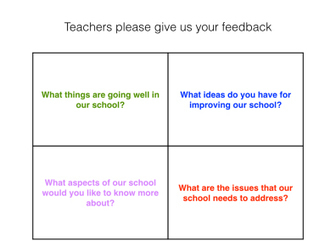
Every school has its own set of problems, there’s no denying it. Many school leaders really value feedback from their teachers about areas for improvement. Even when leaders may not be seeking feedback, there is always a strong chance that someone will tell them what they think, or what “a group of people think”, or even what “everybody” thinks. In many schools, processes have been put in place to support the gathering of feedback to assist school improvement.


Learn more:


- https://gustmees.wordpress.com/2015/05/13/andragogy-adult-teaching-how-to-teach-ict/


- https://gustmees.wordpress.com/2014/01/04/practice-better-ways-to-say-i-dont-know-in-the-classroom/


Via Patti Kinney
Gust MEES's insight:

Every school has its own set of problems, there’s no denying it. Many school leaders really value feedback from their teachers about areas for improvement. Even when leaders may not be seeking feedback, there is always a strong chance that someone will tell them what they think, or what “a group of people think”, or even what “everybody” thinks. In many schools, processes have been put in place to support the gathering of feedback to assist school improvement.


Learn more:


- https://gustmees.wordpress.com/2015/05/13/andragogy-adult-teaching-how-to-teach-ict/


- https://gustmees.wordpress.com/2014/01/04/practice-better-ways-to-say-i-dont-know-in-the-classroom/


Apollo B. Gabazira's curator insight, July 11, 2015 3:56 AM

Feedback culture accompanied by a high digital-quotient (DQ) brings to schools or any other institution, 'fail-safe' thinking as well as real time learning & improvement 

Scooped by Gust MEES
May 18, 2015 8:21 AM
Scoop.it!

On Educational Coaching, Mentoring & High-Impact Learning

On Educational Coaching, Mentoring & High-Impact Learning | 21st Century Learning and Teaching | Scoop.it
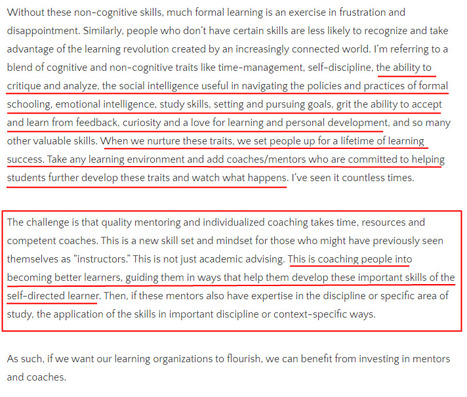
Coaching is a difference-maker in education.  Think of the mindset evident in high-performing athletic teams, chess teams, even actors and other entertainers. Content providers are valuable, but that is not what makes learning organizations distinct, especially not those that seek to reach and provide a high-quality education to a full spectrum of learners.

.

The same thing is true as we continue to implement things like competency-based education models. Many celebrate the way CBE can reduce the cost of college degrees, increasing access and opportunity, and addressing critical workforce needs. However, if cost reduction happens at the expense of great coaching and mentoring, I am concerned that we will make little progress in the democratization of education.

.

The “haves and have nots” of education depend largely upon the prerequisite skills needed to take advantage of newer and emerging learning environments ranging from CBE to MOOCs, self-directed learning to self-organized learning environments....


Learn more:


- https://gustmees.wordpress.com/2014/07/10/education-collaboration-and-coaching-the-future/


- http://www.scoop.it/t/21st-century-learning-and-teaching/?tag=Coaching


Gust MEES's insight:
Coaching is a difference-maker in education.  Think of the mindset evident in high-performing athletic teams, chess teams, even actors and other entertainers. Content providers are valuable, but that is not what makes learning organizations distinct, especially not those that seek to reach and provide a high-quality education to a full spectrum of learners. 


The same thing is true as we continue to implement things like competency-based education models. Many celebrate the way CBE can reduce the cost of college degrees, increasing access and opportunity, and addressing critical workforce needs. However, if cost reduction happens at the expense of great coaching and mentoring, I am concerned that we will make little progress in the democratization of education.


The “haves and have nots” of education depend largely upon the prerequisite skills needed to take advantage of newer and emerging learning environments ranging from CBE to MOOCs, self-directed learning to self-organized learning environments....

Learn more:


- https://gustmees.wordpress.com/2014/07/10/education-collaboration-and-coaching-the-future/


- http://www.scoop.it/t/21st-century-learning-and-teaching/?tag=Coaching


No comment yet.
Scooped by Gust MEES
May 12, 2015 6:47 PM
Scoop.it!

12 Hard Truths About Leadership That Will Make You Smarter

12 Hard Truths About Leadership That Will Make You Smarter | 21st Century Learning and Teaching | Scoop.it
Take these lessons to heart and you will succeed significantly.


Learn more:


- http://www.scoop.it/t/21st-century-learning-and-teaching/?tag=LeaderShip


Gust MEES's insight:
Take these lessons to heart and you will succeed significantly.


Learn more:


- http://www.scoop.it/t/21st-century-learning-and-teaching/?tag=LeaderShip


Lay Leng Low's curator insight, May 12, 2015 10:51 PM

How to intentionally practise and implement these 12 truths is the challenge.  In particular, how to do the things that make us proud and not worry about what other people think. 

Dr. Deborah Brennan's curator insight, May 15, 2015 2:48 PM

Great tips for not only leaders, but people in general.  Do what you love, listen to others, reflect, and forgive yourself when you make mistakes.

Rescooped by Gust MEES from Luxembourg (Europe)
May 10, 2015 11:58 AM
Scoop.it!

Leadership Develops When You Escape Your Comfort Zone

Leadership Develops When You Escape Your Comfort Zone | 21st Century Learning and Teaching | Scoop.it

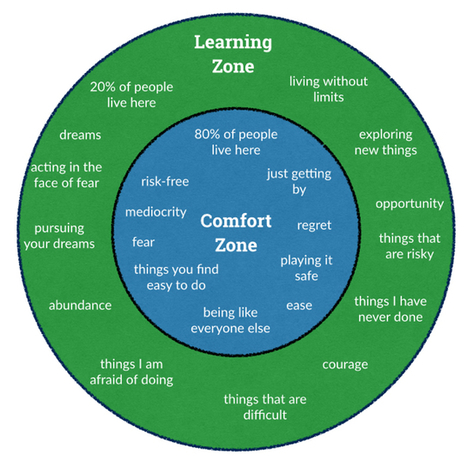
Successful leaders know that they must get out of their comfort zone to succeed. Great leaders from history are those who have spent a large amount of their time outside their comfort zone.

.

Leaders who take risks and step into their learning zone are those that succeed. It’s only when you can give up what’s safe and familiar that you create opportunities and develop new capabilities. As you do, you expand your influence and gain the skills required to take on bigger and bigger challenges.

.

In this sense, leaders are self-made and not born, they are developed, not promoted. Leadership is a learned skill that is developed as you step out of your comfort zone.

.

Learn more:

.

- http://www.scoop.it/t/21st-century-learning-and-teaching/?tag=LeaderShip


Via Patti Kinney, Gust MEES
Gust MEES's insight:

Learn more:

.

- http://www.scoop.it/t/21st-century-learning-and-teaching/?tag=LeaderShip


Marlena Gross-Taylor's curator insight, May 17, 2015 10:24 AM

To be a fearless, 360 leader you have to step outside of your comfort zone. The experience provides the opportunity for growth! #leadupchat #edchat #mschat 

Dr. Deborah Brennan's curator insight, May 17, 2015 11:54 AM

Vygotsky talked of the Zone of Proximal Development, and this article is in line with that foundational philosophy about learning.  When we think about improving schools, both of Vygotsky and this article apply.  We need leaders, teachers, and students operating outside their comfort zone, taking risks, setting goals, and learning.  There is a danger in struggling schools to push too hard and move buying the productive zone for learning.  This article speaks well to that aspect of learning.  With good intentions, leaders at building, district, and state level often push a school and omits staff beyond the productive learning zone into the danger zone.  This is done through programs, initiatives, and monitoring often with the goal of providing support, but with the result of overwhelming the school and staff.  

Yolanda jiménez's curator insight, May 26, 2015 12:58 AM

Muy interesante.  

Rescooped by Gust MEES from Supports for Leadership
April 25, 2015 7:06 PM
Scoop.it!

9 Keys to Being an Inspirational Leader

9 Keys to Being an Inspirational Leader | 21st Century Learning and Teaching | Scoop.it
I am fascinated by what it takes to be an extraordinary leader–an inspirational leader. I am fascinated by WHY some leaders seem to magically make a huge impact on the world while others do not  — Steve Jobs being one case in point, as he changed forever the lives of people and the world with his vision.  Let us ponder the question, “Are we all born leaders”? In a certain way I believe we are. We are ultimately leaders of our own lives and destinies. We become leaders of our families and communities, and many take on leadership positions in business. However, holding a leadership title does not guarantee that we have what it takes to inspire others and make a lasting positive impact. I recently came across a quote that speaks to this: “Leaders are not born. They are made. Who makes them? They make themselves.” ~ Peter Castenbaum, Corporate Mystic.


Learn more:


- http://www.scoop.it/t/21st-century-learning-and-teaching/?tag=LeaderShip


Via Mark E. Deschaine, PhD
Gust MEES's insight:
I am fascinated by what it takes to be an extraordinary leader–an inspirational leader. I am fascinated by WHY some leaders seem to magically make a huge impact on the world while others do not  — Steve Jobs being one case in point, as he changed forever the lives of people and the world with his vision.  Let us ponder the question, “Are we all born leaders”? In a certain way I believe we are. We are ultimately leaders of our own lives and destinies. We become leaders of our families and communities, and many take on leadership positions in business. However, holding a leadership title does not guarantee that we have what it takes to inspire others and make a lasting positive impact. I recently came across a quote that speaks to this: “Leaders are not born. They are made. Who makes them? They make themselves.” ~ Peter Castenbaum, Corporate Mystic.


Learn more:


- http://www.scoop.it/t/21st-century-learning-and-teaching/?tag=LeaderShip


No comment yet.
Scooped by Gust MEES
April 18, 2015 4:58 PM
Scoop.it!

Counterfeit Leadership

Counterfeit Leadership | 21st Century Learning and Teaching | Scoop.it
The responsibility of a leader is to lead. (What a concept.) The fact is, some leaders are causing irreparable damage to great institutions by shirking their responsibilities. They’re afraid to address difficult issues, make tough decisions, and introduce the change that’s required to achieve long-term success. Instead, these “counterfeit leaders” spend much of their time playing politics, protecting their turf, and promoting their self-interests. To make matters worse, counterfeit leaders, in both public and private sectors, often masquerade as positive role models while condoning unethical or irresponsible behavior that undermines the very foundation of their institution.

With full complicity, we reward these misguided efforts by electing politicians for “life” and by paying executives zillions of dollars to damage the same organizations that they “swear” to serve. And just to show there are no hard feelings when things do go irreparably wrong, we offer many of our “finest” golden parachutes to make sure they have a soft landing into their next misadventure.

How do you spot a counterfeit leader? Here are some ways to evaluate our leaders:


Real leaders achieve success by setting the bar high, encouraging teamwork, promoting win-win relationships, and demanding everyone’s best effort. Real leaders win the support of their constituents by earning their trust and respect. This is achieved through powerful ideas, personal expertise, and impeccable integrity rather than through their position or by “pulling rank.”


Learn more:


- http://www.scoop.it/t/21st-century-learning-and-teaching/?tag=Frank+SONNENBERG


Gust MEES's insight:
The responsibility of a leader is to lead. (What a concept.) The fact is, some leaders are causing irreparable damage to great institutions by shirking their responsibilities. They’re afraid to address difficult issues, make tough decisions, and introduce the change that’s required to achieve long-term success. Instead, these “counterfeit leaders” spend much of their time playing politics, protecting their turf, and promoting their self-interests. To make matters worse, counterfeit leaders, in both public and private sectors, often masquerade as positive role models while condoning unethical or irresponsible behavior that undermines the very foundation of their institution.

With full complicity, we reward these misguided efforts by electing politicians for “life” and by paying executives zillions of dollars to damage the same organizations that they “swear” to serve. And just to show there are no hard feelings when things do go irreparably wrong, we offer many of our “finest” golden parachutes to make sure they have a soft landing into their next misadventure.

How do you spot a counterfeit leader? Here are some ways to evaluate our leaders:


Real leaders achieve success by setting the bar high, encouraging teamwork, promoting win-win relationships, and demanding everyone’s best effort. Real leaders win the support of their constituents by earning their trust and respect. This is achieved through powerful ideas, personal expertise, and impeccable integrity rather than through their position or by “pulling rank.”


Learn more:


- http://www.scoop.it/t/21st-century-learning-and-teaching/?tag=Frank+SONNENBERG


No comment yet.
Scooped by Gust MEES
April 14, 2015 9:17 AM
Scoop.it!

Now or Never | WinWin | Proactive THINKing

Now or Never | WinWin | Proactive THINKing | 21st Century Learning and Teaching | Scoop.it
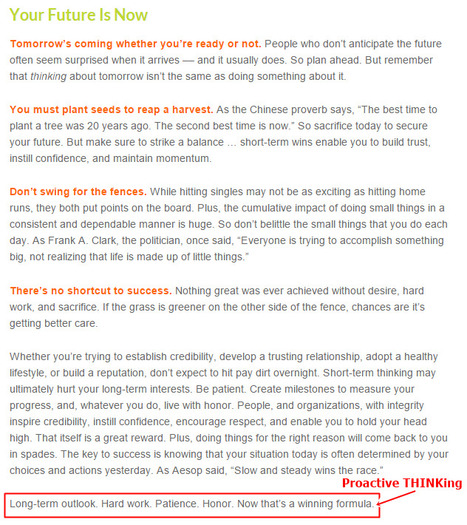
Some folks want everything now. The problem is that short-term thinking may hurt your long-term interests. There are simply no shortcuts in the long run.


Learn more:


- http://www.scoop.it/t/21st-century-learning-and-teaching?tag=Proactive+Thinking


Gust MEES's insight:
Some folks want everything now. The problem is that short-term thinking may hurt your long-term interests. There are simply no shortcuts in the long run.


Learn more:


- http://www.scoop.it/t/21st-century-learning-and-teaching?tag=Proactive+Thinking


Maximillian Danskin's curator insight, April 14, 2015 1:08 PM

in future years i would hope to instill these very logistics into my students. kids in this era have everything handed to them on a silver platter. hard work and accountability are two lot concept in this corner of the world and i believe majority of teenagers have no idea what this guy is talking about. just shows how sad our country has gotten over the past 10 years. technology has degraded our country.

Scooped by Gust MEES
April 2, 2015 2:36 PM
Scoop.it!

When People Don't Get It | Leadership | EDUcation4.0 | eLeadership

When People Don't Get It | Leadership | EDUcation4.0 | eLeadership | 21st Century Learning and Teaching | Scoop.it
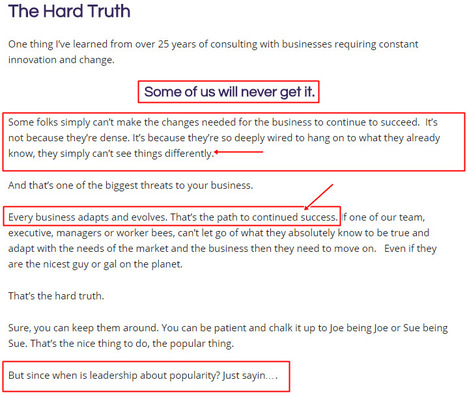
When people don't get it - the need for change or whatever - it's time to....
Gust MEES's insight:

When people don't get it - the need for change or whatever - it's time to....


No comment yet.