


Tablets can be used for much more than playing games and reading the latest e-books. Learn more about how tablets are also changing the face of education.
Read more:
http://www.onlineuniversities.com/blog/2012/08/teaching-with-tablets/

 Your new post is loading...
 Scoop.it! Tablets can be used for much more than playing games and reading the latest e-books. Learn more about how tablets are also changing the face of education.
Read more: http://www.onlineuniversities.com/blog/2012/08/teaching-with-tablets/

edtechie's comment,
August 25, 2012 7:38 PM
Love this!
Sign up to comment
Scoop.it!

In this age of "instant information" is it shortsighted to block social networking sites within an organisation purely because of stories in the press relating to scams, misuse and threats?
Is it time for a re-think? With the increase in the number of organisations embracing Bring Your Own Device (BYOD) this trend is only going to grow. So perhaps now is the time to look at educating users about the issues, and empowering them to use these tools responsibly, rather than trying to block access; after all, this may turn into a battle you can’t win.
So, how do you educate users about social networking sites and the issues around them?
- Passwords
- Sensible sharing
- Monitoring (for employees)
- Monitoring (for employers)
Read more:
Scoop.it!

It’s back to school time, and along with the flurry of activity to buy backpacks and school supplies to fill them come frequent posts about how to be a good instructor. Whether you’re a new teacher or a veteran, such pieces can provide helpful guidance and reminders for faculty. I used to post a list of what students want from faculty above my desk to help me stay cognizant of my students’ needs while I worked through each day.
The down side is that these lists can become a bit long and repetitious. Therefore, I’m going to narrow my list to the top four characteristics of effective online instructors, tempered by what I have heard from students about what they liked and disliked about the instruction of a course.
Read more:
Scoop.it!
Scale models of Machines invented by Leonardo da Vinci. via Michel Rodriguez
Via carol s. (caravan café)
Scoop.it!

Online security breaches are becoming increasingly common. But there are ways you can protect yourself. Read this blog post by Jen Haley on Security & Privacy.
Gust MEES: there is more even to consider, so check out please also my FREE courses (5 minutes ONLY...):
- http://gustmeesen.wordpress.com/2012/03/16/beginners-it-security-guide/
- http://gustmees.wordpress.com/category/get-smart-with-5-minutes-tutorials/
===> Don't have a good memory and being a "bad organizer"? Don't worry and check any Friday my specially created Hashtag on Twitter #FSCD where I remeber YOU what to take care about ;) Stay tuned... <===
Read more:
Scoop.it!
YouTube.com/Teachers was created to show teachers how to use these videos to educate, engage and inspire their students. YouTube.com/Teachers is part of YouTube's larger educational initiative, YouTube EDU.
Scoop.it!

Robin Good: Participatory culture writer and book author Henry Jenkins interviews cyberculture pioneer Howard Rheingold (Net Smart, 2012) by asking him to explain some of the concepts that have helped him become a paladin of the and "new literacies" so essential for survival in the always-on information-world we live in today.
This is part three of a long and in-depth interview (Part 2, Part 1) covering key concepts and ideas as the value of "community" and "networks", the architecture of participation, affinity working spaces, and curation.
Howard Rheingold: "...at the fundamental level, curation depends on individuals making mindful and informed decisions in a publicly detectable way.
Certainly just clicking on a link, “liking” or “plussing” an item online, adding a tag to a photograph is a lightweight element that can be aggregated in valuable ways (ask Facebook).
But the kind of curation that is already mining the mountains of Internet ore for useful and trustworthy nuggets of knowledge, and the kind that will come in the future, has a strong literacy element.
Curators don’t just add good-looking resources to lists, or add their vote through a link or like, they summarize and contextualize in their own words, explicitly explain why the resource is worthy of attention, choose relevant excerpts, tag thoughtfully, group resources and clearly describe the grouping criteria."
In other words, "curators" are the ones creating the metadata needed to empower our emerging collective intelligence.
Curation Is The Social Choice About What Is Worth Paying Attention To.
Good stuff. In-depth. Insightful. 8/10
Full interview: http://henryjenkins.org/2012/08/how-did-howard-rheingold-get-so-net-smart-an-interview-part-three.html
Via Robin Good 
Shaz J's comment,
September 3, 2012 3:20 AM
You're welcome :)
It's interesting interesting that you mention POV and stance, as that is not something I had explicitly articulated for myself, but naturally it must be implicitly true. In that sense, it reminds me (again) that curation forces self-reflection in order to present the content better, and that can only be a good thing. 
Liz Renshaw's comment,
September 8, 2012 9:57 PM
Agree with posts about curation guiding self reflection. This interview in particular is top value and two of my fav people indeed.

Andrew McRobert's curator insight,
August 19, 2014 8:43 AM
8. This links a series of three interviews quite lengthy but there is some insightful information for the novice in the digital information age. There is video links within the article, including a great question and answer with Robin Good on curation. The video brings a balance to this inclusion.
Scoop.it!

Report shows U.S.has eighth-highest PC malware rate among developed countries, examines new 'ransomware' that hijacks Web cams...
Thirty percent of computers in the United States are infected with some form of malware, putting America among the top 10 most malware-infected countries in the OECD (Organization for Economic Cooperation and Development). If it's any consolation, South Korea has the dubious honor of topping that list with a malware infection rate of over 57 percent.
Gust MEES: it's good being on the Top worlwide, but NOT on this list! How could that get resolved to get better results? Education can play a major role here, check my free courses and learn How-To get protected by easy to learn steps here:
- http://gustmees.wordpress.com/2012/07/11/cyberhygiene-hygiene-for-ict-in-education-and-business/
- http://gustmees.wordpress.com/2012/07/07/bring-your-own-device-advantages-dangers-and-risks/
- http://gustmees.wordpress.com/2012/05/28/not-only-rights-but-also-responsibility/
- http://gustmees.wordpress.com/2012/05/03/update-your-third-party-applications/
- http://gustmees.wordpress.com/2012/05/27/visual-it-securityteachers-worksheet-part1/
- http://gustmeesen.wordpress.com/2012/03/16/beginners-it-security-guide/
Compare also with Europe to find out how they act for a better security, learn from others:
- Lowest Malware infections in EU: http://www.scoop.it/t/luxembourg-europe?tag=Lowest+Malware+Infections+in+EU

Diego Cruz-Savinon's curator insight,
April 10, 2014 2:06 PM
When I read this article, I didn't think it was possible for 30 percent of U.S computers were infected by some form of Malware. This is just the thing that motivates more to work on computer security.
Scoop.it!

This month, the U.S. Department of Education kicked off Connected Educator Month, with engaging keynotes, panel discussions, book chats, and more. During this month, educators in the U.S.
Scoop.it!

Massive Open Online Courses (MOOC) are online classes that educate students through online resources.
Scoop.it!
Why is storytelling important? We tell you all you need to know about it: the why, the how, even the science behind it. How have stories evolved over the yea...
Scoop.it!

Even as more and more companies embace social media for internal and external communication, only a few are actively managing the risk that social media entails.
A MUST read...: http://www.readwriteweb.com/enterprise/2012/08/defusing-the-corporate-social-media-timebomb.php
Scoop.it!

Robin Good: Excellent guide to digital curation resources by Charles W. Bailey, Jr.. It includes alphabetically organized lists of digital-curation related resources from academic programs to file formats, guidelines, organizations, blogs, and a very rich list of digital curation software tools.
From the site: "This resource guide presents selected English-language websites and documents that are useful in understanding and conducting digital curation. It is also available as an EPUB file (see How to Read EPUB Files)."
Excellent. 9/10
Full guide: http://digital-scholarship.org/dcrg/dcrg.htm
(Image credit: GroupPartners) Via Robin Good |
Scoop.it!

A key aspect of scholarship is how you create a personal research library, find and access your sources when needed, and cite them accurately and comprehensively. Patrick Dunleavy explains how the (relatively new) software Mendeley has transformed his previous time-consuming practice in just a few days, and solved numerous other problems of accessing literature and sources wherever he is. Mendeley can offer all academics and PhDs massive productivity gains.
Read more:
Via Ana Cristina Pratas
Scoop.it!

Sensitive personal information about more than 1,000 children has been published on the UK Independent Schools Guide website after an alleged cyber attack.
Read more:
Scoop.it!

Dear Teacher, We are thrilled to be launching a new set of courses specifically dedicated to educating teachers in new technologies for education and English Language Teaching.
We are especially proud and pleased to announced that the course creator and tutor is no other than Nik Peachey, an edtech/ICT expert that most of you will have heard of. Nik Peachey is well-known known around the world for his great edtech blogs, writings, and presentations at international conferences where he is a keynote/plenary speaker.
Please read the brief descriptions of the two new courses we are launching in September 2012. Both courses will be delivered online on our Moodle website and require minimal knowledge of technology in order to participate. Both are flexible and can be attended whenever you have time available to read the input and complete the required tasks or participate in the discussions.
Read more: http://us2.campaign-archive1.com/?u=6d6e7c5eb514be9e7e5977690&id=2e767c6102
Scoop.it!

What are the components of a digital classroom?
What are the components of a digital classroom? From eBooks to smartboards, iTunesU implementation to online learning, the classroom as we know it is changing.
It’s true that a digital classroom is a vague idea. And subjective–one educator’s cutting edge learning laboratory is the next educator’s been there, done that.
The following infographic looks at some of the more common elements of a digital classroom, including:
- eBooks
Read more: http://www.teachthought.com/technology/the-elements-of-a-digital-classroom/
Scoop.it!

Nearly every nation in the world would like to bring in the best and brightest scholars to its schools (and hopefully tap into some of that genius in their economy), but not all have the resources or the facilities to do so.
While the U.S. and Europe still dominate many of the lists of top universities, other nations, even some smaller ones, are working hard to provide some serious international competition, building massive education cities and cutting-edge universities that are designed to bring in students from all over the world.
While some still have a long way to go, others are proving that top-tier higher education is going to be a far more global game in the coming decades. We highlight just a few of these cities and their impressive educational offerings in this list.
Read more: http://edudemic.com/2012/08/10-up-and-coming-cities-that-are-disrupting-education/
Scoop.it!

Most (84pc) of information security executives believe their organisations are vulnerable to advanced persistent threats (APTs) targeting intellectual property or other critical organisational assets, reveals a new survey that gauges the state of...
Scoop.it!
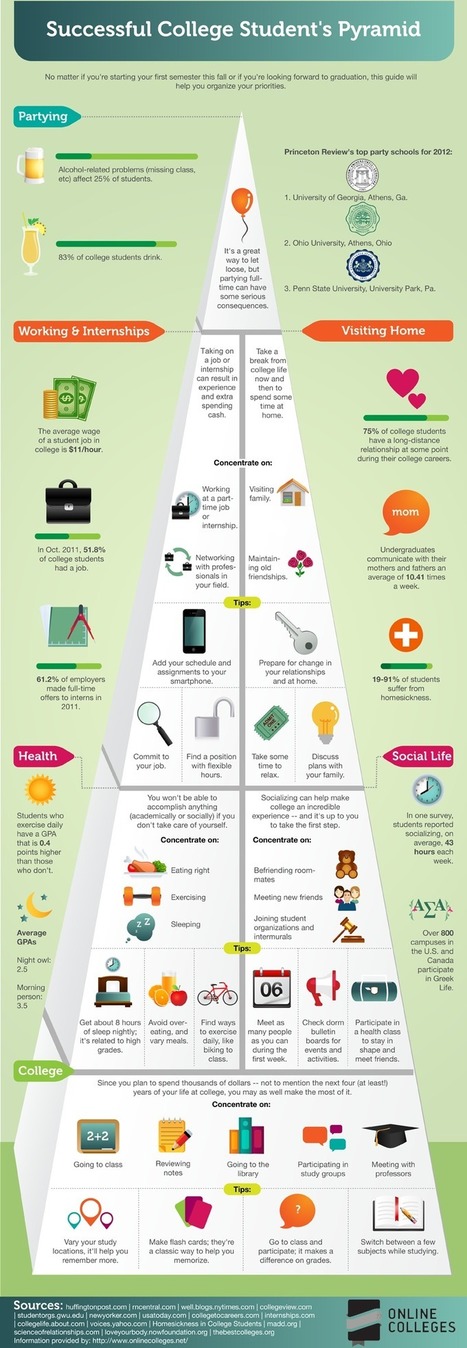
How to learn online? Find out how online learning is different to classroom learning, and how you can learn more effectively.
Thanks to http://www.scoop.it/t/a-new-society-a-new-education
Scoop.it!
Lately there has been a fair amount of pressure on educators to cultivate “21st century skills” in their students. But what exactly does this mean?
Read more:
Via Dr. Susan Bainbridge, David Theisen
Scoop.it!

Free services in exchange for personal information. That's the "privacy bargain" we all strike on the Web. It could be the worst deal ever.
technology review, published by MIT
A MUST read...: http://www.technologyreview.com/news/428045/the-curious-case-of-internet-privacy/
Scoop.it!

A 21-year-old Maryland man who was part of a credit card hacking ring that targeted businesses in Seattle and across the country has been sentenced to seven years in prison.
Gust MEES: Education ===> use such examples to educate your learners about the misuse of Internet and show them what Cybercrime is and how it is get punished; prison, jail... Good also for e-Citizen and Digital-Citizen Education. Look also at my curation here:
- http://www.scoop.it/t/securite-pc-et-internet?q=prison
- http://www.scoop.it/t/securite-pc-et-internet?q=jail
Scoop.it!

From
europa

European Commission Press release Brussels, 23 July 2012 Digital Agenda – Commission consults on a future EU Network and Information Security legislative initiative The European Commission is seeking the views of governments, businesses, citizens about their experiences and EU possible responses to cyber incidents which cause disruption to essential Network and Information Systems (NIS), including the internet.
The Commission has launched this consultation to help it prepare a legislative proposal on network and information security, which will be an important element of the upcoming EU strategy on Cyber security. Feedback received will help the Commission draw up an approach to possible future risk management and security breach reporting requirements that would affect businesses in particular. The consultation runs until 12 October 2012.
Background, read more:
|






