Tout sur les grandes évolutions et les petites révolutions de la vie numérique ! Explorez, commentez, partagez : rejoignez la communauté du collectif.
En savoir plus :
http://lecollectif.orange.fr/mots-cles/60-secondes

 Your new post is loading...
 Scoop.it! Tout sur les grandes évolutions et les petites révolutions de la vie numérique ! Explorez, commentez, partagez : rejoignez la communauté du collectif.
En savoir plus :
http://lecollectif.orange.fr/mots-cles/60-secondes
No comment yet.
Sign up to comment
Scoop.it!

Keynote speeches, panel discussions, and new reports all put the spotlight on models for combining face-to-face and online instruction.
While the rise of blended learning has long been on the radar of leaders in virtual education, last week's Virtual School Symposium may have been its unofficial coming-out party.
Read more, very interesting...:
Scoop.it!

We’ve been discussing blended learning in the Edudemic Magazine for several months but I had been struggling to find a video that helps explain what it actually is and why you should care. Then I happened upon one of the startups I’ve been watching. Education Elements has a terrific page along with a video to describe exactly what blended learning is, what it hopes to achieve, and what it looks like.
A must watch...: http://edudemic.com/2012/10/what-exactly-is-blended-learning/
Scoop.it!

How are phones being used in the classroom? Is all this BYOD and 1:1 tech actually useful? What are teachers saying about the phone’s increasingly large presence in their classrooms? A new infographic spells it out.
Scoop.it!

The Norton Cybercrime Report is out for 2012! Cybercrime continues to have far-reaching effects and is increasingly a problem on mobile devices and in our social networks (where we seem to be less vigilant).
After surveying more than 13,000 consumers in 24 countries, the researchers found that the numbers of online adults increased by 20% from last year, and that cybercrime impacted just under ½ of them in the previous 12 months.
Read more, a MUST:
Scoop.it!

From
ht

Let’s be honest, we don’t like to read big pieces of text. Text-heavy graphs are rather difficult for understanding, especially when dealing with numbers and statistics. That is why illustrations and flowcharts are often used for such kind of information. An infographic, or a visual representation of study or data, like anything else, can be done right or wrong. How to create a successful infographic? A good idea and a good design.
Stop by the link for more on what defines an infographic, what contributes to its popularity, as well as the various types of infographics and references for tutorials and best practices.
Additional topics covered include: The major parts of an infographic How to create an infographic Developing ideas & organizing data Research & sources Typography, graphics & color Facts & conclusions Designing & EditingVia Lauren Moss
Scoop.it!

The eLearning community at Twitter is extremely active. Professionals involved at the eLearning Industry are looking which Twitter hashtag to use to c...
Gust MEES
Include also #itsecurity #cybersecurity #InternetSafety #OnlineSafety #eSafety #eCitizen #digcit #digitalcitizen #Bullying #Cyberbullying #BYOD #BYOT as they are also part of 21st Century Learning!
Scoop.it!

“The Russian shadow economy is an economy of scale, one that is service oriented and that has become a kleptocracy wherein crony capitalism has obtained a new lease on life in cyberspace,” says a new report into the cybercriminal Russian underground.
Professor John Walker, chair of the London chapter ISACA and CTO of Secure-Bastion, sees a road-map for APT laid out by the report. “In a nutshell,” he told Infosecurity, “what the Trend Micro report is confirming is that the much debated logical attack vectors of
===> the Advanced Persistent Threat (APT), and the more focused Advanced Evasion Techniques (AET) as reported by StoneSoft are not hype, but reality.<===
“In the Trend Micro report,” he continued, “we see the imagination of the Russian Cyber Attacker laid out before our eyes – with some excellent examples of the lengths cyber criminals are prepared to take to underpin a successful mission.
===> It is also very clear that, this mission is lucrative, and would seem to imply it is going to be with us for some time yet.” <===
Read more, a MUST:
Scoop.it!

Where does curation sit in all of this? Whilst blogging implies creating content or self-publishing, curation is aggregating content by one person for others – going out with a broom to sweep autum...
Via k3hamilton
Scoop.it!

Facebook will be launching an internal investigation following the revelation by Czech blogger Bogomil Shopov that data belonging to over one million Facebook users was offered for sale for $5.
Read more, a MUST: http://www.net-security.org/secworld.php?id=13870
Scoop.it!
October 30, 2012 | 10:41 AM | By Katrina Schwartz As the number of K-12 students who take online courses continues to grow — more than two million are currently enrolled — the need to uphold rigorous standards to online education is becoming that much more important. And with criticism leveled at many online schools for poor academic performance, the online education model needs to create a more accurate way to assess the quality of the dozens of programs in the space.
Read more, a MUST: http://blogs.kqed.org/mindshift/2012/10/how-to-uphold-online-learning-to-quality-education/
Scoop.it!

October 26, 2012
At DHS, we’re working to develop the next generation of leaders in cybersecurity while fostering an environment for talented staff to grow in this field.
We are building strong cybersecurity career paths within the Department, and in partnership with other government agencies. We are also creating training and development opportunities to retain our most talented employees and ensure their professional development. In collaboration with the National Security Agency, we are strengthening the nation’s educational infrastructure by supporting Centers of Academic Excellence across the country.
In addition, we are extending the scope of cyber education beyond the federal workplace through the National Initiative for Cybersecurity Education, involving students from kindergarten through post-graduate school.
And we sponsor the U.S. Cyber Challenge, a program that works with academia and the private sector to identify and develop the best and brightest cyber talent to meet our nation’s growing and changing security needs.
============================================= Gust MEES
Read also my FREE courses:
- http://gustmeesen.wordpress.com/2012/02/13/why-ict-security-why-the-need-to-secure-a-computer/
- http://gustmeesen.wordpress.com/2012/03/16/beginners-it-security-guide/
- http://gustmees.wordpress.com/2012/10/11/learning-basics-of-cyber-security-by-easy-to-follow-steps/
- http://gustmees.wordpress.com/2012/07/11/cyberhygiene-hygiene-for-ict-in-education-and-business/
=============================================
Read more, a MUST: http://www.dhs.gov/blog/2012/10/26/inspiring-next-generation-cyber-professionals
|
Scoop.it!
Scoop.it!

While there is growing support for international cybersecurity exercises, more can be done to ensure such exercises are successful, according to a report published Oct. 25 by the European Network and Information Security Agency (ENISA).
Read more, a MUST:
Scoop.it!

Technology is a powerful tool for learning that can be used effectively to help students develop the skills necessary to succeed in school and beyond.
Read more, very interesting...: http://gettingsmart.com/cms/blog/2012/10/5-instructional-shifts-to-promote-deep-learning/
Scoop.it!

The names Oprah Winfrey, Michael Jordan and Steve Jobs aren't usually associated with failure.
But before these successful super stars made it big in their respective industries, they first failed, were fired, or heard the word "no" countless times.
- Steve JOBS - Elvis PRESLEY - The BEATLES - Walt DISNEY - J.K. ROWLING - Steven SPIELBERG - Stephen KING - Oprah WINFREY - Jerry SEINFELD - Michael JORDAN - Hugh JACKMAN - Lucille BALL - Fred ASTAIRE - Sidney POITIER - Oliver STONE
Read more, a MUST for motivation...: http://www.businessinsider.com/15-people-who-failed-before-becoming-famous-2012-10?0=thewire#
Scoop.it!
ABOUT
The National Cyber Security Alliance (NCSA) has created the National Cyber Security Education Council (NCEC), a public-‐private partnership between government and industry to help address formal cybersecurity education in the United States.
Read more: http://www.staysafeonline.org/ncec/about
Scoop.it!

The return of IM worms, such as the recent Skype threat, underscores a risk that IT managers face in an increasingly BYO world.
It was an early form of consumerization with people bringing the applications they used in their personal lives into the workplace. Call it a “BYOA” approach: Bring Your Own Application. Always being ready to adapt to emerging trends, attackers started crafting malware that would exploit the weaknesses these new applications introduced into the workplace. Attackers adapted methods that worked so well with email worms like the ILOVEYOU worm of 2000 to create a new kind of worm that could spread even faster over IM networks.
============================================
Gust MEES
Check out also my curation and my FREE course about it:
- http://gustmees.wordpress.com/2012/07/07/bring-your-own-device-advantages-dangers-and-risks/
- http://www.scoop.it/t/securite-pc-et-internet?tag=BYOD
- http://www.scoop.it/t/21st-century-learning-and-teaching?tag=BYOD
============================================
Read more, a MUST: http://consumerization.trendmicro.com/dont-let-byod-become-byov-bring-your-own-viruses/
Scoop.it!

Rehearsing tasks, from teaching to medicine to consumer complaints, frees the brain for complex work, writes Doug Lemov.
Practice lets us execute a task while using less and less active brain processing. It makes things automatic. When performers master one aspect of their work, they free their minds to think about another aspect. This may be why many of us have our most creative thoughts while driving or brushing our teeth. Rote learning and conceptual thinking often feed synergistically on each other, freeing our brain capacity for those tasks that require the maximum amount of attention and creativity.
Read more, very interesting: http://online.wsj.com/article/SB10001424052970204530504578078602307104168.html?mod=googlenews_wsj
Scoop.it!

NetPublic » Permis de bon sens numérique et guide du bon sens numérique 2012
Test du permis du bon sens numérique
- la protection de la vie privée,
- l’éducation numérique des enfants
Á lire et à faire le test absolument :
http://www.netpublic.fr/2012/10/permis-bon-sens-numerique-guide-bon-sens-numerique-2012/
Via Frederic GOUTH
Scoop.it!

Symantec helps consumers and organizations secure and manage their information-driven world.
Zero-Day World
Zero-day (zero-hour or day zero) vulnerabilities are previously unknown vulnerabilities that have not been revealed publicly but are exploited by attackers. Discovering and exploiting zero-day vulnerabilities helps cyber criminals to increase the success rate of attacks. Attacks using zero-day exploits are tough to identify and analyze because in many cases information is not available until attacks have already occurred. There is practically no protection against zero-day attacks as details of the vulnerability is usually a mystery when these attacks are first observed.
Learn more, a MUST: http://www.symantec.com/connect/blogs/zero-day-world
Scoop.it!
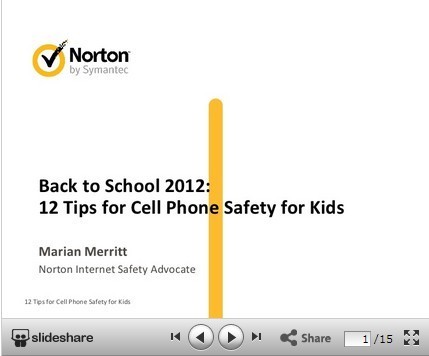
We all acknowledge the benefits of staying in touch with your children but have we taken all the measures to ensure they are protected against the most common risks? Take a look at the slideshow and find out how you can help your kids stay safe on their mobile.
Read more, a MUST: http://www.itsnotacon.co.uk/2012/09/06/mobile-phone-safety-for-kids/
Scoop.it!

One of the chief aims of the new program will be to determine which adversaries are behind cyber attacks against businesses and critical infrastructure.
The FBI has introduced a team of specialists, which will be on call 24/7, to investigate cyber threats affecting businesses, critical industries and domestic security -- and possibly determine who's behind on them.
Read more, a MUST: http://www.scmagazine.com/fbi-rolls-out-round-the-clock-cyber-crime-team/article/265894/
Scoop.it!
The Family Online Safety Institute works to make the online world safer for kids and their families by identifying and promoting best practice, tools and methods in the field of online safety, that also respect free expression.
Read more, a MUST: http://www.fosi.org/annual-conference-2012-program.html
|