


21st Century Learning and Teaching
791.7K views |
+7 today
Related articles to 21st Century Learning and Teaching as also tools...
Curated by
Gust MEES
 Your new post is loading...
 Scoop.it! 
Sir Ken Robinson speaks to Paddy O'Connell about his new book Finding Your Element. Educationalist Sir Ken Robinson speaks to Paddy O'Connell about schools stifling children's creativity and his new book Finding Your Element. Learn more: - http://www.scoop.it/t/21st-century-learning-and-teaching?tag=Creativity
Gust MEES's insight:
Educationalist Sir Ken Robinson speaks to Paddy O'Connell about schools stifling children's creativity and his new book Finding Your Element. Learn more: - http://www.scoop.it/t/21st-century-learning-and-teaching?tag=Creativity 
Scoop.it!

In school, we learn about geniuses and their ideas, but how did they get those ideas? What are the mental processes, attitudes, work habits, behaviors, and beliefs that enable creative geniuses to view the same things as the rest of us, yet see something different? Learn more: - http://www.scoop.it/t/21st-century-learning-and-teaching?tag=Creativity
Gust MEES's insight:

Monty Bell's curator insight,
June 2, 2014 7:44 PM
Good addition to 21st Century learning discussion. 
Ness Crouch's curator insight,
June 6, 2014 11:25 PM
Creativity is something that can be nourished but can it be learned? I'm not able to decide on that yet. 
Josie Gibson's curator insight,
June 8, 2014 9:24 PM
Some excellent reminders - 'All experiences are neutral...you don't see things are THEY are, you see them as YOU are'.
Scoop.it!

America is currently facing a crisis of leadership in business and in government. Yet at the same time – participation in leadership seminars and programs has never been higher. The leadership industry, with many of its roots in America, is now a $50 billion industry. If America is so good at [...] Kellerman explains that the current state of leadership is no better understood or produced than it was 40 years ago and that followers are becoming more and more disenchanted by those who are leading them. Though the leadership industry thrives, leadership in practice is declining in performance. Learn more.
Gust MEES's insight:
Kellerman explains that the current state of leadership is no better understood or produced than it was 40 years ago and that followers are becoming more and more disenchanted by those who are leading them. Though the leadership industry thrives, leadership in practice is declining in performance. Learn more.

John Ludike's curator insight,
March 29, 2014 3:43 AM
Hence the trend being many organisations and practitioners not endorsing American based approaches and either creating their own locally as well as those of Europe, Asia and Middle East many of which are currently producing better economic outcomes.
Scoop.it!
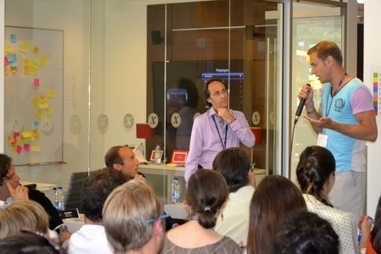
«L’idée est de créer une communauté de talents, au service de l’innovation» Parce qu’être créatif n’est plus réservé aux artistes et autres scientifiques dans l’intimité d’un atelier ou d’un laboratoire. Parce que l’économie créative est devenue un véritable facteur de développement pour les villes et les entreprises. Parce que Montréal et Barcelone sont reconnues comme des métropoles créatives. Trois raisons parmi bien d’autres de participer à l’École d’été en management de la création, organisée par HEC et l’Université de Barcelone. Via Thierry Belleguic
Gust MEES's insight:

Thierry Belleguic's curator insight,
February 17, 2014 11:29 AM
Parce qu’être créatif n’est plus réservé aux artistes et autres scientifiques dans l’intimité d’un atelier ou d’un laboratoire. Parce que l’économie créative est devenue un véritable facteur de développement pour les villes et les entreprises. Parce que Montréal et Barcelone sont reconnues comme des métropoles créatives. Trois raisons parmi bien d’autres de participer à l’École d’été en management de la création, organisée par HEC et l’Université de Barcelone. 
Anthony MARTINS de NOBREGA's curator insight,
February 19, 2014 4:37 AM
Break the barriers...Be different! des slogans à incarner....
Scoop.it!

Kim Phillips shares the 12 Most Striking Tendencies of Creative People. Ever wonder what makes those wacky, creative types tick? How is it that some people seem to come up with all kinds of interesting, original work while the rest of us trudge along in our daily routines? Creative people are different because they operate a little differently.
Gust MEES's insight:

K'Ailene M. McGlothen's curator insight,
February 3, 2014 2:13 PM
Interesting article celebrating the unique traits of creative people.
Scoop.it!

Rawn Shah once told me that knowledge is evolving faster than can be codified in formal systems and is depreciating in value over time. This pretty well sums up the situation.
Humans have the ability to deal with some very complex things, yet too often our societal and organizational barriers block us from using our abilities. In the new economy, it’s not what you know, but what you do with what you can learn, that will be valued. It will take rebels on the edges to do this. Via Ana Cristina Pratas
Gust MEES's insight:
Céline Schillinger, a fellow change agent, says that companies must cultivate their rebels in order to remain relevant to their workers, while staying competitive in their arenas.
These rebels can let them see beyond the organization’s walls. Rebellious people are essential for a new economy that no longer requires the diligence and obedience now provided by networked computers.
The rebel spirit is the competitive advantage for innovation and creativity.
Scoop.it!

Children are naturally curious, so where does it go as they grow older and what can we do, as teachers, to inspire it? Mathew Green wrote that classrooms and schools should be the most innovative, ...
Gust MEES's insight:

mariegardon's curator insight,
October 14, 2013 11:36 AM
Quelques pistes que l'on pourrait tester avec nos élèves français
Scoop.it!

"Geniuses produce because they think fluently and flexibly," says Michael Michalko in his book "Cracking Creativity."
"Fluency of thought means generating quantities of ideas." A key characteristic of genius is immense productivity. Thomas Edison held 1093 patents. Einstein published 248 papers. Darwin wrote 119 papers besides his theory of evolution. Therefore, if you want more creative/innovative thinking in your organization, you must encourage the generation of "quantities of ideas."
However, if you stifle creative thinking by sending subtle or not so subtle messages that "we must just spend our time doing things the way we have always done"...because they have worked, you'll never find a better more efficient method. Your innovative risk-taking competitor will! That's how Microsoft climbed to success passing IBM and why they know they have to continue investing mega-millions in R&D.
===> You must encourage people to think creatively and take risks. <===
Gust MEES's insight:
Scoop.it!

Though computer programming is becoming more important, many K-12 schools don't offer classes. Now commercial products are starting to offer at-home learning, offering sleek new platforms focused on teaching how to think like a computer programmer.
Gust MEES's insight:
Do YOUR BEST for that the kids could develop their creavity...
Scoop.it!
Gust MEES's insight:
Explore mechanical elements such as cams, levers, and linkages to create your own moving sculpture.
A MUST check!!!
Learn more:
- http://www.scoop.it/t/21st-century-learning-and-teaching/?tag=Creativity
- http://www.scoop.it/t/21st-century-learning-and-teaching/?tag=Tinkering
|
Scoop.it!

"Thinglink is a powerful tool, and some new uses are making it even more compelling. Beyond creating pictures with links, images, and videos, a “next level” exists that turns ThingLink into a powerful organizer, aggregation tool, and curator." Learn more: - http://gustmees.wordpress.com/2014/07/29/practice-creativity-examples-with-thinglink/ Via Beth Dichter
Gust MEES's insight:
Thinglink is a powerful tool, and some new uses are making it even more compelling. Beyond creating pictures with links, images, and videos, a “next level” exists that turns ThingLink into a powerful organizer, aggregation tool, and curator." Learn more: - http://gustmees.wordpress.com/2014/07/29/practice-creativity-examples-with-thinglink/

Rebekah Lee's curator insight,
August 15, 2014 3:29 AM
A pretty nifty way to insert signposts on a screenshot to display pop up instructions 
W. Bradley Gooderham's curator insight,
August 15, 2014 1:45 PM
Whoa, just whoa. ThingLink is so cool and what a great way to densify creative products and engage a diversity of learning pathways! I am going to include this in my next resume for sure.
Scoop.it!
Vidéo. Sir Ken Robinson à l'Etudiant : L'éducation doit permettre de développer les talents naturels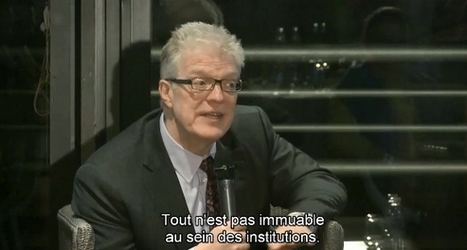
Spécialiste de la créativité, Sir Ken Robinson était l'invité de l'Etudiant à Paris, fin 2013. Retour en images sur cette rencontre-débat, dans laqu... Nous éduquons nos enfants comme si leur vie était planifiée alors que la nôtre ne l'a jamais été". Contre le mythe des parcours linéaires, Sir Ken Robinson prône une éducation qui permette à chacun de "découvrir son vrai talent", et d'être ainsi dans "son élément". Un concept qui a donné son titre à son best-seller, traduit en 22 langues (L'Elément, Playbac, 2013). Learn more: - http://www.scoop.it/t/21st-century-learning-and-teaching?tag=Creativity
Gust MEES's insight:
Nous éduquons nos enfants comme si leur vie était planifiée alors que la nôtre ne l'a jamais été". Contre le mythe des parcours linéaires, Sir Ken Robinson prône une éducation qui permette à chacun de "découvrir son vrai talent", et d'être ainsi dans "son élément". Un concept qui a donné son titre à son best-seller, traduit en 22 langues (L'Elément, Playbac, 2013). Learn more: - http://www.scoop.it/t/21st-century-learning-and-teaching?tag=Creativity

Karine Boyer-Kempf's curator insight,
April 22, 2014 5:30 PM
oh que je suis d'accord !! mais si l'école casse les talents naturels alors que faire ?
Scoop.it!

Every student has a talent that we can uncover if we keep our eyes and mind open. If we teachers were able to harness a fraction of the talents our students possess, we’d find enough creative energy to power our classroom for the entire school year.
Gust MEES's insight:
If we teachers were able to harness a fraction of the talents our students possess, we’d find enough creative energy to power our classroom for the entire school year.
Scoop.it!

Here’s to the crazy ones. The misfits. The rebels. The troublemakers. The round pegs in the square holes. The ones who see things differently. They’re not fond of rules. And they have no respect for the status quo. You can quote them, disagree with them, glorify or vilify them. About the only thing you can’t do is ignore them. Because they change things. They push the human race forward. And while some may see them as the crazy ones, we see genius. Because the people who are crazy enough to think they can change the world, are the ones who do. - Apple Inc "Think Different" ad.
Gust MEES's insight:
Scoop.it!
La créativité, pourquoi et comment ? Fausses idées, composantes de la créativité. Objectifs pour l'éducation, science et créativité... Entretien avec Sir Ken...
Gust MEES's insight:

宮西 咲's curator insight,
January 27, 2014 3:42 AM
話の途中でデジタル関連の用語が出てくるけれど、いくら英語ができたところで、ネットに関心がなかったら、さっぱりわかりませんよね。理解度は背景知識に大きく影響されると。
Scoop.it!
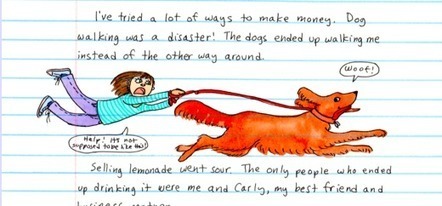
Encouraging kids to think in pictures and words can free up their creativity and language skills as they write.
Gust MEES's insight:
I wish teachers and educators would be already that far in their way of thinking ;)
Learn more:
- http://www.scoop.it/t/21st-century-learning-and-teaching/?tag=Creativity

Lou Salza's curator insight,
November 28, 2013 11:14 AM
This is particularly important for students with language learning differences--Lou
Excerpt: "...“There’s something about writing that is a link to your brain,” said Marissa Moss, author of the popular children’s book series Amelia’s Notebook. In the books, Moss takes on the persona of a little girl expressing her ideas about the world and people around her. The books are a combination of words and drawings and look free form – as though Amelia sketched them herself. Taking a cue from Moss, teachers from Oak Knoll Elementary School in Menlo Park, Calif., decided to have their students keep notebooks in a similar style. The notebooks aren’t graded; rather, they’re a place of private, free expression. Karen Clancy and Andrea Boatright presented the project at the Innovative Learning Conference hosted by the Nueva School recently. “They’re not used to being given permission to write about whatever they want,” Clancy said. But once her students realized that they really weren’t being graded and that they had freedom of expression, they eventually came to demand time to write. Moss says writing without fear of consequences is key to developing a writer’s voice. “If you’re perfect you are guaranteed to not write a thing,” Moss said. “It’s like driving with one foot on the gas and one foot on the break.” She has developed some guides to help teachers coax students into using art and writing in their journals at the same time, as a way of flexing their visual thinking along with literacy...." 
Audrey's curator insight,
December 2, 2013 6:08 PM
Teachers and students already think this way. Audrey curating for homeschoolsource.co.uk
Scoop.it!
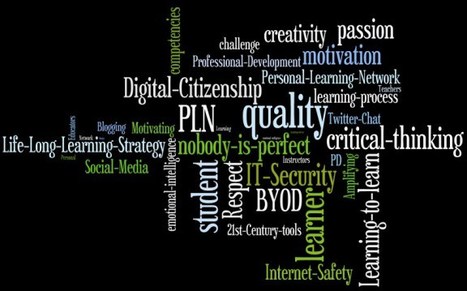
. . This is the second blog about "Blogging" and in the first one ===> PracTICE: Using Blogs for Critical Thinking and Proactive Thinking <=== WE were talking about WHAT would be the BEST way...
Scoop.it!

Too often, schools bring only tepid energy to the blending of traditional and online learning, Charles Mojkowski says.
That sounds promising, but all of that capability must be matched by a worthy partner. And educators have been far from worthy. To the blend, they add a stale array of timeworn and tepid ingredients:
• A 20th-century school organizational structure; • A fixation on providing the same learning outcomes for every student; “Educators are failing to exploit the new and emerging technologies in ways that will give student learning opportunities the jolt they need.”• A focus on external motivational techniques; • A rigid curricular scope and sequence for all students; • An asphyxiating and narrow assessment system; and • A separation of in-school from out-of-school learning.
Gust MEES's insight:

KC Beck's curator insight,
October 3, 2013 12:20 PM
Creativity is an esential part of the blended learning. It is important to highlight the noncognitive skills that students possess. It also important to acknowledge that not all students learn the same. Competency-based education allows non-traditional learnings to compete with traditional learners.
Scoop.it!
One of our most innovative, popular thinkers takes on-in exhilarating style-one of our key questions: Where do good ideas come from? With Where Good Ideas Co...
Gust MEES's insight:
Check it out and learn from it ;)
Scoop.it!
Gust MEES's insight:
Scoop.it!

Open today 12 to 5PM*
Gust MEES's insight:
|







Learn more:
- http://www.scoop.it/t/21st-century-learning-and-teaching?tag=Creativity