 Your new post is loading...

|
Scooped by
Gust MEES
July 14, 2023 3:08 PM
|
What is Creative Thinking?
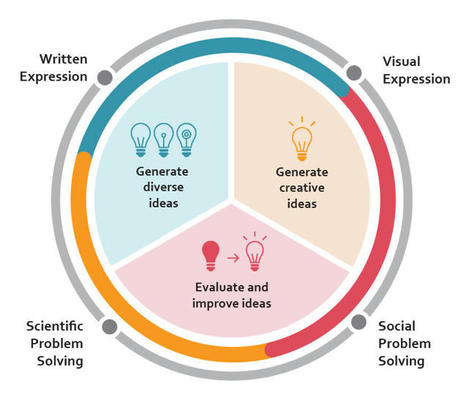
Creative thinking is the way of thinking that leads to the generation of valuable and original ideas. All people are capable of engaging in creative thinking and practicing ‘everyday’ creativity (addressing everyday activities in a non-conventional way). Creative thinking can be applied not only to contexts related to the expression of imagination, such as creative writing or the arts, but also to other areas where the generation of ideas is functional to the investigation of issues, problems or society-wide concerns.
The PISA assessment will examine students’ capacities to generate diverse and original ideas, and to evaluate and improve ideas, across a range of contexts or ‘domains’. The assessment includes four domains: written expression, visual expression, social problem solving and scientific problem solving. In each of these domains, students engage with open tasks that have no single correct response. They are either asked to provide multiple, distinct responses, or to generate a response that is not conventional. These responses can take the form of a solution to a problem, of a creative text or of a visual artefact. Learn more / En savoir plus / Mehr erfahren: https://www.scoop.it/topic/21st-century-learning-and-teaching/?&tag=Creativity
|
|
Scooped by
Gust MEES
January 26, 2020 6:42 AM
|
|
|
Scooped by
Gust MEES
November 11, 2018 11:43 AM
|
The real principle on which human life is based is organic growth and development,” Robinson said. It’s based on the need to invent your own life.” But the education system is not set up to allow for that kind of organic development, although Robinson acknowledges that many educators are doing their best to protect this form of learning. “They’re doing wonderful work because they believe in kids and the work, but they’re doing it against a headwind,” he said.
Part of the problem is the multitude of opinions and lack of clarity on exactly what it is an education should do. Debates about how to improve education will continue to rage because at a fundamental level participants don’t agree about why (or if) kids should go to school. Robinson firmly believes that creativity is a central element of what sets humans apart from other forms of life on earth and so educators’ mission should be to bring out the unique creative energy within each child.
Robinson believes education is “to enable students to understand the world around them, and the talents within them, so that they can become fulfilled individuals and active, compassionate citizens.” He doesn’t deny that learning information about the world is important, but he says it’s equally important for students to understand their own talents, motivations and passions if they are going to lead lives that satisfy them. The current system of conformity and compliance leaves no space for this type of self-exploration. Learn more / En savoir plus / Mehr erfahren: https://www.scoop.it/t/21st-century-learning-and-teaching/?&tag=Sir+Ken+Robinson
|
|
Scooped by
Gust MEES
August 8, 2018 12:41 PM
|
|
|
Scooped by
Gust MEES
June 13, 2018 3:32 PM
|
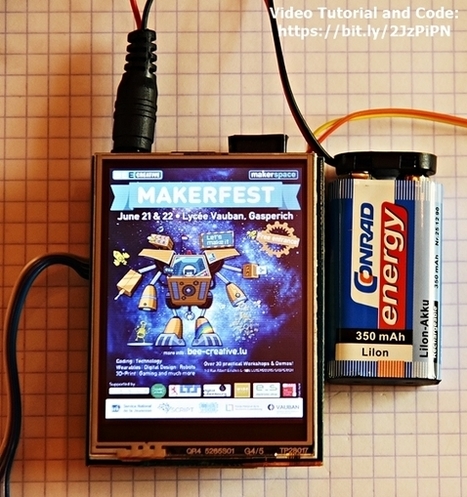
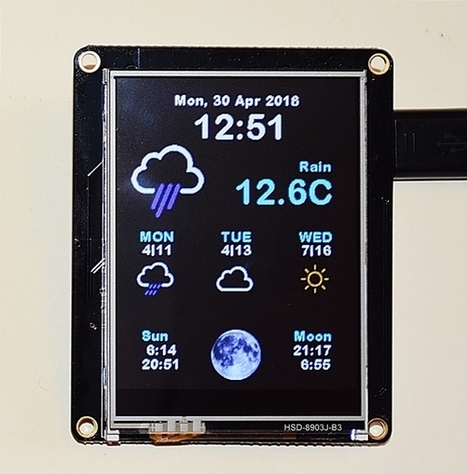
We were already playing around with a 2.8 inch TFT Display and SDCard recently in a previous tutorial <===> First Steps with the Arduino-UNO R3 | Maker, MakerED, Coding | 2.8″ TFT Touch Screen with SDCard <===> and we will create a badge. Learn more / En savoir plus / Mehr erfahren: https://www.scoop.it/t/21st-century-learning-and-teaching/?&tag=ARDUINO
|
|
Scooped by
Gust MEES
June 7, 2018 8:21 AM
|
|
|
Scooped by
Gust MEES
May 18, 2018 4:23 AM
|
Learning to Code
So, you like video games? Do you know that actual humans make video games with some type of computer code? It's true. But even better, kids can write programs too. It might seem scary to get started, but it's really not too bad. If you want to get started, I am going to recommend code.org. There are plenty of learning guides that are appropriate for a variety of ages. Oh, and it's free and online.
Even the lowest level activities are very complete—they even include ideas about functions and debugging. It's the best way to get a general idea of computer programming before moving on to a particular language.
If you want to be more creative with your programming, there is also Scratch (scratch.mit.edu). Scratch is a graphical (and free) programming language that focuses on the control of animated sprites. It's pretty easy to pick up and it's built so that you can share programs and modify others.
Finally, there is one more set of coding activities—physical programming. Physical programming takes some type of code but adds onto it some actual object that the code can control. If that sounds awesome, it's only because it is. There are two physical programming platforms that I have worked with before—Raspberry Pi and Arduino. Although these devices are not free, they aren't super expensive either. Both platforms have tons of great projects that kids (or adults) can work on.
Example: https://projects.raspberrypi.org/en/ and https://create.arduino.cc/projecthub Learn more / En savoir plus / Mehr erfahren: https://www.scoop.it/t/21st-century-learning-and-teaching/?&tag=ARDUINO
|
|
Scooped by
Gust MEES
May 12, 2018 9:52 AM
|
We’re excited to announce the Arduino Engineering Kit, the first product released as a result of our new partnership with MathWorks, to reinforce the importance of Arduino at the university level in the fields of engineering, Internet of Things, and robotics.
The Arduino Engineering Kit, which will be available for purchase starting today on the Arduino online store, consists of three cutting-edge, Arduino-based projects and will teach students how to build modern electronic devices – challenging them intellectually and helping them develop physical engineering skills that will better prepare them to enter the commercial market following graduation. In addition to the hardware, after registering online, students and educators will have access to a dedicated e-learning platform and other learning materials. The kit also includes a one-year individual license for MATLAB and Simulink, providing the user with hands-on experience in system modeling and embedded algorithm development. Learn more / En savoir plus / Mehr erfahren: https://www.scoop.it/t/21st-century-learning-and-teaching/?&tag=ARDUINO
|
|
Scooped by
Gust MEES
May 9, 2018 4:35 PM
|
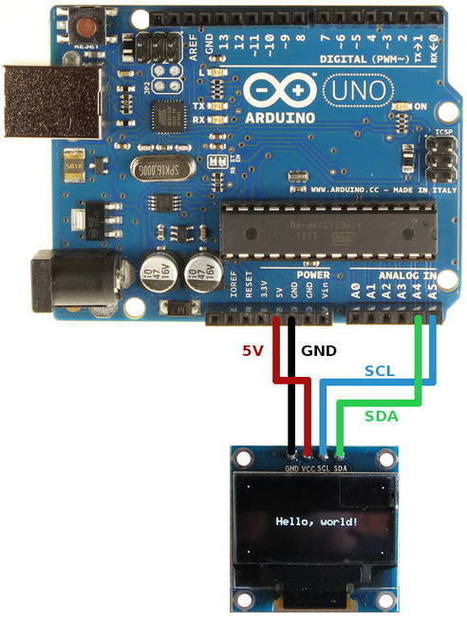
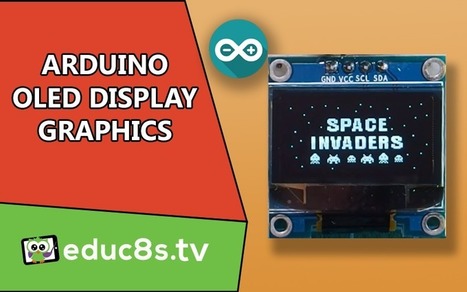
How to connect and program the Geekcreit 0.96 inch 4 pin white I2C OLED module with Arduino. OLED display based on a SSD1306 OLED driver IC.
In this tutorial a 0.96 inch monochrome OLED display from Geekcreit is connected or interfaced to an Arduino. Libraries are then installed and some example programs run which show how to use the display in an Arduino sketch.
The display connects to Arduino using only four wires – two for power and two for data, making the wiring very simple. The data connection is I2C (I²C, IIC or Inter-Integrated Circuit). This interface is sometimes called TWI (Two Wire Interface).
At the very lowest level, the Arduino Wire library is used to communicate with the display. Libraries are available that make it easy to start using the display right away to display text and graphics. These libraries are installed in this tutorial. [Gust MEES] It works with THIS OLED <===> https://www.amazon.de/dp/B01L9GC470 Learn more / En savoir plus / Mehr erfahren: https://www.scoop.it/t/21st-century-learning-and-teaching/?&tag=ARDUINO
|
|
Scooped by
Gust MEES
May 1, 2018 12:35 PM
|
As robots take over more and more “dirty, dull, and dangerous” jobs from humans and automation assumes the knowledge work once done by people, the vocations that require complex, creative thinking will remain the domain of the living.
This point was driven home in a recent World Economic Forum (WEF) report, which forecasts expected advances in automation, artificial intelligence, and other areas that constitute Industry 4.0. The changes, already unfolding, could — and likely will — be profound, and include shifts in even the most essential job skills.
The report compares the top skills needed in 2015 and those predicted to be critical in 2020 (which is just a few heartbeats away). Quality control and active listening drop from this list — perhaps new technology will take care of these. Emotional intelligence and cognitive flexibility take their place. What I found most interesting is that creativity rockets from the number 10 spot all the way up to number three. Learn more / En savoir plus / Mehr erfahren: https://www.scoop.it/t/21st-century-learning-and-teaching/?&tag=Creativity
|
|
Scooped by
Gust MEES
April 26, 2018 6:56 PM
|
|
|
Scooped by
Gust MEES
April 24, 2018 8:19 PM
|
|
|
Scooped by
Gust MEES
April 23, 2018 3:21 PM
|
|
|
|
Scooped by
Gust MEES
March 18, 2022 4:39 PM
|
Summary: A new method, based on narrative theory, helps spark creativity and innovation in people.
Source: Ohio State University
Researchers have developed a new method for training people to be creative, one that shows promise of succeeding far better than current ways of sparking innovation.
This new method, based on narrative theory, helps people be creative in the way children and artists are: By making up stories that imagine alternative worlds, shift perspective and generate unexpected actions. Learn more / En savoir plus / Mehr erfahren: https://www.scoop.it/topic/21st-century-learning-and-teaching/?&tag=Creativity
|
|
Scooped by
Gust MEES
May 23, 2019 12:52 PM
|
For decades, neuroscientists and psychologists have tried to understand what exactly goes on in the brain when we turn our imaginations loose and what limits the ability of many of us to envision distant scenarios. In a new study, published in the Journal of Personality and Social Psychology last month, researchers report that creative professionals seem to be better than others at surmounting the mental barriers to accessing distal imagination, and their ability may be explained, in part, by their tapping into a brain network that only they can access.
By using the dorsomedial part of what scientists refer to as the brain’s “default network,” creative people can stretch their imagination to more distant futures, places, perspectives and hypothetical realities. The default network consists of a group of interconnected brain regions, including the medial prefrontal cortex, the posterior cingulate cortex, the angular gyrus and the hippocampus. These brain areas talk to each other when we daydream, recall memories or think about the intentions of others. Previous literature suggests that they may also play a role in envisioning the future. Learn more / En savoir plus / Mehr erfahren: https://www.scoop.it/topic/21st-century-learning-and-teaching/?&tag=Creativity
|
|
Scooped by
Gust MEES
August 18, 2018 12:20 PM
|
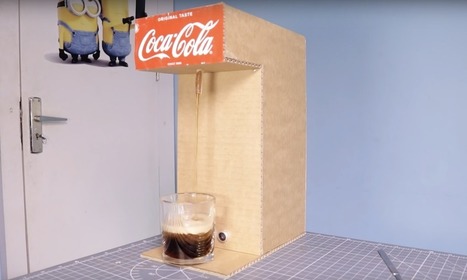
If you’re ever wanted to make something awesome, but thought that you just didn’t have the right tools to do so, this soda fountain by “The Wrench” could provide the needed inspiration.
The project uses an Arduino Nano to control a small air pump via a relay, which turns on when a glass is the correct dispensing position. This pushes air into a sealed soda bottle, and soda is pushed out of another tube to equalize the pressure.
Learn more / En savoir plus / Mehr erfahren: https://www.scoop.it/t/21st-century-learning-and-teaching/?&tag=ARDUINO
|
|
Scooped by
Gust MEES
June 18, 2018 6:11 PM
|
|
|
Scooped by
Gust MEES
June 12, 2018 3:30 PM
|
|
|
Scooped by
Gust MEES
May 29, 2018 6:27 PM
|
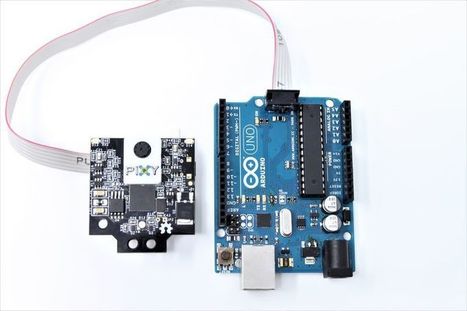
Robot vision made easier
Pixy2 is smaller, faster and more capable than the original Pixy. Like its predecessor, Pixy2 can learn to detect objects that you teach it, just by pressing a button. Additionally, Pixy2 has new algorithms that detect and track lines for use with line-following robots. The new algorithms can detect intersections and “road signs” as well. The road signs can tell your robot what to do, such as turn left, turn right, slow down, etc. And Pixy2 does all of this at 60 frames-per-second, so your robot can be fast, too.
Use Pixy2 for lots of different applications, find a project, or use Pixy2 for something no one has considered!
Connect directly to Arduino or Raspberry Pi
No need to futz around with tiny wires — Pixy2 comes with a special cable to plug directly into an Arduino and a USB cable to plug into a Raspberry Pi, so you can get started quickly. No Arduino or Raspberry Pi? No problem! Pixy2 has several interfaces (SPI, I2C, UART, and USB) and simple communications, so you get your chosen controller talking to Pixy2 in short order.
Learn more / En savoir plus / Mehr erfahren: https://www.scoop.it/t/21st-century-learning-and-teaching/?&tag=ARDUINO
|
|
Scooped by
Gust MEES
May 13, 2018 5:06 PM
|
Bitmaps & Code by Leslie Birch Time to create two image files and convert them into a code the OLED can understand.
Use Photoshop or another imaging program to create two cameo profile pics and turn them into bitmaps (.bmp). They should be monologue and 128x64 pixels. Notice I had my images each facing another direction.
Download LCD Image Converter and run.
Choose New Image and create a name. Then hit enter.
Now choose Image and Import. Select the file.
Now choose Options and Conversion, then Prepare. The followiing should be checked: Type: Monochrome, Threshold Dither, Main Scan Direction: Left to Right, Line Scan Direction: Forward
Now select Image. Make sure Select to Rows is checked. 8-Bit and Little Endian.
Hit OK, then File, Convert. Name the file. Now do the same process for your other file. The completed files will contain a series of code that you need to cut and paste into the project code to replace the files I provided. It will look something like this, only longer. Note that you don't need the beginning name, just the brackets and what is contained within them...
Learn more / En savoir plus / Mehr erfahren: https://www.scoop.it/t/21st-century-learning-and-teaching/?&tag=ARDUINO https://www.scoop.it/t/21st-century-learning-and-teaching/?&tag=OLED
|
|
Scooped by
Gust MEES
May 12, 2018 8:13 AM
|
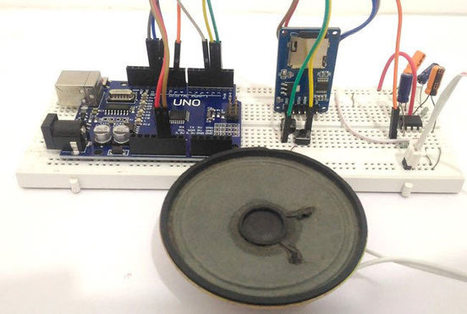
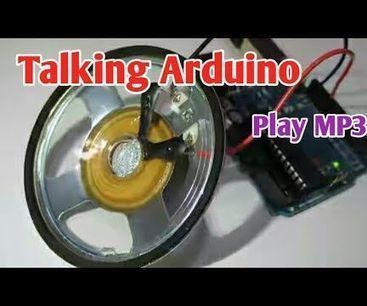
Adding sounds or music to our project will always make it looks cool and sounds much more attractive. Especially if you are using an Arduino and you have lots of pins free, you can easily add sound effects to your project by just investing in an extra SD card module and a normal speaker. In this article I will show you how easy it is to Play music/add sound effects using your Arduino Board. Thanks to the Arduino community who have developed some libraries to build this in a fast and easy way. We have also used IC LM386 here for amplification and noise reduction purpose. [Gust MEES] GREAT music quality!! Learn more / En savoir plus / Mehr erfahren: https://www.scoop.it/t/21st-century-learning-and-teaching/?&tag=ARDUINO https://www.scoop.it/t/21st-century-learning-and-teaching/?&tag=SDCard
|
|
Scooped by
Gust MEES
May 3, 2018 9:54 AM
|
|
|
Scooped by
Gust MEES
April 30, 2018 4:14 PM
|
|
|
Scooped by
Gust MEES
April 25, 2018 3:28 PM
|
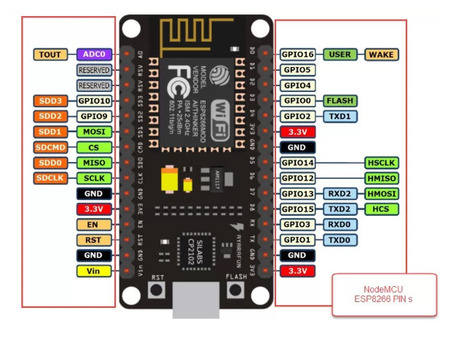
Der NodeMCU ESP8266 ist wohl derzeit das Lieblings-Controller-Board vieler Bastler. Denn es vereint viele Vorteile unter einem Dach. Hier ein kleiner Auszug, was zum Erfolg des NodeMCU ESP8266 geführt hat: - kompakt und klein
- WLAN on Board
- viel Speicherplatz
- USB-Schnittstelle (Bootloader)
- lässt sich über Arduino IDE programmieren
- große Anzahl an Schnittstellen
Tja, und um genau diese Schnittstellen geht es hier in diesem Beitrag.
Hier zeigen wir Euch z.B. wo welche GPIO Ports liegen, wo ihr den Ground findet, an welcher Stelle das Board 3,3 Volt liefert. Welche PIN Stecker für RX und TX verwendet werden können – einfach alles, was man so über die PINs des NodeMCU ESP8266 wissen muss.
Learn more / En savoir plus / Mehr erfahren: https://www.scoop.it/t/21st-century-learning-and-teaching/?&tag=ARDUINO https://www.scoop.it/t/21st-century-learning-and-teaching/?&tag=ESP8266+WiFi+Module
|
|
Scooped by
Gust MEES
April 23, 2018 7:47 PM
|
|





















What is Creative Thinking?
Creative thinking is the way of thinking that leads to the generation of valuable and original ideas. All people are capable of engaging in creative thinking and practicing ‘everyday’ creativity (addressing everyday activities in a non-conventional way). Creative thinking can be applied not only to contexts related to the expression of imagination, such as creative writing or the arts, but also to other areas where the generation of ideas is functional to the investigation of issues, problems or society-wide concerns.
The PISA assessment will examine students’ capacities to generate diverse and original ideas, and to evaluate and improve ideas, across a range of contexts or ‘domains’. The assessment includes four domains: written expression, visual expression, social problem solving and scientific problem solving. In each of these domains, students engage with open tasks that have no single correct response. They are either asked to provide multiple, distinct responses, or to generate a response that is not conventional. These responses can take the form of a solution to a problem, of a creative text or of a visual artefact.
Learn more / En savoir plus / Mehr erfahren:
https://www.scoop.it/topic/21st-century-learning-and-teaching/?&tag=Creativity