 Your new post is loading...

|
Scooped by
Gust MEES
February 8, 2017 10:15 AM
|
Researchers at MIT and Brigham and Women’s Hospital have designed a small voltaic cell that are sustained by the acidic fluids in the stomach and generate enough power to run sensors or drug delivery devices that can reside in the gastrointestinal tract for extended periods. This type of power could offer a safer and longer-lasting alternative to the traditional batteries now used to power such devices. Learn more / En savoir plus / Mehr erfahren: http://www.scoop.it/t/21st-century-innovative-technologies-and-developments/?tag=Research
|
|
Scooped by
Gust MEES
November 9, 2016 11:52 AM
|
The flexible wing might weigh one-tenth as much as a traditional aircraft wing. Tiny robots would crawl atop and inside...
|
|
Scooped by
Gust MEES
August 18, 2016 2:30 PM
|
|
|
Scooped by
Gust MEES
August 12, 2016 3:33 PM
|
|
|
Scooped by
Gust MEES
August 3, 2016 7:53 AM
|
Strictly speaking, video isn’t an interactive medium, but a new research project from MIT aims to change that: The school’s CSAIL lab has come up with a technique through which viewers can reach out and “touch” objects in videos, manipulating them directly to achieve effects similar to what you’d expect if you were actually touching the object live in the real world.
Basically, that means that using this technique, if you were watching a YouTube video of someone playing guitar and it zoomed in tight on the fretboard, you could theoretically use your mouse to drag across the strings and watch them vibrate as if you’d strummed them in real life. Or, you could even load test an old covered bridge by applying virtual stressors like simulated wind, or a truck rumbling across.
The new CSAIL model works by analyzing vibrations given off by every object, as captured using traditional cameras shooting video that is then analyzed by algorithms developed by the research team. These vibrations, when analyzed by the new technique from as little as five seconds of video of a given object, then provide realistic prediction models that anticipate how the object will react to other movement or forces acting upon them.
|
|
Scooped by
Gust MEES
March 31, 2016 6:07 PM
|
Wi-Fi could soon have a very detailed geofence, if MIT researchers have their way. They’ve introduced a new project named ‘Chronos’ that helps Wi-Fi signals locate you within “tens of centimeters.”
The team managed this by monitoring several Wi-Fi bands, then cobbling the data together to find out how long a signal takes to find the end user. In knowing the time and distance it takes for a Wi-Fi signal to travel, MIT can create advanced geofencing.
|
|
Scooped by
Gust MEES
June 1, 2015 8:28 AM
|
|
|
Scooped by
Gust MEES
January 25, 2015 9:21 AM
|
Implanted into the brain or spinal column, they can transmit drugs, light, and electrical signals.
|
|
Scooped by
Gust MEES
October 7, 2014 5:30 AM
|
|
|
Scooped by
Gust MEES
September 16, 2014 5:37 PM
|
|
|
Scooped by
Gust MEES
July 8, 2014 12:15 PM
|
Scientists at the Massachusetts Institute of Technology are developing an audio reading device to be worn on the index finger of people whose vision is impaired, giving them affordable and immediate access to printed words.
New Hope for Cancer Treatment MIT Technology Review New details of how these compounds work and for whom will be presented by many groups involved in the new push for cancer immunotherapy at this year's American Association for Cancer Research...
Learn more:
Via Krishan Maggon
|
|
Scooped by
Gust MEES
November 29, 2013 9:42 AM
|
Engineers at the Massachusetts Institute of Technology's Senseable City Lab have developed a drone that can potentially lead you wherever you want to go.
|
|
|
Scooped by
Gust MEES
January 9, 2017 4:56 PM
|
|
|
Scooped by
Gust MEES
November 1, 2016 2:07 PM
|
Towards this end, researchers at MIT are investigating ways of making artificial neural networks more transparent in their decision-making. As they stand now, artificial neural networks are a wonderful tool for discerning patterns and making predictions. But they also have the drawback of not being terribly transparent. The beauty of an artificial neural network is its ability to sift through heaps of data and find structure within the noise. This is not dissimilar from the way we might look up at clouds and see faces amidst their patterns. And just as we might have trouble explaining to someone why a face jumped out at us from the wispy trails of a cirrus cloud formation, artificial neural networks are not explicitly designed to reveal what particular elements of the data prompted them to decide a certain pattern was at work and make predictions based upon it. Learn more / En savoir plus / Mehr erfahren: http://www.scoop.it/t/21st-century-innovative-technologies-and-developments/?tag=AI
|
|
Scooped by
Gust MEES
August 12, 2016 3:41 PM
|
Your next tattoo could be functional as well as aesthetic. A new MIT Media Lab product called DuoSkin created in partnership with Microsoft Research turns temporary tattoos into connected interfaces, letting them act as input for smartphones or computers, display output based on changes in body temperature and transmit data to other devices via NFC.
Cindy Hsin-Liu Kao, PhD Student at the MIT Media Lab, explains the origins of the project in the video above. Kao says that metallic jewelry-like temporary tattoos are a growing trend, providing a great opportunity for creating something that meshes with existing fashion while also adding genuinely useful functional capabilities. She notes that in Taiwan, there’s a “huge culture” of cosmetics and street fashion, which is affordable and accessible enough that “you can very easily change and edit your appearance whenever you want.” The DuoSkin team wanted to achieve the same thing with their technological twist on the tattoo trend. Learn more / En savoir plus / Mehr erfahren: http://www.scoop.it/t/21st-century-innovative-technologies-and-developments/?tag=MIT
|
|
Scooped by
Gust MEES
August 7, 2016 3:34 AM
|
For years now, scientists have been working to make cells into computers. It’s a logical goal; cells store information in something roughly approximating memory, they behave due to the strict, rules-based expression of programming in response to stimuli, and they can carry out operations with astonishing speed. Each cell contains enough physical complexity to theoretically be quite a powerful computing unit all on its own, but each is also small enough to pack by the millions into tiny physical spaces. With a fully realized ability to program cell behavior as reliably as we do computer behavior, there’s no telling what biological computing could accomplish. Learn more / En savoir plus / Mehr erfahren: http://www.scoop.it/t/21st-century-innovative-technologies-and-developments/?tag=MIT
|
|
Scooped by
Gust MEES
May 13, 2016 4:47 PM
|
Researchers have invented an origami robot that, true to its name, unfolds in your stomach.
If that sounds gross to you, that's because it totally is, but it could be a game-changer in the medical community due to its ability to remove batteries from the human body, according to a paper recently presented at the International Conference on Robotics and Automation.
Learn more / En savoir plus / Mehr erfahren: http://www.scoop.it/t/21st-century-innovative-technologies-and-developments/?tag=Robotics
|
|
Scooped by
Gust MEES
February 5, 2016 7:52 AM
|
Cutting-edge research from Massachusetts Institute of Technology makes bold claims about RFID technology.
Now, the researchers claim their cutting-edge findings would mean that security concerns regarding RFID systems become a thing of the past. According to Chiraag Juvekar, an electrical engineering graduate at MIT and a co-author of the research, the new chip has been designed to curb so-called 'side-channel attacks' that can be used to steal the encryption keys contained in RFID technology.
|
|
Scooped by
Gust MEES
May 29, 2015 4:02 PM
|
WHEN YOU COMBINE robots and cheetahs with military funding, you’re bound to end up with something incredible. Robotics engineers from MIT have spent over five years developing a battery-powered quadruped robot capable of running as fast as a human being. And now they’ve trained that robot to jump over hurdles—autonomously.
In a video released today, the team from MIT shows off their DARPA-funded, four-legged harbinger of terror approaching and clearing obstacles up to 18 inches tall while maintaing an average speed of 5 mph. The 70-lb robot (roughly the same weight as a female cheetah) estimates the height, size, and distance of objects in its path, and adjusts its approach to prepare a jump and safe landing—all without slowing down.
Learn more:
- http://www.scoop.it/t/21st-century-innovative-technologies-and-developments/?tag=Robotics
|
|
Scooped by
Gust MEES
November 10, 2014 9:32 AM
|
As its name suggests, the Self-Assembly Lab focuses on making things that can, well, self-assemble. It has created a series of small wood planks, for instance, that fold into a toy elephants when exposed to moisture. Tibbets and collaborators Christophe Guberan and Erik Demaine are working on clothing that could morph in response to the weather. In the future, the Lab’s research could make way for Ikea furniture that assembles itself with a splash of water—no Allen wrench required.
|
|
Scooped by
Gust MEES
September 19, 2014 4:34 PM
|
|
|
Scooped by
Gust MEES
August 11, 2014 3:59 PM
|
He watched his brother die from a cancer that no drug could cure. Now one of the world’s most renowned cancer researchers says it’s time for Plan B.
Now imagine you could see these mutations—see cancer itself—in a vial of blood. Nearly every type of cancer sheds DNA into the bloodstream, and Vogelstein’s laboratory at Johns Hopkins has developed a technique, called a “liquid biopsy,” that can find the telltale genetic material.
Learn more:
- http://www.scoop.it/t/21st-century-innovative-technologies-and-developments/?tag=Cancer
|
|
Scooped by
Gust MEES
April 21, 2014 5:25 PM
|
Grâce à un système composé de nanotubes de carbone, des scientifiques du MIT et de Harvard ont réussi à stocker une plus grande partie de l’énergie solaire sous forme chimique, de manière à pouvoir produire de la chaleur à la nuit tombée…...
Learn more:
|
|
Scooped by
Gust MEES
April 7, 2014 11:20 AM
|
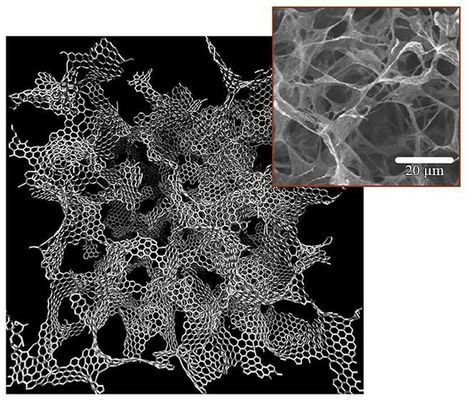
What if the materials we are accustomed to using could change, move, live?
|















Learn more / En savoir plus / Mehr erfahren:
http://www.scoop.it/t/21st-century-innovative-technologies-and-developments/?tag=Research