 Your new post is loading...

|
Scooped by
Gust MEES
June 27, 4:41 PM
|
An email attachment leads to the installation of a malicious Chrome extension. Researchers say it is part of a Windows backdoor delivered via a phishing email. The malware abuses Chrome Native Messaging to move control from the browser into the host system. Its most notable trick isn’t the phishing lure itself, but the way it uses legitimate browser and Windows features to run PowerShell and collect data while staying inside expected workflows. Learn more / En savoir plus / Mehr erfahren: https://www.scoop.it/topic/securite-pc-et-internet
|
|
Scooped by
Gust MEES
May 11, 3:31 PM
|
|
|
Scooped by
Gust MEES
April 3, 6:35 PM
|
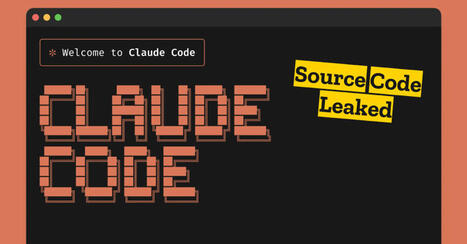
A hacker was quick to pounce on the accidental leak of Anthropic’s AI tool, Claude Code, by spreading malware on a GitHub page that claimed to host the source code.
Cybersecurity vendor Zscaler spotted a hacker exploiting interest in the Claude Code leak to push two malware strains, Vidar and Ghostsocks. Zscaler traced the threat to a GitHub page from the account “idbzoomh,” which purports to offer the leaked source code for Claude Code and claims: “I spent significant effort rebuilding the entire build system from scratch, fixing every compilation error, and making this source snapshot actually work. Learn more / En savoir plus / Mehr erfahren: https://www.scoop.it/t/21st-century-innovative-technologies-and-developments/?&tag=AI
|
|
Scooped by
Gust MEES
October 15, 2024 2:25 PM
|
|
|
Scooped by
Gust MEES
January 3, 2024 12:05 PM
|
Google-Nutzer aufgepasst: Trojaner nutzt Cookies, um Konten zu übernehmen
Ein relativ neuer Typ von Schadsoftware nutzt Cookies, um Zugang zu Google-Konten zu erlangen. Da er diese auch selbst generieren und entschlüsseln kann, behalten Hacker auch dann Kontrolle über das Konto, wenn das Passwort geändert wird. Learn more / En savoir plus / Mehr erfahren: https://www.scoop.it/topic/securite-pc-et-internet
|
|
Scooped by
Gust MEES
December 20, 2023 12:02 PM
|
|
|
Scooped by
Gust MEES
July 13, 2023 8:33 AM
|
Kryptomining-Malware versteckt sich ausschließlich im Ram
Ein Python-Skript namens Pyloose hat es auf Linux-Systeme abgesehen, um direkt aus dem Arbeitsspeicher heraus Kryptowährungen zu schürfen.
|
|
Scooped by
Gust MEES
April 4, 2022 2:41 PM
|
A new Remote Access Trojan (RAT) might have an amusing name to some, but its capabilities show the malware to be no laughing matter.
Dubbed Borat RAT, Cyble Research Labs said in a recent malware analysis that the new threat doesn't settle for standard remote access capabilities; instead, Borat RAT also includes spyware and ransomware functions.
According to the cybersecurity researchers, the Trojan, named after the character adopted by comedian Sacha Baron Cohen, is offered for sale to cybercriminals in underground forums.
Borat RAT has a centralized dashboard and is packaged up with a builder, feature modules, and a server certificate. Learn more / En savoir plus / Mehr erfahren: https://www.scoop.it/topic/securite-pc-et-internet/?&tag=RAT
|
|
Scooped by
Gust MEES
August 3, 2021 6:53 AM
|
Microsoft has continued its analysis of the LemonDuck malware, known for installing crypto-miners in enterprise environments. It makes a strong case for why it is worth removing it from your network.
This group, according to Microsoft, has a well-stocked arsenal of hacking tools, tricks and exploits aimed at one thing: for their malware to retain exclusive access to a compromised network for as long as possible.
While crypto-mining malware could be just a nuisance, LemonDuck attributes suggest the attacker group really do try to own compromised networks by disabling anti-malware, removing rival malware, and even automatically patching vulnerabilities -- a competitive effort to keep rival attackers from feeding off its turf. Learn more / En savoir plus / Mehr erfahren: https://www.scoop.it/topic/securite-pc-et-internet
|
|
Scooped by
Gust MEES
June 25, 2021 4:14 PM
|
Researchers have discovered a strain of cryptocurrency-mining malware that abuses Windows Safe mode during attacks.
After finding reports on Reddit of Avast antivirus users querying the sudden loss of the antivirus software from their system files, the team conducted an investigation into the situation, realizing it was due to a malware infection.
Crackonosh has been in circulation since at least June 2018. Once a victim executes a file they believe to be a cracked version of legitimate software, the malware is also deployed. Learn more / En savoir plus / Mehr erfahren: https://www.scoop.it/t/securite-pc-et-internet/?&tag=crypto-currency
|
|
Scooped by
Gust MEES
March 29, 2021 4:58 PM
|
Un nouveau malware circule sur Android. Repéré par un groupe de chercheurs, il se présente sous la forme d'une mise à jour critique du système et permet à un tiers de prendre le contrôle d'un smartphone en collectant des données personnelles.
Le cabinet de sécurité Zimperium, qui avait déjà découvert la faille StageFright en 2015, explique que le malware a été intégré dans une application baptisée System Update, disponible en dehors du Play Store. Learn more / En savoir plus / Mehr erfahren: https://www.scoop.it/t/securite-pc-et-internet/?&tag=Android
|
|
Scooped by
Gust MEES
March 21, 2021 7:28 PM
|
The malicious app spreads the BlackRock malware, which steals credentials from 458 services – including Twitter, WhatsApp, Facebook and Amazon.
Researchers are warning of a fake version of the popular audio chat app Clubhouse, which delivers malware that steals login credentials for more than 450 apps.
Clubhouse has burst on the social media scene over the past few months, gaining hype through its audio-chat rooms where participants can discuss anything from politics to relationships. Despite being invite-only, and only being around for a year, the app is closing in on 13 million downloads. However, as of now the app is only available on Apple’s App Store mobile application marketplace – there’s no Android version yet (though plans are in the works to develop one).
Cybercriminals are swooping in on Android users looking to download Clubhouse by creating their own fake Android version of the app. To add a legitimacy to the scam, the fake app is delivered from a website purporting to be the real Clubhouse website – which “looks like the real deal,” said Lukas Stefanko, researcher with ESET. Learn more / En savoir plus / Mehr erfahren: https://www.scoop.it/t/securite-pc-et-internet/?&tag=Android https://www.scoop.it/topic/securite-pc-et-internet/?&tag=Apps
|
|
Scooped by
Gust MEES
February 2, 2021 11:42 AM
|
A small but complex malware variant is targeting supercomputers worldwide.
Reverse engineered by ESET and described in a blog post on Tuesday, the malware has been traced back to attacks against supercomputers used by a large Asian Internet Service Provider (ISP), a US endpoint security vendor, and a number of privately-held servers, among other targets.
The cybersecurity team has named the malware Kobalos in deference to the kobalos, a small creature in Greek mythology believed to cause mischief.
Kobalos is unusual for a number of reasons. The malware's codebase is tiny but is sophisticated enough to impact at least Linux, BSD, and Solaris operating systems. ESET suspects it may possibly be compatible with attacks against AIX and Microsoft Windows machines, too.
"It has to be said that this level of sophistication is only rarely seen in Linux malware," commented cybersecurity researcher Marc-Etienne Léveillé. Learn more / En savoir plus / Mehr erfahren: https://www.scoop.it/t/securite-pc-et-internet/?&tag=Linux
|
|
|
Scooped by
Gust MEES
May 18, 5:38 AM
|
TrickMo, l’un des virus bancaires les plus redoutables sur Android, fait son grand retour. Pour échapper aux chercheurs et aux autorités, il se cache sur la blockchain. C’est une tactique de plus en plus répandue dans le milieu criminel. Learn more / En savoir plus / Mehr erfahren: https://www.scoop.it/topic/securite-pc-et-internet
|
|
Scooped by
Gust MEES
April 3, 7:02 PM
|
These include a tools system to facilitate various capabilities like file read or bash execution, a query engine to handle LLM API calls and orchestration, multi-agent orchestration to spawn "sub-agents" or swarms to carry out complex tasks, and a bidirectional communication layer that connects IDE extensions to Claude Code CLI.
The leak has also shed light on a feature called KAIROS that allows Claude Code to operate as a persistent, background agent that can periodically fix errors or run tasks on its own without waiting for human input, and even send push notifications to users. Complementing this proactive mode is a new "dream" mode that will allow Claude to constantly think in the background to develop ideas and iterate existing ones. Learn more / En savoir plus / Mehr erfahren: https://www.scoop.it/t/21st-century-innovative-technologies-and-developments/?&tag=AI
|
|
Scooped by
Gust MEES
December 23, 2024 9:13 AM
|
Cybersecurity researchers have found that it's possible to use large language models (LLMs) to generate new variants of malicious JavaScript code at scale in a manner that can better evade detection.
"Although LLMs struggle to create malware from scratch, criminals can easily use them to rewrite or obfuscate existing malware, making it harder to detect," Palo Alto Networks Unit 42 researchers said in a new analysis. "Criminals can prompt LLMs to perform transformations that are much more natural-looking, which makes detecting this malware more challenging. Learn more / En savoir plus / Mehr erfahren: https://www.scoop.it/topic/securite-pc-et-internet/?&tag=AI
|
|
Scooped by
Gust MEES
September 25, 2024 10:31 AM
|
Software developers have embraced “artificial intelligence” language models for code generation in a big way, with huge gains in productivity but also some predictably dubious developments. It’s no surprise that hackers and malware writers are doing the same.
According to recent reports, there have been several active malware attacks spotted with code that’s at least partially generated by AI.
|
|
Scooped by
Gust MEES
January 3, 2024 11:55 AM
|
Exploit erlaubt böswilligen Zugriff trotz Passwort-Reset
Durch eine Schwachstelle in einem OAuth-Endpunkt können sich Cyberkriminelle dauerhaft Zugriff auf das Google-Konto einer Zielperson verschaffen. Learn more / En savoir plus / Mehr erfahren: https://www.scoop.it/topic/securite-pc-et-internet
|
|
Scooped by
Gust MEES
July 14, 2023 5:24 AM
|
Since at least May 2021, stealthy Linux malware called AVrecon was used to infect over 70,000 Linux-based small office/home office (SOHO) routers to a botnet designed to steal bandwidth and provide a hidden residential proxy service.
This allows its operators to hide a wide spectrum of malicious activities, from digital advertising fraud to password spraying.
According to Lumen's Black Lotus Labs threat research team, while the AVrecon remote access trojan (RAT) compromised over 70,000 devices, only 40,000 were added to the botnet after gaining persistence. Learn more / En savoir plus / Mehr erfahren: https://www.scoop.it/t/securite-pc-et-internet/?&tag=Linux
|
|
Scooped by
Gust MEES
March 14, 2023 7:51 AM
|
|
|
Scooped by
Gust MEES
January 21, 2022 4:40 PM
|
|
|
Scooped by
Gust MEES
July 27, 2021 6:15 AM
|
Microsoft is warning customers about the LemonDuck crypto mining malware which is targeting both Windows and Linux systems and is spreading via phishing emails, exploits, USB devices, and brute force attacks, as well as attacks targeting critical on-premise Exchange Server vulnerabilities uncovered in March.
The group was discovered to be using Exchange bugs to mine for cryptocurrency in May, two years after it first emerged.
Notably, the group behind LemonDuck is taking advantage of high-profile security bugs by exploiting older vulnerabilities during periods where security teams are focussed on patching critical flaws, and even removing rival malware. Learn more / En savoir plus / Mehr erfahren: https://www.scoop.it/topic/securite-pc-et-internet
|
|
Scooped by
Gust MEES
May 7, 2021 5:40 PM
|
Unknown threat actors have been employing a Windows rootkit for years to stealthily install backdoors on vulnerable machines.
In a campaign dubbed Operation TunnelSnake by Kaspersky researchers, the team said on Thursday that an advanced persistent threat (APT) group, origin unknown but suspected of being Chinese-speaking, has used the rootkit to quietly take control of networks belonging to organizations.
Rootkits are packages of tools that are designed to stay under the radar by hiding themselves in deep levels of system code. Rootkits can range from malware designed to attack the kernel to firmware, or memory, and will often operate with high levels of privilege.
According to Kaspersky, the newly-discovered rootkit, named Moriya, is used to deploy passive backdoors on public-facing servers. The backdoors are then used to establish a connection -- quietly -- with a command-and-control (C2) server controlled by the threat actors for malicious purposes.
The backdoor allows attackers to monitor all traffic, incoming and outgoing, that passes through an infected machine and filter out packets sent for the malware. Learn more / En savoir plus / Mehr erfahren: https://www.scoop.it/topic/securite-pc-et-internet
|
|
Scooped by
Gust MEES
March 24, 2021 9:43 AM
|
An upgraded variant of Purple Fox malware with worm capabilities is being deployed in an attack campaign that is rapidly expanding.
Purple Fox, first discovered in 2018, is malware that used to rely on exploit kits and phishing emails to spread. However, a new campaign taking place over the past several weeks -- and which is ongoing -- has revealed a new propagation method leading to high infection numbers.
In a blog post on Tuesday, Guardicore Labs said that Purple Fox is now being spread through "indiscriminate port scanning and exploitation of exposed SMB services with weak passwords and hashes. Learn more / En savoir plus / Mehr erfahren: https://www.scoop.it/topic/securite-pc-et-internet/?&tag=Malware
|
|
Scooped by
Gust MEES
March 12, 2021 12:38 PM
|
Researchers say the new RedXOR backdoor is targeting Linux systems with various data exfiltration and network traffic tunneling capabilities.
Researchers have discovered a new backdoor targeting Linux systems, which they link back to the Winnti threat group.
The backdoor is called RedXOR – in part because its network data-encoding scheme is based on the XOR encryption algorithm, and in part because its samples were found on an old release of the Red Hat Enterprise Linux platform. The latter fact provides a clue that RedXOR is utilized in targeted attacks against legacy Linux systems, noted researchers.
The malware has various malicious capabilities, said researchers – from exfiltrating data to tunneling network traffic to another destination. Learn more / En savoir plus / Mehr erfahren: https://www.scoop.it/t/securite-pc-et-internet/?&tag=Linux
|


































An email attachment leads to the installation of a malicious Chrome extension. Researchers say it is part of a Windows backdoor delivered via a phishing email. The malware abuses Chrome Native Messaging to move control from the browser into the host system. Its most notable trick isn’t the phishing lure itself, but the way it uses legitimate browser and Windows features to run PowerShell and collect data while staying inside expected workflows.
Learn more / En savoir plus / Mehr erfahren:
https://www.scoop.it/topic/securite-pc-et-internet