Your new post is loading...

|
Scooped by
Roxana Marachi, PhD
August 4, 2020 11:47 AM
|
By Candice Bernd
"Working parents grappling with the difficult choices before them this school semester — keeping their children home to learn remotely, or risking COVID-19 transmission by sending them to class — are increasingly turning to a new trend being hailed as a “solution” to the pandemic: privatized “microschools.” Microschools consist of small groups, or “pods,” of mixed-level students located in homes or local facilities like churches or community centers, who are guided through personalized pedagogies by parents or educators as an alternative to public education. The model blends a private school and homeschool approach, retaining flexibility of homeschooling while relying on paid teachers to facilitate a classroom experience.
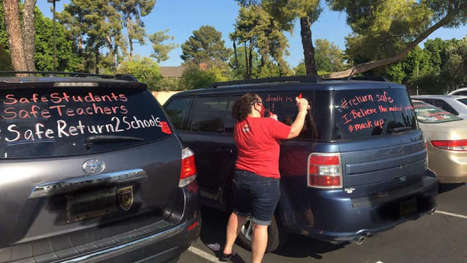
Right-wing and libertarian proponents of privatization, including Charles Koch, the Walton Family Foundation, the Heritage Foundation, the Reason Foundation and Education Secretary Betsy DeVos, are exploiting the pandemic to push the model. DeVos tweeted her support several times last week for the School Choice Now Act that would provide $5 billion in tax credits for families opting for homeschooling or private school. At the same time, DeVos and the Trump administration have threatened to withhold federal funds from any school that does not open its classrooms fully in the fall. Microschools were already gaining interest over the last several years with companies like Prenda piloting the model in Arizona in 2018. Since its launch, Prenda has opened more than 200 “campuses” in the state, according to its CEO, Kelly Smith. The pandemic, however, has strengthened the appeal: Google searches for “microschool” have spiked since major districts began announcing plans to remain online for the fall. Now, Silicon Valley is jumping on the bandwagon, with several new start-ups hoping to take advantage of what they see as a big market amid the COVID-19 crisis. New online platforms in Seattle and San Francisco are connecting families and educators looking to pool resources and form microschools. But educators and union activists warn privatized microschools could exacerbate inequality as affluent parents leave public schools for the social and economic benefits of cocooning their children into pods. Predominantly Black and Brown families are likely to be left behind, widening an already dire racial gap in public education. These educators are fighting back against the impossible choice driving many parents toward private microschools. The Demand Safe Schools Coalition, made up of progressive teachers unions and organizations, is mobilizing today for increased government resources to ensure safe, equitable and science-based school reopenings for working families. The Chicago Teachers Union, the United Teachers Los Angeles and National Educators United are among the coalition groups demanding more nurses and counselors, personal protective equipment, cleaning supplies and virus testing services. The coalition is also targeting DeVos’s privatization agenda, demanding a moratorium on new charter and voucher programs. Meanwhile, teachers across the U.S. are set to revitalize the Red for Ed movement in a strike wave similar to 2018. Today’s “Day of Resistance” comes as the American Federation of Teachers adopted a resolution last week authorizing last-resort “safety strikes” if school reopening plans fail to meet demands to ensure teachers’ and students’ health and safety amid the pandemic. In Arizona, teachers are mobilizing today in the state’s capitol as part of a motor march “funeral procession” of educators delivering their own signed obituaries to Gov. Doug Ducey. Hundreds of teachers have held similar motor marches in cars painted with slogans like “Red for Ed, Not Dead for Ed,” over the last several weeks. Governor Ducey announced last week that schools would wait for a green light from public health officials before reopening. His latest order requires schools to open in-person in some capacity starting August 17. When it comes to privatizers’ proposed solution to the crisis though, Arizona educators say microschools are just another way to siphon public dollars into a charter model. Mesa Rejects Microschool Pilot Organizers with Save Our Schools Arizona and the Mesa Education Association successfully beat back a proposed microschool pilot for 100 K-8 students in Arizona’s Mesa Unified School District by flooding school board members with 76 public comments in opposition to the proposal ahead of a special board meeting on July 23. The district proposed an emergency procurement of $440,000 to partner with Prenda on the program, which would have placed students with unlicensed “guides” teaching company curricula with a Mesa public school teacher overseeing as the “teacher of record.” During the July 23 public meeting, Prenda CEO Smith told Mesa Public Schools board members that the company’s microschools are about 80 percent white, 8 percent Black and 8 percent Latinx, emphasizing that those figures include many poor rural students. He insisted that the pilot would be representative of demographics of the predominantly Latinx school district, but board members questioned the extent to which Prenda guides determine which students are selected. “Speaking as a person of color, this just reeks of just separating — ok, so we’ll have a special meeting for children of color and families of color … in this model. Absolutely not. I don’t like anything that’s been said,” said Mesa Governing Board Member Kiana Maria Sears during the meeting. She described the plan as chasing down students who were leaving the district for charters. “This is unconscionable, where we are right now.” Later Smith cited his participation in a program led by 4.0 Schools, which trains “education entrepreneurs” and has helped launch dozens of start-ups and private schools in New Orleans. The lessons he learned in the program, he said, helped him design Prenda. Board Member Sears was again shocked, saying, “That’s an explosive point for someone who’s originally from New Orleans, who saw … the decline and the privatization of all of Orleans Parish,” where more than 93 percent of students now attend charter schools. Smith declined to discuss how many other districts in the state are weighing potential partnerships or pilot programs with Prenda, telling Truthout that, “We like [that kind of partnership] a lot. We’re in talks with various people in multiple states about doing more of that as one of our goals to make this model accessible.” Partnerships with school districts, he says, are “the best way” for the company to ensure equity. According to its website, Prenda is backed by 4.0 Schools, the Walton Family Foundation and the Mercatus Center at George Mason University, a right-wing think tank funded by Charles Koch, who serves on the organization’s board of directors. Koch also funds 4.0 Schools. In 2018, the Walton Family Foundation gave $325,000 to Prenda, according to the Foundation’s publicly listed grantees. Moreover, Prenda microschools are partly funded through the state’s voucher-style Empowerment Scholarship Account (ESA) program. The company also partners with several charter schools, through which state funding flows to its campuses. In June 2020, Prenda raised $6,149,990 in new equity, according to a news site that tracks venture capital. Other privatization groups backed by the Kochs and the Waltons, such as Yes. Every Kid. and the American Federation for Children, are already promoting similar voucher programs for microschools as an innovative solution for families in crisis. “My goal is not to engage in a political struggle,” Smith said when asked about company’s backers. “My goal is to empower kids as learners, and we’re excited to work together with anyone who wants to work with us.” His company’s goal, he says, “is not to replace, it’s not to destroy; it’s to augment and add and innovate together.” Christina Bustos, an executive board member with the Mesa Education Association, doesn’t see it that way. She told Truthout that Prenda’s failed partnership with Mesa Public Schools was in part due to the company’s desire to extract funds from the district after the May 15 extended deadline for ESA applications. She also argued that new legislation is needed to regulate microschools. Prenda’s microschools use tax dollars to place children as young as 5 in a private home or facility with an unlicensed and untrained independent contractor. To make matters worse, there is no law in the state regulating this kind of corporate operation. Smith, similarly, has no background in education. Bustos is not just concerned about safety; she’s also worried about the cultural competency of Prenda’s untrained guides. “They have these Black and Brown kids coming into these white people’s homes, and we have no control over what these white people are saying to our children, or how they’re teaching them to think critically or question or not question authority,” Bustos says. “I’m far more confident that there’s checks and balances in public schools.” That’s if Mesa’s Black and Brown kids are included at all. Teachers and Mesa school board members questioned the model’s ability to include low-income families who live in apartments or those who can’t access broadband internet. The problem is amplified by the fact that communities of color are the ones that have been hardest hit by COVID-19. “It’s white flight, but for the schools,” Bustos says. Research on charters has long confirmed that self-selection ultimately becomes self-segregation, and widens existing gaps in achievement and school funding. Bustos says it’s all part and parcel of DeVos’s plan to dismantle public education by depriving schools of federal support amid a national crisis. The GOP’s new coronavirus relief package includes $105 billion for education, but two-thirds of the funding is tied to schools reopening for in-person instruction. DeVos outlined the privatization plan on “Fox News Sunday” saying, “American investment in education is a promise to students and their families. If schools aren’t going to reopen and not fulfill that promise, they shouldn’t get the funds. Then give it to the families to decide to go to a school that is going to meet that promise.” Just as privatization proponents exploited Hurricane Katrina to decimate the public school system in New Orleans, DeVos is now exploiting the pandemic to redirect federal relief funds intended for public schools into vouchers for private schools. If the current trend continues, more and more of those federal relief dollars are likely to be funneled into corporate microschools. “This community was trying to create some kind of a solution to a problem that they think that they have: that people are going to pull their kids out of the school because they want them homeschooled,” Bustos told Truthout. “In my mind, part of the reason they’re having this problem is because Betsy DeVos is pushing this model.” Mesa school board members ultimately agreed that it would be better to replicate a public version of the microschool model, using district teachers and resources instead of outsourcing to a private company. Until a vaccine for COVID-19 is fully developed and distributed, public school districts are finding real merits in the model. Bustos supports the effort, which is already underway. “We as teachers have been begging for school districts to allow us more freedom to teach children in ways that are more meaningful, bring more joy, inspiration and natural curiosity to our schools,” Bustos submitted to the Mesa school board on July 23. “If you divided up the money [originally allocated for Prenda] with a small cohort of teachers, we would be overjoyed to teach a small group of students in a very similar way.” Beyond Arizona, Microschools Multiply Despite the company’s defeat in Mesa, Smith’s microschool model is spreading rapidly across the state and across the U.S. Prenda is building fast-growing Facebook communities for both guides and parents to share tips and resources. But Arizona isn’t the only state in which parents and educators are scrambling over Facebook to organize themselves into microschools and more informal pods for child care and education. Throughout the nation, parents are increasingly pooling their time and sharing the costs of nannies and tutors. Others are volunteering their living rooms as contemporary one-room schoolhouses. Tech start-ups are taking advantage, using the forums to advertise and hone their services. School districts are also turning to such online platforms, hoping to formalize the creation of microschools in their own communities. A new public-private partnership may already be in the works in Seattle, where Bloomberg reported that the CEO of one such startup, Weekdays, said she has been in contact with administrators at Seattle Public Schools. Last week, San Francisco officials announced plans to open 40 “learning hubs” of low-income students to assist their remote learning needs. Susan Solomon, president of United Educators of San Francisco, tells Truthout the district hasn’t yet involved the union in its communications regarding the new plan for hubs, but the union is also struggling with the creation of pandemic pods among wealthier families in the Bay Area. “All of this is taking advantage of a pandemic to do what certain people like Betsy DeVos have wanted to do all along, and that is starve public education to death,” Solomon says. “If all the money and effort that’s going into monetizing microschools and starting private pods would be going toward … helping public schools have enough resources to reopen safely, we could solve this crisis.” For original post, please visit: https://truthout.org/articles/covid-19-microschools-are-betsy-devoss-latest-privatization-scheme/
|
|
Scooped by
Roxana Marachi, PhD
June 19, 2019 2:16 PM
|
|
|
Scooped by
Roxana Marachi, PhD
July 26, 2018 3:42 PM
|
By Leonie Haimson
"David Leonhardt's latest NY Times column touting charter schools is full of bogus claims and sloppy journalism. He inveighs against progressive critics, writes that he wants a fact-based debate over education reform “in a more nuanced, less absolutist way than often happens" but then adds: "Initially, charters’ overall results were no better than average. But they are now." The link is to a CREDO website that doesn't show this. The most recent CREDO national study of charters from 2013 examined charters in 26 states plus NYC and found significant (if tiny) learning gains in reading on average but none in math. CREDO is generally considered a pro-charter organization, funded by the Walton Foundation and many independent scholars have critiqued its methodology. Moreover, the main finding of the 2013 study was that the vast majority of charter schools do no better than public schools, as Wendy Lecker has pointed out. In 2009, CREDO found, 83 percent of charters had the same or worse results in terms of test scores than public schools, and in 2013, about 71-75 percent had the same or worse results. Finally, to the extent that in some urban districts, there are studies showing that charters outperform public schools on test scores, there are many possible ways to explain these results, including an overemphasis on test prep, differential student populations, peer effects, higher student attrition rates and under-funding of most urban public schools. Leonhardt also writes that "The harshest critics of reform, meanwhile, do their own fact-twisting. They wave away reams of rigorous research on the academic gains in New Orleans, Boston, Washington, New York, Chicago and other cities, in favor of one or two cherry-picked discouraging statistics. It’s classic whataboutism. " Yet three out of these four links have nothing to do with charter schools, nor are they peer-reviewed studies. The NYC study by Roland Fryer instead focuses on which attributes of NYC charter schools seemed to be correlated with higher test scores compared to other NYC charter schools. The Chicago link goes to a NY Times column Leonhardt himself wrote on overall increases in test scores and graduation rates in Chicago public schools that doesn’t even mention charter schools. The DC link also is far from “rigorous research,” but sends you to a DCPS press release about the increase in 2017 PARCC scores, with again no mention of charter schools, or even “reform” more broadly. If there are indeed “reams of rigorous research” supporting charter schools, one might expect that Leonhardt would link to at least one actual, rigorous study showing this. Leonhardt's previous column on charter schools discussed this recent report from Doug Harris of Tulane's Education Research Alliance on the improved results of New Orleans charter schools. Others including Mercedes Schneider have critiqued the Harris study. I immediately focused on the section of the report in which Harris mentions possible alternative explanations for these schools' academic progress, including their substantial increased funding after Katrina.
After citing the the abundant research that spending matters when it comes to student outcomes, and admitting that the NOLA schools saw a $1,358 funding increase per student after privatization, Harris then argues:
It is questionable, however, whether the results from these studies provide a valid indication of the counterfactual in this case. First, the corruption and dysfunction in the Orleans Parish School Board prior to the storm implies that the additional resources would not have been used to generate better outcomes to the extent that the average district did in the above school funding studies. Second, the city’s spending increase, which came mainly from local funding and philanthropists, may have been partly caused by the reforms. The same inefficiencies that led to public disenchantment with the local OPSB pre-Katrina led to a widespread perception in the city that the reforms improved schools (Cowen Institute, 2016). This increased public support likely contributed to political support for local property tax levies and the backing of philanthropists that produced the spending increase. Any effect of spending on student outcomes, in this sense, may not be just an alternative explanation, but rather an indirect effect of the reforms. Therefore, while spending almost certainly contributed to the overall effect, it is unclear whether it was a substantial cause. Here Doug Harris maintains that he doesn't even have to attempt to disentangle the differential impact of increased funding in NOLA schools on student outcomes from their charterization, since in his estimation, it was unlikely that philanthropic support or increased local spending would have occurred without privatization happening first. Thus he posits that the political will to fund schools properly was an effect of charterization, and thus not a possible cause of their academic improvements - a speculative argument at best. One could study whether increased funding for schools has occurred primarily in those school districts that charters have taken over. One could also analyze the degree to which public support for public schools has become dependent on their privatization. Harris doesn't attempt either, as far as I know. In any case, if either statement is true, this says more about the weaknesses in our political system than the inherent quality of charter schools. Leonhardt, of course, doesn't mention this weakness of Harris' argument in his column on the NOLA report, nor does he mention any of the evidence that the growth of charter schools nationally has also been associated with reports of corruption, increased segregation, suspension rates, abuse of student rights, and loss of funding for democratically-governed public schools, as the recent NPE/Schott report card points out, among others. Research studies focusing on other aspects of the corporate “reform” agenda more generally, including the implementation of the Common Core, teacher evaluation linked to test scores, more closures of public schools, and expansion of online learning, have shown generally dismal academic results. It is indeed time to engage in more “fact-based” discussions of these trends, and I would urge NY Times columnists like Leonhardt to start doing so." For original post, see: https://nycpublicschoolparents.blogspot.com/2018/07/more-sloppy-non-fact-based-journalism.html
|
|
Scooped by
Roxana Marachi, PhD
March 21, 2018 3:11 AM
|
By Ade Adeniji"Brokerage firm founder Charles Schwab rode the emerging wave of online investing to amass client assets of over $2 trillion, and he now has a net worth of $6 billion. Schwab is one of those people who's been rich for a very long time, since the 1970s, and he's now well along in his philanthropy. The Charles and Helen Schwab Family Foundation (CHSFF) funds programs in several areas, but of course, being a finance guy, Schwab's biggest passion is education and, more specifically, charter schools. We're not sure why charters and finance billionaires go together like peas and carrots, but we'll save the theorizing for another article. What's notable about Schwab is that he's deeper into this area than many of the more glitzy hedge fund donors who get so much attention. Perhaps his profile is lower because he's based out West. While he's very much a national funder, with grantmaking that has reached into many states, such as New York and Massachusetts, Schwab's biggest investments have been in California. He was born and raised in the state, got a B.A. and an M.B.A. from Stanford University and Charles Schwab Corporation is headquartered in San Francisco. Let's take a closer look at what CHSFF has been funding in recent years. The first thing that jumps out is that the foundation has put money into a pretty broad swath of the usual suspects in the ed reform world. These include charter school chains like Aspire Public Schools and KIPP, and charter advocacy outfits like the National Alliance for Public Charter Schools and California Charter Schools Association. CHSFF has also given money to Michelle Rhee's outfit, StudentsFirst. The foundation is also working the human capital side of things, and has put money into Teach for America, The New Teacher Project, and the Stand for Children Leadership Center. Money has also gone for "ideas," with support for the Thomas Fordham Institute among a few other places. All in all, it's just the sort of diversified portfolio that a finance guy might put together. A $1 million gift to the Charter School Growth Fund in 2011 stands out, not only because of the size of the gift but also because of its destination. Founded in 2005, the Charter School Growth Fund (CSGF) is a bit like the mother ship of the charter school movement, working to grow and professionalize this alternative ed sector. A lot of the major players in the charter school funding world have given to CSGF, including Walton, Gates, Dell, Bradley, and Fisher. Schwab 's investment here is yet more evidence that it's a core member of the charter cabal."... https://www.insidephilanthropy.com/charter-schools/2014/7/11/whats-charles-schwab-into-charter-schools-of-course.html
|
|
Scooped by
Roxana Marachi, PhD
January 20, 2018 3:57 PM
|
|
|
Scooped by
Roxana Marachi, PhD
January 14, 2018 2:58 PM
|
[Selected Quote]
"FRAUD AND PROFITEERING Many of the schools and entities caught up in the scandals, or with documented examples of profiteering off the charter industry, have been funded by the WFF. Lack of oversight, and the “everybody come” atmosphere created by the almost total deregulation of the charter application process has inevitably allowed some bad actors entering the market to treat charter schools as tax-funded ATMs. In 2014, the Center for Popular Democracy and Integrity in Education released the results of a media survey of charter school fraud, waste and abuse in just 15 states (43 states have active charter school laws). The groups found more than $100 million in fraud (later updated to $200 million). Many of the schools and entities caught up in the scandals, or with documented examples of profiteering off the charter industry, have been funded by the WFF: - The Brighter Choice Foundation, which manages 11 Albany, N.Y., charter schools and has been the recipient of more than $9.4 million in Walton Family Foundation grants, hired Ronald Racela as the director of finance for its four direct-run charter schools. A year later, in 2011, Racela was promoted to chief financial officer of the Brighter Choice Foundation. In 2013, Racela was arrested and charged with embezzling more than $200,000 from both the Brighter Choice Foundation and the individual schools he worked for.
- The Harambee Institute of Science and Technology Charter School in Philadelphia doubled as a nightclub until it was shut down in 2010.26
- Two Los Angeles charter schools run by the Magnolia charter school chain were closed in 2014 after fiscal mismanagement and reporting irregularities were found.
- Concept schools in Ohio and Illinois are also under federal and state investigation for a range of concerns around contracting and hiring, management of funds and others.27
- A chain of 60 schools in Miami-Dade and Broward Counties in Florida is run by the for-profit Academica Corp. The schools have received more than $1.1 million in grants from the Walton Family Foundation since 2005. The business dealings of Academica’s CEO, a former real estate developer, have been the subject of an investigative series in the Miami Herald. The newspaper’s reporting has revealed millions of dollars of profiteering within the company, mostly through the purchase of properties for school buildings, which are then leased at a profit to the school governing boards that Academica controls.28
- Options Public Charter School in Washington, D.C., serves students with severe physical and/or mental disabilities. The school came under fire in 2013 when it was discovered that three members of the school’s governing board had jointly created two for-profit corporations that were then contracted to provide services to the school. One of those corporations handled Medicaid billing for the school (and other D.C. charters) and Options was found to be overstating the severity of disabilities of some students in order to increase the federal reimbursements for them.29
Moody’s Investment Services issued a report in 2013 which found that the dramatic expansion of charter schools in some economically weak urban areas puts increasing financial stress on traditional school districts and weakens their ability to serve their students. Sometimes, the oversight process itself becomes tainted. In Washington D.C., the Public Charter School Board—one of the only authorizers to receive direct funding from the Walton Family Foundation ($5.8 million)—was responsible for monitoring Options Public Charter School, cited above. But Jeremy Williams, the CFO of the authorizing board, was later arrested and charged with taking $150,000 in payments from the trustees of Options, in order to steer the authorizer away from reviewing the school’s contracts, and helping to pitch the services of the two for-profit corporations established by Options trustees, to other charter schools in the district. Williams is now the subject of a criminal investigation.30 These and many more instances of fraud and profiteering have sparked new cries for stronger regulations on charter schools to protect taxpayer dollars. But perhaps the most disturbing outcome of all, although one anticipated and welcomed by the pro-market ideologues, is the undermining of traditional public school districts." To download report, click on title above or here http://cashinginonkids.com/wp-content/uploads/2015/06/CashingInOnKids_report.pdf
|
|
Scooped by
Roxana Marachi, PhD
December 6, 2016 12:42 AM
|
By Tom Cahill
"The biggest racists in the US aren’t running around with white hoods and burning crosses. They’re running Fortune 500 companies and burning public school systems across the country in favor of privately-run, publicly-funded charter schools. While none of the famous billionaires on this list are dues-paying members of racist groups, they’re engaging in actions that prey on the linchpins of the black community — public K-12 schools. Education reform by itself isn’t overtly racist, but when looking at the actions of these billionaires with a wider lens, it becomes apparent that the effort to privatize public education is primarily taking place in minority communities. The charter school movement is particularly insidious, as it’s essentially a form of institutionalized racism veiled in altruism. In reference to the charter takeover of the New Orleans, Louisiana school district, former U.S. Assistant Secretary of Education Diane Ravitch put it this way: “These heavy-handed tactics require a suspension of democracy that would not be tolerated in a white suburb, but can be done to powerless urban districts where the children are black and Hispanic,” Ravitch told In These Times. “That model requires firing all the teachers, no matter their performance, allowing them to reapply for a job, and replacing many of them with inexperienced TFA recruits. That model requires wiping out public schools and replacing them with privately managed schools that set their own standards for admission, discipline, expulsion, and are financially opaque.” While charter schools have lately been able to brag on themselves as reports tout their higher test scores in math and reading compared to public schools, these studies leave out the fact that many charters refuse to help struggling children and instead dump them into public schools, in order to boost their own statistics. According to NY Chalkbeat, charter schools in New York City suspended 11 percent of students during the 2011-2012 school year, while public schools suspended just 4.2 percent. In fact, 11 NYC charter schools suspended as many as 30 percent of students that year. The charter suspension rate is likely higher, as charters don’t have to report in-school suspension rates. The push for more charter schools isn’t based on a desire to better educate kids, but for the more mundane purpose of higher corporate profit. As the Washington Post pointed out, charter schools, on average, don’t do any better or worse when compared side-by-side with their public counterparts. In fact, if one were to replace the erroneous invisible “composite” public school student that Stanford University used in their report comparing charter and public school test scores with actual public school students, the results would likely be in favor of public schools. So why the push for privately-run, publicly-funded charter schools? The model of education reform is threefold — first, corporate education “reformers” push for “Common Core” standards by which to evaluate all students nationwide, while ignoring factors like geographic location, ethnic background, and economic well-being of different student bodies.
Next, harsh standardized testing that evaluates student performance based on these flawed standards and practically guarantees high failure rates is pushed onto schools — many of which depend on funding from property taxes, meaning that schools in affluent white suburbs are in a better position to succeed based on these standards than inner-city schools in neighborhoods with low property value.
Finally, schools are labeled as “failing” due to the lopsided evaluation process, and privately-run charters are forced onto inner-city populations, paving the way for the privatization of public education in predominantly black and latino communities. Here are 5 white billionaires who are speeding along that process.
1. MARK ZUCKERBERG Not many people are aware of the Facebook billionaire’s foray into education reform. Nonetheless, Zuckerberg did, in fact, spend $100 million in an attempt to establish charter schools in Newark, New Jersey in a joint effort with Governor Chris Christie and Newark mayor Cory Booker. After Zuckerberg’s donation, Booker used the $100 million to start a foundation, though seats on the foundation only went to donors who gave $5 million or more, effectively creating a panel of super-rich, out-of-town, corporate education reformers intent on dismantling public schools. Washington Post education reporter Dale Russakoff described the nature of the reforms the three planned on implementing: “It was dramatically expanding charter schools, getting rid of teachers whose evaluations found them to be weak, judging other teachers by their test scores and rewarding them and streamlining the management of the school district so that it ran more like a business,” Russakoff told NPR. “There were a lot of people, including some very skilled, experienced teachers, who deeply understood the needs of the children in Newark who would have been eager to be part of that conversation. And not only were they insulted that they were left out, there was an agenda that was crafted that didn’t have the benefit of their really important insights into what was needed in Newark.” “Basically, the board decided to spend the money the way the wealthy donors wanted it spent,” Russakoff continued. “And the priorities were not about getting money to the classroom or to the children. The priorities were to have to this kind of business model, top-down reform that had become very popular in the reform movement.” In her book, The Prize: Who’s in Charge of America’s Schools?, Russakoff further outlined how that foundation established to help Newark schools then went on to spend $20 million on consultants, who were paid upwards of $1,000 a day. “I don’t think you could find any way that consultant money helped children,” Russakoff said.
2. THE WALTON FAMILY Walmart is a store that made its billions by forcing its way into communities, pricing out all of their locally-owned competitors until they closed their doors, and forming a monopoly that’s almost impossible to undo. The Waltons took their business experience and are applying it to schools. The single largest private donor to the Teach for America (TFA) program is the Walton family. And Teach for America, like Walmart stores, effectively forces out respected, certified, unionized teachers who know the community and the kids they teach, with young, inexperienced educators given just a 5-week training course. Too often, those are the teachers that are deployed to low-income, high-minority school districts where corporate education reformers have busted teachers’ unions and are in need of young blood eager to get the first notch on their teaching belt, even if it means not getting paid what their predecessors made or having the same workers’ rights.
DC Prep, which operates multiple charter schools for some 1,200 inner-city students, does so with the help of donations exceeding $1 million from the Walton family, and one-third of its teachers are from TFA. Supporters of TFA in Los Angeles include not just the Waltons, but Bank of America, Wells Fargo, Boeing, and the State Farm foundation. These corporations aren’t donating to TFA because they want to help inner-city children, but because of the huge profit potential in the corporate education reform movement.With the help of generous donations from the Walton family, TFA is taking over school districts nationwide, replacing teachers with Master’s degrees and double majors with poorly-trained educators willing to work for pennies. Meanwhile, the profits are raking in from the public sector — in Chicago, for example, TFA recently had its contract with Chicago Public Schools not only renewed, but more than doubled from $600,000 to $1,587,000.
3. CARL ICAHN Billionaire Carl Icahn, who has held controlling stakes in several Fortune 500 companies, is known as a “corporate raider” for his ruthless hostile takeovers of corporations. In the late eighties and early nineties, Icahn famously bought TWA airlines, loaded it down with debt, stripped it of its most valuable assets, then resigned from the company, demanding a $190 million payment as one of its top creditors. Icahn takes the same approach to education as he does with business. Icahn operates 5 charter schools in high-minority communities in New York City, like the Bronx, and the schools are run less like a learning institution and more like a boot camp. They accept less than 5 percent of applicants, and the ones who are accepted are rigorously-tested, schooled on Saturdays, and strictly disciplined. Icahn superintendent Jeffrey Litt admitted that its strict system would leave a permanent mark on children were they to teach K-12. “If we keep a kid in that environment through twelfth grade, the child now leaves us and heads to college and they don’t know any other world… they’re going to be shocked,” Litt told NY Chalkbeat. “We are a public school, but it’s the closest thing to private school,” he told the New York Times, in reference to the school’s low admittance rate.
4. BILL GATES No billionaire has had more of an impact on education than Bill Gates. Through his foundation, the billionaire tech magnate has spent at least $440 million pushing charter schools across the country. $200 million of that has gone into implementing Common Core in 45 states nationwide. As mentioned earlier, Common Core forces a strict set of evaluation standards on public schools, which tend to favor well-funded schools in white suburbs with high property value, and that simultaneously set up inner city schools to “fail” its standards, necessitating a corporate takeover. Teachers have gone on record calling out Gates for pushing Common Core, as it depends on education and technology to meet standards — technology which is often provided by Silicon Valley companies like Microsoft. “They are trying to turn public schools into a corporate money maker and push out the voice of teachers like we have no idea what we’re doing in education,” said Tom O’Kelley, a teacher at Oakland High School in Tacoma, Washington. “Bill Gates certainly doesn’t. He’s a college dropout. He’s a corporate money maker — that’s all he does.” In his book, With the Best of Intentions, author Frederick Hess outlines how billionaire philanthropists like Bill Gates are able to have so much of a say in public education. “[A]cademics, activists, and the policy community live in a world where philanthropists are royalty—where philanthropic support is often the ticket to tackling big projects, making a difference, and maintaining one’s livelihood… The groups convened by foundations [to advise them] tend to include, naturally enough, their friends, allies, and grantees. Such groups are less likely than outsiders to offer a radically different take on strategy or thinking… Almost without exception, the evaluators are hired by funders or grantees….Most evaluators are selected, at least in part, because they are perceived as being sympathetic to the reform in question."
5. RUPERT MURDOCH To his credit, the CEO of Newscorp — the parent company of Fox News — is the most open about his desire to nakedly profit from public school contracts. The billionaire media mogul saw the potential to profit from classroom educational technology, and made a move to get his slice of the pie in New York City by purchasing Brooklyn-based Wireless Generation for $360 million. “When it comes to K through 12 education, we see a $500 billion sector in the US alone that is waiting desperately to be transformed by big breakthroughs that extend the reach of great teaching,” Murdoch said in November of 2010. Murdoch then made political maneuvers to gain favor with New York’s political establishment, and gain contracts with his new purchase. As Mother Jones reported, Murdoch hired former NYC schools chancellor Joel Klein. Not long after, NYC schools entered into a $27 million contract with Wireless Generation to track student performance — one of the ways corporate-owned charter schools justify taking over school districts in predominantly black and brown communities. “Decision making in education is so far removed from people who have anything to do with kids,” University of Arizona education professor Kenneth Goodman told Mother Jones."... For original post, see: http://usuncut.com/class-war/how-these-5-famous-billionaires-are-dismantling-black-public-schools/
|
|
Scooped by
Roxana Marachi, PhD
July 1, 2016 4:02 PM
|
By Thomas Ultican "This January (2016), Fortune Magazine announced that Netflix CEO, Reed Hastings, has launched a new $100-million-dollar fund to support education initiatives and other groups.
The notice goes on to state: “Hastings is the fund’s sole trustee while Neerav Kingsland, the former CEO of charter school supporter New Schools for New Orleans, is serving as CEO. The fund’s website explains its philanthropic mission: “Currently, too many children do not have access to amazing schools. Our aim is to partner with communities to significantly increase the number of students who have access to rich and holistic educational experiences.” The “rich and holistic educational experience” is to be delivered by charter schools employing competency based education (CBE).
Competency Based Education
The United States Department of Education promotes and describes CBE: “Transitioning away from seat time, in favor of a structure that creates flexibility, allows students to progress as they demonstrate mastery of academic content, regardless of time, place, or pace of learning. Competency-based strategies provide flexibility in the way that credit can be earned or awarded, and provide students with personalized learning opportunities. These strategies include online and blended learning, dual enrollment and early college high schools, project-based and community-based learning, and credit recovery, among others.” Instead of a structured course with a teacher, students will log into a computer and earn badges for demonstrating competencies in an online environment. “Personalized learning opportunities” is a euphemism for a computer based course delivered in isolation. It is a terrible idea! The last thing a 21st Century student needs is to be shoved in front of another inert digital device. Students need to interact with “highly qualified” certificated teachers, adults who they can trust. Students need to; measure, calculate, weight, work in small groups, discuss ideas, write, and get professional feedback. Students need structure, stability and direction. None of this is provided online. Technology in education is more of an expensive mirage than a useful tool and competency based education (CBE) is fool’s gold. In 2003, I took the state of California’s 52-hour life insurance course. That meant 52 hours of seat time with an insurance industry veteran who made the subject come alive. Today that insurance course is online with an online exam. No real industry context is imparted and cheating on the exam is rampant. This is the kind of education Hastings and his ilk are vigorously promoting. CBE means lower quality education delivered at great profit to corporate providers and testing companies. CBE learning is embraced by President Obama, Bill Gates, Eli Broad, Reed Hastings, Education Secretary John King, The Walton family, the new federal education law, Pearson Corporation and many business executives. Few experienced education professionals not profiting from one of these entities support it. Computers are good at drilling information and conducting fact checks. However, educators have known for more than a century that this kind of teaching is destructive. To create understanding, all of the modes of learning must be actively engaged. Drill and skill destroys the desire to learn and undermines development of creativity.
Big Money Being Poured into CBE
In 2004, the Don and Doris Fisher Foundation along with the Schools Future Research Foundation each provided $100,000 to start the Charter Schools Growth Fund in Broomfield, Colorado. The Fisher Foundation is based on profits from GAP Inc. and the School Future Research Foundation was a Walton Family Foundation supported fund that seems to have disappeared. The original elected board of directors for the Charter School Growth Fund was comprised of John Walton, Don Fisher, and John Lock. In 2010, the President-CEO of the Charter School Growth Fund, Kevin Hall, decided to purchase the struggling Dreambox Inc. of Bellevue, Washington for $15,000,000. By then the fund was so large and he could do it. He subsequently invested another $10,138,500 into Dreambox. [data from 2014 form 990]
A recent National Public Radio report on the Rocketship schools reported: “Rocketship students often use adaptive math software from a company called Dreambox Learning. The company was struggling when Reed Hastings, the Netflix founder turned education philanthropist and investor, observed it in action at a Rocketship school several years ago. His investment allowed Dreambox to become one of the leading providers of math software in North America, currently used by about 2 million students.” Kevin Hall left his $465,000 a year position at the Charter School Growth Fund to join Hastings on the board of Dreambox Inc. This company is now positioned to be the dominant supplier of software products into the CBE market. Pearson corporation has been positioning itself to be the company that tests students and issues completion badges. If the big standardized test goes away, Pearson will do just fine supporting CBE."... For full post, see https://tultican.wordpress.com/2016/06/29/californias-charter-school-led-cbe-invasion/
|
|
Scooped by
Roxana Marachi, PhD
April 7, 2016 2:45 PM
|
The Walton Foundation is among the heaviest of funders pushing the privatization movement. Here are some of the ways their actual policies contradict their rhetoric of supporting communities. _______________________________ "Walmart Keeps Our Communities in Poverty
Walmart is the largest employer of Latinos in the United States. About 12% of Walmart’s 1.4 million US workers are Latino.[1] Unfortunately, Walmart jobs keep our communities in poverty—wages average just $8.81/hour.[2] A full-time Walmart associate earns less than 70 percent of the 2013 federal poverty line for a family of four. People of color are underrepresented in management jobs at Walmart
Walmart’s low wages are not good for any workers, but minorities are disproportionately represented in low-paying positions. While people of color made up 37% of Walmart’s US workforce in 2012, only 27% of first and mid-level officials and managers were minorities.[3] Racism against Mexican workers
In April 2011, Walmart paid $440,000 to settle an EEOC suit claiming harassment of Latinos at a Sam’s Club in Fresno, California. According to the EEOC, at least nine employees of Mexican descent and one who was married to a Mexican endured regular eth nic slurs and derogatory remarks from a fellow co-worker. The victims were told that Mexicans are only good for cleaning homes and were called “f—-n’ wetbacks,” and despite the victims’ legal status, their harasser even reported three of them to immigration authorities.[4] Exploiting Latino workers in Walmart’s supply chain Guestworkers at Walmart supplier experience abusive conditions
In June 2012, guestworkers from Mexico at a Walmart seafood supplier based in Louisiana went on strike to protest abusive working conditions, including rat-infested housing, long hours without overtime pay and threats made against workers and their families to intimidate them from organizing. Workers at the seafood company, CJ’s Seafood, were said to work up to twenty-four hours straight without overtime pay. They paid $45 of their earnings per week to live in crowded trailers with vermin and no air conditioning, according to one worker. These conditions were documented in a complaint filed with the Department of Labor and the Equal Employment Opportunity Commission. After its first “investigation,” ending June 13, Walmart announced that it was “unable to substantiate claims of forced labor or human trafficking” at CJ’s.[5] However, it quickly became obvious that the company had not even followed up with the workers who lodged the complaints.[6] Walmart finally announced on June 29 that it is suspending its contract with CJ’s pending its investigation.[7] Walmart’s contracted warehouse operators illegally exploit predominately Latino workforce
Walmart’s contractors run a massive national distribution and warehouse network that employs a largely Latino workforce. Warehouse operators have repeatedly violated health and safety standards creating unsafe and unhealthy working conditions that have caused widespread injuries to warehouse workers. In August 2011, workers at NFI Industries, a third-party logistics provider in Chino, CA, which moves Walmart products, filed complaints with Cal-OSHA regarding excessive heat, dangerous speed quotas resulting in repetitive stress injuries, broken and defective machinery leading to dangerous incidents, and dust and chemical inhalation causing dizziness and nosebleeds. In January 2012, Cal/OSHA’s High Hazard Unit found serious violations of the labor code at NFI and cited them for a total fine of $257,000, an unprecedented fine in the warehouse industry.
Wage theft from Latino workers in California
Latino workers at a major Walmart logistics contractor in Mira Loma, CA, Schneider Logistics, filed a suit in Federal Court, in the Eastern District of California against Schneider and two labor agencies contracted by Schneider in October 2011. In January 2013, a federal judge ruled that Walmart could be added as a defendant in the case.
The complaint details widespread wage-theft resulting from a piece-rate system for unloading containers, failure to pay employees for the time they actually worked and other violations of state and federal wage and hour law.
The violations were so significant and apparent that the Court issued a preliminary injunction against both labor agencies and Schneider to remedy their payroll systems and wage and hour practices to avoid irreparable harm to the workers. Over the last ten years it is estimated that these workers have been defrauded of tens of millions of dollars.
When Latino workers have stood up, companies have retaliated
In both cases referred to above, Latino workers who stepped forward to file complaints or legal action have been retaliated against, through firings, threats, captive audience meetings, demotions, reduced hours, changed shifts, and other punitive measures. In September 2012, workers at warehouses in California that supply Walmart stores went on strike in response to illegal retaliation by their employers.
Anti-immigrant political activities
The Walmart PAC and Waltons’ political contributions disproportionately favor anti-immigrant politicians. Between 2005 and 2012, 52% of the Walmart PAC’s political contributions went to members of Congress with scores of 25 and below on the William C. Velasquez Institute’s Immigrant Justice Scorecard from 2010 (the most recent available).[8] On the other hand, only 45% of those ranked received such low scores.
Many elected officials who received contributions from Walmart PAC and the Waltons also supported E-verify, immigrant detention, militarization of the U.S.-Mexico border, and funding local law enforcement agencies to conduct enforcement of federal immigration laws.[9] Supporting SB 1070 and other anti-immigrant legislation through ALEC
Until recently, both Walmart and the Walton family were members of the American Legislative Exchange Council (ALEC), an organization with a history of promoting anti-immigrant model legislation. While Walmart withdrew from ALEC in response to public pressure in May 2012, the Walton Family Foundation apparently remains a member. Arizona’s infamous SB 1070 was written at an ALEC conference in 2009.[10] ALEC’s board also pushed for a law that compelled local government to enforce federal immigration laws and pushed for the elimination of birthright citizenship in January 2008, a right established by the 14th Amendment to the Constitution.[11] ALEC also opposed federal legislation that would allow undocumented immigrations a path to citizenship, using fear-mongering language about “illegal-alien [sic] gang members, criminals, and terrorists” becoming U.S. citizens.[12]"... http://makingchangeatwalmart.org/latinos/ For additional posts on roles of Walton Foundation/Walmart on privatization, see: http://www.scoop.it/t/charter-choice-closer-look?q=walton#
|
|
Scooped by
Roxana Marachi, PhD
March 14, 2016 3:27 PM
|
For full post, click on title above or here: http://www.truth-out.org/news/item/35144-cashing-in-on-kids-172-alec-education-bills-push-privatization-in-2015 By Brendan Fischer and Zachary Peters, PR Watch "ALEC's agenda would transform public education from an accountable institution that serves the public into one that serves private, for-profit interests. (Photo: School Money via Shutterstock; Edited: LW / TO)
Despite widespread public opposition to the corporate-driven education privatization agenda, at least 172 measures reflecting American Legislative Exchange Council (ALEC) model bills were introduced in 42 states in 2015, according to an analysis by the Center for Media and Democracy, publishers of ALECexposed.org and PRWatch.org. (A PDF version of this report may be downloaded here.) One of ALEC's biggest funders is Koch Industries and the Koch brothers' fortune. The Kochs have had a seat at the table - where the private sector votes as equals with legislators - on ALEC's education task force via their "grassroots" group Americans for Prosperity and their Freedom Partners group, which was described as the Kochs' "secret bank." The Kochs also have a voice on ALEC's Education Task Force through multiple state-based think tanks of the State Policy Network, ALEC's sister organization, which is funded by many of the same corporations and foundations and donor entities. ALEC's Education Task Force is also funded by the billionaire DeVos family, which bankrolls a privatization operation called "American Federation of Children," and by for-profit corporations like K12 Inc., which was founded by junk-bond king Michael Milliken. ALEC's education task force has pushed legislation for decades to privatize public schools, weaken teacher's unions, and lower teaching standards. ALEC's agenda would transform public education from a public and accountable institution that serves the public into one that serves private, for-profit interests. ALEC model bills divert taxpayer money from public to private schools through a variety of "voucher" and "tuition tax credit" programs. They promote unaccountable charter schools and shift power away from democratically elected local school boards."... **** ..."Other Koch-ALEC Educational Priorities in 2015 Other ALEC-influenced bills introduced in 2015 include legislation to: - Promote the creation of taxpayer-subsidized charter schools through the Next Generation Charter Schools Act, introduced in three states - Maryland, Utah, and West Virginia - which exempts charter schools from complying with the legal requirements that govern traditional public schools, such as teacher qualification standards. This legislation also creates an appointed, state-level charter school authorizing board, safeguarding charter schools from local accountability.
- Shield charter schools from democratic accountability through bills such as The Innovation Schools and School District Act, introduced in three states - Connecticut, Mississippi, and Texas. This legislation removes local accountability by giving state-level officials - rather than elected local school boards - chartering authority for schools that do not follow the legal obligations of public schools, including possibly waiving provisions of teacher collective bargaining agreements.
- Send taxpayer dollars to unaccountable, for-profit online school providers through the Virtual Schools Act, introduced in five states (Alabama, Illinois, Minnesota, Missouri, and Virginia), the Statewide Online Education Act, introduced in three states (Mississippi, South Carolina, and Virginia), and the Course Choice Program Act, introduced in five states (Alabama, Missouri, Oklahoma, Texas, and Wisconsin). These bills promote an education model where a single teacher remotely teaches a "class" of hundreds of isolated students working from home. The low overhead for virtual schools certainly raises company profits, but it is a model few educators think is appropriate for young children. Even the Walton Family Foundation, no friend to public schools, has documented the failure of online schools in 2015.
- Allow schools to revoke tenure for teachers through the Great Teachers and Leaders Act, introduced in three states - New Mexico, New York, and Oklahoma. This bill allows these schools to let go of teachers, despite seniority or contracted tenure, and purports to base these decisions on "performance," mostly measured through "student growth."
- Limit teacher tenure through the Career Ladder Opportunities Act, a version of which was enacted in Idaho, which modifies teaching contracts and pay scales to base them upon teaching "performance," potentially demonstrated in part by student test scores.
- Create mandated curriculum supporting ALEC's rhetoric about "federalism" in the Founding Principles Act, introduced or expanded in six states - Arkansas, Georgia, Michigan, New York, South Carolina, and Texas. This bill requires the teaching of a semester-long course on the "philosophical understandings" of America's founders that appears geared toward indoctrinating children with conservative views.
- Require the government to facilitate and fund sending students to any school in the state through The Open Enrollment Act, introduced or expanded in three states - Arkansas, Florida, and Rhode Island. These "open enrollment" programs are an alternative to voucher programs and have a similar fiscal impact on state education budgets.
Drivers of the School Privatization Agenda in ALEC Some of the interests funding ALEC and driving the effort to undermine universal public education include:
The Kochs' Americans for Prosperity (AFP) group. AFP has long been a member and funder of ALEC's education committee and has been active in promoting ALEC policies in the states, lobbying in favor of measures like vouchers in Wisconsin and holding rallies in Oklahoma to support the Special Needs Scholarship Act. AFP has also launched "issue ads" to support ALEC modeled school reforms.
Members of the State Policy Network (SPN) are also key drivers of the ALEC agenda in the states. SPN is a network of state-based "mini-Heritage Foundations" that provide academic cover and the appearance of local grassroots support for ALEC policies - even though the groups are working in a coordinated fashion. For example, SPN affiliates like Colorado's Independence Institute, Arizona's Goldwater Institute, Florida's James Madison Institute, and others are part of the ALEC Education Task Force. SPN was created to help ALEC's national agenda look local, as CMD has documented.
K12 Inc., the nation's largest provider of online charter schools, in which low-paid teachers manage as many as 250 students at a time and communicate with their pupils electronically. The corporation, co-founded by famed Wall Street junk bond king Michael Milliken, is on the ALEC Education Task Force and its lobbyist Lisa Gillis has Chaired ALEC's Special Needs Subcommittee. On top of other studies showing that full-time virtual schools are not appropriate for most children, the conservative Walton Family Foundation commissioned a study from Stanford University in 2015 which found that, over the course of a school year, students in virtual charters learned the equivalent of 180 fewer days in math and 72 fewer days in reading than their peers in traditional charter schools, on average. The 501(c)(4) American Federation for Children and its 501(c)(3) wing the Alliance for School Choice are key drivers of the school privatization agenda in ALEC. The groups were organized and are funded by the billionaire DeVos family (heirs to the Amway fortune); Richard DeVos has received the ALEC "Adam Smith Free Enterprise Award" and Betsy DeVos chairs AFC. AFC's top lobbyist at ALEC is disgraced former Wisconsin Assembly Speaker Scott Jensen, who was convicted of three felonies for misuse of his office for political purposes and banned from the state Capitol for five years (though the charges were later reversed and dropped as part of a plea deal).
The Milwaukee-based Bradley Foundation, one of the top school privatization funders in the country, has spent more than $31 million promoting "school choice" nationwide between 2001 and 2012. For decades, Bradley has also been a major ALEC funder bankrolling ALEC operations and key reports. The foundation has over $800 million in assets and has been headed for many years by Michael Grebe, Governor Scott Walker's longtime campaign co-chair (he is retiring in mid-2016)."... For full post, click on title above or here: http://www.truth-out.org/news/item/35144-cashing-in-on-kids-172-alec-education-bills-push-privatization-in-2015
|
|
Scooped by
Roxana Marachi, PhD
February 14, 2016 8:35 PM
|
"Washington State has been ground zero in the fight over charter schools this past year, and misinformation abounds. Over the last several years Bill Gates and the Waltons of Walmart poured millions of dollars into Washington to establish charter schools in the state. Last fall the Washington State Supreme Court decided that those charter schools are unconstitutional, due to a lack of public oversight while using taxpayer dollars. The same organizations backed by Bill Gates including the League of Education Voters (LEV), Stand for Children (SFC) and the Washington State Charter Schools Association along with Democrats for Education Reform (DFER) founded by hedge fund managers, began funneling money to state legislators to bring bills to the floor that will circumvent public oversight of these charter schools.
Why all the flurry of activity over charter schools in our state? It's the money, of course. Charter school operators, owners and CEO's stand to gain millions by taking Federal, state and district money to run their schools, whether they meet standards set by school district guidelines or not.
Many of these charter schools will take state money allocated for each student and then, particularly if they are special education students or students with behavioral issues, or others who require more resources, will push them back into the public schools while keeping the taxpayer dollars.
Charter schools also make large profits by offering “blended learning” alternatives, which means placing students in front of computers for classes and testing. Some charter schools will place more than 40 students in a classroom in front of computers and have one “teacher” oversee the process. The teacher is not required to be certified, and many times is a Teach for America, Inc. (TFA) recruit who is paid far less than a certified teacher in the district, thus allowing the charter school to pocket money that should be spent teaching and supporting students.
There are charter school consultants who are openly fraudulent, charter school operators who bilk millions from states, and charter franchises that receive millions from the Department of Education, which is highly influenced by Eli Broad, a millionaire who champions charter schools. Some of our elected representatives will go to great lengths to set up profitable online charter schools in their districts.
Although charter schools tout themselves as being a better option to public schools, study after study has shown that is not the case. Skewed media coverage of the battle over charter schools, especially from the slick operation “The Seventy Four,” has created an echo chamber of misinformation about charter schools.
I want to set the record straight.
Let’s start with "the children". At this time approximately 840 students are enrolled in charter schools in Washington State—illegally according to the state supreme court. The state’s total public student population is 1.5 million. So a great deal of money and time are being spent on less than .001% of the total student population.
State legislators are spending more time and effort keeping these charter schools open than coming up with solutions to adequately fund public schools. The state legislators have been found in contempt of court by the Washington State Supreme Court for not meeting their paramount duty to adequately fund education and are being fined $100,000 per day for their lack of action or resolve.
These same legislators are getting money from charter school lobbyists. Representatives Chad Magendanz, Eric Pettigrew, Dave Sawyer and Senator Steve Litzow, all big proponents of charter schools, have received contributions from the League of Education Voters and Stand for Children, all backed by money from Bill Gates and DFER.
Representative Chad Magendanz started his political career as a school board director who pushed for a charter school plank in the PTSA state platform. As a state legislator he is now pushing a bill attempting to skirt the issue of illegal charter school funding by taxpayers. His idea is to use the state lottery money to fund charter schools.
In 2012 Representative Eric Pettigrew, along with Representative Steve Litzow and backed by the League of Education Voters, introduced a bill to allow charter schools in our state. Pettigrew was the target of a tremendous backlash from his constituents, and the bill failed. But this year Pettigrew and Litzow are back trying to save charter schools with two more bills.
Washington State Representative David Sawyer came out in support of charter schools in December of last year. At the same time a charter school PAC announced it would provide campaign donations to several state representatives, including Sawyer, in the run-up to the legislative session beginning in January of this year.
For information on other elected representatives in the state of Washington who are receiving money to push the charter school agenda, see Does the Education Platform of the Washington State Democrats Mean Anything to Our Legislators?
Charter schools were rejected three times in Washington State before Initiative 1240 which called for allowing charter schools in the state. This campaign was funded by none other than Bill Gates and Alice Walton of the Walmart family. $2.5M worth of campaign ads flooded the radio, local TV channels on online media during the campaign. The measure passed with 50.69% voting yes to 49.31% opposed to the initiative. This was hardly a mandate of the people.
Then came the buyer’s remorse as students in charter schools faced expulsion without due process. There are no protections such as appealing to an elected school board or a school- district official.
Then there is the matter of race. Charter school operators target minority communities and rarely venture outside of urban areas. Many of these charters are populated with un-certified and poorly paid Teach for America, Inc. recruits who receive only five weeks of training before they stand in front of a classroom. This would not go over well in the suburbs. There is an undertone of racism in the assumption that minority children deserve less. What is not addressed when charter school proponents talk about closing the "achievement gap" is that most of the children who fall into the gap live in low income areas and have pressing, basic needs that are not being met, including adequate food and clothing, necessary health care and even safe shelter. A bootstraps approach to schooling is not enough to close the gap.
The battle over charters in our state has more to do with money and ego than it does a genuine concern for children.
The question comes down to who should be determining the best way to teach our children. Might it not be parents, families, caregivers and educators who know the children better than anyone else? Or should it be a few wealthy individuals not educated in child development or any related field, who never went to public school, have never taught, and whose children will never step into a public school?
For additional information on some of the topics described in this article, see: Got Dough? How Billionaires Rule Our Schools BOOT CAMP for Education CEOs: The Broad Foundation Superintendents Academy Eli Broad and the End of Public Education as We Know It How to tell if your School District is infected by the Broad Virus League of Education Voters (LEV) recent Gates’ grants
- See more at: http://progressive.org/pss/washingtons-charter-school-fight%E2%80%94lets-set-record-straight#comment-4555
|
|
Scooped by
Roxana Marachi, PhD
December 8, 2014 10:53 PM
|
"By Ruth Conniff
"This animated video by Pulitzer Prize-winning cartoonist Mark Fiore looks at school privatization through the eyes of little Timmy, a kindergartener who likes his public school. Timmy gets a confusing lesson in corporate education reform, starting with the rightwing mantra: “Public schools have failed.”
“But I like my public school,” Timmy protests. A top rightwing think tank has devoted more than $30 million to spread the message that public education is failing. According to a report by One Wisconsin Now, the Milwaukee-based Bradley Foundation is a major underwriter of this propaganda effort. Bradley spent millions on shoddy research, media punditry, and a lobbying campaign to promote the idea that public schools have failed and to push school vouchers and other privatization schemes as the “solution”. Large, national charter-school chains have been major of the beneficiaries of the campaign to fix “failing” public schools. Among them, Rocketship––“a low-budget operation that relies on young and inexperienced teachers rather than more veteran and expensive faculty,” according to a report by economist Gordon Lafer for the Economic Policy Institute. Not all charter schools are bad. Some offer high-quality, alternative models classrooms that are enriching for kids. But over the last decade, the charter school movement has morphed from a small, community-based effort to foster alternative education into a vehicle for privatizing public education, pushed by free-market foundations, big education-management companies, and profit-seekers looking for a way to cash in on public-education funds."... For full post on The Progressive:
http://www.progressive.org/news/2014/12/187929/profitship-learning#sthash.dnE8ChWh.dpuf For Mark Fiore's animated video, click here:https://www.youtube.com/watch?v=opcHQ_v6PuU For additional articles related to Rocketship:
http://www.scoop.it/t/charter-choice-closer-look?q=rocketship  and www.stoprocketship.com
|
|
Scooped by
Roxana Marachi, PhD
December 5, 2014 1:08 PM
|
By Mike Lux "Hedge fund CEOs and various kinds of slick venture capitalists see tapping the public education "market" -- the pool of public dollars federal, state, and local governments spend on education -- as a great new way to make big bucks. Many of these investors hoping for big payoffs, including some of the Walton family and the Koch brothers, also have very conservative political agendas. So when you hear politicians from both parties tout all the glories of charter schools and vouchers, ask yourself this question: Do you really want Wall Street hedge funds -- hedge funds being the ultimate speculators on Wall Street -- running our educational system? Will we have charter school-backed securities that these hedge funds can speculate in and manipulate the price of? Charter school bubbles that will blow up in our faces? If charter schools don't make quite as much money as the hedge funds think they will, will there be a massive disinvestment in schools? Fortunately, there are plenty of people and organizations willing to take this foolishness on. Many of them are local groups of parents fighting to save and strengthen the public schools their kids go to. "... For full post, click on title above or here:
http://www.huffingtonpost.com/mike-lux/singularly-bad-idea-wall_b_6261920.html
|
|
|
Scooped by
Roxana Marachi, PhD
June 6, 2020 11:53 PM
|
By Thomas Ultican 3/2/2020 The City Fund has joined the Walton Foundation, the Broad Foundation, and the Chan Zuckerberg Initiative (CZI) in the upper echelon of spending to privatize public education. (Gates is in a spending zone of his own.) City Fund grants are of the same magnitude as CZI’s and approximately half the size as those from the Walton foundation. Since its establishment in July, 2018, City Fund reports issuing $110 million in large grants defined as more than $200,000; smaller grants not accounted for. Founders John Arnold and Reed Hastings have also provided the associated political action group, Public School Allies, with $15 million. Reorganizing and Retooling the Attack on Public Schools
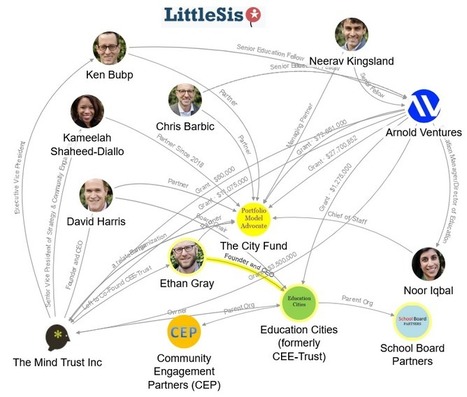
Reorganizing the Attack Little Sis Map
On the ides of March (2018), the Indy Star reported that David Harris the CEO of Mind Trust in Indianapolis was leaving to join a new national organization. Since Julius Caesar’s assassination, events linked to the ides of March are often viewed with alarm. This event portended a reorganized attack on public education and a new billionaire financed entity dedicated to establishing the portfolio model of public school management throughout America.
Until February of 2020, the secretive City Fund did not even have a web site. On July 31, 2018, City Fund Managing Partner, Neerav Kingsland, took to his blog and made public The City Fund – a new non-profit – and named its founding staff. He also arranged for a small group interview with The 74. Matt Barnum of Chalkbeat wrote an introductory piece called “With big names and $200 million, a new group is forming to push for the ‘portfolio model.’” In December 2018, Barnum reported that The City Fund was starting an associated political action organization called Public School Allies. Since those few 2018 articles, The City Fund has operated in the dark.
This February they finally launched a web site and made available some accounting for their spending over the last year and a half. Because City Fund is a non-profit organization, they must soon file tax documents that will reveal in even more detail their spending and organizational structure. Their new transparency is apparently related to the imminent non-profit tax reporting requirements.
The Little SiS map above outlines some for the 2018 reorganization for the coming relentless attack on democratically run public schools. There were changes at The Mind Trust. It was co-founded in 2006 by Indianapolis Mayor Bart Peterson and the youthful lawyer he chose as his education guy, David Harris. It became the prototype corporate education reform local organization. In 2010, Harris and Mind Trust Vice President, Ethan Gray founded the Cities of Education Entrepreneurship Trust (CEE-Trust) which became Education Cities in 2014 after its disaster in Kansas City. This organization was designed to scale the Indianapolis methods of school privatization nationally.
In the 2018 reorganization, Mind Trust continued under new leadership and Education Cities was divided into two new school choice promoting organizations; School Board Partners and Community Engagement Partners. City Fund gave both new organizations $250,000 in seed money. Two lawyers, David Harris and Kameelah Shaheed-Diallo, left Mind Trust to become partners at City Fund. To insure Mind Trust’s continued success as an anti-democratic school privatizing organization, City Fund provided the new leadership with $18,000,000.
School Board Partners is an organization looking to co-opt elected school board members into furthering the portfolio model of education reform. They claim to offer training for school board members however every state requires school board members to go through training provided by the state. Community Engagement Partners purpose is continuing Education City’s support for local organizations that are working to privatize public education and instituting Betsy DeVos’s school choice agenda.
Education Cities CEO Ethan Gray became a Partner at The City Fund. Gray’s Director of Finance and Operations, Kevin Leslie, became Director of Grants and Operations at the City Fund. Education Cities Managing Partner Carrie Douglass became founding leader of School Board Education Partners. Senior Fellow Charles MacDonald is now Executive Director of Community Engagement Partners (CEP) and Associate Partner Rebecca Weinberg Jones became CEP Deputy Director.
Neerav Kingsland worked at both Arnold Ventures and The Hastings Fund before becoming Managing Partner of City Fund. He was also a board member of the California Charter Schools Association. Chris Barbic, the co-founder of YES Prep, worked at Arnold Ventures after a disastrous tenure leading Tennessee’s turnaround schools. He became a partner at City Fund in 2018. Noor Iqbal worked at Arnold Ventures and then for about a month at Mind Trust before becoming the Chief of Staff for City Fund. Ken Bubp worked first at Mind Trust, then Arnold Ventures and is now a Partner at City Fund.
Public School Allies Founding City Fund staff member Gary Borden is no longer on the team, but he really is. Borden is now Managing Director of Public School Allies the 501 C4 organization established by City Fund to administer their political influence campaign. A lawyer by profession, Borden holds a bachelor’s degree from Pennsylvania State University, majoring in economics and international business, and JD from Georgetown University. Before taking on Public School Allies, Borden was executive director of California Charter Schools Association Advocates (CCSA Advocates), which is CCSA’s political influence organization. Borden lives in Oakland, California.
For last November’s elections in Louisiana, Borden sent $1,500,000 to Louisiana Federation of Children which also received large contributions from California billionaire William Oberndorf plus Arkansas billionaires Alice and Jim Walton. These funds were used for independent expenditures supporting choice friendly candidates; five running for the state school board and 20 vying for the state legislature."... For full post, please visit: https://tultican.com/2020/03/02/the-city-fund-spending-prolifically-to-privatize-public-education/
|
|
Scooped by
Roxana Marachi, PhD
May 5, 2019 3:56 PM
|
By Arthur Camins A police officer uses lethal force on an unarmed non-white citizen. One bystander sees police self-defense while another sees racially motivated police brutality. It is an all too common story. Prosecutors and criminal defense lawyers know that a range of race, class, and sociopolitical-influenced perceptions make eyewitness testimony highly variable and often reliable. However, what happened is not just a matter of perception. There is a reality to the dead person’s innocence and the bias that caused it. Reports of corruption and abrupt closing of charter schools attended by predominantly non-white children have become a regular occurrence. For example, its study, Asleep at the Wheel, the Network for Public Education recently chronicled the plethora of problems with charter schools. They found that the U.S. government has wasted up to $1 billion on charter schools that never opened or opened and then closed because of mismanagement and other reasons. Reports of abusive rigid discipline and high suspension rates are also common. Charter school advocates are unfazed by such information, while others are appalled. As with eyewitnesses to crimes in which race and class are elements, varying perspectives explain different perceptions. Nonetheless, the disruption to the lives of innocent children, the drained funds from public schools, and the bias that caused it are real. In recent years, people associated with the hedge fund industry, technology titans such as the Gates, Zuckerberg, and Jobs families, and right-wing foundations have all invested financial and political capital to promote charter schools. Their predominant ideological lens– no matter their political party affiliation– is competition and associated risk. That is why the liberal Gates and the conservative Walton families find common cause on charter schools. Long- and short-term triumphs and failures are essential features of their entrepreneurial worldview. Through that lens "start-ups" come and go, IPOs rise and fall, businesses merge, and divisions divested. Lost jobs and careers are collateral damage–especially when the victims are poor and/or not White. That is their normal. It is the world in which they have triumphed. They look at the world through the lens of their personal success. The losers in the process are, well–just part of how things get done. They have wealth and power and seek to impose and extend their will and perspective on everything within their reach. The public sector–including schools–is in their way. Increasingly democracy, and with it, government regulation is in their way too. Hence, they favor private over elected school boards. They are a tiny minority, but their perspective has gained bipartisan political and mass-media traction.
Another lens is the common good and its explicit companion, cross-racial unity. It has no wealth and power to extend its reach. However, it has a distinct advantage. It represents the vast majority of Americans. The questions you ask frame the answers you get. Let's ask, "Do you favor single a democratically-governed, high-quality public education system for every child or two taxpayer-funded systems: One privately-governed and another democratically governed?" I haven't seen such a poll, nor have I seen any that ask: “Is it fair to drain money from public schools to fund charter schools?” or “Is it acceptable for schools to frequently open and close?” My best guess is that the stability, the common good, and racial unity will win hands down over the disruptive, market competition, and racially-divisive perspectives. The coming 2020 state and federal elections will be an opportunity to change direction. However, I don’t expect the candidates who are running for office to shed their pro-charter school biases on their own. I don’t expect them to advocate for an unambiguous common good, racial unity agenda for public education. That will require determined political action.
We need to tell them what we want. As a start, here are a few suggestions:
- Increase the funding for all public schools to the level of well-resourced suburban schools. (Note: Charter schools are not public)
- Fund schools through an equitable tax on wealthy individuals and corporations instead of inequitable local real estate taxes.
- Reduce class size so that students can get the attention they need.
- Fully fund special education.
- Increase teachers’ salaries so that they are commensurate with similar professions.
- Provide teachers with paid time for professional growth and collaboration.
- Do away with punishment and humiliation by high-stakes test scores.
- Fund Medicare-for-All, so that every child arrives at school healthy.
- Fund the Green-New-Deal, so children and their families have a sustainable, equitable future.
School privatization advocates have money. Public school advocates have the majority–If we make demands and vote." Arthur H. Camins is a lifelong educator. He works part-time with curriculum developers at UC Berkeley as an assessment specialist. He retired recently as Director of the Center for Innovation in Engineering and Science Education at Stevens Institute of Technology. He has taught and been an administrator in New York City, Massachusetts, and Louisville, Kentucky. The ideas expressed in this article are his alone. For original post, see: https://www.dailykos.com/stories/2019/5/5/1855552/-Eyewitnesses-to-Charter-School-Corruption-and-Disruption-Different-Perceptions-One-Reality
|
|
Scooped by
Roxana Marachi, PhD
May 11, 2018 2:16 PM
|
"By Amy Frogge and Will Pinkston Many Washingtonians may not realize it, but the University of Washington Bothell is harboring an organization that’s intent on dismantling public education in America. UW Bothell’s Center on Reinventing Public Education (CRPE) — an anti-public education think tank funded by the Bill & Melinda Gates Foundation, the Walton Family Foundation and other philanthropies that are hostile to public schools — is wreaking havoc in communities as far-flung as Indianapolis, Nashville, and New Orleans. CRPE’s list of “senior research affiliates” reads like a Who’s Who of special interests determined to tear down public schools and replace them with publicly funded, privately run charter schools. As members of the local school board in Nashville who are fighting against the devastating effects of school privatization, we are writing this column to advise Washington public education advocates — including the leadership and faculty at UW Bothell — that you have an enemy in your midst. CRPE first surfaced in Nashville in 2010, when it convened an elite group of civic, and charter school leaders to ink a “collaboration compact” with Metro Nashville Public Schools, America’s 42nd-largest school system with 86,000 students. The heart of the CRPE compact seemed reasonable: “Collaborate as partners on the city-wide effort to provide an excellent education for all students.” What happened next didn’t resemble collaboration at all, but rather outright hostility. As it turns out, no one who signed the CRPE compact actually cared about public education. Instead, their sole focus was forcing the unabated growth of charter schools at the expense of traditional schools. Political and business interests aligned with the charter movement seized on the CRPE compact to attempt a wholesale privatization of Nashville’s public school system. Some even shamefully referred to their plan as “New Orleans without the hurricane” — a reference to the charterization of Crescent City schools in the wake of Hurricane Katrina. CRPE, led by pro-privatization director Robin Lake, cheered the effort. Fortunately, the voters of Nashville ultimately rejected CRPE and Lake’s agenda by overwhelmingly electing and re-electing a strong pro-public education contingent to the Nashville school board. Yet the well-funded CRPE threat persists, in our city and elsewhere in the U.S. Nationally, CRPE is now aligned with President Donald Trump and U.S. Education Secretary Betsy DeVos. In a new report, CRPE urges local school systems to gloss over the negative fiscal impact of charter schools by instead reneging on teacher pension commitments, slowing teacher pay improvements, and undertaking mass closings of traditional schools. Our view: UW Bothell should consider forming a “Center on Recommitting to Public Education” to counteract the damage done by CRPE. If the turmoil of the past seven years in Nashville is any indication, we’ve had enough of CRPE’s false promise of collaboration. In talking with other school board members around the country, we know many of them feel the same. At the end of the day, CRPE is merely a tool to facilitate the demise of public education. As observers of education politics and policy, we know that many Washingtonians strongly support public schools and that your state’s voters have spoken at the polls against privatization. With this column, we are hoping that readers — including UW Bothell Chancellor Bjong Wolf Yeigh and UW Bothell faculty — will stand in solidarity with American public education advocates and in opposition to CRPE’s destructive agenda. Amy Frogge and Will Pinkston are elected members of the Metro Nashville Board of Public Education. For original post, see: https://seattleducation.com/2017/10/01/uw-bothell-think-tank-aims-to-dismantle-public-education/
|
|
Scooped by
Roxana Marachi, PhD
February 2, 2018 5:04 PM
|
[Update 1/21/18]:
"The charter schools described below were approved by the California State Board of Education on January 19th, 2018 despite community opposition and district/county denials documenting serious red flags in their petitions.
Perseverance Prep was approved in full, and Promise Academy as a K-8. This is not the first time such flags have been overlooked with state level votes. Analyses by In The Public Interest suggest a troubling track record of problematic approvals that have led (predictably) to closures. For more on the financial roots of “Silicon Schools Fund” and “Innovate Schools,” both of which have heavily funded and promoted Perseverance, Promise, and other local charter chains, see this Walton keyword subset of posts from a larger collection documenting the harms of charter expansions. Consider also forwarding on to friends in San Francisco, where Innovate’s recruitment attempts have been ramping up recently and have been revealed here, here, here, and here. See additional links below."... Full post at: https://eduresearcher.com/2018/01/18/charter-red-flags/
|
|
Scooped by
Roxana Marachi, PhD
January 20, 2018 3:01 PM
|
"Teacher at a *~bAy aReA cHaRteR~*. While I am lucky to get to work with children every day, there is no limit to how awful these privately-owned, racist and exploitative companies can be. I try to take a break from eternally rolling my eyes at these neoliberal a$$holes to write about how removed from reality a charter school can be." Want to talk to me? Communicate with me on my Twitter account. More about my school. We have: - no cafeteria
- no school nurse
- no on-site custodian
- no school library
- school is 7:45 - 4 PM (8.25+ hours) daily
- recess is 15 minutes and running is prohibited
- lunch is 15 minutes and kids are not allowed to talk during lunch
- every student (from pre-K to 5th grade) has mandatory computer class for 90 minutes a day"
https://charterschoolnightmares.tumblr.com/ Related post documents link where blog is indicated as having been written by teacher at Rocketship
https://deutsch29.wordpress.com/2017/12/17/bay-area-rocketship-charter-where-vomit-stays-on-the-carpet/
|
|
Scooped by
Roxana Marachi, PhD
June 20, 2017 3:03 AM
|
By Denise Smith Amos
"The founder of a charter school company that managed two schools in Jacksonville was charged Monday, along with a business partner, with racketeering and organized fraud allegedly involving 15 charter schools in Florida. Prosecutors say Marcus May, owner of Newpoint Education Partners, is accused of misusing and co-mingling charter school money, as well as taking excessive payments and “kickback” fees, and spending the proceeds on such things as cruises, numerous trips to foreign countries, plastic surgery, home mortgages and a personal watercraft. “May obtained more than $1 million of public funds from a pattern of thefts from the state department of education, six school districts and 15 Newpoint-managed charter schools,” said District 1 State Attorney Bill Eddins, in a prepared statement. In total, Newpoint’s charter schools in Florida received $57 million from the state and from six school districts, including Duval, between 2007 and 2016, the affidavit attached to the charges states. In Jacksonville, Newpoint ran the San Jose Academy and San Jose Preparatory High schools on Sunbeam Road. Both are now managed by a different company and serve 310 middle and high school students. An attorney representing May and Newpoint, David McGee of Pensacola, said his client did nothing wrong and that the expenditures were proper because his client earned that money from his companies. “To the extent that it is legitimate income … he can use the income from his businesses to buy some of the same things other people buy,” McGee said. The latest charges accompany others filed against Newpoint last year by Eddins, whose district includes Escambia, Okaloosa, Santa Rosa and Walton counties. “This has been in court for a year and there has been a series of allegations that haven’t held water so far,” McGee said. The new charges go beyond last year’s indictment, said Russell Edgar, assistant state attorney on the case, because they involve more charter schools and counties. “We thought this was not an isolated case,” he said. “It appears to be a pattern throughout the state.” He said May used Newpoint to convince parents and others to start charter schools, form nonprofit corporations and take positions on school governing boards. (Charter schools are public schools run by non-public boards rather than elected school board members.) These charter board members had little or no experience operating schools or handling bookkeeping, payroll or facilities, according to the affidavit. May, through Newpoint, charged the charter schools a management fee of 18 percent of whatever the state sent the schools in per-student funding, plus his expenses, the affidavit says. May hired a bookkeeping company for all the schools and directed that company to weekly withdraw all but $1,000 from each charter school’s bank account and to deposit those funds into a single Newpoint bank account. The affidavit said such co-mingling of funds is against Florida law and was done without the knowledge of charter school board members. According to the affidavit, May used his own companies to buy and then sell items and services to the charter schools at hundreds of thousands of dollars over the actual cost. He had some of his companies pay “leases” to another of his companies, which in turn paid off mortgages and downpayments on his personal homes. He also had the charter schools lease furniture, equipment and computers from a company he and a partner owned. That company within a couple days then paid “kickbacks” to May or to Newpoint for no apparent reason, the affidavit said. In 2014, his partner’s company, called School Warehouse, received $375,000 from Newpoint schools in Duval and Pinellas counties which had paid markups of 165 percent over retail prices. School Warehouse sent $175,000 of that to a Fifth Third Bank account to pay the partner’s home mortgage and the rest, $200,000, went to another related company, which transferred $25,000 to a real estate company owned by May and $175,000 to First Merit Bank , where it was applied to a balance on May’s home equity credit line, the affidavit said. In 2015, School Warehouse received more than $225,000 from Newpoint’s charter schools, and School Warehouse wired $100,000 to another real estate company owned by May, the affidavit said. A similar kick back scheme involved Apex Learning, a Washington online learning company. Beginning in 2012, Apex charged Newpoint’s charter schools an “elevated” price for online curriculum and materials and “rebate” back to Newpoint — not the schools — the difference between the elevated and the actual price, the charges say. That way, Apex rebated to $23,785 to May from Duval, part of more than $700,000 in rebates from Apex, the affidavit says."... For full post, see: http://jacksonville.com/news/metro/education/2017-06-19/charter-school-founder-accused-theft-use-school-money-world-trips
|
|
Scooped by
Roxana Marachi, PhD
October 4, 2016 2:07 PM
|
By Alan Singer "Success Academy Charter Schools were closed on Wednesday September 28. It wasn’t a national or religious holiday, it hasn’t snowed yet, and public schools were open, teachers were teaching, and children were learning. Success Academy Charter Schools were closed last Wednesday so its CEO Eva Moskowitz could rally political opponents of New York City Mayor Bill de Blasio and highlight potential challengers for the 2017 mayoral election. Moskowitz needed kids to fill up the audience so she pulled them out of school and dragged them and their parents to Brooklyn’s Prospect Park.
To keep the children and their parents happy, Moskowitz brought entertainment, the rapper turned actor Common. Speakers included potential mayoral rivals Bronx Borough Present Ruban Diaz Jr. and Brooklyn Congressional Representative Hakeem Jeffries. Jeffries dismissed individuals and groups that oppose the charter networks as “haters.” Moskowitz is demanding that New York City double its number of charter school seats to 200,000 by 2020.
Officially, the rally was sponsored by a group called Families for Excellent Schools. Except the group is not really about families. Four of its five founding board members are Wall Street brokers. Its big money pro-charter financial backers include the Walton Family Foundation and the Broad Foundation. The Families for Excellent Schools website claims that its executive director, Jeremiah Kittredge, was a public school teacher and labor organizer before he joined them. But according to his LinkedIn page, Kittredge only graduated from Brown University in 2008 and has been a professional charter school advocate ever since. I have questions for Eva and her friends, and maybe also for the Brooklyn district attorney’s office. Children and parents who attended the rally got nice blue t-shirts. I want to know who paid for the 20,000 t-shirts (estimated bulk rate $5 each or about $100,000) and the busses that transported participants (estimated at $600 a bus, $60,000 for 100 busses)? Did organizers pay to use Prospect Park and for extra police assigned to the rally (it costs $4,000 just to rent the boathouse for a wedding)? Did Success Academy cover expenses with public money and why wasn’t the money for the rally used for education? A pro-charter event organized by Moskowitz and Families for Excellent Schools at the state capital in Albany in 2015 cost an estimated $700,000. Children were pulled out of school that day also. Who keeps paying, besides the children?
On October 6 the Alliance to Reclaim our Schools is planning demonstrations in dozens of cities to support public schools. Parents, students and educators will gather outside of their schools before the bell to hold a rally and march. They are not charter schools, so after the rallies children and teachers will walk into their buildings to start the school day and learn."... For full post, click on title above or here: http://www.huffingtonpost.com/alan-singer/how-success-academy-chart_b_12308004.html
|
|
Scooped by
Roxana Marachi, PhD
May 7, 2016 1:11 AM
|
"The following is a letter to the editor by Wayne Au, an Associate Professor in the School of Educational Studies at the University of Washington Bothell where he serves as Chair of the Campus Diversity Council: The April 20 opinion piece by Amy Van, “Learning, uninterrupted: Students and faculty at Summit Sierra carry on with a successful school year,” is typical for its kind. It lauds a local charter school for serving a diverse student population and raising test scores, all with the intent of proving both how well Summit Sierra is doing as an individual school, and how great charter schools are generally. However, speaking as a professor of education who studies charter schools, I think there are several issues to raise with Van’s opinion piece that would be important for IE readers to know. For instance, Van is a staff member for the Washington State Charter School Association (WSCSA). Since 2013, the WSCSA has been granted over $13.55 million by the Gates Foundation to support charter schools. This is not surprising since Bill Gates Jr., Alice Walton, and Eli Broad all personally donated large sums to support the passage of Washington’s charter school initiative, and given that their respective foundations provided millions of dollars to local non-profits who ran the charter school initiative campaign. So IE readers should not expect an unbiased discussion of charter schools coming from the WSCSA or their staff since they essentially are paid to promote charters."... For full post, click on title above or here: http://www.iexaminer.org/2016/05/letter-to-the-editor-half-truths-spin-and-obfuscation-about-summit-sierra-charter/
|
|
Scooped by
Roxana Marachi, PhD
March 30, 2016 12:38 AM
|
By Kalli Holloway "Perhaps guided by the old adage that you have to spend money to make money, the champions of education "reform" have poured billions into the effort to privatize and profit from America’s schools. Those funds are used on multiple fronts: launching charter schools, underwriting the political campaigns of politicians, and of course, investing in media to propagate the free-market privatization vision. Among the most visible properties in this effort is the Seventy Four, the well-funded, power broker-backed education news website run by former journalist-turned-school privatization activist Campbell Brown. Launched last year, the site’s reported $4 million annual budget comes from a collective of school privatization’s big hitters: The Dick and Betsy DeVos Family Foundation, Bloomberg Philanthropies, Jonathan Sackler (of OxyContin producer Purdue Pharma) and the Walton Family Foundation. Philanthropy of this sort has an endgame—the privatization of America’s public schools—and media manipulation is an essential part of a winning strategy. Brown, leveraging her longstanding image as a truth-seeking newsperson in service of her new brand as an earnest education reformer, has been indispensable to this effort. As the head of the Seventy Four, under the guise of providing hard-hitting education news, she leads one of the key media efforts to push the anti-union, pro-privatization message of the charterization movement, all while keeping its billionaire backers out of the picture and off the front page."... For full post, click on title above or here: http://www.alternet.org/education/campbell-brown-new-leader-propaganda-arm-school-privatization
|
|
Scooped by
Roxana Marachi, PhD
March 1, 2016 12:01 AM
|
By Colin Poitras "When charter schools first appeared in the U.S. in the early 1990s, they were seen as an exciting alternate choice for families looking to move their children out of low-performing urban schools. Still widely popular, charter schools have become a major part of the nation’s educational infrastructure, expanding at a rate of about 12 percent a year. Nearly three million children, or about six percent of all children enrolled in public schools nationwide, currently attend charter schools. But with states facing mounting pressure to ease regulations to allow more charter schools, and with the federal government and private industry offering millions of dollars in new charter school grants and incentives, UConn professor of educational leadership and law Preston Green III is urging policymakers to be careful. In a recent paper that is receiving national attention, Green and three co-authors outline the many parallels they see between today’s charter school systems and the early days of the subprime mortgage crisis, where aggressive business practices and unchecked growth created a national housing ‘bubble’ that threw the country into deep recession. The housing bubble was particularly devastating to urban African-American families, many of whom relied on subprime mortgages to purchase their first homes. Without sufficient regulatory safeguards in place to protect them, these vulnerable families would later lose their properties to foreclosure when the ‘bubble’ burst and they were unable to meet the terms of their loans. When it comes to charter schools, Green, the John and Carla Klein Professor of Urban Education in UConn’s Neag School of Education, is concerned that, as with the subprime crisis, insufficient regulation could result in the formation of charter school “bubbles”: a concentration of poorly performing schools in urban African-American communities. Green is a leading scholar in the fields of law and urban education, educational policy, and educational equity, with a focus on the legal and policy issues pertaining to educational access, school choice and charter schools. “Charter school bubbles are most likely to form in black urban communities, because those are the communities where there is the greatest anger toward traditional public schools and the wish for change,” says Green. “It is because of that anger that these communities are most at risk of making an over-commitment to charter schools, which could then lead to the bubble we reference.” As the lead author of the paper, “Are We Heading Toward a Charter School ‘Bubble’?: Lessons from the Subprime Mortgage Crisis,” Green advances a detailed and heavily annotated argument expressing his concerns. He is joined by research co-authors from Rutgers University, Montclair State University, and the University of Wisconsin at Madison. The paper has sparked a national conversation. Since it first appeared online in December, the paper has been reported in journalist Jennifer Berkshire’s widely-read EduShyster blog, the Washington Post, Mother Jones, Salon, NEA Today, and a host of other online media sites, blogs, and podcasts. Critics say the paper’s comparisons are unreasonably provocative. Others support its conclusions as timely and important. “I knew it was going to be controversial, but I felt it was something that needed to be said,” Green says. “I am very concerned with where charter schools are headed. We are in a position of repeating the mistakes that we made with subprime mortgages, where we encouraged ostensibly positive goals, but didn’t put the protections in place that are needed.” Critics of charter schools often point to individual schools and districts where problems have surfaced. Green’s paper focuses instead on larger systemic issues. The authors point out that more than $200 million in charter school fraud, abuse, and mismanagement has been identified in 15 states. Reports of private for-profit charter school management companies declining to enroll students with special needs and disabilities, instituting aggressive disciplinary practices, charging public school districts exorbitant rent for facilities, and using high-pressure tactics to recruit students in minority neighborhoods, are additional cause for concern, Green points out in the paper. “If we’re going to have private entities involved in public education, we need to have sufficient regulation, because without those regulations, without that oversight, there could be systemic abuse,” he says. “And because of the particular issues within urban communities, the failure of providing safeguards and regulations could result in a very negative situation.” Multiple Authorizers, Multiple Problems One of Green’s primary concerns is the recent push by the charter school industry for states to allow multiple independent authorizers of charter schools. Advocates argue that having multiple authorizers would make the application process more efficient, and offer more options for national providers interested in opening charter schools. But Green counters that having multiple authorizers opens the door for “authorizer hopping,” where low-performing providers could go searching for a favorable authorizer that won’t be as careful screening for quality or as demanding when it comes to accountability. Recent federal laws, such as the Every Student Succeeds Act, encourage charter school expansion, adding another element to the charter school authorization debate. In the private sector, major entities like Netflix and the Walton Family Foundation, have pledged millions of dollars in support of charter school growth. Traditionally, charter schools have been authorized by local public school districts. Those districts have demanded quality and accountability because they are responsible for educating all students in their community and would bear the brunt of educating students returning to their district should charter schools close. Shifting authorization to independent authorizers, Green says, means handing over that authority to an outside entity that doesn’t have a stake in the game. “If you are going to have these private entities and use these private approaches, you cannot forget the public role in this,” he says. “Under state constitutional law, governments are supposed to provide a system of public education that ensures safeguards are in place.” According to the Center for Education Reform, states with multiple school authorizers have nearly three and a half times as many charter schools as those authorized by local school districts. A separate study cited in the paper, this one by Stanford University’s Center for Research on Education Outcomes, found that “states with multiple authorizers experienced significantly lower growth in academic learning in their charter school students,” indicating that some charter school operators were successful in choosing the least rigorous option to provide oversight. Charter schools already outnumber public schools in some districts. The Recovery School District in Louisiana, for example, is considered the first all-charter school district in the country. In Detroit, 14 entities that are not locally controlled have the power to open and close schools. “What I get most concerned about is a situation where you have an all-charter school district where the authorizers, the entities that make decisions about what schools are going to come into play, are not connected with that school district,” Green says. “If you have a situation where the vast majority of decision-makers are not connected to the community, then you have a problem.” In the paper, Green lays out his concerns clearly: “Charter school boards have the responsibility … to ensure that their schools follow all applicable laws, and that the schools spend public funds in a fiscally accountable manner. By contrast, for-profit [management entities] have the incentive to increase their revenues or cut expenses in ways that may contradict the goals of charter school boards.” Subprime Similarities Green compares the shift in charter school authorization to the start of the subprime crisis, where the federal government, seeking to increase homeownership for minorities and the poor, deregulated the financial industry and encouraged the distribution of subprime loans. Traditionally, mortgage originators such as banks screened loans carefully, because they assumed all of the risk if the loan went into default. When the subprime industry emerged, banks and other mortgage originators no longer screened loans as closely, because the loans were guaranteed by the federal government and they were allowed to sell them on a secondary market, spreading out the risk. In essence, the originators of the mortgages no longer had any skin in the game. Despite all of his concerns, Green remains a believer in the charter school concept. He insists that the paper he authored is not meant to be an attack on charter schools, but rather an exposé highlighting issues of concern. Green believes the country right now is at “ground zero” with respect to the growth of charter school bubbles. The paper concludes with a series of recommendations for greater federal and state oversight, including more transparency in charter school approvals, improved quality assurance, and sanctions against schools that exercise low standards. “What we are saying is that there should be a deliberative and thoughtful process in overseeing charter schools to make sure that the choices of parents and children are honored and, in the end, meaningful,” he says. The flip side of that scenario is daunting. “If charter schools aren’t sufficiently regulated,” Green says, “we could see a proliferation of poorly monitored schools in these communities. The proliferation of these poorly regulated schools could gather such momentum that it could be a while before people start to realize there are problems, and by then, it will take some time to dismantle all that.” Just like what happened in the subprime mortgage crisis. The paper – “Are We Heading Toward a Charter School ‘Bubble’ ?: Lessons from the Subprime Mortgage Crisis” – is scheduled for publication in print in the University of Richmond Law Review next month. http://today.uconn.edu/2016/02/a-charter-school-warning/
|
|
Scooped by
Roxana Marachi, PhD
September 2, 2015 10:03 PM
|
By T. Jameson Brewer
"Teach For America (TFA) turns 25 this year and, for at least the first 23 of those years, the organization was able to mark each year as a success as the organization grew in numbers, financial support, political clout, and wild public support. However, those years are slowly drawing to a close.
While TFA still receives tens of millions of dollars from the federal government and from private philanthropic organizations like the Walton Family Foundation -- an organization that benefits from systemic inequality and poverty yet is somehow interested in undermining the business of Wal-Mart by improving education (another conversation for another day) -- TFA has had a rough couple of years recently.
Notably, recruitment is down at TFA and they have shut down numerous offices and training sites throughout the U.S. (though, they continue to thrive internationally through the spin-off organization Teach For All). Much of TFA's current woes lie in the growing tide of criticism waged against the organization.
Opponents of the program suggest that TFA corps members are replacing traditionally certified teachers, that TFA operationalizes and reinforces deficit ideologies about the students they work with by relying on a White-savior mentality, and that giving corps members only 18 hours of student teaching not only undermines the profession but hurts students.
More recently, others have pointed out that TFA has shifted entirely from focusing on teachers and teaching and more on influencing policy decisions as it seeks to install alumni of the organization as political puppets who work as principals, school board leaders, and other elected political positions.
In fact, TFA's mission statement doesn't even include the word teach or teachers at all. And while all of this criticism is worthwhile -- and in my estimation very true -- dissident voices from corps members and alumni themselves have for far too long been silent."...
For full post, click on title above or here:
http://www.huffingtonpost.com/t-jameson-brewer/challenging-teach-for-ame_1_b_7766472.html
|
|
Scooped by
Roxana Marachi, PhD
December 8, 2014 2:59 PM
|
By Barbara Miner
"Like most principals, Brittany Kinser is a cheerleader for her school. “I just want to make sure you’ll be positive,” she says when I visit the Rocketship charter school in Milwaukee.
Looking younger than her thirty-seven years and with the physique of a long-distance runner, Kinser has a seemingly endless supply of energy and enthusiasm. It’s hard not to like her. Following one of the school’s axioms—Dress for Success—she is wearing a magenta pencil-skirt that nicely sets off her black sweater, tights, and four-inch stiletto heels. Her Dress for Success message is clear: I am competent and I am in charge.
At the same time, Kinser is nervous about my visit. It’s understandable. For almost a quarter century, I have criticized using public tax dollars to fund private voucher schools and privately run charter schools. Rocketship, an entrepreneurial network of charter schools based in the Silicon Valley, has become a national poster child for the privatization of public education. It is particularly known for its bare-bones curricular focus on standardized test scores in reading and math, its use of computer-based “learning labs” that cut down costs, and its promotion of the Rocketship brand—including a daily pep rally where students chant that they are “Rocketship Rocketeers.”
After visiting Rocketship Southside Community Prep, as Milwaukee’s K4 through fifth-grade school is formally known, I could see why some people might react positively. Students were well behaved. Parents were welcome. The young teachers were energetic.
But as I left the school, I couldn’t help thinking: Can young students dress their way to success? Or chant their way to academic achievement? Are computerized worksheets the answer to reducing the achievement gap?
Rocketship opened its Milwaukee school in 2013, serving overwhelmingly low-income, Latino students on the city’s South side. The local chamber of commerce raised $2.5 million in private contributions to help fund Rocketship’s expansion to eight schools in Milwaukee by 2017.
Just inside the main entrance, there are banners from various universities hanging from the ceiling—part of the school’s message that students should be thinking about college. At the students’ eye level are Dress for Success posters featuring young children wearing the school uniform of khaki pants and a blue polo shirt with the Rocketship logo.
I’m not opposed to uniforms. I wore them throughout high school and appreciated that I didn’t have to figure out every morning what to wear. But the nuns never told us that our uniforms were the key to success. The policy was based more on a Catholic school philosophy that worried about the sin of pride and that discouraged too much attention to individual appearances. At Rocketship, I couldn’t quite figure out the laser-like focus on Dress for Success. They don’t take it lightly. The school handbook notes that students who do not wear their uniform “may lose recess, lunch or other privileges.”... For full article published on "The Progressive", click on title or image above or here: http://www.progressive.org/news/2010/12/187931/rocketship-lands-milwaukee#sthash.YGLtwC0G.dpuf For recent news related to the illegal forced parent work policies that are central to Rocketship's parent engagement model (revealed by the Public Advocates report) please visit: http://sco.lt/9FGAkr For other Rocketship related posts: http://www.scoop.it/t/charter-choice-closer-look?q=rocketship  and www.stoprocketship.com.
|