Your new post is loading...

|
Scooped by
Elizabeth E Charles
October 25, 2019 4:00 PM
|
Research on the forgetting curve has revealed some shocking statistics. Within one hour, people will have forgotten an average of 50 % of new information. Within 24 hours, they have forgotten an average of 70 % of the new information, and within a week, they will have forgotten 90 % of it. Of course, it’s not the same for everybody, but it’s still pretty disconcerting. And this fact is the problem with corporate training – most of it goes to waste. Most of what your employees have learned will be forgotten unless you employ what is known as “spaced repetition.”
|
|
Scooped by
Elizabeth E Charles
March 21, 2019 7:21 PM
|
It’s long been known that drawing something helps a person remember it. A new study shows that drawing is superior to activities such as reading or writing because it forces the person to process information in multiple ways: visually, kinesthetically, and semantically. Across a series of experiments, researchers found drawing information to be a powerful way to boost memory, increasing recall by nearly double.
|
|
Scooped by
Elizabeth E Charles
October 13, 2018 11:37 AM
|
As a professor of cognitive psychology, I teach about memory, especially about when and why our memories often fail us. Students are excited to apply this material to their everyday lives.
|
|
Scooped by
Elizabeth E Charles
September 6, 2018 7:15 PM
|
We’ve all heard about memory strategies like spaced repetition and retrieval practice, but what else is there? Actually, neuroscientists are discovering some pretty exciting things about the way memory works, and as always, we’re here to share their research with you. Here are five ways to improve your memory based on the latest findings:
|
|
Scooped by
Elizabeth E Charles
September 30, 2017 4:13 PM
|
Wondering what are some Memorization Techniques For Online Learning? Check some Memorization Techniques For Online Learning.
Remember those moments when you try to memorize something and information is too difficult to remember or organize? Usually, you are limited in time too. Well, don’t get frustrated: There are techniques that can help you achieve memorizing without any additional problem.
|
|
Scooped by
Elizabeth E Charles
August 11, 2016 3:34 PM
|
As a professor of cognitive psychology, I teach about memory, especially about when and why our memories often fail us. Students are excited to apply this material to their everyday lives.
During a recent class, a student asked whether other faculty were familiar with this research and remarked that it would be helpful if everyone structured their lessons with this knowledge in mind.
|
|
Scooped by
Elizabeth E Charles
July 21, 2016 4:29 PM
|
Wondering how to enhance Active Recall In eLearning? Check this article to discover 6 ways to enhance Active Recall In eLearning.
|
|
Scooped by
Elizabeth E Charles
May 16, 2016 3:08 PM
|
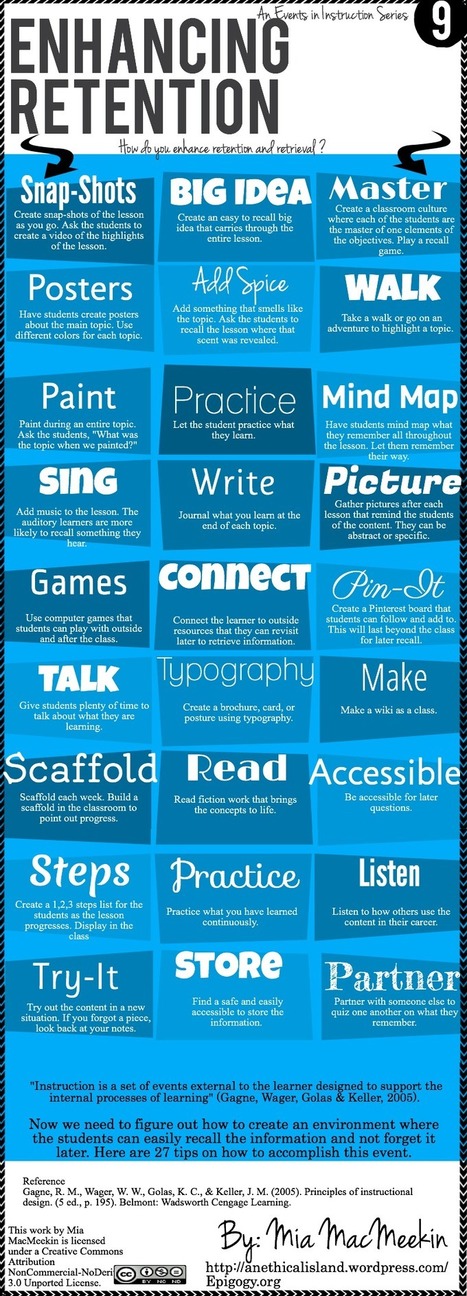
The 27 Ways Teachers Can Enhance Retention and Knowledge Transfer Infographic refers to Gagne’s 9th and presents ways that teachers can ensure that their students can retain information and transfer their new knowledge or skill to different situations.
|
|
Scooped by
Elizabeth E Charles
April 29, 2016 12:42 PM
|
Using pen and paper for note-taking helps boost memory and the ability to understand, more so than laptops.
|
|
Scooped by
Elizabeth E Charles
April 13, 2016 7:10 AM
|
Grab these tricks to increase the likelihood that learners will remember your eLearning content.
It’s happened to all of us: we’re presented with information and yet we forget it. Why does it happen? One of the most common reasons is because our attention is elsewhere. It’s similar to what happens when a student is attending a lecture, yet is simultaneously spending time on their smartphone. While they may be physically present in the lecture, their divided attention leads to a failure to retain most, if not all, of the information taught.
|
|
Scooped by
Elizabeth E Charles
March 1, 2016 2:40 PM
|
5 Science-Based Study Tips to Help Your Sad, Failing Memory If there’s one thing that rocks about having reached a certain age, it’s knowing that there are things you will never again have to do… Like...
|
|
Scooped by
Elizabeth E Charles
December 5, 2015 2:25 PM
|
Hemingway once wrote a six-word novel that reads as follows: "For sale: baby shoes, never worn." What makes it famous, other than the author? Neuroscient
|
|
Scooped by
Elizabeth E Charles
November 1, 2015 12:10 PM
|
Learning ability is probably the most important...
|
|
|
Scooped by
Elizabeth E Charles
May 23, 2019 2:03 PM
|
With video in learning one can feel as though one is learning, as the medium holds your attention but as you are hurtled forward, that knowledge disappears off the back. It’s like a shooting star; looks and feels great but the reality is that it burns up as it enters the atmosphere and rarely ever lands.
|
|
Scooped by
Elizabeth E Charles
November 22, 2018 3:23 PM
|
At the University of Texas at Austin, linguistic researchers have found that we recall information from conversations better when we’ve been listening to someone who speaks clearly, as it frees up cognitive resources which would otherwise be used to decipher the words themselves rather than the meaning behind them. These findings have promising implications for the classroom.
|
|
Scooped by
Elizabeth E Charles
September 7, 2018 3:26 PM
|
Teachers have long known that rote memorization can lead to a superficial grasp of material that is quickly forgotten. But new research in the field of neuroscience is starting to shed light on the ways that brains are wired to forget—highlighting the importance of strategies to retain knowledge and make learning stick.
|
|
Scooped by
Elizabeth E Charles
October 27, 2017 1:32 PM
|
Do you wish you had an easier time remembering facts and figures you just learned? Do you have trouble recalling the name of the colleague you were just introduced to? If you are like most people, you wish you had a stronger “mental sticky note”, or working memory.
|
|
Scooped by
Elizabeth E Charles
November 24, 2016 2:28 PM
|
Although reading something once or twice and then remembering it for life would be ideal, the reality is that much of what we learn goes in one ear and out the other. In fact, research shows that within just one hour, if nothing is done with new information, most people will have forgotten about 50% of what they learned. After 24 hours, this will be 70%, and if a week passes without that information being used, up to 90% of it could be lost.
Improve knowledge retention in your training programme by actively engaging your learners and create learning that truly sticks!
Via EDTECH@UTRGV
|
|
Scooped by
Elizabeth E Charles
July 15, 2016 4:56 PM
|
Not all memory is created equal. While some of us have detailed, context-dependent accounts of when and where we learned something, others seem to have a reserve of facts in their brain that they can pull from, independent of the original context in which they learned the information. Why does memory differ from person to person in this way, and how does it affect learning?
|
|
Scooped by
Elizabeth E Charles
May 13, 2016 5:00 PM
|
If you’ve ever wished you could rid your brain of unnecessary information, you’re in luck—your brain already does it for you. A research group at Lund University in Sweden has found that the human brain not only contains learning mechanisms but also forgetting mechanisms that erase “unnecessary” learning. In the study, the researchers trained human... Read More
|
|
Scooped by
Elizabeth E Charles
April 16, 2016 5:16 PM
|
Being able to pick up skills quickly is critical in today’s workplace.
|
|
Scooped by
Elizabeth E Charles
March 25, 2016 4:46 PM
|
Learning and memory specialist Marilee Sprenger writes about vocabulary critical to the Common Core and offers 11 strategies for helping students learn it.
|
|
Scooped by
Elizabeth E Charles
February 25, 2016 3:03 PM
|
Although there is more to learning than regurgitating facts on an exam, memorization is an important route to building content knowledge and expertise.
|
|
Scooped by
Elizabeth E Charles
November 6, 2015 1:05 PM
|
You've probably been studying all wrong.
|