Content curation trends
185.9K views | +0 today
Your new post is loading...
Scooped by Guillaume Decugis
May 28, 2011 5:55 AM
Scoop.it!

Recreating Human Behavior

Recreating Human Behavior | Content curation trends | Scoop.it
First SEO ruled. Then SMO became at least as important. But while a lot of people expect it to be as systematic, it's not something than can be done without remembering that it's fundamental underlying subject is not the Google algorithm. But the Human one.

An account of the Social Media Optimization Conference by TheNextWeb
No comment yet.
Scooped by Guillaume Decugis
May 20, 2011 1:25 PM
Scoop.it!

I can haz Curation ?

I can haz Curation ? | Content curation trends | Scoop.it
Interesting interview of Ben Huh, founder of the Cheezburger network, owning dozens of successful UGC sites.

Lessons of what users are good at? Curation.

"One of the things that I've found out is that people are really, really, really good at curating," he said. "People are really good at filtering and curating, more so than they are at creating content."

Huh continued: "The ability to curate requires that you sit at a computer. The ability to create requires that you get off your computer and go out there. Very, very different things and different people are willing to do that."

Maybe soon a new player in the whole curation market?

via http://www.scoop.it/u/sbanderson
No comment yet.
Scooped by Guillaume Decugis
May 10, 2011 2:12 PM
Scoop.it!

The End of the Destination Web and the Revival of the Information Economy Brian Solis

The End of the Destination Web and the Revival of the Information Economy Brian Solis | Content curation trends | Scoop.it
Brian Solis is great at giving perspectives: in this post, he unifies all of the recent trends affecting the future of digital content in a single impressive post.

From a Web of Data to the Contextual Web, here's what happens when we mix alogirthms and humans and create this new Web based on "humanrithm".

"They’re no longer consumers, but stakeholders in the information economy."

Yes we can!
No comment yet.
Scooped by Guillaume Decugis
May 5, 2011 4:50 AM
Scoop.it!

Content curation means Quality through the essential human touch

Content curation means Quality through the essential human touch | Content curation trends | Scoop.it
Quality has been predicted a big trend (or an objective?) in Social Media for 2011. And I see more and more views that this need to be achieved through human interaction, rather than pure algorithm.

"Content curation equates with Quality in the commercial sphere. And the only way to add quality to content currently is through human intervention." says Tim Greenhalgh in this blog post.

He even puts it in equation: OCC = Q + H (see what it means in the post if you like maths!).

Overall, we're moving to a situation where algorithms are going to be serving humans for the better. What @axelletess called "Humanrithm" here: http://t.co/SNQM0uU - a word that I like a lot as it doesn't oppose both approaches but reconciles them.
No comment yet.
Scooped by Guillaume Decugis
May 4, 2011 4:11 AM
Scoop.it!

4 Soft Skills For Content Curation

4 Soft Skills For Content Curation | Content curation trends | Scoop.it
"Content curation is more than tools and engaging with members of the target audience." says Ian Smith from Intelegia in this interesting post.

I agree!

He lists 4 skills (listening, be inquisitive, manage time and be proactive) but I'll add one more:

Give your opinion!

If you're just going to be a filter, then a robot will eventually do it. Giving your opinion to enrich or nuance a post is what makes curation interesting to readers, isn't it?

And this is what makes the Web human...
No comment yet.
Scooped by Guillaume Decugis
April 13, 2011 2:15 PM
Scoop.it!

3 ways social media is changing journalism

"A Pulitzer prize for investigative tweeting may not be that far-fetched, said Southern Methodist University journalism professor Jake Batsell, at the 2011 Society of American Business Editors and Writers conference in Dallas."

Interesting report by Sam Taute showing social media curation's value is on the rise. Not just in volume, but by quality standards as well.
No comment yet.
Scooped by Guillaume Decugis
April 13, 2011 1:00 PM
Scoop.it!

Facebook won't rule the world after all

Facebook won't rule the world after all | Content curation trends | Scoop.it
Some are concerned about Facebook World domination plan. However, if Facebook owns the social graph, the interest graph is a different matter.

(This is a guest post I wrote for Business Insider).
No comment yet.
Scooped by Guillaume Decugis
April 2, 2011 11:32 PM
Scoop.it!

The 5 Models Of Content Curation

The 5 Models Of Content Curation | Content curation trends | Scoop.it
In this interesting post, Rohit Bhargava who gave a great definition of digital curation back in 2009, identifies several forms of curation and explains how they bring value to the reader. A Must-read for curators.
No comment yet.
Scooped by Guillaume Decugis
March 25, 2011 3:39 PM
Scoop.it!

Are Content Curators the power behind social media influence?

Are Content Curators the power behind social media influence? | Content curation trends | Scoop.it
Interesting Guest Post by Neicole Crepeau who compares the role of curators with Google's in the way content gets accessed.

As a consequence, the end of the posts concludes that :

"If the Curator is the new Google, we can expect businesses to optimize for the Curator just as they optimized for Search on the web. In this new world, Curators become a commodity and they have value that will be sought after. Marketers will seek curators in specific topic areas and with specific traits. Marketers will want to know:

The topics this person curates. Curators specialize.
The networks and communities he/she curates to. Curators who are plugged into niche communities and forums may be even more valuable.
The number of connections on those networks. The volume or following always counts.
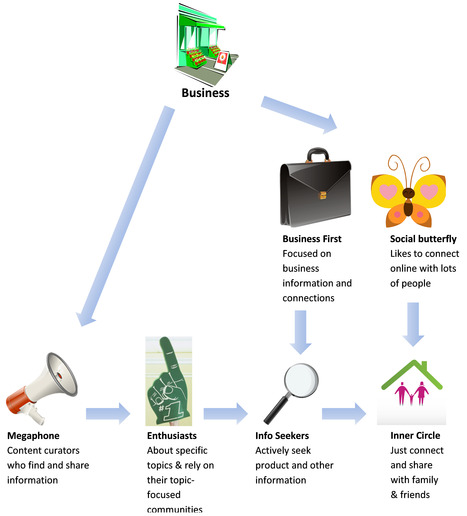
The types of connections the curator has. What’s the quantity of different types of social users following this curator: gamers, social butterflies, shoppers, deal seekers?
Reshare value. How many of this curator’s followers reshare the content, and how wide a net do they cast?
The click-through-rate for this curator’s content. How often do people open the items this curator shares?
The conversion rate resulting from this curator’s content. How often does a recommendation from this person generate sales? How often does a click through on a piece of content from this curator result in a sale?"

So curators... what's you conversion rate ?
No comment yet.
Scooped by Guillaume Decugis
March 25, 2011 12:40 PM
Scoop.it!

Brands matter to content. But so do ads.

Interesting study on the perceived quality of content and the impact of the media brand and ads.

Key take-aways:

'"Good" consumer brands confer a quality halo on editorial content.' Yes, it means good brands can bring a value to content close to the one brought by media brands. Surprising... or not?

"The obvious conclusion to draw from that finding is that owners of "good" brands may be able to cut out the publisher altogether and produce their own content" concludes Chrystia Freeland.

Something media brands can obviously be concerned about but an opportunity for brands to create a positive perception by associating curated content with their brands.
No comment yet.
Suggested by Sam
March 23, 2011 7:12 AM
Scoop.it!

‘Curation Nation’ & ‘Mediactive’: A new era in media

‘Curation Nation’ & ‘Mediactive’: A new era in media | Content curation trends | Scoop.it
JD Lesica reviews these two great books that describe a new era of participation on the Web.

Interesting excerpt (quoting Bill Gates) from Steve Rosenbaum's curation nation:

"Bill Gates uttered one of the smartest things he has ever said: “The future of search is verbs.” To me, the meaning was clear: when people search, they aren’t just looking for nouns or information; they are looking for action. They want to book a flight, reserve a table, buy a product, cure a hangover, take a class, fix a leak, resolve an argument, or occasionally find a person, for which Facebook is very handy. They mostly want to find something in order to do something. A lot of the social web is or will be directed towards helping people select stuff for other people, because the automated things get the topic, but not the meaning."
No comment yet.
Scooped by Guillaume Decugis
March 21, 2011 3:18 PM
Scoop.it!

Is every company now a media company?

Is every company now a media company? | Content curation trends | Scoop.it
Interesting interview of Tom Forenski on how every company now has to become a media:

"That's when it hit me that every company is a media company, every company has to publish to its customers, to its staff, to its communities.

Even if you make diapers you still need the skills of a media company. And in today's fragmented media world you need those skills even more than before because there is an important phenomena in media: if you establish a pole position it is very difficult for others to dislodge you.

For example, Zappos blogging in online shoe buying, have you heard of anyone else in that space? The same happens in other media sectors. People complain about the quality of Techcrunch coverage but it's in a pole position in startup coverage and so you have to live with it whether you like it or not. For companies, if they can't establish a pole position in their media space their competitors will grab it. If you are not seen online you are invisible."
No comment yet.
Scooped by Guillaume Decugis
March 16, 2011 2:13 PM
Scoop.it!

Creation, Curation, and the Ethics of Content Strategy

One of the best talks I've attended at SxSWi. By Margot Bloomstein. Very aligned with our own vision at Scoop.it.

My key take-aways:
- Curation can not be automated. Algorithm filters fail. Margot gave brilliant examples.
- Not only do they fail but they can not create a story which is what curation is about. Curation = expression
- Topic selection is the first act of curation (now you know why we start by that on scoop.it ;-))
- Curation is subjective: otherwise it doesn't add value.

Could have been a spec for Scoop.it...
Guillaume Decugis's comment, March 18, 2011 11:38 AM
Thanks! :-)
Otir's comment, March 23, 2011 7:03 PM
Great presentation, indeed, lots of valuable insights for me too.

(On another note, it's Bloomstein, not Margot Bloomfield, if you want to edit her name in your blurb, I'm sure she would appreciate :-) )
Guillaume Decugis's comment, March 23, 2011 8:28 PM
Ooops! Thanks for correcting Otir ;-) My bad. Just another proof (if needed) that the collective "watch is accurate" ;-)
Suggested by axelletess
May 23, 2011 12:27 PM
Scoop.it!

Eli Pariser: Beware online "filter bubbles"

Great TED Talk by Eli Pariser on why algorithms are not curators and what dangers these filters cause when they're invisibly at work like on the above picture where 2 users have totally different results in Google for the same keyword "Egypt" at the time of the protests.

First, before the Internet, we had human gatekeepers. Then, with the Internet, they were overflown by the amount of content out there. That's what some called information overload, or what Clay Shirky calls "Filter Failure" (see: http://bit.ly/ma2dSd).

Now, a lot of companies believe in "automated curation" which to me doesn't make sense because there is more to curation than just filtering (http://bit.ly/k3T9nc). Algorithmic filtering can help and is certainly needed but it doesn't replace human curation, an old concept now turning social on the Internet.

But there's another problem with filters. As summarized on the TED site: "As web companies strive to tailor their services (including news and search results) to our personal tastes, there's a dangerous unintended consequence: We get trapped in a "filter bubble" and don't get exposed to information that could challenge or broaden our worldview. Eli Pariser argues powerfully that this will ultimately prove to be bad for us and bad for democracy."

Algorithms limit us to a pattern without being really accountable nor being challengeable. Who can you complain to in the above Google example?

Surprising, challenging views are what we need. Subjectivity as well. Can that really be delivered by a robot?
No comment yet.
Scooped by Guillaume Decugis
May 15, 2011 12:56 PM
Scoop.it!

Gaining Authority in the Age of Digital Overload

Gaining Authority in the Age of Digital Overload | Content curation trends | Scoop.it
"Steve Rubel, EVP of Global Strategy and Insights for Edelman, explains how companies can become more influential online."

According to Steve, this boils down to a mix of things where data, expert development and content curation play a key role.

This is whole about being more relevant to produce signal in the noise as we shift to an era of content validation.

I think this is a must read for anyone interested in content publishing.
No comment yet.
Suggested by Pym
May 5, 2011 1:51 PM
Scoop.it!

Media Brands versus Curators by @steverubel

Media Brands versus Curators by @steverubel | Content curation trends | Scoop.it
An interesting explanation on the role of the curators, how they are developping, and how Media brands should consider them.

Friend? Foe? Target?
Carrie Shaw's comment, May 11, 2011 4:37 PM
I think Rubel missed the mark here... curation requires a human element; the concept of "automatic curation" is a contradiction in terms!
Pym's comment, May 12, 2011 7:04 AM
Agree that human element is essential for a good curation, but this article is I guess more interesting on the perpective it gives on the "game" with brands
Suggested by axelletess
May 4, 2011 3:43 AM
Scoop.it!

How NPR’s Andy Carvin became the Curator of the Revolution

How NPR’s Andy Carvin became the Curator of the Revolution | Content curation trends | Scoop.it
This post by Georgy Cohen has a few weeks but I think it's still very interesting as it analyzes how events now get reported from a distance through the use of social media.

As for the Ossame Bin Laden death a few days ago, Social Media give us a variety of sources producing content that you can curate from, checking and recouping facts without being on the ground.

I also like this analysis as it points out that - unlike what some critics of curation think - good curation is not about low-value-added selection of content. See how "Carvin even used his network to help debunk rumors being reported by major media organizations".

Context, context, context...
No comment yet.
Suggested by axelletess
April 23, 2011 1:37 PM
Scoop.it!

Social curation for Fashion. Makes a lot of sense.

Social curation for Fashion. Makes a lot of sense. | Content curation trends | Scoop.it
This is an interesting move. I've unsurprisingly been a great advocate of using curation for discovery. Discovery unlike search remains a very tricky problem in spite of the great web tools we have now. As this article points out, the web's history been caught between two major trends : more and more content (content explosion), more and more tools to help us manage this explosion.

Now, if there are industries where discovery does really matter and where it's a very tricky subject involving your social circle, Fashion is one of them.

So this is why seeing social curation startups address the fashion business makes a lot of sense to me. Socially curated fashion catalogs might just be what we need to decide what to wear, as author Vikram Alexei Kansara concludes.
No comment yet.
Scooped by Guillaume Decugis
April 13, 2011 1:04 PM
Scoop.it!

Can Venture Capitalize on Curation?

Can Venture Capitalize on Curation? | Content curation trends | Scoop.it
"Curation has come of age. The sheer volume of Web content, and the increasing demand of both content consumers and Web advertisers makes it clear that content without curation is simply noise."

So where's the value for VC's?

While Yuri Milner, the well-known Russian VC who made impressive bets on Facebook, Zynga and Groupon, sees Curation as the next big thing, Steve Rosenbaum explores that in this post.
No comment yet.
Scooped by Guillaume Decugis
April 4, 2011 12:19 PM
Scoop.it!

Why Google's +1 is not the social web

Why Google's +1 is not the social web | Content curation trends | Scoop.it
Great post by @axelletess on what she started to call Humanrithms at the last SxSW.

Ok, Axelle works for Scoop.it so I'm not totally objective but still, I like the word Humanrithm as it describes well the hybrid combination we need to build to create proper curation and filtering.

And Google is at the heart of it: built on algorithms, the company needs to embrace social media differently and I also fear - like Axelle - that +1 is not enough to bring signal back in the noise.
No comment yet.
Scooped by Guillaume Decugis
April 2, 2011 10:53 PM
Scoop.it!

The Economics of Blogging and The Huffington Post

The Economics of Blogging and The Huffington Post | Content curation trends | Scoop.it
Although The Huffington Post does not pay those who volunteer to write blogs for it, this content represents only a small share of its traffic. And, to put it bluntly, many of those blog posts aren't worth very much.
No comment yet.
Scooped by Guillaume Decugis
March 25, 2011 2:43 PM
Scoop.it!

Nothing is more addictive than being heard

Nothing is more addictive than being heard | Content curation trends | Scoop.it
This is a guest post I wrote for TheStartUp.eu describing how social media noise doesn't just prevent us from getting signal but also from being heard.

And how we started Scoop.it to solve that.
No comment yet.
Suggested by Otir
March 23, 2011 8:35 PM
Scoop.it!

What is curation? | One Day at a Time

What is curation? | One Day at a Time | Content curation trends | Scoop.it
I love the way Otir (a Scoop.it user: yeah!) describes curation with simple-yet-very-accurate sentences in that concise but meaningful post. In particular:

"Thanks to curation, it has become possible to find those who are passionate about a topic, and trust them to bring us very interesting finds, because their watch is accurate and it has become less time consuming to publish and share the results of what we see and appreciate."
No comment yet.
Scooped by Guillaume Decugis
March 21, 2011 3:21 PM
Scoop.it!

Curation Can Create A Snapshot Of Our Digital Lives

How will you tell your kids or grand kids stories of what you did back then in the early days of social media? For Tom Foremski, the answer is simple: curation.

"In the future, kids might ask "What did grandpa do at SXSW in 2011?" They could search the Internet and come up with a mess of tweets, photos and posts. But without much context, and without editing, that would be a poor answer to that question."
No comment yet.
Suggested by axelletess
March 17, 2011 3:07 PM
Scoop.it!

Why Curation Is Just as Important as Creation

Why Curation Is Just as Important as Creation | Content curation trends | Scoop.it
"The role of the information curator has been a contentious one, and not everyone has been on board with the concept."

A great summary of the curators' role by Steve Rosenbaum and why it's hrad for content creators to admit its importance in the new digital economy where attention is more valuable than information.
No comment yet.
✖

Get a demo of Scoop.it Enterprise

Learn how content curation can help your company.
* Mandatory fields