Your new post is loading...
Vancouver, July 2025 — The Canadian Vocational Association (CVA-ACFP) delivered a DACUM I training workshop in Vancouver, British Columbia, for a select group of professionals from WorkSafeBC. The five-day training, led by John Avery (President of CVA-ACFP and DACUM trainer) and Bruno Chauvel (CVA-ACFP DACUM trainer), marked a significant milestone in the advancement of competency-based methodologies within WorkSafeBC, British Columbia’s provincial agency responsible for promoting workplace health and safety, preventing injuries, and supporting return-to-work programmes for injured workers.
This research contributes to global discussions on the future of VET in the context of rapid technological change. It also highlights how automation risk assessments can support curriculum development by identifying where updates or innovations are most needed. Strengthening the alignment between training programs and emerging labor market demands will be essential to ensuring inclusive, future-oriented vocational education.
A powerful new white paper by Tom Chatfield explores how AI is reshaping learning — and what educators must do to protect (and elevate) human skills.
For the VET community, it’s a timely guide to building AI-ready teaching, assessment and workforce skills.
🔑 Key Takeaways
📚 Human learning first
• AI should support, not replace, reasoning, metacognition and judgment.
• Over-reliance risks weakening the core skills VET graduates need.
🧠 AI demands stronger metacognition
• Learners must monitor their thinking, question outputs, verify information.
• This becomes a foundational vocational skill across all sectors.
🤝 Social learning still wins
• AI can simulate dialogue, but trust, collaboration and peer learning remain irreplaceable.
• These are key to adaptability in modern workplaces.
🔧 Use tech to enhance, not distract
• Effective edtech extends human capability and requires structured pedagogy.
• Train learners how to use AI safely, critically and creatively.
🛑 Don’t fight an AI cheating war
• Detection tools don’t work.
• Ask students to document how they used AI and reflect on their decisions.
💬 Rethink assessment
• Shift from product to process: reasoning, iteration, oral exams, portfolios.
• Perfect alignment with VET’s competency-based approach.
📈 Raise the cognitive bar
• Use AI as a “sparring partner” that deepens learning, not a shortcut.
• Teachers become designers of learning systems, not content deliverers.
🎯 Why this matters for VET
• AI literacy, judgment and adaptability are becoming essential labour-market skills.
• Employers expect graduates who can work with AI, challenge it and create value.
• This white paper offers clear principles to build future-capable VET systems.
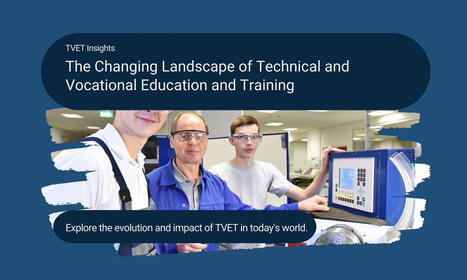
In the rapidly changing technological and workforce context, the world of Technical, Vocational Education and Training (TVET), stands at an important moment. The following blog post explores the merger of TVET with Artificial Intelligence (AI) and how such amalgamation will propel TVET into the future. It guarantees the relevance, adaptability, and inclusion of tomorrow's workforce in today's preparation.
Understanding TVET's Core
At its essence, TVET serves as the principal bridge between the world of education and work. It achieves this goal by offering the subjects, theoretical knowledge and practical skills that adequately respond to the requirements of an occupation. In addition to the numerous economic benefits and impact on a country's GDP, TVET plays a critical role in the social inclusion of disenfranchised individuals. It gives them a clear and defined pathway to empowerment and upward career mobility.
Discover how the changing world of TVET is embracing technology, AI, and digital skills to shape the future of skills development. This blog explores the evolving landscape of technical and vocational education, emphasising the importance of adaptability and innovation in today's job market. Join us
This Compendium presents practical examples of interventions promoting green jobs and skills for green jobs, that were supported by development partners from the G7 and the European Union (EU). Each case, demonstrating proof of impact and responding to a set of quality criteria, has been documented to foster learning and knowledge sharing among practitioners.
In many Technical and Vocational Education and Training (TVET) systems, the discussion about transformation has traditionally focused on infrastructure, curricula, and technology. However, increasing research suggests that the most influential factor for reform lies elsewhere — in the leadership ability of those who manage institutions from within. The question today is not whether leadership is important, but how leadership capacity can be developed in a sustainable, contextual, and evidence-based way.
The green transition is reshaping labour markets, creating demand for a workforce able to support low-carbon economies. Vocational education and training (VET) plays a key role in preparing workers for green jobs, especially in sectors like construction, transport, and energy. Nearly one-quarter of young VET graduates work in “green-driven” jobs – more than their tertiary-educated peers. These jobs range from newly emerging, high-skill positions to evolving mid-skill roles that VET graduates often fill. However, many also work in high-emission sectors at risk of decline, making targeted reskilling essential. In response, VET systems may need to adapt quickly. This includes updating curricula in line with labour market intelligence, expanding access to post-secondary technical education, facilitating transitions out of carbon-intensive industries, strengthening inclusive career guidance, and embedding transferable core skills in all programmes.
In autumn 2025, seven updated vocational apprenticeship occupations have come into effect in Germany. The Federal Institute for Vocational Education and Training (BIBB), together with partners from industry, trade unions, and government, is responding to evolving technological, environmental, and social demands in the labour market.
This resource will help TVET stakeholders reflect upon, and share knowledge about, the challenges and opportunities facing TVET systems. The Atlas works within the BILT framework of three I’s: identification, integration and implementation of new qualifications and competencies in TVET. It has a special focus on the twin transition of greening and digitalization affecting the future of work and society. The three I’s - Identifying new qualifications and competencies in a timely and accurate manner
- Integrating them into appealing and flexible curricula and training regulations
- Implementing them in innovative training approaches
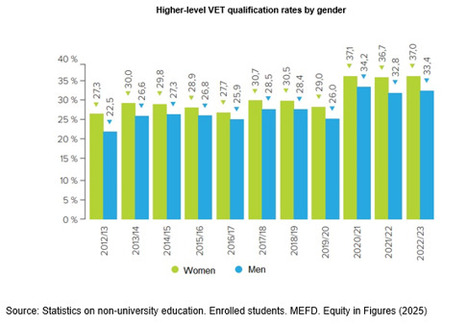
More women in Spain are enrolling in vocational education and training (VET), with recent data showing steady growth in participation and qualification rates across levels and professional branches.
The government's efforts to transform and modernise vocational training over the last six years have contributed to a new record in enrolment figure of 1 193 260 students in the 2024/25 academic year. Although females still participate more in upper secondary general education, more and more are engaging in VET programmes.
This report examines the progress made over two decades (2000-2020) in transforming lifelong learning into a reality for individuals in Europe. The study finds that, while significant progress has been made in promoting flexible and inclusive education and training systems, barriers and challenges remain.
Key changes include increased opportunities for personalisation of learning experiences, expansion of quality education and training pathways with improved accessibility, and easier portability of qualifications across countries. However, challenges persist.
These include fragmented strategies and limited coordination between sectors, implementation hurdles, underuse and underdevelopment of credit systems and quality assurance frameworks, low uptake of validation of non-formal and informal learning, and variations in the recognition of qualifications.
The report provides policy recommendations to address these challenges, including promoting a cohesive strategy with stronger cross-system stakeholder collaboration, integrating non-formal and informal learning, and strengthening the capacity of institutions and stakeholders to further support their implementation.
The report explores the causes and magnitude of anticipated skills shortages through at least 2032. It also examines potential strategies to address impending skills shortages and mitigate their economic impacts.
|
This study examines the challenges and opportunities presented by equity, inclusiveness, and the digital divide in the adoption of Artificial Intelligence (AI) within Technical and Vocational Education and Training (TVET) institutions in Zimbabwe. The study adopted mixed methods design, employing quantitative surveys to map infrastructural and device equity disparities (the digital divide) and qualitative critical ethnography. It used a sample size totalling 5 TVET institutions and 50 key informants. Quantitative data was analysed using frequency distributions to map the prevalence of infrastructural disparities and regression analysis to determine the statistical significance of access gaps related to socio-economic factors. Qualitative data was analysed using thematic analysis to identify, analyse, and report patterns (themes) within the interview and focus group data. Findings revealed significant disparities in AI readiness, with urban institutions generally better equipped. Challenges such as limited funding and high internet costs disproportionately affect marginalized groups. The study concludes that while AI has transformative potential for TVET, equitable adoption is obstructed by systemic inequities and the digital divide. Key recommendations include investing in digital infrastructure, creating national AI strategies for TVET, integrating digital literacy into curricula, and fostering public-private partnerships for AI training.
This article compares gender disparities in access, learning outcomes, and school-to-work transitions (STWT) among dual Vocational Education and Training (dVET) apprentices in Mexico. Drawing on data from a longitudinal research project, the study includes in-depth interviews with 60 apprentices, conducted at the start of dVET and after graduation. The qualitative analysis compares apprentices' opportunities by gender and field of study, distinguishing between traditionally male- or female-dominated areas. The findings reveal significant gender differences in access to dVET highlighting the critical roles played by family and teacher support, as well as peer information. Additionally, the analysis indicates that female apprentices in male-dominated fields face disadvantages with gender-related stereotypes persisting in both educational and workplace environments. Moreover, STWT results suggest that male apprentices experienced greater advantages in fulfilling their expectations. Our results contribute to the broader discussions on gender, equality, and inclusion within comparative dVET studies, emphasizing the need for targeted interventions.
Given the dazzling array of technological advancements and pressing environmental issues this world teems with, one could say that TVET is, in many ways, is the bridge between advancement and sustainability. In perfect harmony with the United Nations Sustainable Development Goals (SDGs), the lifeblood of enriched education and extended job opportunities infuses the TVET landscape with a vision of a brighter future.
In the World of TVET, we must have an unquenchable passion for the highest education and skill development standards. Behind our passion stands Quality Assurance (QA), the ray of light that drives constant growth of a program, that guides our students on their learning and skills acquisition journey.
QA is more than just a buzzword or a set of guidelines. It is a promise addressed to our organisation, associates, and, most significantly, students. It is about engendering and fostering a culture of excellence, responsibility, and our ceaseless drive for improvement. It is about laying out a roadmap of goals and ensuring we evaluate against the returnee's expectations in the sectors we serve and the international state-of-the-art we aspire to conform to. The journey of introspection and growth includes annual self-assessment reports, external audits, and stakeholder engagement. These activities represent the central avenue and beacon for a trajectory of continued goal-seeking and transformation.
The evidence presented, which is complemented by reflections on the suitability, effectiveness and sustainability of the selected instruments, will help policymakers to introduce better targeted and more effective incentives that benefit learners, employers and societies.
This Handbook offers practical guidance for measuring and assessing green jobs and skills for green jobs within in the context of monitoring, evaluation, and learning (MEL).
All you need to know about our impactful Online Freelancer Training that prepares individuals to succeed in the digital economy and the new world of work.
Across the globe, the world of work is changing rapidly. Traditional jobs with fixed hours and secure contracts are giving way to more flexible, task-based work. Much of this new work happens online, mediated through platforms and apps that connect people who want to work with those who need a task done—also known as the gig economy.
For many, especially in regions with high youth unemployment or limited access to formal jobs, this change brings opportunity. In places such as Africa, Southeast Asia, and Latin America, more young people and women are turning to online freelancing to earn an income, often from home or shared community spaces. Yet, this digital shift is not without challenges. It brings new risks, such as unstable incomes, lack of job security, and danger of exploitation if not navigated correctly.
Micro-credentials are impacting upon universities around the world. Offering flexible skills-focused short learning, they are increasingly popular among higher education students, professional learners and employers. University World News explores how micro-credentials are driving changes to learning, qualifications and collaboration with industry.
This study explores the use of analytical artificial intelligence (AI) to enhance lesson planning in teacher education, particularly in vocational business education. Providing detailed, individualized feedback for lesson planning is challenging for university instructors. An analytical AI platform that offers expert-level feedback on lesson plans could be a suitable supplement to traditional feedback as it balances out critical aspects of generative AI systems. In a longitudinal study with 103 participants, an experimental group received AI feedback on the lesson plans they developed throughout a semester, while a control group received human feedback. Results indicate that AI feedback can match or surpass human feedback in some dimensions, improving planning aspects like certain content-related sustainability aspects, action orientation, relatedness or even technology use, lesson structure, and learner engagement. Besides the integration of didactic planning dimensions into the lesson plans, this study looked at student motivation, self-reported AI literacy, AI attitudes, self-efficacy with digital technologies and digital competences. Results of these meta-dimensions show that the mere use of AI does not automatically enhance AI literacy, change attitudes or improve motivation. The study suggests that as a consequence, analytical AI platforms can effectively supplement traditional feedback but should be used within a holistic framework.
The dual system in Austria depends on companies’ willing and ability to train apprentices. This is done on a voluntary basis and, so businesses must weigh the costs against the benefits. The latest analyses reveal that this investment pays off for many businesses, both economically and through various non-monetary benefits.
Since the 1970s, regular studies have assessed the costs and benefits of company-based training. At the end of 2024, a report on the professional image screening was published, providing a cost-benefit analysis of apprenticeship training.
This report offers an overview and analysis of WBL in Serbia, providing insights into various aspects of its design and implementation. The key messages highlight the importance of aligning the country’s WBL practices with the European quality criteria, emphasising the progress made in recent years, while identifying areas for further improvement. The findings cover WBL in initial vocational education and training (IVET), WBL in continuing vocational education and training (CVET), and WBL in active labour market programmes (ALMPs)
Ministers responsible for Vocational Education and Training (VET) from across Europe convened in Herning, Denmark, on 11 September to endorse “The Herning Declaration on attractive and inclusive Vocational Education and Training for increased competitiveness and quality jobs 2026-2030”. The forward-looking Declaration marks a pivotal moment for European skills policy as the continent leads digital and green transformations to meet economic competitiveness challenges
Artificial intelligence (AI) is reshaping the way we learn, teach and make sense of the world around us, but it is doing so unequally. While one-third of humanity remains offline, access to the most cutting-edge AI models is reserved for those with subscriptions, infrastructure and linguistic advantage. These disparities not only restrict who can use AI, but also determine whose knowledge, values and languages dominate the systems that increasingly influence education. This anthology explores the philosophical, ethical and pedagogical dilemmas posed by disruptive influence of AI in education. Bringing together insights from global thinkers, leaders and changemakers, the collection challenges assumptions, surfaces frictions, provokes contestation, and sparks audacious new visions for equitable human-machine co-creation. Covering themes from dismantling outdated assessment systems to cultivating an ethics of care, the 21 think pieces in this volume take a step towards building a global commons for dialogue and action, a shared space to think together, debate across differences, and reimagine inclusive education in the age of AI. Building on UNESCO’s Recommendation on the Ethics of AI, its Guidance on Generative AI in Education and Research and its twin AI competency frameworks for teachers and students, such a global commons can direct collective sense-making and bold reimagination around curricula, pedagogy, governance and policy with human rights, justice and inclusion at its core. Cutting-edge AI models empower some, while 1/3 of humanity remains offline
|