|
Scooped by
Adrian Bahan (MNPS)
onto UNIT VI April 5, 2016 9:35 AM
|
 Scoop.it!

No comment yet.
Sign up to comment

|
|
Scooped by
Adrian Bahan (MNPS)
onto UNIT VI April 5, 2016 9:35 AM
|
Scoop.it!

 Your new post is loading...
 Your new post is loading...
Your new post is loading...
Scoop.it!
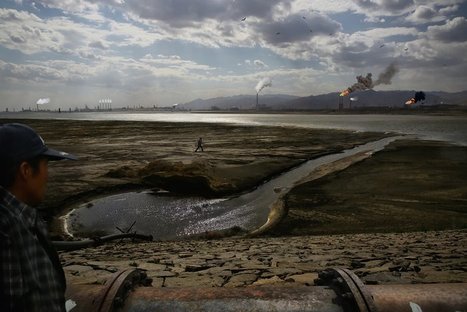
This series of images shows the extent of China’s pollution problems and the human toll of exponential growth on local communities in China’s vast and severely damaged northern region
Ghazlan Mandukai, 52, left, looks out over the vast, toxic tailings lake beyond the industrial city of Baotou, Inner Mongolia. He farmed in this area for 40 years until the influx of steel and rare earth metal factories rendered local lands infertile. Poisonous waste that results from refining rare earths is continually dumped into the Weikuang Dam, as seen here.
Tags: pollution, China, East Asia, industry, sustainability, images, art, landscape.

Keone Sinnott-Suardana's curator insight,
June 22, 2016 10:21 PM

Nicole Canova's curator insight,
May 1, 2018 10:30 PM
China has one of the fastest-growing economies in the world: but at what cost? They make themselves competitive in global markets by delivering goods and services at low prices, which they achieve through under-paying workers, not using resources to ensure workers' safety, and polluting the environment by ignoring protocols for safely disposing of waste products, which costs time and money. The result is air that is unsafe to breathe, millions of people and animals with poisoned water supplies, and land that cannot be farmed.

Matt Danielson's curator insight,
December 12, 2018 3:39 PM
CHina's pollution issues are pretty bad, possibly the worst polluter in the world. The air quality can be so terrible it reminds me of Industrial revolution London, except Chinese cities are even worse. Not just air pollution from smoke stacks but land pollution from dirty mining and water pollution in rivers from factories all play key roles in China's pollution problem. Some estimates put the number as high as a million Chinese deaths per a year attributed to pollution. This article does a good job of breaking down the pollution issue into simple terms.
Scoop.it!
From
nist

NIST MEP infographics are visual representations that emphasizes the importance of manufacturing to America and the economy.
Scoop.it!
From
visual
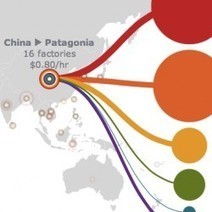
This dynamic map shows where major garment companies outsource manufacturing. Displaying companies by annual revenue highlights some of the industry's
Scoop.it!

View infographics from USAID on food security, gender equality, education, and other key topics related to ending extreme poverty.
Scoop.it!
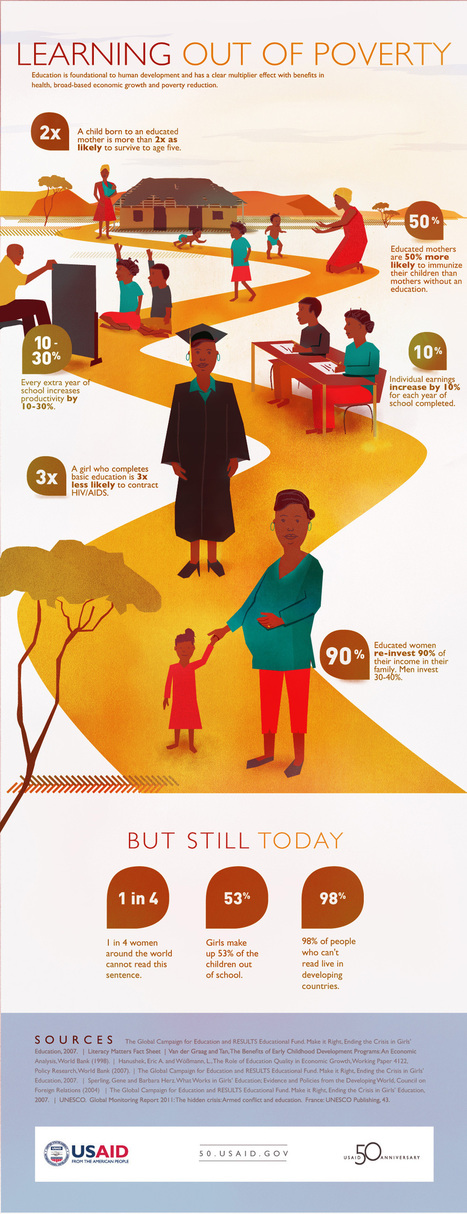
An excellent infographic that highlights the importance of education in the process of fighting poverty. Why is education (especially women) so pivotal for development? Should this change how we think about humanitarian aid?

Fiqah Nasrin's curator insight,
January 27, 2014 8:37 AM
From this article i get to know that a child who born to an educated mother will benefit more than a child who born to mothers without an education. Quite a number of women in the world are without a proper education. Is it fair to women without a proper education to be condemn to be told that their child will do poorly rather than a child of an educated mothers. Their child would eventually suceed through hard work and support from their family. 
Zemus Koh's curator insight,
January 27, 2014 10:11 AM
From this infographic, I can see the importance of education and how it can impact us in our lives. Education is key as it can help us in many ways such as being able to teach our offspings survival skills and also help us to earn more so that we can bring up a family and support them. However important education is, it still comes with a price. As such, many are deprived of this oppurtunity to be educated even though education is somewhat considered a neccessity. Other benefits of education to women include a lesser chance of contracting STDs and also having a higher chance to immunize their children compared to non-educated women. Since education is a key to survival and an important part in our lives, why is it that no effort is made to promote this or to fund more projects that help the less fortunate to get a chance to be educated?
Fiqah Nasrin's curator insight,
February 23, 2014 7:28 AM
This article tells me that a child who born to an educated mother will benefit more than a child who born to mothers without an education. Quite a number of women in the world are without a proper education. Is it fair to women without a proper education to be condemn to be told that their child will do poorly rather than a child of an educated mothers. Their child would eventually succeed through hard work and support from their family. It stated that most children who drop out from school are girls and most of the people cant read live in developing countries. In this century i am sure that proper education are given to those who could not afford it as everyone want to succeed. I think that it does not matter if a child's mother is without an education as they can succeed if they work hard and opportunity is given to them.
Scoop.it!

"It’s not just a sausage in a bun; it’s a beautiful blank canvas. It’s a hot dog, which is a foodstuff eaten worldwide. Here are 40 distinctive varieties from around the globe — from iconic NYC 'dirty water dogs' to fully loaded South American street-cart dogs to Japanese octo-dogs. There is a tubesteak out there for every craving that ever was."
Adrian Bahan (MNPS)'s insight:
The 4th of July is the day of Coney Island's Hot Dog eating contest and the quintessential day to have a barbeque in the United States. Some see the hot dog as a mere symbol of the uniformity of globalized culture in the 21st century that diffused out from the United States. There is much more to be seen in the globalization of food. Yes, the global goes to the whole world, but distinct places make this global cultural trait intensely local. For example the hot dogs in Cincinnati are famous for being topped with chili and an obscene quantity of cheese, but in Costa Rica, I learned to love eating hot dogs deep fried, topped with cabbage, mayo and ketchup, just like the Ticos. Food is but one example of this phenomena known as glocalization, where diffusion and divergence keep the world both global and local. Tags: food, culture, diffusion, globalization, consumption.

Geography's curator insight,
July 6, 2015 2:21 PM
While we often think of the Chicago Dog in the midwest, there's quite a variety out there! Which would you try and which is your favorite? 
Jose Soto's curator insight,
August 5, 2015 9:50 PM
The 4th of July is the day of Coney Island's Hot Dog eating contest and the quintessential day to have a barbeque in the United States. Some see the hot dog as a mere symbol of the uniformity of globalized culture in the 21st century that diffused out from the United States. There is much more to be seen in the globalization of food. Yes, the global goes to the whole world, but distinct places make this global cultural trait intensely local. For example the hot dogs in Cincinnati are famous for being topped with chili and an obscene quantity of cheese, but in Costa Rica, I learned to love eating hot dogs deep fried, topped with cabbage, mayo and ketchup, just like the Ticos. Food is but one example of this phenomena known as glocalization, where diffusion and divergence keep the world both global and local.
Tags: food, culture, diffusion, globalization, consumption. 
Colleen Blankenship's curator insight,
February 14, 2019 12:03 PM
What are the cultural connections of the hot dogs, toppings, and buns with the areas with which they are associated?
Scoop.it!
"The reason why some countries are rich and others poor depends on the quality of their institutions, the culture they have, the natural resources they find and what latitude they're on." Tags: development, statistics, economic, globalization, poverty.
Adrian Bahan (MNPS)'s insight:
I can't say I agree with all the arguments put forward in this video, it can still be a nice starting point to get students to critically analyze the ideas put forth and assess the merits of the claims being made.

Henk Trimp's curator insight,
June 12, 2015 6:26 AM
Questionable, but intriguing contribution to an ever continuing discussion... 
Kaitlyn Evans's comment,
July 30, 2015 5:24 AM
I'm not sure if I believe everything this video stated, however I think it is a good topic to analyze. I think it would be interesting to see how the rich countries became rich. They can't just have started on top. I also believe the rich countries abuse the poor countries because we can get goods/minerals/just about anything for a small price and then sell it in the rich country for much more.
Scoop.it!
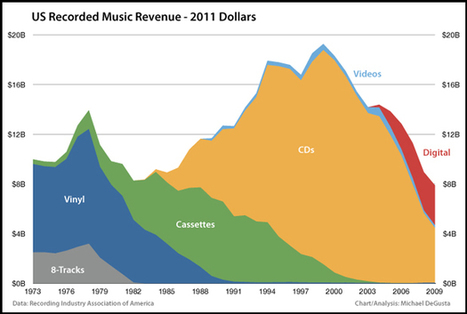
It's much worse than people realize.

Luis Cesar Nunes's curator insight,
March 31, 2015 7:48 AM
We are becoming obsolete as a Charlie Chaplin film, perpetuate the grace of the silent film as the industry is all forward-talkie.
Colleen Blankenship's curator insight,
March 30, 2016 12:11 PM
The relatively recent decline of music industry, as well as the newspaper industry, are good examples to teach the concept of creative destruction. As jobs are created through new emerging technologies, older jobs will be rendered obsolete and be 'destroyed.' While many bemoan the loss of particular jobs as regrettable, it is a part of globalization of economic geography that as jobs are created with new technologies, other jobs disappear. Indoor plumbing meant the death of the water-carrying guilds (while I might be sad they lost their jobs, I'm keeping my plumbing). The trick is to make these transitions smooth and to prepare the labor force to have skills that the new economy will demand so that individual families and workers aren't casualties of this 'creative destruction' process. Tags: economic, labor, globalization, unit 6 industry. 
BrianCaldwell7's curator insight,
April 5, 2016 8:12 AM
The relatively recent decline of music industry, as well as the newspaper industry, are good examples to teach the concept of creative destruction. As jobs are created through new emerging technologies, older jobs will be rendered obsolete and be 'destroyed.' While many bemoan the loss of particular jobs as regrettable, it is a part of globalization of economic geography that as jobs are created with new technologies, other jobs disappear. Indoor plumbing meant the death of the water-carrying guilds (while I might be sad they lost their jobs, I'm keeping my plumbing). The trick is to make these transitions smooth and to prepare the labor force to have skills that the new economy will demand so that individual families and workers aren't casualties of this 'creative destruction' process. Tags: economic, labor, globalization, unit 6 industry.
Scoop.it!
What is financial inclusion? No-frills bank accounts? Mobile money? Microloans? In this short, animated video, we learn how financial inclusion can improve l... Via KRII-KROTOASA RESEARCH-INTENSIVE INSTITUTE
Scoop.it!
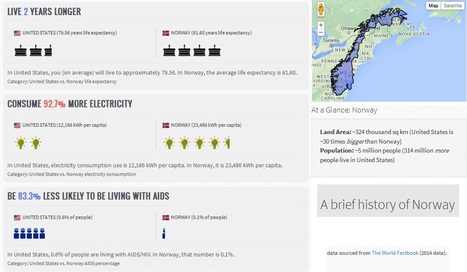
"MyLifeElsewhere allows you to compare your home country with different countries around the world. Ever wonder what your life would be like if you were born somewhere else?"

's curator insight, January 31, 2015 1:56 AM
Un site d'une grande simplicité d'utilisation bien qu'en anglais. Le principe est de choisir deux pays dans un menu déroulant pour en comparer les principaux indicateurs de développement sous la forme de petites infographies très pédagogiques. Dernière information sur ce site, les statistiques utilisées proviennent des bases de données open source de la CIA américaine. 
Brian Wilk's curator insight,
February 7, 2015 7:51 PM
After studying this comparison tool and using it to find the best of the best and worst of the worst, I picked out some highlights I'd like to share. Monaco is clearly the place to be born, earn, and live. When compared to the USA, the infant mortality rate is 71% less, the life expectancy is 10 years longer @ 84, and you'll earn 62% more money, no doubt because you have ten more years in which to do so. I believe the stats may be skewed a bit in this country comparison as the very rich live there and they have access to the best medical care, and probably don't have very many infants with them when they make the move from elsewhere, hence the low infant mortality rate. Austria is not a bad second choice as you are 33% less likely to be unemployed. On a sobering note, the life expectancy if you live in Namibia is only 52! Yikes, I'm already 53... It's far worse however in Swaziland. The life expectancy is sadly only 50.5 years and you are 44 times more likely to have AIDS than if you lived here. 26.5% of the population has AIDS! Be thankful for where you live and stop complaining, it's far worse on average in nearly all other countries. 
Monika Fleischmann's curator insight,
February 15, 2015 4:59 AM
Seth Dixon's insight:
Did you know that with 1/30th the territory of the United States, Norway still has over 25% more coastline? I didn't either until I compared Norway to the United States using My Life Elsewhere. This site is designed allow United States students to imagine how their lives might be different if they were born in a different part of the world. Students would probably die 21 years earlier if they were born in Liberia and 11 times more likely to have died in infancy. Students would be 43.8% less likely to grow up and be unemployed and have 36.3% less babies if they were born in Taiwan. This side-by-side format is a great way to help students help make these statistics real and meaningful. One major drawback: this site only allows users to compare a country to the United States. If you prefer to have students compare, say Cuba to the United Arab Emirates, I would recommend that you try If It Where My Home.
Scoop.it!
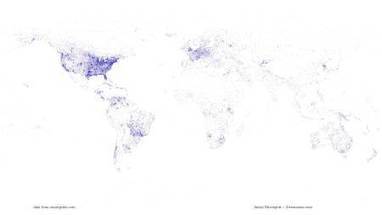
Geography can be difficult to teach - sometimes it can seem like it's mostly just facts and places. Regions. Types of mining in different places. Weather patterns. Vegetation. Lots of, well . . . b...
Scoop.it!
|
|
|
Scooped by
Adrian Bahan (MNPS)
March 11, 2014 12:41 PM
|
Scoop.it!
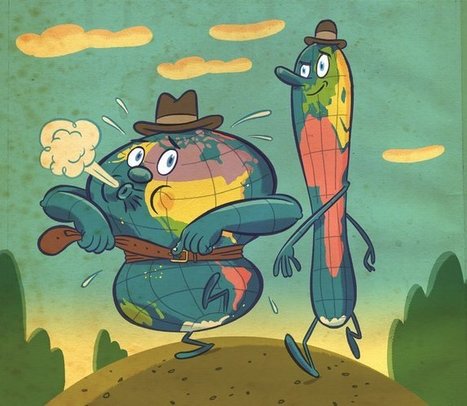
The old labels no longer apply. Rich countries need to learn from poor ones.
BILL GATES, in his foundation’s annual letter, declared that “the terms ‘developing countries’ and ‘developed countries’ have outlived their usefulness.” He’s right. If we want to understand the modern global economy, we need a better vocabulary.
Mr. Gates was making a point about improvements in income and gross domestic product; unfortunately, these formal measures generate categories that tend to obscure obvious distinctions. Only when employing a crude “development” binary could anyone lump Mozambique and Mexico together.
It’s tough to pick a satisfying replacement. Talk of first, second and third worlds is passé, and it’s hard to bear the Dickensian awkwardness of “industrialized nations.” Forget, too, the more recent jargon about the “global south” and “global north.” It makes little sense to counterpose poor countries with “the West” when many of the biggest economic success stories in the past few decades have come from the East.
All of these antiquated terms imply that any given country is “developing” toward something, and that there is only one way to get there.
It’s time that we start describing the world as “fat” or “lean.”

Fat and Lean nations... let's see if it sticks...

Fat or Lean - what sort of world do we live in
An interesting discussion on the way we perceive and label the world.

Hoy en día poca claridad de dónde exactamente queda y quiénes son?
|
|
Scooped by
Adrian Bahan (MNPS)
April 4, 2016 11:23 PM
|
Scoop.it!

This post contains an infographic, report, and interactive map to explain the current state of US Manufacturing employment.
|
|
Scooped by
Adrian Bahan (MNPS)
March 31, 2016 11:58 AM
|
Scoop.it!

Who has the oil? http://pic.twitter.com/7Njc7OD8rw
Natural resources are not evenly distributed...this distribution pattern impacts global economics, industrialization, development and politics tremendously.
Tags: industry, economic, energy, resources.

it is the distribution of resources which has made the middle east as important as it is. it is interesting to note that this is also one of the most politically backwards places on the globe.

Natural resources are not evenly distributed...this distribution pattern impacts global economics, industrialization, development and politics tremendously.
Tags: industry, economic, energy, resources.
|
|
Scooped by
Adrian Bahan (MNPS)
March 14, 2016 8:12 PM
|
Scoop.it!
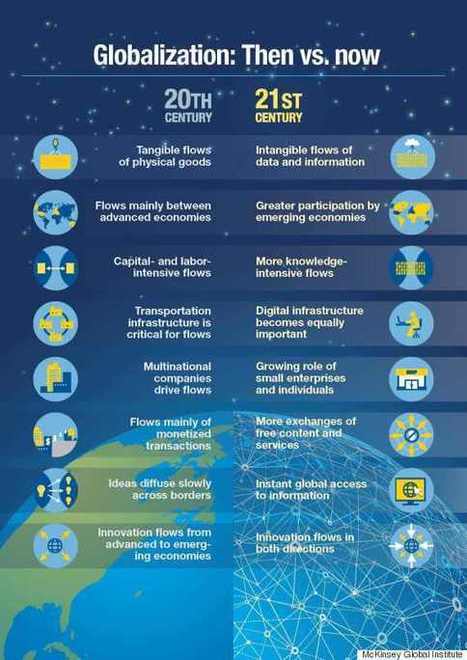
"Yes, globalization. For many people, that word conjures up, at best, images of container ships moving manufactured goods from far-flung factories. At worst, it harkens back to acrid debates about trade deficits, currency wars and jobs moving to China. In fact, since the Great Recession of 2008, the global flow of goods and services has flattened, and cross-border capital flows have declined sharply. But globalization overall isn't on the wane. Like so much in our world today, it has reinvented itself by going digital."
Tags: technology, globalization, diffusion, industry, economic.


This chart is pretty straight forward, yet it clearly lays out the difference between 20th and 21st century Globalization patterns. Through modern invention and progress in technology the world has become a place where connections can be created at the speed of light. Through technology, the world no longer has to wait for the physical movement of goods and ideas, at the touch of a button information can be in anyone's hands
|
|
Scooped by
Adrian Bahan (MNPS)
March 14, 2016 8:04 PM
|
Scoop.it!
"LIVING IN THE AGE OF AIRPLANES is a story about how the airplane has changed the world. Filmed in 18 countries across all 7 continents, it renews our appreciation for one of the most extraordinary and awe-inspiring aspects of the modern world." airplanesmovie.com
I was absolutely delighted to see this film on the big screen...it was as visually stunning as any film I'd ever seen. I and my young children were mesmerized. So much of the modern world that we take for granted is absolutely revolutionary. This is a great teacher's guide to teaching with this film.
Tags: transportation, globalization, diffusion, industry, economic, National Geographic, video, visualization.
|
|
Scooped by
Adrian Bahan (MNPS)
February 10, 2015 6:17 PM
|
Scoop.it!

Which statement is true?
A. 60% of all households without toilets in the world are in India.
B. India’s Muslims are less affected by the sanitation problem than Hindus.
C. India’s lack of toilets is worse than China’s.
D. Lack of toilets in India puts women at especially high risk.

I was unpleasantly surprised to learn that all these statements are indeed true. Reading about the struggles India has endured with the lack of indoor plumbing many of its people must endure made me think of a previous article I had read about the "Two Mexico's." Rapid development in certain areas for certain people has revolutionized the standard of living for some, but the persistence of corruption has lead to economic lag for many of the people of both nations, meaning significant portions of the population are being left behind during this period of development. The sanitation and plumbing systems of inca are woefully inadequate for a country of over a billion people, subtracting from the leaps that have been made in other areas. The dangers faced by women as a result of the lack of indoor plumbing was a surprise, although it does make sense. Millions of Indian women have to resort to walking to communal bathrooms, oftentimes at night on solitary trips, which leaves them vulnerable to the kids of sexual assault that have plagued Indian media. I hope for the sake of the Indian people that improvements in the rates of indoor plumbing in the country continue to be made.

One thing about this issue is the fact that most of the people living in the area dont have the proper sanitation. Many of the issues that they face are a lack of government and funding and jobs. However the issue in India is the worst within the world. China has a huge lack of sanitation but in India the situation is much worse.
|
|
Scooped by
Adrian Bahan (MNPS)
February 10, 2015 9:24 AM
|
Scoop.it!
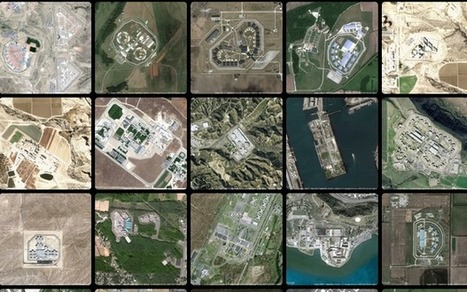
America has more than 5,000 prisons. This is what they look like on our landscape.
Begley’s images capture the massive scale of this entire industry and the land that we devote to it (America has less than 5 percent of the world’s population but houses a quarter of the world’s prisoners). His website, in fact, includes only about 14 percent of all of the prisons he’s captured (each one is scaled to the same size).
Tags: remote sensing, land use, geospatial, landscape.

This article is interesting from a geographic and social perspective, because the overhead pictures show just how much we alter the land with our prisons. What is really interesting is how the US has less than five percent of the world's population but has one quarter of its prisoners. Because of this, it can be inferred that the country has many prisons. Yet, what astonished me about the prisons is that they seem to be out in the middle of nowhere. The buildings seem expansive on the landscape and dominate it. It just makes me wonder, how much does the United States spend on building and up-keeping these complexes.

This article explores a graphic representation of the quantity and volume of prisons throughout the United States. The project has no figures, statistics, or words - the pictures stand on their own as statements about the growing amount and size of prisons across the country. The photos show many rural prisons that house prisoners from urban areas, which changes both the areas where the prisons are and the areas that the inmates came from.
The photos are an intriguing visual of the money and materials put into prison systems in the United States. The photographer (Josh Begley) noted that upon seeing all the images together, the thing that stood out to him was that there were baseball fields in almost all of them. He says, "the baseball field mimicked the form about these buildings as well. There was something very American about it when I first saw it."
It's surprising to see how much material is necessary to, as the article described it, "warehouse" people. While prisons do more than just house inmates, seeing a visual representation of all the money put into prisons in the United States makes me wonder whether it could be better spent on reformed versions of prisons, rather than on maintaining the ones we already have and the new ones just like those that are currently being constructed.
- K

These picture demonstrate the power of satellite imagery and technology perfectly. While I am amazed by the sheer beauty in spatial organization and design by these prisons, I am horrified at the maps incarcerations that are occurring in America, especially the mass incarceration of poverty stricken minorities in America. Prisons demonstrate a larger social issue than what I previously thought. I never knew that such a thing as prison-based gerrymandering could even exist. Prisons demonstrate economic and political problems as well. With more prisons, state must allocate more of their budget to supporting these facilities. The fact that so many prisons are being built demonstrate a larger problem in the political world, and that maybe there is an issue with the justice system. Fixing the system would allow for states to allocate more money that would have been use on supporting prisons to supporting education and helping those who are less privileged.
|
|
Scooped by
Adrian Bahan (MNPS)
September 24, 2014 1:08 AM
|
Scoop.it!
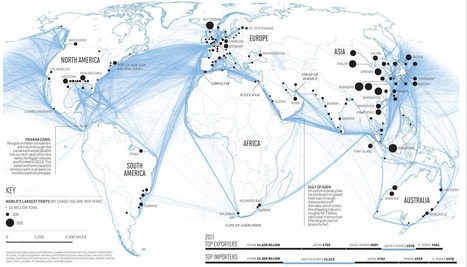
Commerce knits the modern world together in a way that nothing else quite does. Almost anything you own these days is the result of a complicated web of global interactions. And there's no better way to depict those interactions than some maps.
|
|
Rescooped by
Adrian Bahan (MNPS)
from Geog 200
March 11, 2014 12:49 PM
|
Scoop.it!
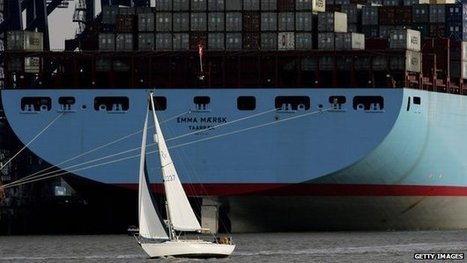
What is blue, a quarter of a mile long, and taller than London's Olympic stadium? The answer - this year's new class of container ship, the Triple E. When it goes into service this June, it will be the largest vessel ploughing the sea. Each will contain as much steel as eight Eiffel Towers and have a capacity equivalent to 18,000 20-foot containers (TEU).

These vessels are specifically made to increase more profit and is a symbol of economic power for trades between Europe and Asia. They aim to increase containment of cargo so it is more efficient and time consuming of going back to fourth. However, they forced ports to become bigger to compete and keep up with these new inventions. These ships are getting too big and are only able to transit through the Suez canal and cannot go through the Panama. This lead to the Chinese expanding their reach to Nicaragua and building a larger canal to be able to pass through Central America.

These containers are symbols of global commerce that enable economies of scale to be profitable and the outsourcing of so many manufacturing jobs to developing countries. The invention of these containers have changed the geography of global shipping and the vast majority of the world's largest ports are now in East Asia. Today though, the biggest container ships are too big to go through the Panama Canal, encouraging China to build a larger canal through Nicaragua.
These containers are symbols of global commerce that enable economies of scale to be profitable and the outsourcing of so many manufacturing jobs to developing countries. The invention of these containers have changed the geography of global shipping and the vast majority of the world's largest ports are now in East Asia. Today though, the biggest container ships are too big to go through the Panama Canal, encouraging China to build a larger canal through Nicaragua.
Tags: transportation, globalization, diffusion, industry, economic.