UNIT II APHuG
367 views | +0 today
Follow
UNIT II APHuG
Population and Migration
Your new post is loading...
Scooped by Adrian Bahan (MNPS)
September 30, 2014 5:59 PM
Scoop.it!

Mapping Europe's war on immigration - Le Monde diplomatique - English edition

Mapping Europe's war on immigration - Le Monde diplomatique - English edition | UNIT II APHuG | Scoop.it
Europe has built a fortress around itself to protect itself from ‘illegal' immigration from the South, from peoples fleeing civil war, conflict and devastating poverty. The story is best understood through maps. The forbidden world It is a strange thing, this paranoid fear of invasion, this determination to protect themselves at all costs from these human beings who every year exile themselves from their homelands to head for an imagined promised land in the rich countries. But the rich (...)
No comment yet.
Scooped by Adrian Bahan (MNPS)
September 24, 2014 1:11 AM
Scoop.it!

Welcome to the Anthropocene

"A 3-minute journey through the last 250 years of our history, from the start of the Industrial Revolution to the Rio+20 Summit. The film charts the growth of humanity into a global force on the equivalent scale to major geological processes."

Olga Boldina's curator insight, September 24, 2014 10:39 AM

добавить свой понимание ...

Courtney Barrowman's curator insight, May 21, 2015 11:33 AM

Summer reading KQ1: How has the Earth's environment changed over time?

Alex Smiga's curator insight, March 14, 2016 7:44 PM

Many geologists and other scientists now recognize that we are in a new geologic era.  This new era, called the Anthropocene, is distinguished by the fact that one species (homo sapiens), is dramatically modifying the environment. These modifications are impacting geologic processes to such a degree that this time period is geologically distinct (see this remote sensing interactive for examples of environmental change).  Paul Crutzen, a Nobel Prize–winning scientist who champions the term Anthropocene declared, “It’s no longer us against ‘Nature.’ Instead, it’s we who decide what nature is and what it will be.”  This video is a great primer for discussing the nature and extent of human and environmental interactions as related to industrialization, globalization and climate change.  This is definitely one of my favorite resources. 

Scooped by Adrian Bahan (MNPS)
September 12, 2014 12:29 AM
Scoop.it!

Geoenrichment - Infographic

Geoenrichment - Infographic | UNIT II APHuG | Scoop.it
No comment yet.
Scooped by Adrian Bahan (MNPS)
April 22, 2014 6:23 PM
Scoop.it!

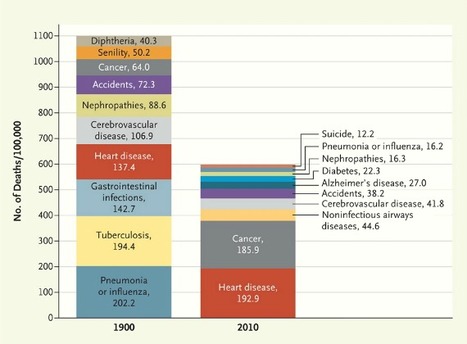
How we die (in one chart)

How we die (in one chart) | UNIT II APHuG | Scoop.it
The New England Journal of Medicine looks at death reports in 200 years of back issues.
No comment yet.
Scooped by Adrian Bahan (MNPS)
January 29, 2014 8:47 AM
Scoop.it!

Will saving poor children lead to overpopulation?

Hans Rosling explains a very common misunderstanding about the world. CC by www.gapminder.org
Ms. Harrington's curator insight, January 28, 2014 6:18 PM

A clear explanation of how saving the poor will slow population growth.

Scooped by Adrian Bahan (MNPS)
October 1, 2013 1:11 PM
Scoop.it!

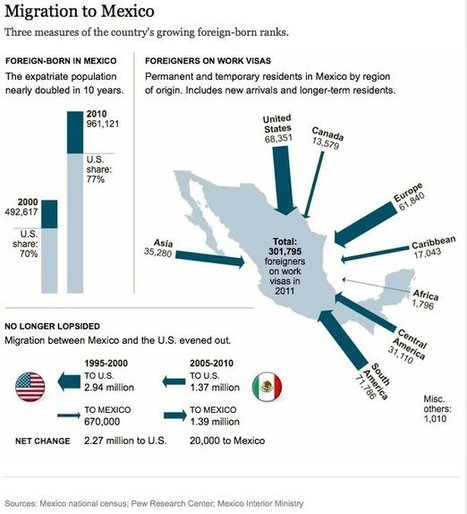
Migration to Mexico

Migration to Mexico | UNIT II APHuG | Scoop.it
Three measures of Mexico’s foreign-born.
No comment yet.
Scooped by Adrian Bahan (MNPS)
September 10, 2013 7:32 PM
Scoop.it!

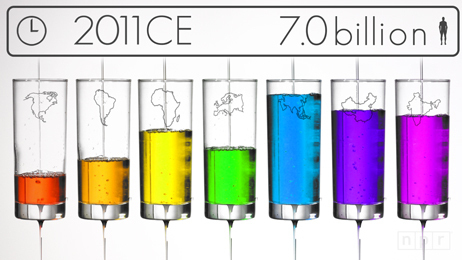
NPR Video: Visualizing How A Population Hits 7 Billion

NPR Video: Visualizing How A Population Hits 7 Billion | UNIT II APHuG | Scoop.it
The United Nations says today symbolically marks the moment when the world's population reaches 7 billion. A little more than two centuries ago, the global population was 1 billion. How did it grow so big so fast?


This is an excellent way to visualize population data and explain the ideas that are foundational for the Demographic Transition Model. 

Sarah Ann Glesenkamp's curator insight, September 17, 2014 7:56 PM

Unit 2

Isabella El-Hage's curator insight, March 18, 2015 12:45 PM
This article and video links to Unit Two through "population predictions for the future". This video gives a good representation of how the world's population grew so fast. It's hard to visualize the massive number of 7 billion, and how the number of people born and passed flow into that number, but the cup with the liquid filling in and out made it easier to comprehend. In the past two hundred years the world's population has grown from 1 to 7 billion! Due to advanced technology, and better health care, and agriculture and medicines, people are able to live longer. The UN predicts that the population with hit 10 billion by 2100, but then start to decrease or steady out. I think money needs to be invested in educating women in countries like India about contraceptives and birth control.
Scooped by Adrian Bahan (MNPS)
September 10, 2013 7:20 PM
Scoop.it!

Hans Rosling on global population growth

TED Talks The world's population will grow to 9 billion over the next 50 years -- and only by raising the living standards of the poorest can we check population growth.


TED talks are great resources, and this one about global population growth, is a great link with Hans Roslings trademark data visualizations that simplifiy complex data and 'tell the story,' but this time using far more common visual aids.

Ken Morrison's comment, September 29, 2012 10:01 PM
Hello. Sorry about the suggestion. I thought I was posting that to my site. Have a great day. I really like your site. Ken
Sarah Ann Glesenkamp's curator insight, September 21, 2014 11:28 PM

Unit 2

MissPatel's curator insight, December 16, 2014 3:25 AM

This is a brilliant video to help you understand the QoL and SoL linked to population. 

Rescooped by Adrian Bahan (MNPS) from Peer2Politics
March 12, 2013 7:48 PM
Scoop.it!

Averting a Tragedy of the Global Commons - The Globalist

Averting a Tragedy of the Global Commons - The Globalist | UNIT II APHuG | Scoop.it

Medieval villages risked a "tragedy of the commons" when farmers — individually pursuing their economic self-interest — depleted a shared natural resource by collectively overgrazing it. Seán Cleary, founder of the FutureWorld Foundation, explains that in the hyperconnected world of today we risk a tragedy of the "global commons."


Via jean lievens
No comment yet.
Scooped by Adrian Bahan (MNPS)
September 30, 2014 4:04 PM
Scoop.it!

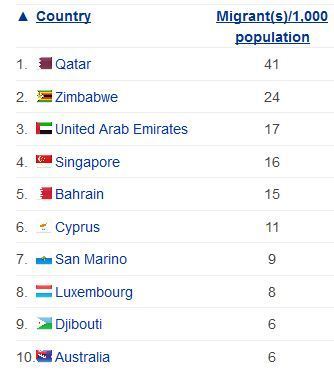
Countries with the Most Migrants

Countries with the Most Migrants | UNIT II APHuG | Scoop.it

List of the countries with the most migrants in the world as measured by net migration rate.


Which countries have the most migrants per capita living there?  What spatial or development patterns do you see on this list?  


Tags: Migration, population, Immigration, statistics, worldwide, unit 2 population. 

Adrian Bahan (MNPS)'s insight:

Remember this is based on a % of the total population, and not total #. Which countries have the most migrants per capita living there?  What spatial or development patterns do you see on this list? 

Lauren Sellers's curator insight, May 22, 2014 12:04 PM

This is an interesting little chart because it reveals to us which countries have the highest percentage of migrants that make up their general population. Definitely suprised me to see Qatar as the number one on the list, I would have expected the US to be at the top, but it is not even in the top 10!

Lona Pradeep Parad's curator insight, May 28, 2014 7:26 PM

This shows the net migration of immigrants. 

Scooped by Adrian Bahan (MNPS)
September 12, 2014 12:30 AM
Scoop.it!

Joel Cohen: An Introduction to Demography (Malthus Miffed: Are People the Problem?) - YouTube

Malthus Miffed: Are People the Problem, the Solution, or Both? An Introduction to Demography and Populations Study through an Examination of the World's Popu...
No comment yet.
Scooped by Adrian Bahan (MNPS)
May 12, 2014 1:50 PM
Scoop.it!

Population pyramids: Powerful predictors of the future

"Population statistics are like crystal balls -- when examined closely, they can help predict a country's future (and give important clues about the past). Kim Preshoff explains how using a visual tool called a population pyramid helps policymakers and social scientists make sense of the statistics, using three different countries' pyramids as examples."

Nancy Watson's curator insight, September 26, 2014 4:04 PM

Population unit

Lauren Quincy's curator insight, March 20, 2015 1:51 PM

Unit 2: Population and Migration


This video was about how demographers categorize data and analyze it. This video showed a few different population pyramids in order to show differences in population in different countries. It showed China as an example and pointed out the remnants of the one child policy 35 years before and how the number of men were higher due to sex selective abortions. They also talked about how the population pyramids could show what stage in the demographic transition model a country was in and how they use them to predict future patterns and changes. 


This relates to unit 2 because it covers topics such as population change, demographic transition models, sex composition, population policies and much more. Population pyramids are very useful due to the visualization of sex, age and number composition in a countries population. They are very important in the use of predicting the future change in population because it can tell what the population has gone through in the past and what to expect in the DTM. 

Daniel Lindahl's curator insight, March 21, 2015 10:43 PM

This video illustrates how population pyramids have the ability to show how populations will rise and fall over time. Pyramids specifically show the population based on a specific age, and illustrates a country's amount of young people in comparison to the elderly. 

Scooped by Adrian Bahan (MNPS)
January 29, 2014 8:49 AM
Scoop.it!

How people in Muslim countries prefer women to dress in public

How people in Muslim countries prefer women to dress in public | UNIT II APHuG | Scoop.it
Even as publics in many of the surveyed Muslim-majority countries express a clear preference for women to dress conservatively, many also say women should be able to decide for themselves what to wear.
Ignacio Garrido's curator insight, January 14, 2014 10:19 AM

Execise 18 :


1. You have to send the answer by moodle

2. To sum up the new in 5 lines.

3. What do you think about this way of dress?

4. What is the favourite way of muslim dress prefer in each countries?

5. Who has written the new? Do you think is he/she objective? Why?

6. Is these new as you can wath on TV ? Think your answer.

7. Can you relationed the pictures ( number in graphic ) with its real name ( in the text of the new )?


Good Luck

Tracy Galvin's curator insight, May 5, 2014 2:57 PM

I am not sure if it is because I am an independently raised western woman but this whole article seems to completely address women as property.  I realize that some countries are much stricter than others but it is not something I can comprehend.

Brian Wilk's curator insight, March 22, 2015 7:09 PM

It appears our friends in Saudi Arabia like their women to be almost completely hidden from view with 74% claiming that the most appropriate dress is to have no more than the eyes showing while in public. Pakistan is the second most tolerant at a distant 35%. Overall, the most popular "form" for women in public is to show the facial region only with 44% of countries surveyed agreeing. On the other end of the spectrum is Lebanon who think that women with no head dress is appropriate nearly half the time. Turkey is in second with 32% believing that this is okay.

Put another way, Lebanon thinks it is okay for their women to dress with no head dress by a 15-1 ratio over the Saudi's. Unbelievable that I am writing about this in the year 2015. The Middle East should allow more than the middle of their women's face to be shown. Lebanon seems to be the most tolerant, let's hope the rest of the countries can follow their lead.

Rescooped by Adrian Bahan (MNPS) from Rhode Island Geography Education Alliance
October 29, 2013 6:25 PM
Scoop.it!

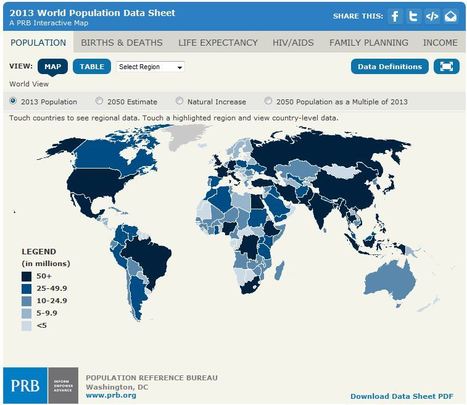
2013 World Population Data Sheet Interactive World Map

2013 World Population Data Sheet Interactive World Map | UNIT II APHuG | Scoop.it

The PRB World Population Data Sheet is a great resource; now you can access that same data through this interactive map.


Via Seth Dixon
No comment yet.
Scooped by Adrian Bahan (MNPS)
September 10, 2013 7:59 PM
Scoop.it!

Per Square Mile: If the world's population lived in one city...

Per Square Mile: If the world's population lived in one city... | UNIT II APHuG | Scoop.it
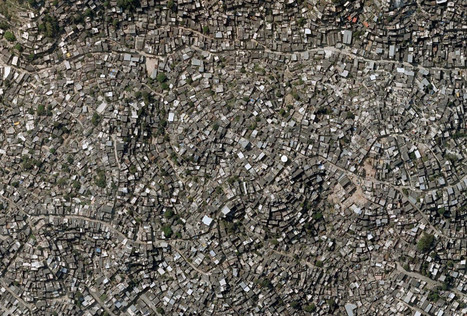
If the world's population lived in one city, how big would it be?
No comment yet.
Scooped by Adrian Bahan (MNPS)
September 10, 2013 7:22 PM
Scoop.it!

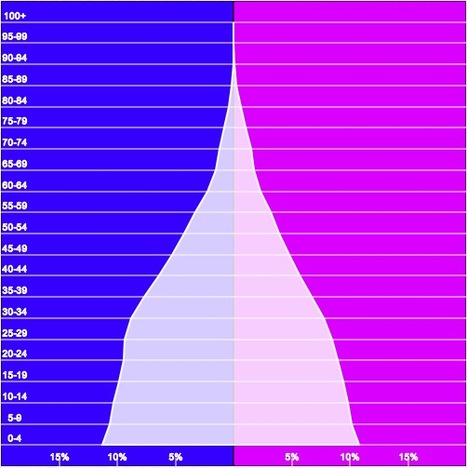
Global and National Population Pyramids

Global and National Population Pyramids | UNIT II APHuG | Scoop.it
Interactive Visualization of the Population Pyramids of the World from 1950 to 2050...


Need population pyramids?  This is a site with good global and national population pyramids with good temporal data as well to show changes in the population (good for explaining the demographic transition model).   

MissPatel's curator insight, December 16, 2014 3:22 AM

If you struggle with population structure - this visualisation may be useful. 

Daniel Lindahl's curator insight, March 21, 2015 11:09 PM

This website allows the user to look into the past, and into the future of population all over the world. The population pyramids show the distribution between young and elder people. It is very interesting to see how the pyramid is able to show the predicted population pyramid of the future as well. 

Tori Denney's curator insight, May 27, 2015 6:39 PM

Access to health care, education, utilities, and sanitation - Population pyramids show population of different ages from each gender in a certain country. From population pyramids, you can conclude a country's development level. For example, if there is an equal population of all ages, this means that they have amazing health care, great education to educate women about birth control towards population, and good sanitation. From all of this information, you can tell how developed a country may be and perhaps also whether the country has many cities And urbanization. 

Scooped by Adrian Bahan (MNPS)
March 18, 2013 3:27 PM
Scoop.it!

Population 7 Billion

Population 7 Billion | UNIT II APHuG | Scoop.it

"Just 200 years ago, there were only 1 billion people on the planet, and over the next 150 years, that number grew to 3 billion. But in the past 50 years, the global population has more than doubled, and the UN projects that it could possibly grow to 15 billion by the year 2100. As the international organization points out, this increasing rate of change brings with it enormous challenges."


Roman M's curator insight, September 10, 2014 9:17 AM

At first, the world's population did not grow a lot. Now we are growing about 1 billion in 12 years, that is scary compared to the 200 years we grew about 1 billion. These are some pictures of some highly dense populations. It is even scarier that in 2100 the population is suspected to be 15 billion.

jada_chace's curator insight, September 10, 2014 9:25 AM

Over the years our world population has grown enormously. Almost  200 years ago there was only 1 billion people in the world, and as time went on the population started to increase dramatically. By 2100, geographers say the population will grow to be 150 million people in the world. The population continues to grow throughout time, we therefore should be cautious on how we are to our environment.

Gene Gagne's curator insight, November 22, 2015 12:49 PM

I saw the pictures. It is amazing how peoples back yards are all different. From water to dirt to garbage to no back yards at all. I was commenting on the fact with the population growth there is only one way to build and that is up. Then i saw the pictures of the High risers and how tall they were and so close together. It is a no wonder people live in a stressful environment. There is nothing like living in a wide open land lot with grass in Wyoming or Montana but that sure will change in the next 50 years.

Rescooped by Adrian Bahan (MNPS) from Human Geography
March 12, 2013 12:12 AM
Scoop.it!

Religion and Demographics

http://www.ted.com Hans Rosling had a question: Do some religions have a higher birth rate than others -- and how does this affect global population growth? ...


What are the connections between religion and demographics?  How does this impact population structure in a particular country?  I found this video from Jeff Martin's fabulous website; Check it out!  http://www.martinsaphug.com/  


Via Matthew Wahl
Juliette Norwood's curator insight, January 13, 2014 9:21 AM

This can be viewed in the perspective of a citizen of an LDC. In LDCs, there are religions that cause the woman to be subservient to men. A higher birth rate could be the cause. If these  small religions were to distribute and be adhered to, there could possibly be a spike in the birth rate.

Sarah Ann Glesenkamp's curator insight, September 17, 2014 7:35 PM

Unit 2

Alex Smiga's curator insight, October 4, 2015 11:50 AM

Hans raps about religion and babies