


Tidbits, titbits or tipbits?
7.4K views |
+2 today

Engaging leadership ideas to get your dendrites firing
Curated by
Jess Chalmers
 Your new post is loading...
 Scoop.it! 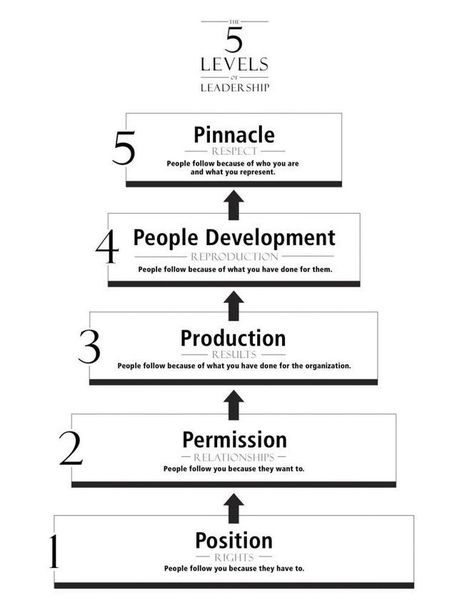
In order to study great leadership you have to study great "followership." Great leaders naturally attract great followers. Via John Michel, Kenneth Mikkelsen 

John Michel's curator insight,
November 23, 2013 6:33 AM
Pinnacle leaders stand out from everyone else. They are a cut above, and they seem to bring success with them wherever they go. Leadership at this high level lifts the entire organization and creates an environment that benefits everyone in it, contributing to their success. Level 5 leaders often possess an influence that transcends the organization and the industry the leader works in.
Scoop.it!

We know that the brain is exquisitely tuned to social relationships, shaped by and shaping our relationships with others from birth onwards. A number of evolutionary psychologists maintain that our brain is proportionately the largest of all mammals because of the need to maintain relationships with large numbers of people. So why should relationship issues be so hard and what can the neurosciences tell us that might help?
Article from Developing Leaders - Issue 13 - Autumn 2013. Find it on page 48-51 in the magazine. Via Kenneth Mikkelsen

John Thurlbeck, FCMI FRSA's curator insight,
November 26, 2013 11:17 AM
I've always felt that the labelling of relationship management as 'soft stuff' is wholly inaccurate, as it has never been so and never will be!
Managing your relationships as a leader and manager has always been tough, complex and often downright hazardous! So 'soft stuff' is a complete oxymoron! However, here's a useful article to explore why is is so hard just that little bit further!
Scoop.it!

It seems we’re all racing to get more entrepreneurial. Increasing creativity and innovation is not only on the priority list for start-ups; it’s also a strategic goal for CEOs of small, medium, and large-sized companies. Despite this growing obsession, however, big companies are still not very good at it. Via Kenneth Mikkelsen

Kenneth Mikkelsen's curator insight,
November 19, 2013 3:16 PM
Beth Altringer on why injecting veteran entrepreneurs into an established business can work wonders. It's a terrific blog post. A highly recommended read.
Scoop.it!

Once in a while, you get inspired by events in your life that seem to be a precursor to real societal change. A hopeful change. A needed change. An evolutionary change. The Drucker Forum 2013 editi...
Scoop.it!

What can I do to improve my body language with some simple, actionable tips? The latest research reveals the best tips to improve your body language easily:
Scoop.it!

It wasn't until I came across Adam Grant's book, Give and Take: A Revolutionary Approach to Success, that I realized it wasn't about being nice or cutthroat. Via Barb Jemmott
Scoop.it!

When I led education at PeopleSoft a gazillion years ago, I shared with the head of all customer-facing services a copy of Training Magazine's annual numbers issue, published each November (now their November/December issue). Via Jay Cross
Scoop.it!

Improve your memory by clenching your right fist, chewing gum, walking, ignoring stereotypes, sniffing rosemary and more...
Scoop.it!

The dangers of playing it safe aren’t sudden, obvious, and dramatic. They don’t make headlines. They develop slowly over time and are almost impossible to pinpoint. This fact often makes them more dangerous than the high-profile missteps we see and hear about in the news because, like a slow leak in a tire, you don’t see or feel these dangers on a daily basis. Via Kenneth Mikkelsen
Scoop.it!

Linus J Fernandes's curator insight,
October 17, 2013 5:58 AM
"credibility is the outcome of countless actions. It is the result of the combination of what team leaders do (i.e. their behaviours) and how they do it (their attitudes); in other words, how they work and interact with several key actors, not only the team members (players and staff, in our case)."

AlGonzalezinfo's curator insight,
October 17, 2013 6:05 AM
Fantastic scoop Roger! I love the visual AND the material!!
Here is one of my favorite sections form the article:
“We propose an original model that places particular emphasis on the team leader’s ability to create his/her personal credibility with multiple stakeholders at different levels.”
Credibility for team performance
Credibility derives from several perceptions that followers develop toward the team leader. The most frequently cited perceptions are:
~Technical competency, which is normally seen as essential, but not sufficient, to be considered credible; ~Energy, often associated with the outcome of both enthusiasm and passion; ~ Fairness, which can be seen as a combination of sincerity, spontaneity, and good ethics;
|
Scoop.it!

Think of two people who work in your organization: one a level or two below you, and the other a level above. Now imagine getting an email from each of them. Ask yourself how long it would take you
Scoop.it!

How To Foster Employee Trust And Growth Through Constructive Feedback Via John Michel, AlGonzalezinfo

Chery Gegelman's curator insight,
November 23, 2013 8:52 AM
"...Giving people self-confidence is by far the most important thing a leader can do..." 
Denise Lombardo's curator insight,
November 23, 2013 6:47 PM
Lots of resonance here - in terms of working as a leader with other teachers, and in terms of teaching and providing feedback to students. The notion of postivies plus constructive criticism and honesty aligns with formative assessment principles, too, eg Medals and Missions (Petty).

Tony Phillips's curator insight,
November 24, 2013 6:12 PM
Leaders can improve their level of engagement theough effective coaching strategies.
Scoop.it!


Sridevi Parthasarathy's curator insight,
November 20, 2013 11:43 PM
The most powerful thought this article provokes, is the need to empower children to feel independent and take pride in their ideas. Education is no longer about a tedious transfer of information but facilitating innovation in learning and debating differences. This will call for a radical change in the way we view our education system, especially in India. We claim to mimic the traditional Gurukul system which called for experiencing life while learning from it; but we go against every construct of experience and believe that recall of knowledge is way to suceed. The Social Media could contribute greatly in this process of debate, as long as we put in regulators to help people focus.
Scoop.it!

Your life is like a river. You can be fresh like moving water or stink because of lack of movement. Leadership requires you to learn. Via AlGonzalezinfo
AlGonzalezinfo's curator insight,
November 19, 2013 7:36 AM
Excellent post here, with 4 simple ways to improve the quality of our leadership.
The first one is to read books! I would highly recommend Leadership and Self Deception by the Arbinger Institute as self-deception can prevent anyone from smelling their own leadership smell...
Scoop.it!

It's tough to admit a bad decision and take the steps to correct it. Here's how to make it easier. Via Yesenia Sotelo
Scoop.it!
Professor Adam Grant talks about a revolutionary new approach to success in business and in life at an Action for Happiness event in London on 19 May 2013.
Scoop.it!

Optimism is the faith that leads to achievement. Nothing can be done without hope and confidence! Via John Michel, AlGonzalezinfo
AlGonzalezinfo's curator insight,
November 15, 2013 10:09 AM
Thanks for a great article John Michel on an incredibly relevant and often overlooked area, HOPE.
Here is one of my favorite sections of the post on what HOPE is:
Of course, this does not imply hope is a denial of reality. Nor is it an elixir to cure all of our ills. We can, after all, hope for a job, for success for our family, for recovery from illness, for a better, safer world. But hope certainly comes with no guarantees. Rather, hope is, in the words of author and activist Joan Chittister, “…a series of small actions that transforms darkness into light. It is putting one foot in front of the other when we can find no reason to do so at all.” Hope then, is what we have when we have no sure answers but still expect a better end. It is hope which allows us to overcome hurdles we could not otherwise endure and, in doing so, moves us into a space where healing and growth can begin to occur.
John Michel's curator insight,
November 15, 2013 10:57 AM
It’s been said that hope is the first of our “emergency” virtues. Specifically, hope is a virtue that keeps us going through difficulties. It is a life raft we cling to when all seems lost.
Scoop.it!

What is thought leadership? It's become a cliché over the past few years. This post sets the record straight about what thought leadership is and isn't. Via Marc Rougier, Jimun Gimm, Donna Murdoch

Marc Rougier's curator insight,
October 30, 2013 9:35 PM
Whether we go for Joel Kurtzman definition "cutting edge thinkers" to a more achievable goal of demonstrating expertise to your customers, what does it mean to be a thought leader and how to achieve it. 
Serge Meunier's comment,
November 1, 2013 6:44 AM
Hello Marc, je ne sais si vous connaissez et appréciez ou apprécierez Derek Sivers : il y a là une diagonale pas sans humour ni à mon avis pertinence quand au leadership. Amicalement, Serge - De France. http://sco.lt/7eWKIr
Scoop.it!

Empathy definition and training, plus more free online materials, articles, tools and tips for personal and organizational development, and business training for management, sales, marketing, project management, communications, leadership, time...
Scoop.it!

I have just finished running a two-day program in Phuket for the Malaysian Directors Academy on The Innovation Zone: Unleashing the Mindset. The Academy also asked me to contribute an article to their magazine Board View.
Scoop.it!

Julian Birkinshaw tells the story of how his company struggled for 20 months to receive a payment for some consultancy work. Read this blog post to understand how bureaucracy works and why a lack of accountability flourish in large organizations.
|






